Hood River
Hood River County, Oregon. County seat.
Hood River is a city in the Columbia River Gorge about sixty miles east of Portland, where sailboarders arrived in the early 1980s.1
Details
Point at a dot to see the place.Tap a dot to see the place. Road map of Hood River.
In Hood River
- Hood River Fruit LoopHood River · Self-guided tour of our fruit loop stands along a scenic 35 mile driveA 35-mile self-guided drive through Oregon's Hood River Valley past some thirty farm stands, cideries, and lavender fields, organized by growers in 1992 around a printed map.
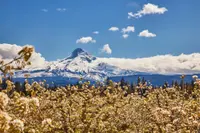
- Mt. Hood Scenic BywayHood River · Scenic bywayThe glacier-caked summit of Oregon's highest peak creates a dramatic centerpiece for this 100-mile/161-kilometer route that skirts the mountain through fruit valleys and thick fir forest.
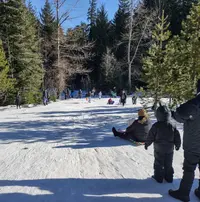
History
Stairs Above the Columbia
The state guide described long flights of weather-beaten stairs climbing the cliffs on First and Eugene Streets, from the business district on the lower terraces of the Columbia River to homes clinging to the sheer wall and resting on the heights above.4 The city lies in the Columbia River Gorge about sixty miles east of Portland and had a population of about 8,313 people in 2020.1 It is the seat of Hood River County, which the city and the surrounding area formed on June 23, 1908, by separating from Wasco County.1,4
Waucoma, Dog River, and the Coes
When Lewis and Clark arrived in October 1805, tepees of the village of Waucoma, the Place of the Cottonwoods, stood near the confluence of the Columbia and Hood Rivers.4 William Clark’s map named the stream Labeasche River after expedition member François Labiche, but that name did not stick and the stream came to be known as Dog River.1 The Federal Writers’ Project guide says the name came from an early emigrant train that, being delayed, was forced to subsist on dog meat.4 In 1852 W. C. Laughlin and Dr. Farnsworth brought herds onto the valley’s grass, but winter storms destroyed their stock and so discouraged the men that they soon left.4 Nathaniel and Mary Coe, the first permanent Euro-American settlers, took up a 319.92-acre claim in 1854, and their home served as community center, courthouse, church, and funeral parlor.2,3 Mary Coe renamed the stream Hood River, and by the guide’s account she refused to accept mail for the community unless it bore that address.1,4
Rails, Strawberries, and the Big Ditch
The town was platted in 1881 in anticipation of the railroad and grew around its depot, and the Oregon Railroad & Navigation Company’s first train arrived in 1882.1,3 Virgil Winchell, an old settler, often told of a winter when early storms cut the valley off from the outside world and left the settlers without food staples.4 As a small boy he found blue jays and owls sheltering in his father’s barn, his father chinked the exits and caught them, and that night the family ate blue jays and owl pie.4 With the coming of transportation, sawmills were built in the heavily timbered valley.4 A small settlement grew up and formally incorporated in 1895.1 The state guide names strawberries as the valley’s first cash crop: T. R. Coon, a pioneer teacher, brought Clark Seedling plants into the valley in the eighties, and within a few years it was producing them in car lots.4 In 1886 Peter Mohr started the first commercial apple orchard, planting 400 trees on the east side of the valley.5 The eleven-mile big ditch, built by Jeremiah F. Davenport’s Valley Improvement Company and finished in 1897, changed the valley ‘almost overnight from a poverty pocket to a land boom,’ David Burkhart and Ruth Guppy wrote in 2007.5 Japanese immigrants who came in the early 1900s hired on to clear land as a step toward acquiring property, and orchardists employed them to remove the stumps.1,5 The first carload of Hood River apples went to New York City in 1900.4
The Bank at Third and Oak
The population grew from 622 people in 1900 to about 3000 by 1910.3 The Mt. Hood Railroad reached up the valley to Parkdale in 1910.2,3 Half of the commercial buildings now standing downtown went up between 1901 and 1914, among them the First National Bank on the northwest corner of Third and Oak streets, completed in September 1910.3 Members of the Stanley-Smith Lumber Co. had founded the bank in 1904, and its upper floor was designed as a meeting hall and offices for the Hood River Commercial Club.3 About 1914 the war in Europe and a lack of strong domestic markets brought depression to the valley.3 In 1932 the Butler Bank closed, and the bank’s National Register nomination calls the First National the only bank that remained open in the Hood River Valley throughout the Depression.3 City Hall, built in 1920 by local contractor L.C. Baldwin and dedicated in February 1921 by Mayor E.L. Scobee, is still used by the city.6
Tule Lake, Hanel Lumber, and Sailboards
By 1910 the county counted 468 Japanese and Japanese American residents, and after Executive Order 9066 in 1942 most of Hood River’s Japanese residents were sent to the Tule Lake camp in northern California.1,7 Masuo Yasui and his brother Renichi Fujimoto had run the Yasui Brothers’ Store for more than thirty years before they were forced to close it permanently.8 Those who came back found business signs reading ‘No Japs Wanted,’ in the Oregon Encyclopedia’s account, or ‘No Jap Trade Wanted,’ in the Oregon History Project’s.1,7 By 1990 the cost of retooling sawmills for smaller logs, the export of unmilled logs, and the listing of the Northern Spotted Owl had squeezed small mills, and Hood River’s Hanel Lumber was among those that sold out or folded.1 Sailboarders came in the early 1980s for the Gorge winds and the depressed local economy, and by the Oregon Encyclopedia’s count Hood River had over thirty windsurfing equipment suppliers by 1999, more than all the other Gorge towns combined.1 In 1986 the Port of Hood River remodeled the abandoned Diamond Fruit Cooperative cannery into the Waucoma Center, and the Full Sail Brewing Company works out of the Columbia Building, a cannery facility.1,9
Within 30 Miles
Measured in a straight line from the town, nearest first.
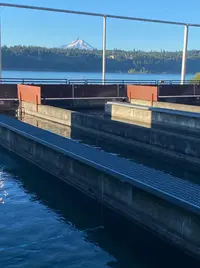
- Spring Creek National Fish HatcheryUnderwood · National fish hatcheryA federal salmon hatchery on the Washington shore of the Columbia at Underwood, where tule fall Chinook climb a stepped ladder each September to the spring water that raised them.
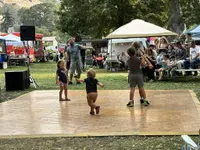
- Huckleberry FestivalBingen · Community festivalBingen, Washington, has held its free, three-day Huckleberry Festival since 1962, with huckleberry pie, a parade dressed in purple and a reptile show kept out of the afternoon heat.
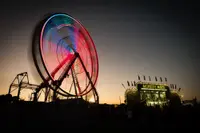
- Hood River County FairHood River, OR · County fairThe Hood River County Fair, a four-day July fair on Wyeast Road near Odell, Oregon, where 4-H livestock were once penned beneath a high school grandstand.
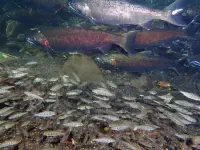
- Willard National Fish HatcheryCook · National fish hatcheryRearing facility only on the Little White Salmon River, producing two million upriver bright fall Chinook annually and up to 1.2 million coho salmon annually in partnership with the Yakama Nation
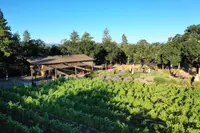
- Syncline WineryLyle · Estate wineryWelcome to our farm and winery in the beautiful Columbia River Gorge Join us for tasting and bottle service in the cellar and gardens.
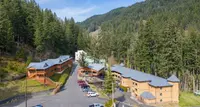
- Tenzen Springs & CabinsStevenson · Boutique cabin retreat with geothermal tubsTenzen invites you to escape your daily routine for an intimate retreat in our boutique cabins and geothermal infinity tubs. The first of its kind in the Pacific Northwest, pairing authentic Japanese bathing with the storied Scandinavian spa culture.
- Carson Hot Springs ResortCarson · Hot springs resortA historical hotel and bathhouse in Carson, Washington, on the Wind River, with the original hotel built in 1901 and the cabins and bathhouse added in 1923.
- Oxbow HatcheryCascade Locks · Fish hatcheryA state salmon hatchery on Herman Creek east of Cascade Locks, Oregon, fed by Oxbow Springs, the water Nestlé eyed from 2008 for its Arrowhead brand.
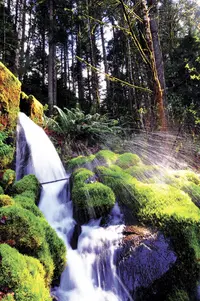
- Bonneville HatcheryCascade Locks · Hatchery facilityOregon's largest state fish hatchery, on Tanner Creek below Bonneville Dam near Cascade Locks, where a ten-foot white sturgeon named Herman lives behind underwater glass.
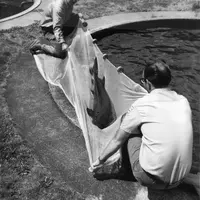
- Skamania County Fair & Timber CarnivalStevenson · FairA free-gate county fair on Rock Creek in Stevenson, Washington, first held in 1908, where amateurs throw axes, roll logs, and pull the misery whip.
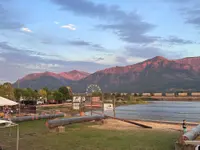
- Columbia River Gorge Scenic BywayStevenson · Scenic bywayWashington State Route 14 along the north bank of the Columbia from Camas to Maryhill, a two-lane road past a volcano's core, a salmon ladder, petroglyphs, and a full-scale Stonehenge.
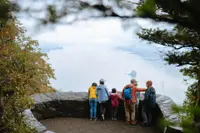
- Northwest Cherry FestivalThe Dalles · Annual festivalThe Northwest Cherry Festival is an April celebration in The Dalles, Oregon, that grew from a growers' Cherry Sweetheart contest begun in 1960 into the Gorge's largest parade.
- Klickitat Canyon DaysKlickitat · Annual town festivalThe annual festival of Klickitat, Washington, held the last full weekend of July since the 1970s, ends with a thousand numbered ducks floating down the river into town.
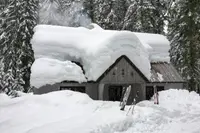
- Peterson Prairie CabinTrout Lake, WA · Cabin rentalMeticulously restored cabin on the Mt. Adams Ranger District under Douglas fir and huckleberry; propane lights and range plus wood-stove insert; sleeps six; site of the salvaged Peterson cabin.
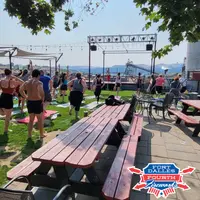
- Fort Dalles FourthThe Dalles · Community-driven independence day celebrationFort Dalles Fourth is The Dalles, Oregon's free Independence Day celebration, held since 2014, closing each Fourth with fireworks fired from a barge on the Columbia River.
11 more within 30 miles on the road map.
Nearby towns: The Dalles and Gresham. All the towns of Oregon. More of Oregon: Scenic Drives.
Sources
- Hood River (city) oregonencyclopedia.org/articles/hood_river_city
- National Register nomination, Colby, Ernest S. and Clara C,, House npgallery.nps.gov/GetAsset/6a436db9-c03d-4065-8ead-a94b3858a366
- National Register nomination, First National Bank of Hood River npgallery.nps.gov/GetAsset/dcd9d077-ec35-4567-940a-0d77258f15ab
- Oregon: End of the Trail (1940), p. 176 archive.org/details/oregonendoftrail00writrich/page/176
- Hood River Irrigation oregonencyclopedia.org/articles/hood-river-irrigation
- Hood River City Hall (historical marker) hmdb.org/m.asp?m=112240
- Central Oregon oregonhistoryproject.org/articles/central-oregon/pdf
- Passing It On: The Yasui Family and Japanese Americans in Hood River. ohs.org/events/passing-it-on.cfm
- Port of Hood River oregonencyclopedia.org/articles/port_of_hood_river