Oxbow Hatchery
Cascade Locks, Hood River County, Oregon. Fish hatchery; all year for rearing ponds.
Details

- Where
- 1200 Frontage Road, Cascade Locks, OR 97014. Directions
- Getting there
- Take I-84 to Cascade Locks at exit 44 and drive through town. Cross the eastbound I-84 on-ramp to Frontage Road. Proceed one mile to the hatchery.
- Access
- Camp host, fishing, ADA accessible, restrooms.
- Phone
- (541) 374-8540
- Managed by
- Oregon Department of Fish and Wildlife.
- Established
- 1913.
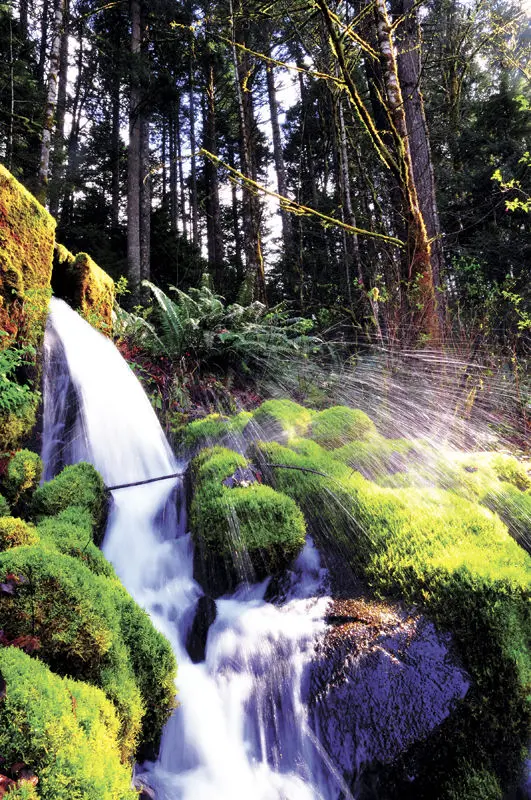
Oxbow Springs pours from the base of the steep cliff walls that stand over Cascade Locks. The hatchery sits below, about two miles east of town on Frontage Road, on Herman Creek. ODFW’s Northwest Region Manager described three springs feeding it: the Middle Spring, the East Spring, and a smaller third spring that flows into a spring reservoir. From the reservoir, pathogen-free water runs by pipe straight to the hatch house. The springs, the reservoir, and the hatchery buildings occupy 33.5 acres owned by the Oregon Department of Fish and Wildlife. It is one of the department’s 33 hatcheries open to visitors.
Raceways, ponds, and Herman Creek
Oxbow keeps salmon only in their earliest stages. The department uses it for interim egg incubation and early rearing of coho and spring Chinook. No adult fish are collected or spawned here, and no fish are released from the grounds. An audit page from the Fish Passage Center lists 12 concrete raceways along with the incubation and early-rearing facilities. The sources differ on the species. ODFW’s visitors’ guide names spring Chinook, coho, and winter steelhead. A 2016 department statement names spring Chinook, coho, and sockeye, produced each year for harvest and conservation programs. Fingerlings can be viewed in the rearing ponds year-round. In summer and early fall the springs run low, and the hatchery cuts back production and moves fish to other locations to reduce losses.
Grown salmon return to the creek outside the fences, and adults can be seen spawning in Herman Creek from September through November. Upstream and down, the Upper and Lower Herman Creek Ponds hold coho brought in from other facilities for interim rearing. The audit page names a third satellite, Wahkeena Pond. At the lower site a head gate on Herman Creek controls flow to a Farmers Screen installed in June 2007. It is a 15-cubic-foot-per-second custom retrofit, built to fit an existing concrete structure in close work with ODFW’s on-site crew, and it passes fish and debris while sending fresh creek water to the rearing ponds. The visitors’ guide lists birds of prey, wading birds, waterfowl, and songbirds among the wildlife, and notes a camp host, fishing, restrooms, and ADA access.
Bonneville, the dam, and the Mitchell Act
Oxbow was built in 1913 to give Bonneville Hatchery more rearing room. After Bonneville Dam was built, the hatchery was relocated in 1937 to its present site. It ran as a state-funded hatchery until 1952. That year it was remodeled and expanded under the Columbia River Fisheries Development Program, known as the Mitchell Act, which was set up to enhance declining fish runs in the Columbia River Basin.
The water rights date from the same periods. The Herman Creek satellite ponds draw on a right with a 1922 priority date for 20.0 cubic feet per second, separate from the spring system. The hatchery’s 10-cfs right on Oxbow Springs carries a 1951 priority date, and according to testimony before the Fish and Wildlife Commission it was acquired after the remodel of the 1950s.
Denzil Dwight Miller worked here in the later decades. He was born in 1920 in Grant City, Missouri, and served with the 59th Coast Artillery in the Asiatic Pacific Theater, 39 months of it as a prisoner of war of the Japanese. Afterward he went into service with the Oregon State Fish Commission. He worked at the Trask, Sandy, Siletz, and Cascade hatcheries before Oxbow, where he retired in 1981. His obituary records that he gave away generous amounts of vegetables from his gardens to neighbors and friends and made “the best dill pickles.” He died at his home in Cascade Locks in 2010, at 90. Kerry Charles Bennett was taken on at Oxbow in 1967 and was later promoted to assistant manager.
In 2004 the hatchery took on a new kind of work. That year, according to an Idaho Department of Fish and Game report, Oxbow personnel and facilities were first used for sockeye smolt rearing in the Snake River sockeye captive broodstock program. Snake River sockeye had been declared endangered on November 20, 1991. In 2004, fish from the program’s production groups were planted or released into Redfish, Alturas, and Pettit lakes in Idaho’s Sawtooth Valley.
Oxbow Springs and the bottling plant
In 2008 the City of Cascade Locks asked ODFW whether it could buy spring water from Oxbow to support an economic development project. The department declined, saying the hatchery needs all the water available, especially in summer and fall. Little Herman Creek feeds Oxbow Springs, and the Columbia Gorge News reported that Nestlé had eyed the springs since 2008 as a source for its Arrowhead brand.
In 2009 the city returned with a proposal for a water exchange, a contract under Oregon water law in which two right holders trade equal volumes and each keeps its underlying right. Under the plan, the city would take Oxbow spring water and sell it to Nestlé for a bottling plant. The Columbia Gorge News described the plant as 250,000 square feet in one 2014 report and as a $50 million plant on Port of Cascade Locks property in a 2016 report. In return the hatchery would receive municipal well water. ODFW’s example ran this way: 0.5 cfs of spring water to the city for twelve months, 1.0 cfs of groundwater back to the hatchery for the six months when fish most need it. The department raised fish on the city’s groundwater for a year and reported that they did well and that the water tested chemically identical to the spring. A study by Cramer Fish Sciences found no harm to the cold-water refuge Herman Creek offers salmon migrating up the Columbia.
The environmental groups BARK and Food & Water Watch opposed the plant. They objected to plastic-bottle waste and to the “consequences of giving away what is currently public water to a private corporation.” In 2012 the groups asked the Oregon Water Resources Department to partially cancel the hatchery’s water right for alleged non-use. A state administrative law judge found their arguments “without merit.” In August 2014 the Water Resources Commission, meeting at the Best Western Inn in Hood River, voted unanimously to leave the right intact. Only one member of the public spoke. Roberta Lapp of Hood River said she worried how the salmon would fare on well water, and she testified that a sign at the hatchery states that “only the salmon have legal rights to this water,” a sign she “would like to see stay there.” Dave Palais, natural resources manager for Nestlé Waters North America, said: “Obviously we’re pleased to see the process move forward.”
On May 17, 2016, Hood River County voters passed Measure 14-55, banning large-scale commercial water bottling in the county. The Cascade Locks precinct was the only part of the county where it lost, and city leaders said they would keep pursuing the plant. That September, Anna Mae Leonard of Cascade Locks fasted at the Capitol in Salem, joined by tribal members who asked Governor Kate Brown to deny the exchange. On October 31, 2016, the state approved a transfer that mapped ODFW’s diversion points on Little Herman Creek and split the 10-cfs right into parts of 9.5 and 0.5. The exchange itself had not yet begun. City administrator Gordon Zimmerman said it could take anywhere from “three weeks and three years.”
Labor Day weekend, 2017
The Eagle Creek Fire reached Cascade Locks over Labor Day weekend in 2017, and Oxbow, Bonneville, and Cascade hatcheries were evacuated. Firefighters used the three hatcheries as staging and firefighting areas, drew on their water and power, and foamed some hatchery buildings to keep them from catching. To reduce demand on water and equipment, ODFW released some fish early into the Columbia River. The three facilities were then rearing six million fish, mainly coho and Chinook. When the department reported on September 5, no structures at any of the three had burned. “ODFW staff will continue to operate the facilities as best we can under these difficult conditions,” said Bruce Eddy, the department’s East Region administrator.
Notable Events
- 1913Oxbow Hatchery was originally constructed in 1913 to provide additional rearing facilities for Bonneville Hatchery. myodfw.com
- 1922The Satellite Ponds at Herman Creek are not part of the spring system; the 1922 priority date is for 20.0 cfs. dfw.state.or.us
- 1937Oxbow was relocated to its present site in 1937 following construction of Bonneville Dam, and was operated as part of the Columbia River Fisheries Development Program (Mitchell Act). fpc.org
- 1951The 1951 priority date for 10.0 cfs, the right later proposed for exchange with the City of Cascade Locks, was acquired after the hatchery was remodeled in the 1950s. dfw.state.or.us
- 1952Oxbow was remodeled and expanded as part of the Columbia River Fisheries Development Program after operating as a state-funded hatchery. myodfw.com
- 2004Calendar year 2004 represents the first year that Oxbow Fish Hatchery personnel and facilities have been utilized for sockeye smolt rearing with the captive broodstock program. osti.gov
- 2007A new Farmers Screen was built and installed for the Oregon Department of Fish & Wildlife at the lower hatchery site of Oxbow Hatchery on Herman Creek, to supply fresh water to the rearing ponds. farmerscreen.org
- 2008Little Herman Creek feeds Oxbow Springs, a waterway Nestle has eyed since 2008 as a possible source for its Arrowhead brand. columbiagorgenews.com
- 2008In 2008, the city approached ODFW and asked if they could purchase spring water from Oxbow Hatchery to facilitate an economic development project in Cascade Locks. ODFW declined because the hatchery facility needs all the water that is available, especially during the summer and fall months. dfw.state.or.us
- 2009Testimony before the Commission said the defense of the transfer application arose because of the Exchange Process that was initiated in 2009. dfw.state.or.us
- 2012Environmental groups BARK and Food & Water Watch took legal action in 2012, asking the Oregon Water Resources Department to partially cancel Oxbow Hatchery's water right over alleged non-use. columbiagorgenews.com
- 2017Three ODFW fish hatchery facilities in Cascade Locks-Bonneville, Oxbow and Cascade-were evacuated over Labor Day Weekend due to the Eagle Creek Fire, and ODFW made early releases of fish to reduce demands on the water supply and equipment. dfw.state.or.us
- 2017Firefighters used the three Cascade Locks hatcheries, including Oxbow, as staging and firefighting areas, foamed some hatchery buildings to keep them from catching fire, and at the time of reporting no structures at the three hatcheries had been damaged by fire. portlandtribune.com
People
- Denzil Dwight Miller, Oregon State Fish Commission, later Fish and Wildlife, hatchery man who retired from Oxbow Hatchery (retired 1981).
- Kerry Charles Bennett, Taken on at Oxbow Hatchery in 1967 and promoted to Assistant Manager, retiring after 35 years with Oregon Department of Fish and Wildlife (1967-1990).
Sources
- myodfw.com/oxbow-hatchery-visitors-guide
- myodfw.com/visit-odfw-hatcheries
- columbiagorgenews.com/news/owrc-upholds-ruling-on-oxbow-water-right/article_7c890af4-ace3-5649-b3ec-223b0147c967.html
- osti.gov/servlets/purl/893360
- cascadelocksmuseum.org/publications
- farmerscreen.org/projects/oxbow-hatchery
- cascadelocksmuseum.org/news/tag/history
- dfw.state.or.us/habitat/water/cascade_locks.asp
- dfw.state.or.us/news/2017/09_sep/090517.asp
- portlandtribune.com/2017/09/06/odfw-evacuates-three-fish-hatcheries-in-cascade-locks
- fpc.org/hatchery/IHOT_HatcheryAudits/oxbowhatchery2-.pdf
- dfw.state.or.us/agency/commission/minutes/13/12_dec/Approved_September%206%202013_Commission%20Minutes.pdf
- digitalcollections.library.oregon.gov/nodes/view/226553