
Spring Creek National Fish Hatchery
Underwood, Skamania County, Washington. National fish hatchery.
Details

- Where
- 61552 State Road 14, Underwood, WA 61552. Directions
- When
- The best time to visit is late August through September; the fish ladder opens the last week of August; spawning takes place September 15-30.
- Season
- Late August through September, when the adult salmon are returning.
- Getting there
- From I-84 exit 64 near Hood River, OR, cross the Hood River/White Salmon toll bridge ($2.00 toll each way), turn left onto State Highway 14 and travel about 3 miles; the hatchery is on the left at about mile marker 61.
- Hours
- Monday - Friday 7:30 am - 4:00 pm.
- Access
- Adjacent Spring Creek Hatchery State Park is a 10-acre day-use park in the Columbia River Gorge National Scenic Area, southeast Skamania County, with premier windsurfing, ~150 parking spaces, and six unsheltered picnic tables.
- Phone
- (509) 236-0928
- Website
- fws.gov
- Managed by
- U.S. Fish & Wildlife Service.
- Established
- 1901.
- Coordinates
- 45.723751068115, -121.55808258057.
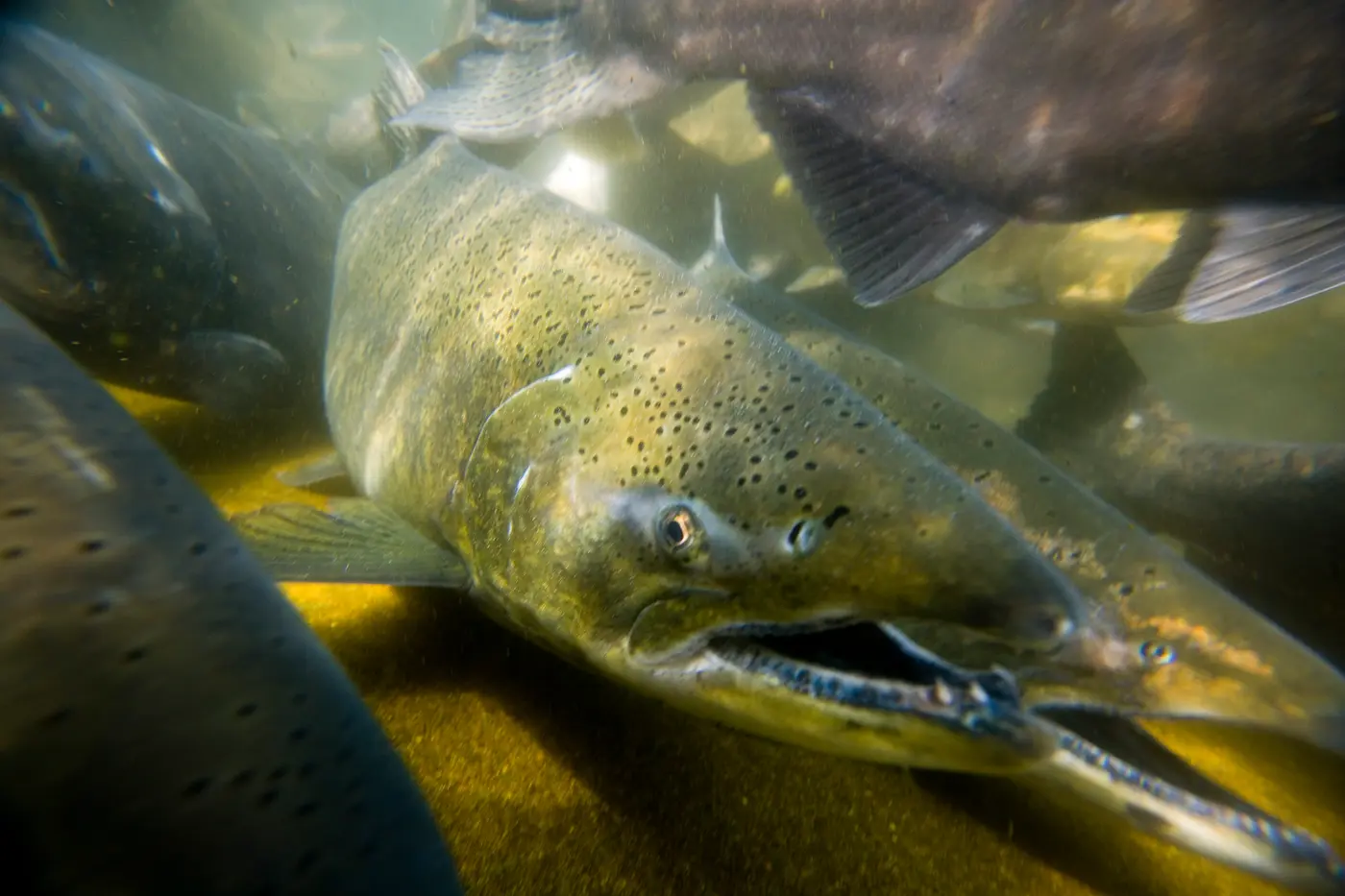
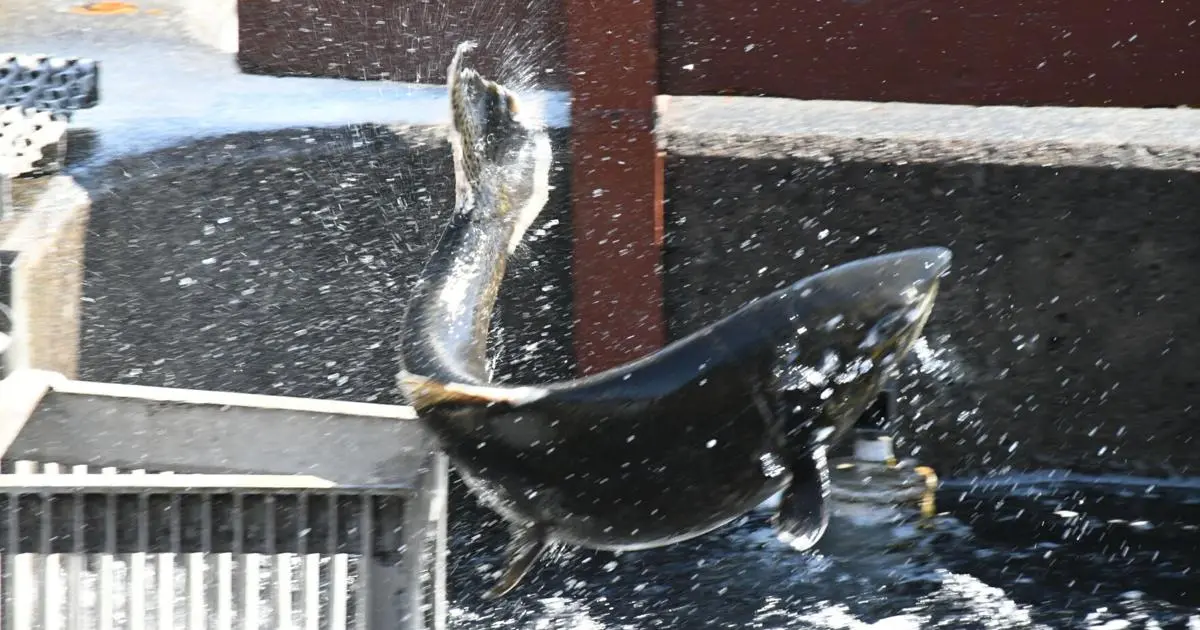
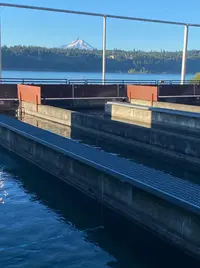
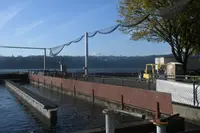
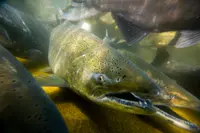
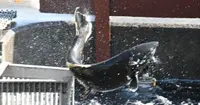
In the last week of August the crew at Spring Creek National Fish Hatchery opens its fish ladder, and adult tule fall Chinook salmon begin coming up out of the Columbia River right away. The hatchery describes the ladder as more like a staircase, with a resting space between “rungs.” The fish climbing it left this shore as juveniles years before. The Columbia Gorge News describes how they find their way back: imprinting, a biological urge that lets them track the smells and tastes of the waters where they originated.
The hatchery sits at river mile 167 on the north bank, about 20 miles upstream of Bonneville Dam and about two miles below the mouth of the Big White Salmon River. The U.S. Fish & Wildlife Service runs it. The Service puts its yearly output at 12.5 million young tule fall Chinook. The hatchery’s own Facebook profile says “more than 10.5 million,” and a 2007 federal review recorded an on-station release of 15.1 million subyearling smolts. The returns are counted every fall. By the Columbia Gorge News story of September 23, 2026, about 75,000 fish had come back. The hatchery’s website gave about 90,000 as of the same date.
The ladder, the spawning room, the raceways
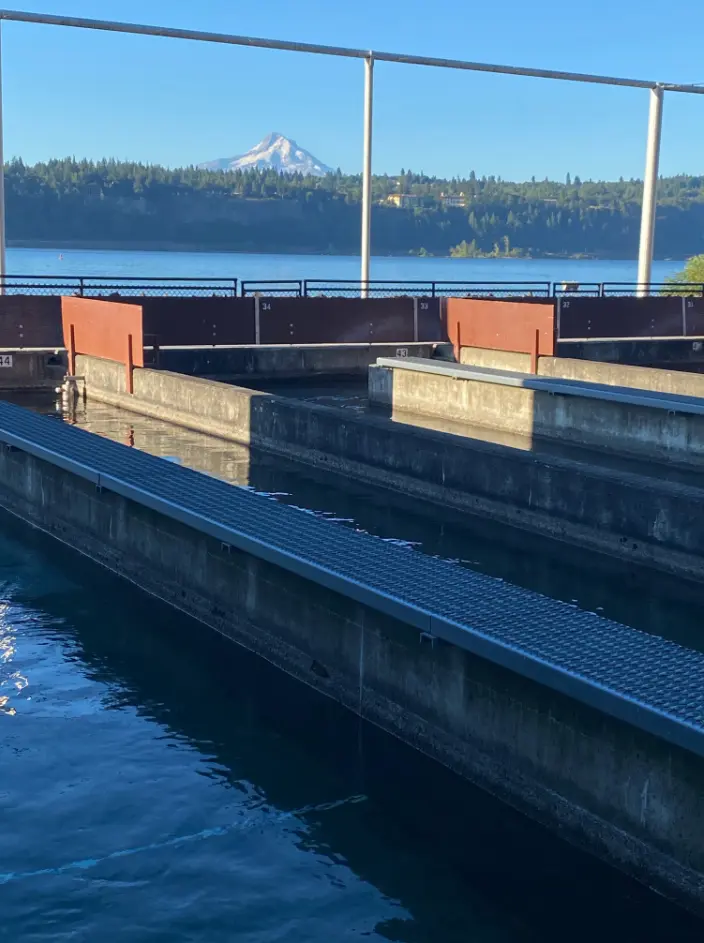
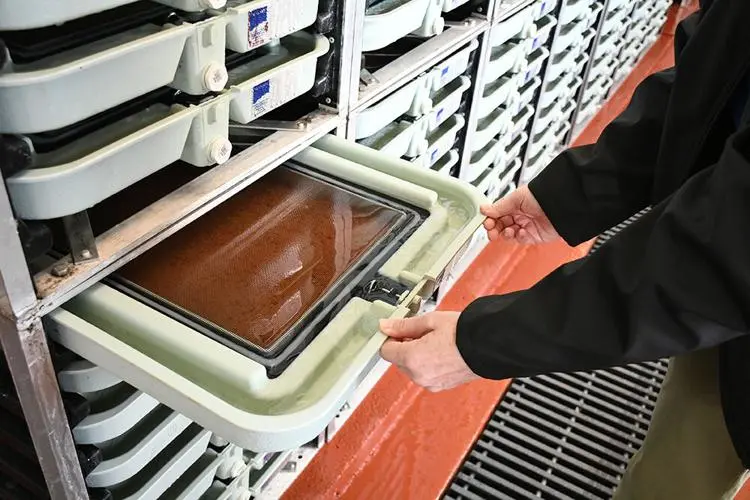
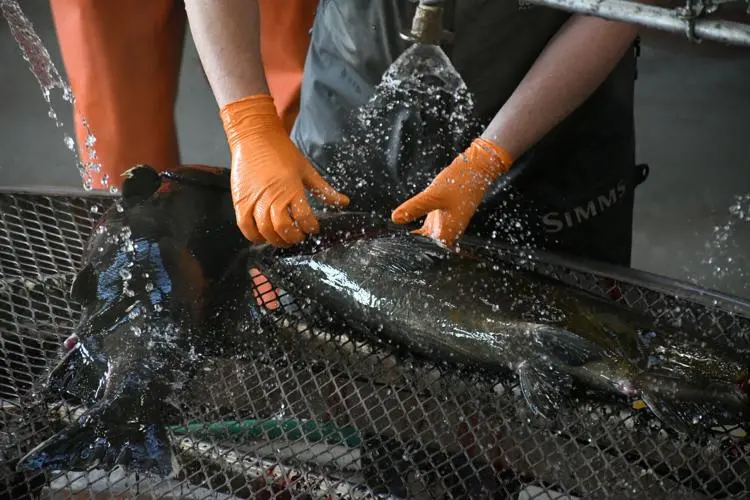
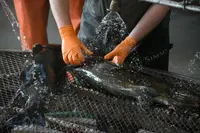
Adults stay on station through September. From September 15 to 30, fish are crowded each day into the Spawning Building. Staff remove eggs from the females and fertilize them with milt from the males. The spawned carcasses are sampled for disease and for coded-wire tags. The 2007 review states that adults beyond what the broodstock needs go to tribes and food banks. The fertilized eggs move to the Incubation Building, out of public view, where they reach the eyed stage in October and hatch in late fall.
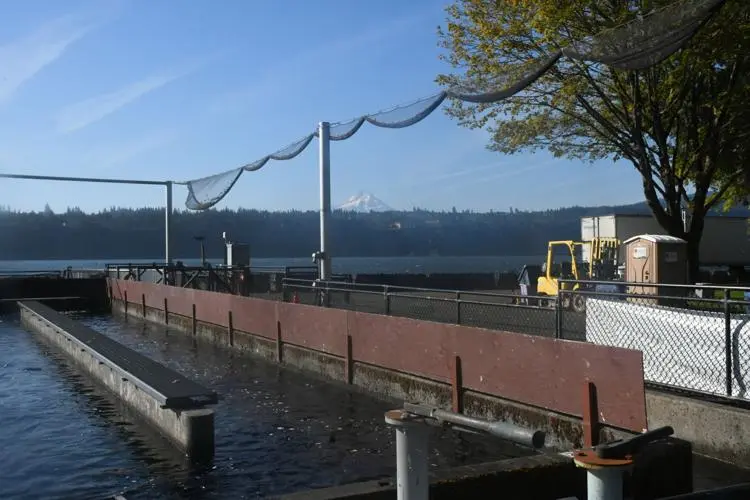
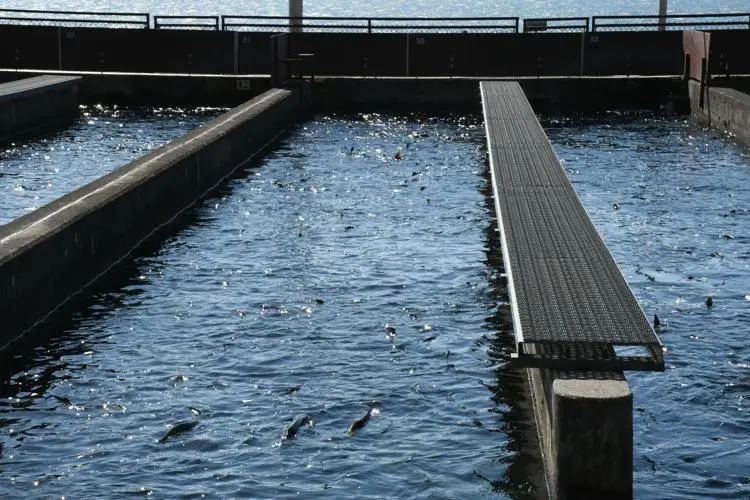
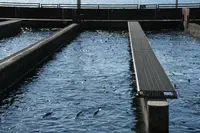
In January the fry go into the outdoor raceways, open concrete channels where visitors can see them again and where they are fed several times a day. In March and April several large white Fish Marking Trailers stand around the grounds, and the public may look inside. Crews there clip the adipose fin of every fish to mark it as a hatchery fish. A small share also get a coded wire tag in the snout, which tells biologists where the salmon go in the ocean and who catches them. Others get a PIT tag, a small microchip placed in the body cavity, which helps count how many fish return over the dams. The Service’s own pages differ on timing: one puts marking in February, and one gives a single April release where another describes two groups, in April and in May.
By summer there are no fish on station. Crews clean and disinfect the water-reuse system and turn to maintenance. The grounds are still open to walkers. The mile-long entrance road runs along the riverbank, and picnic tables at the hatchery look across to Mt. Hood. A short interpretive nature trail winds out closer to the water, where windsurfers’ sails cross the river. A Service road-trip guide notes that the shore makes respectable smallmouth bass habitat.
The adjacent Spring Creek Hatchery State Park is a 10-acre day-use ground with about 150 parking spaces and six unsheltered picnic tables. State Parks writes that strong west winds drive against the river current there, “creating big swells and frothy whitecaps.” The park has hosted professional windsurfing competitions. Bald eagles, osprey, peregrine falcons and beavers are among the wildlife listed for the site.
Five springs under the basalt
The hatchery’s water comes from five unnamed springs at the base of basalt cliffs north of the grounds. Geologists identify the rock in those cliffs as the Frenchman Springs Member of the Wanapum Basalt, and the springs discharge from it. According to the Columbia Gorge News, early employees found the water clean and free of sediment, close to ideal for salmon. The hatchery reuses it through a series of biological filters, which requires pumps, filters and motor control centers, so that it needs less fresh water. It also holds rights to Columbia River water.
The fish raised in that water are local stock. Tule fall Chinook are native to the lower Columbia and its tributaries below The Dalles Dam, and this run belongs to the White Salmon River. The 2007 review states that the broodstock came from wild Big White Salmon fish and has been reared here since 1901, which makes the hatchery a genetic repository for the original stock. The river’s own spawning habitat had shrunk twice. Condit Dam, a private utility dam built in 1913 at river mile 3.4, blocked all upstream migration. Then, in the early 1940s, the pool behind Bonneville Dam drowned the lower river. When the review was written, Condit Dam was scheduled for removal in 2008, and Spring Creek’s tules were named the stock of choice for returning fall Chinook above it.
The open house each September
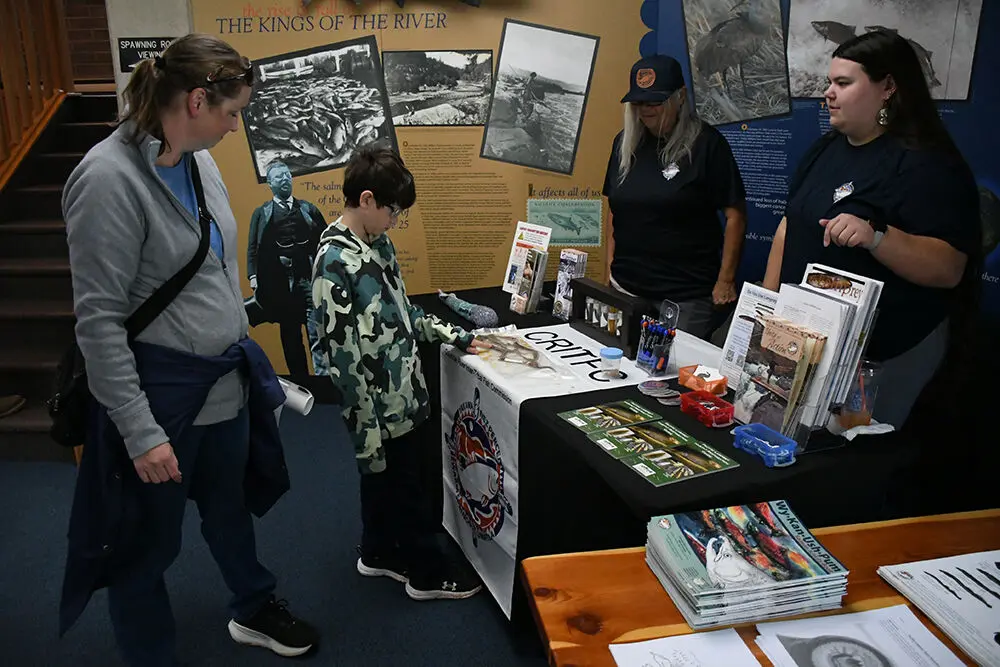
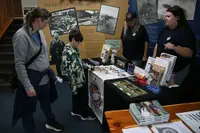
Each September the hatchery holds an Open House so the public can see the adults jumping the ladder, watch spawning, and learn what hatcheries do. Children’s activities have included Migration Golf, fish printing and chalk art. The 2026 Open House, on September 19, marked 125 years and more than one billion fish since 1901. Interpreters explained each stage of spawning while adults moved through the ladder and the holding ponds. Children played salmon-migration mini-golf, blew bubbles, watched a fish dissection, and made gyotaku, which the Gorge News called “the ancient art of Japanese fish painting.”
“It’s all about the kids and getting people out here to learn about fish,” said Hatchery Manager Dave Carie. “That’s our next generation; we want them to continue to fish and conserve the environment.”
The hatchery also carries out tribal treaty trust responsibilities, which the Gorge News states entitle Columbia Basin tribes to half of the river’s fish. “We produce salmon so they have something to fish for,” said Brooke Silver, a fish biologist with the Columbia River Fish and Wildlife Conservation Office. At a partner table, representatives of the Columbia River Inter-Tribal Fish Commission, which was founded by the Yakama, Warm Springs, Umatilla and Nez Perce tribes, explained their Pacific lamprey restoration work. One of them, Kaitlynn Spino, is a Yakama Nation descendant who works in outreach. “I’m trying to get that younger generation of scientists to become interested in fisheries,” she said. “It’s how I was raised.”
The centennial in 2001 had a different program. The Yakama Nation gave cultural dancing and demonstrations in the afternoon and ran a concession of Indian tacos and Indian fry bread, with a salmon bake. Visitors putted a salmon to the ocean and back. A 1995 Service brochure listed a Visitors’ Weekend on the second weekend of September.
Eggs by rowboat, 1901
The search for this site began downriver. According to the Hood River News in 2001, the U.S. Fish Commission judged its Clackamas Station unsuitable for egg collection. In the fall of 1896 it surveyed streams on both sides of the Columbia between Viento and Celilo Falls, and the White Salmon River looked promising. The following fall, crews built two large racks and a downstream trap at the mouth of the Big White Salmon. They took 3,415,000 eggs and carried them by boat to a site on the Little White Salmon River.
Spring Creek was authorized under Special Acts of March 3, 1887, and July 1, 1898, and went into operation in September 1901 to support the Columbia’s commercial fishery. The Service describes it as one of several egg collection stations for the Bureau of Commercial Fisheries Clackamas Hatchery. A State Parks brochure says the Fish Commission set it up as a series of tents and wooden troughs on the north side of what is now Highway 14. That year Dennis Winn, then stationed at the Little White Salmon Hatchery, delivered the first fall chinook eggs to Spring Creek by rowboat. There were no roads or railroads. The only way in was by Columbia River steamer. The site had long been a Native American fishing place. Nearby, the Broughton Lumber Company’s planing mill was running by 1901, finishing rough boards sent down by flume from a mill at Willard.
The settlement grew slowly. By 1919 forms were set for the first known residence on the site, called the cottage, and State Route 14 was finished in 1920. As the population of the Gorge grew, heavy fishing and habitat loss led the government to raise fish at the station rather than only collect eggs there.
The rising Bonneville pool
Bonneville Dam was completed in 1938. That May the hatchery was reauthorized under the Mitchell Act to mitigate for the dam. The accounts of what happened to the buildings differ. The Fish & Wildlife Service says the original hatchery was flooded. The 2001 Hood River News says the rising pool caused flooding problems, and that in 1941 Corps of Engineers Bonneville engineers moved the buildings, built a new fish ladder and new concrete circular ponds. During that period the place became known as the Underwood Station. The 2007 review says the hatchery was remodeled in 1938 to keep it above the pool. The State Parks brochure says the hatchery standing today was built in the mid-1930s on its present site.
The next rebuilding came with another dam. The 2007 review records a 1970 remodel to meet commitments under the John Day Dam Mitigation Act. The Service and the 2001 newspaper give 1972 for a redesign and rebuilding by the Army Corps of Engineers, and the Service places it in a new location. A 1995 brochure says capacity was doubled that year to make up for fall chinook spawning grounds lost to the John Day Lock and Dam. The Army Corps now provides most of the hatchery’s funding. Some money comes through the Pacific Salmon Treaty, to raise salmon for southern resident killer whales.
The station has also kept its own people and records. In September 2003 it hosted a gathering of Service retirees, with Mamie Parker, then Assistant Director of Fisheries and Habitat Conservation, as keynote speaker. Cheri Anderson joined the gorge hatchery complex in 1998 and ran its information and education programs for nearly 30 years. In 2018 a preservation effort gathered logbooks, journals, annual reports and photographs from the complex’s six stations. In 2022 school groups came back to the hatchery for the first time since 2019 and watched tules moving through the ladder. By October 3, the last collection day that year, 111,554 tule fall Chinook had entered it, a record.
Notable Events
- 1887Authorized by Special Act 24 Stat. 523. fws.gov
- 1898Authorized by Special Act 30 Stat. 612. fws.gov
- 1901Dennis Winn brought the first fall chinook eggs to Spring Creek from the White Salmon River by rowboat. columbiagorgenews.com
- 1901Established as one of several egg collection stations for the Bureau of Commercial Fisheries Clackamas Hatchery. fws.gov
- 1901Placed into operation to support the commercial fishing industry in the Columbia River. fws.gov
- 1919Forms were set for the first known residence on site, called the cottage. columbiagorgenews.com
- 1920State Route 14 was not completed until 1920; the source describes the hatchery's earlier dependence on Columbia River steamers. columbiagorgenews.com
- 1930sThe hatchery you see today was constructed in the mid-1930s at its current location. parks.wa.gov
- 1938Completion of Bonneville Dam brought the first major changes; the rising pool caused flooding problems for the hatchery. columbiagorgenews.com
- 1938Reauthorized under the Mitchell Act for mitigation of Bonneville Dam and conservation of fishery resources in the Columbia River Basin. fws.gov
- 1941Bonneville Dam engineers moved hatchery buildings, constructed a new fish ladder and built new concrete circular ponds. During this time the hatchery became known as Underwood Station. columbiagorgenews.com
- 1946The hatchery's Mitchell Act reauthorization was amended for Bonneville Dam mitigation and conservation of Columbia River Basin fishery resources. fws.gov
- 1970Remodeled again to expand operations to meet commitments under the John Day Dam Mitigation Act. fws.gov
- 1970sThe facility has undergone changes over the years with the most recent renovation being in the early 1970s by the U.S. Army Corps of Engineers. parks.wa.gov
- 1972The U.S. Army Corps of Engineers redesigned and rebuilt the hatchery; expansion partially compensated for fall chinook spawning-ground losses caused by dam construction elsewhere on the Columbia River. columbiagorgenews.com
- 2018A preservation mission gathered documents, records, annual reports, logbooks, journals and photographs from the six stations of the Columbia River Gorge National Fish Hatchery Complex. fws.gov
- 2022By the last collection day of October 3, a record total of 111,554 tule fall Chinook salmon had entered the hatchery's fish ladder. fws.gov
- 2022In the first year since 2019, the hatchery reopened to school groups, who could see tule moving through the ladder. fws.gov
People
- Dennis Winn, Stationed at Little White Salmon Hatchery; delivered the first fall chinook eggs to Spring Creek by rowboat (1901).
- Brooke Silver, Fish biologist with the Columbia River Fish and Wildlife Conservation Office; explained the hatchery's fish-production purpose.
- Dave Carie, Hatchery manager.
- Kaitlynn Spino, Columbia River Inter-Tribal Fish Commission representative who attended the hatchery event and explained Pacific lamprey protection and restoration.
- Laurie Porter, CRITFC representative explaining the agency's lamprey restoration project.
- Laurie Potter, Columbia River Inter-Tribal Fish Commission representative who attended the hatchery event and explained Pacific lamprey protection and restoration.
- Chris Goodell, Maintenance Team.
- Chris Hankin, Biological Technician.
- Daniel Bressman, Biological Science Technician.
- James Sapuay, Administrative Officer.
- Jennifer Rowlen, Park Ranger, Visitor Services.
- Jeremiah Youtsey, Biological Technician.
- Jorge Alcala, Facilities Operations Specialist.
- Mark Doulos, Maintenance Team.
- Mamie Parker, The Service's then-Assistant Director of Fisheries and Habitat Conservation; keynote speaker at the retirees' gathering hosted at Spring Creek (September 2003).
- Cheri Anderson, Recently retired information and education specialist for the Columbia River Gorge National Fish Hatchery Complex, a job held for nearly 30 years (1998 (joined the Columbia River Gorge National Fish Hatchery Complex)).
- Kyle Hanson, Deputy assistant regional director for the Fish and Aquatic Conservation program; explained environmental conditions affecting salmon success.
Sources
- fws.gov/fish-hatchery/spring-creek
- fws.gov/fish-hatchery/spring-creek/about-us
- columbiagorgenews.com/archive/spring-cr-hatchery-celebrates-saturday/article_24fa1daa-d8ff-5228-aa61-bdf6b0da80f3.html
- columbiagorgenews.com/news/fish-hatchery-celebrates-125-years-of-salmon-spawning/article_752dd598-aca5-4d4b-914d-40e7804635c6.html
- fws.gov/story/hatchery-road-trip-spring-creek
- fws.gov/story/2022-07/conserving-our-past-reflection-over-time
- fws.gov/story/2025-06/peaks-rivers-cheri-anderson
- fws.gov/sites/default/files/documents/GorgeNFHReview_Summary_19Dec2007_FINAL_508.pdf
- fws.gov/story/2022-10/what-year
- fws.gov/fish-hatchery/spring-creek/contact-us
- parks.wa.gov/sites/default/files/2023-03/Spring%20Creek%20Hatchery%20State%20Park%20Brochure%2005-24-17.pdf