Hillsboro
Washington County, Oregon. County seat.
Hillsboro, the seat of Washington County west of Portland, grew from the farms of East Tualatin Plains into the center of the Silicon Forest.1
Details
Point at a dot to see the place.Tap a dot to see the place. Road map of Hillsboro.
In Hillsboro

The Calendar

History
The Courthouse Sequoias
The Porter Sequoias at the county courthouse were planted in 1880, and the Oregon Encyclopedia calls them downtown Hillsboro’s most prominent landmarks.1 The town is the seat of Washington County and lies in the Tualatin River Basin west of Portland, and about 106,447 people lived within its city limits in 2020.1
East Tualatin Plains and David Hill
The earliest people here were the Atfalati, who gathered at Chatakuin, now Five Oaks, to settle disputes, arrange transactions, and carry out community affairs.1 Retired Hudson’s Bay employees, mountain men such as Joe Meek, and missionaries such as John Smith Griffin arrived in the late 1830s, Oregon Trail immigrants followed, and the land around their farms became known as East Tualatin Plains.1 A marker on Meek’s land claim says he arrived in 1840 after driving the first wagon from Fort Hall to Walla Walla, and that he died there in 1875.2 Meek, A.T. Smith, and David Hill played prominent roles at the 1843 meeting in Champoeg that formed Oregon’s first provisional government, and as a result of their influence East Tualatin Plains became the seat of the Tuality District.1 The 1940 state guide dates the settlement to 1841 and says David Hill, who settled in 1842, named the new village Columbia, a name the first County Court changed to Hillsboro.3 The Oregon Encyclopedia tells it differently: Hill and Isaiah Kelsey sold or gave parts of their Donation Land Claims for the first town plat in 1850, and after Hill died later that year the town was renamed Hillsborough in his honor.1 The name was shortened to Hillsboro’ and became Hillsboro when the post office was reestablished in 1892.1
Mills, Saloons, and Interurbans
Sternwheelers on the Tualatin River in the 1860s and Ben Holladay’s Willamette Pacific Railroad in the 1870s let farmers ship their crops to Portland and beyond.1 Flour and lumber mills went up at the railroad station south of town.1 The misbehavior of workers in the town’s four saloons earned nineteenth-century Hillsborough the nickname Sin City, and at the same time brass bands, literary societies, and temperance groups were started.1 During the 1890s brick and stone replaced wooden buildings, and the city created districts for power and water.1 Stallion shows were held downtown each year, and the Portlanders Simeon Reed and William Ladd kept country estates where they bred imported European sheep.1 The town doubled in size between 1900 and 1910, with mills and factories processing grain, dairy products, and lumber, two theaters, and a Carnegie library.1 Interurban lines arrived in 1908 and 1912, and in 1913 Hillsboro voters prohibited the sale of liquor in town, six years before the Volstead Act.1 In 1940 the Federal Writers’ Project guide counted 3,039 people in a shipping point for wheat and milk products, with a milk condensing plant and a cannery it called one of the largest in the state.3
Tektronix and the Silicon Forest
During the Depression the interurban lines shut down, and WPA and CCC programs built a new post office and improved Shute Park.1 In World War II, work in Portland’s shipyards fueled housing growth, and the federal government funded improvements to the Hillsboro airport as a national defense project.1 In 1951 Tektronix began making oscilloscopes just east of Hillsboro, what the Oregon Encyclopedia calls the first seedling in the Silicon Forest of high-tech firms along the Sunset Highway.1 Hillsboro was still a tight-knit agricultural community in 1973, and on March 16 of that year its teachers began a strike.4 A plaza marker in Portland credits Congressman Les AuCoin with securing the federal funds for the light rail system from Portland to Hillsboro.5 The Washington County Historical Society, founded in 1956, bought the Heidel House in Hillsboro in 1966 to house its collection.6 The museum reopened in 2020 as the Five Oaks Museum, named for the site where the Kalapuyan Indians gathered, and closed in December 2024.6 The 1940 guide records that David Hill lies in Calvary Cemetery beside the Reverend John S. Griffin, who, it says, established the first Congregational Church in Oregon on the North Tualatin Plains.3
Within 30 Miles
Measured in a straight line from the town, nearest first.
- Holiday Tree LightingCornelius · Holiday tree lighting ceremonyCornelius, Oregon's December tree lighting at Veterans Memorial Park on Baseline Street, where Santa and the mayor light the tree and lead a walk to the elementary school.
- Elephant Garlic FestivalNorth Plains · Festival celebrating elephant garlicA free three-day elephant garlic festival held the second weekend of August in North Plains, Oregon, where every food booth must serve at least one garlic dish.
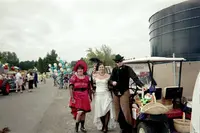
- Forest Grove Corn RoastForest Grove · FestivalA day of food, vendors, games, crafts, music, children's events and roasted corn on a street closed for the day; established in 1964 as a way to introduce incoming educators.
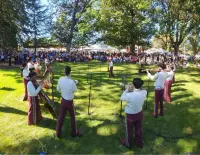
- Trees to Sea Scenic BywayBanks · State bywayOne of Oregon's newest scenic byways, connecting Tualatin Valley through the Tillamook State Forest to the Oregon Coast.
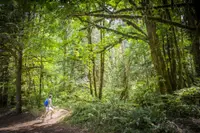
- The Freakybuttrue PeculiariumPortland · Museum & oddities gift shopNo jump scares; a whole host of weird, wild and goofy things, from aliens to zombies and everything in between.

- Vineyard and Valley Tour RouteSherwood · Tour routes & trailsHandpicked produce, carefully crafted wines and bucolic beauty will tempt you at every turn on this 57-mile/92-kilometer route through the Tualatin Valley — an easy side trip from the Portland metro area

- Robin Hood FestivalSherwood · Summer festivalEach third weekend of July since 1954, Old Town Sherwood, Oregon, holds a Robin Hood festival that knights its volunteers and shoots arrows against Nottingham, England.
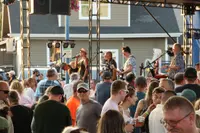
- Paul Bunyan StatuePortland · 31-foot-tall concrete and metal sculpture of mythical logger paul bunyanA 31-foot concrete-plaster Paul Bunyan in Portland's Kenton neighborhood, raised for Oregon's 1959 centennial and framed in the machine shop that still faces him across Denver Avenue.

- Mill Ends ParkPortland · ParkA two-foot circle of soil in a downtown Portland traffic median, Mill Ends Park held the world's-smallest-park title for decades and, by its founder's account, houses leprechauns.

- Portland Saturday MarketPortland · Shopping districtThe largest operating outdoor arts & crafts market in the country, operating since 1974.

- Harry C. Kendall PlanetariumPortland · PlanetariumOMSI's 200-seat, 52-foot domed theater, one of the most technologically advanced planetariums in the Pacific Northwest, with daily planetarium presentations and evening laser shows.
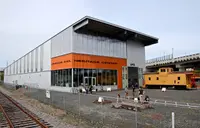
- Oregon Rail Heritage Center (Oregon Pacific Railroad excursions)Portland · Train ridesAll roundtrip excursions depart from the Oregon Rail Heritage Center and travel along the east bank of the Willamette River. After passing the iconic Oaks Amusement Park, the train returns to the ORHC. Each ride lasts approximately 40 minutes.
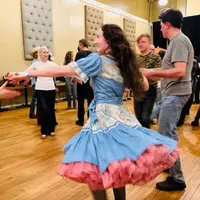
- Portland Old-Time Music GatheringPortland · Grassroots volunteer-run festivalA volunteer-run January festival of Appalachian string-band music held in Portland since 1999, whose 2026 Saturday square dance rotated eleven callers through three bands.
- Danner boot factory toursPortland · In-person factory tourFree, scheduled tours of Danner's working boot factory in Northeast Portland, Oregon, where six visitors at a time watch hides tested, uppers stitched down, and liners dunked for leaks.

- Multnomah Days Festival & ParadePortland · One-day open-airA one-day street festival and parade in Portland's Multnomah Village, begun by local merchants about 1920, whose parade admits no motorized vehicles or floats.

39 more within 30 miles on the road map.
Nearby towns: Gresham, Longview, and Tillamook. All the towns of Oregon. More of Oregon: Flea Markets and Fairs & Rodeos.
Sources
- Related Entries oregonencyclopedia.org/articles/hillsboro
- Joseph L. Meek (historical marker) hmdb.org/m.asp?m=113887
- Oregon: End of the Trail (1940), p. 480 archive.org/details/oregonendoftrail00writrich/page/480
- OHQ vol. 124, no. 3 Duyckinck, The 1973 Hillsboro Teachers’ Strike 324 325 ohs.org/oregon-historical-quarterly/upload/Duyckinck_Hillsboro-Teachers-Strike_OHQ-123_4_Fall-2023_final.pdf
- Les AuCoin (historical marker) hmdb.org/m.asp?m=309588
- Five Oaks Museum (Washington County Museum) oregonencyclopedia.org/articles/washington_county_museum