Longview
Cowlitz County, Washington. County seat.
Longview is a lumber city where the Cowlitz meets the Columbia in western Cowlitz County, planned and built in the 1920s around a mill by lumberman Robert A. Long.1,2
Details
- Founded
- Longview was founded in 1923 on the site of old Monticello, financed by Robert Alexander Long, president of the Long-Bell Lumber Company.2,3,4
- Name
- The city is named for its founder, Robert A. Long, and HistoryLink’s city history says more exactly that it was named after his 1,600-acre horse farm in Lees Summit, Missouri.1,2
- County seat
- The county seat stayed at Monticello only until 1865, when voters moved it to Freeport; in 1872 it went to Kalama, and in 1923 voters moved it to Kelso.1
- Last checked
- October 6, 2026.
Point at a dot to see the place.Tap a dot to see the place. Road map of Longview.
In Longview
The Calendar
History
Monticello on the Delta
An old black walnut tree on Third Avenue marks the site of the 1852 Monticello Convention, commemorated in 2006 as the birthplace of Washington Territory.5 The city stands where the Cowlitz meets the Columbia in western Cowlitz County, 66 miles upriver from the Pacific Ocean, and HistoryLink reports that wood and paper manufacturing is still its main industry.2
The Hudson’s Bay Company came first: the National Register nomination dates its Cowlitz Farm of 600-700 acres to 1837, and the 1950 Federal Writers’ Project guide has the company building two warehouses on the site in 1846-7 for hides, wool, furs, and wheat.3,4 In 1849 two American settlers, Jonathan Durbee and H. D. Huntington, took up claims near the present city, and by 1852 logging camps had sprung up, their cuts moved by sailing ships that made their way up the Columbia without difficulty.4 On November 25, 1852, delegates met at Harry Darby Huntington’s home at Monticello and drafted a plea for a new territory to be called Columbia, and partly as a result Congress created the Territory of Washington.1,3,4 Monticello became seat of the new Cowlitz County in 1854, but the high water of 1867 destroyed it, and the 1950 guide says the fear of floods kept settlers away afterward.1,4
R. A. Long’s Planned City
Robert Alexander Long, a Kansas City timber baron and president of the Long-Bell Lumber Company, had left a Kentucky farm in 1873, and by 1918 his company’s timber in Texas and Louisiana was nearly exhausted.2,3 Long-Bell bought Cowlitz County timber from Weyerhaeuser in 1919, and in 1922 Long spent $2.6 million for 14,000 acres in 245 separate pieces of property, though HistoryLink’s account of the Allen Street Bridge has the company buying 11,000 acres in 1921.1,6 Long did not want a squalid mill town to spring up beside his mill, and with guidance from Kansas City developer J. C. Nichols he embarked on a planned community.1,2 Dikes and drainage canals cost another $3.25 million, and the 1950 guide tells how sloughs and swamps became sunken gardens and a chain of lakes.1,4 HistoryLink’s city history says Longview was named after Long’s 1,600-acre horse farm in Lees Summit, Missouri, while its county history says only that every name considered, Long-Bell and Longport among them, carried the name Long.1,2 Another Long View already existed, a flag stop in Benton County serving three rural families, which gave up the name for a $25 covered platform to protect mail sacks, and the name became official in January 1923.2
On January 3, 1923, the Allen Street Bridge in Kelso collapsed into the Cowlitz River under workers returning home, the coroner counted two dead and 18 missing, and HistoryLink calls it, in terms of fatalities, Washington’s worst bridge disaster.6 The six-story Hotel Monticello opened on July 23, 1923, its 200 rooms lodging prospective residents and business people looking for property.2 The town was dedicated in July 1923, a census that December counted 3,724 people, and on February 14, 1924, Longview incorporated as a third-class city, though Long-Bell owned all the land and paid most of the taxes.1,2
Mills, Port, and Bridge on the Columbia
The Long-Bell mill opened in June 1924, as the county history has it the largest lumber producer in the world, and at that summer’s Pageant of Progress visitors watched from catwalks as giant Douglas firs were sawed into lumber.1,2 Longview Fibre began making kraft paper from Long-Bell’s sawdust in 1927, and Weyerhaeuser opened its mill next door in June 1929 on the site of Mount Coffin, which was dynamited for gravel and building stone.1,2 County voters chose the foot of Oregon Way for the Port of Kelso’s new dock on August 1, 1925, the dock was dedicated on April 15, 1926, and on December 7, 1929, voters renamed it the Port of Longview.7 On March 29, 1930, President Herbert Hoover turned a telegraphic key in the other Washington, and a knife cut a chain of daffodils along the Longview Bridge to Rainier, Oregon, later renamed the Lewis and Clark Bridge.8
Depression, War, and the End of Long-Bell
The lumber market slumped in 1927, and the 1930 census found 10,652 people, far short of the 30,000 expected and the 50,000 the city was planned for.2 In December 1933 the Cowlitz River flooded and washed out sections of the LP&N tracks and railroad drawbridge, and the empty train depot became Cowlitz General Hospital in 1935 and was demolished in 1968.2 In 1940 Reynolds Metals Company built an aluminum plant employing some 500 workers, and during World War II Weyerhaeuser made thousands of tons of bleached sulfite pulp for the War Production Board to make smokeless gunpowder.2,7 In 1950 the Federal Writers’ Project guide, calling Longview the first planned city in the Pacific Northwest, counted 12,385 people, seventy per cent of them employed in lumber mills, and mill smokestacks 300 feet high visible for miles.4 International Paper bought Long-Bell’s remaining holdings in 1956, and in 1960, with the old-growth fir and cedar depleted, the Longview mills were closed and dismantled.2
The Library, the Theatre, and the Squirrel Bridge
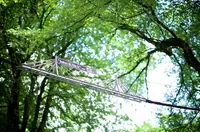
The Public Library, Long’s gift to the city and the second building to face the Civic Center, is Georgian Revival and listed on the National Register of Historic Places.9 A thematic National Register nomination gathered 18 properties and one historic district from the city’s first dozen years, 1923 to 1935.3 The Columbia Theatre was spared from demolition when the eruption of Mount St. Helens on May 18, 1980, pulled the contractor away, and the city bought it on December 9, 1982.10 Over Olympia Way hangs the Nutty Narrows Bridge, 60 feet of aluminum tubing with a fire hose for its roadway, which Amos Peters conceived after seeing too many squirrels killed crossing the street; it was added to the National Register in 2014.11
Within 30 Miles
Measured in a straight line from the town, nearest first.
- Kelso Highlander Festival & Scottish GamesKelso · Highland festival and scottish gamesClan societies march and gather on the Avenue of Clans.
- Rainier Days in the ParkRainier · 3 day festivalA three-day riverfront carnival, parade, and fireworks show in Rainier, Oregon, organized since 2011 by the mayor, his wife, and his daughter, with volunteers.
- Kalama Community FairKalama · Community fairThe Kalama Community Fair fills Haydu Park in Kalama, Washington, for three days each July, and on coronation night it serves free strawberry shortcake in the Exhibit Hall.
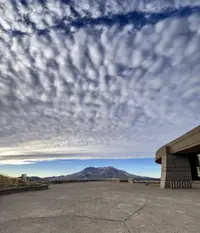
- Spirit Lake Memorial HighwayCastle Rock · Scenic bywayThe only scenic byway in Washington State, not to mention the United States, that enters a volcanic blast zone. Also known as the Spirit Lake Memorial Highway, SR-504 is a 52-mile journey into the scene of epic destruction that Mount St. Helens caused when it erupted on May 18, 1980.
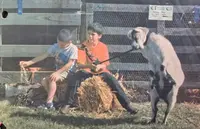
- Castle Rock FairCastle Rock · Small community fairThe Castle Rock Fair in Castle Rock, Washington, is a three-day youth fair of 4-H and FFA animal shows, a rib cook-off, and a quarter arcade selling tickets three for a dollar.
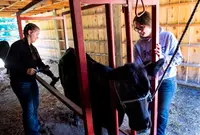
- Kalama Cultural FestivalKalama · FestivalFor many years, the Kalama community held a festival celebrating the unique blending of Hawaiian and Native American cultures of the Pacific Northwest. This year, we continue to build on the foundation of the previous festivals in Kalama, Washington.
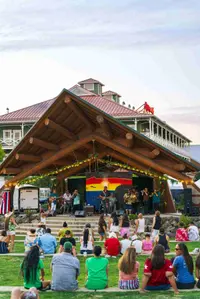
- Clatskanie Heritage DaysClatskanie · CelebrationClatskanie, Oregon's Fourth of July celebration, begun as a barbecue-and-baseball drive to build a town pool after drownings, still runs its parade downhill along Nehalem Street.
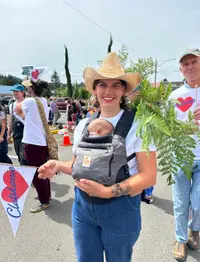
- Vader May Day FestivalVader · FestivalA one-day parade and street fair on A Street in Vader, Washington, begun in 1952 by Girl Scout leader Lena DeAger and still closing with a May Pole dance.
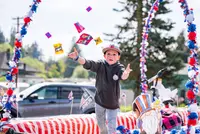
- Planters DaysWoodland · Annual community celebrationWoodland, Washington's four-day June celebration at Horseshoe Lake Park, held since 1922 to mark the diking of the Lewis and Columbia rivers, with a frog jump near sixty years old.
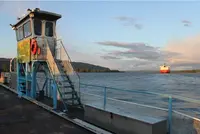
- Oscar B FerryPuget Island · The last ferry on the lower columbia riverThe last ferry on the Lower Columbia River; Wahkiakum County welcomed the Oscar B on February 27, 2015, and it operates at least 18 runs per day.
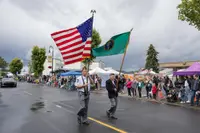
- Bald Eagle DaysCathlamet · Two-day festivalBald Eagle Days, a two-day July festival in Cathlamet, Washington, grew from a parade the Cathlamet Women's Club staged in support of the bald eagle.
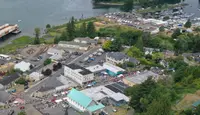
- Columbia County Fair & RodeoSt Helens · County fair & rodeoColumbia County's fair and NPRA rodeo, held in July on grounds east of St. Helens, Oregon, entered between stone monuments carried from its old Deer Island site.
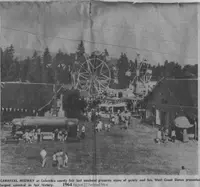
- Cheese DaysToledo · Annual town eventToledo, Washington's July festival has run since 1919 and has outlasted the cheese factory it was founded to celebrate. The parade still ends with free cheese sandwiches.
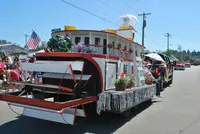
- Vernonia Friendship Jamboree and Logging ShowVernonia · Community logging heritage festivalA three-day August reunion in Vernonia, Oregon, begun after the town's sawmill closed in 1957 and built around a logging show where competitors run logs across Rock Creek.
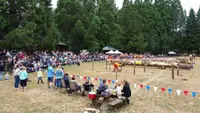
- Winlock Egg DaysWinlock · Annual festivalWinlock's June egg festival in Lewis County, Washington, held since 1921 for a town that once shipped eggs to New York and Hawaii, under a fiberglass egg on a pole.
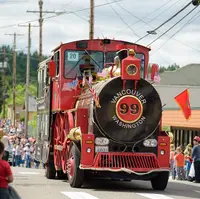
9 more within 30 miles on the road map.
Nearby towns: Hillsboro, Gresham, and Long Beach. All the towns of Washington. More of Washington: Fairs & Rodeos.
Sources
- Cowlitz County -- Thumbnail History historylink.org/File/7482
- Longview -- Thumbnail History historylink.org/file/8560
- National Register nomination, Civic, Cultural, & Commercial Resources of Longview Thematic npgallery.nps.gov/NRHP/GetAsset/NRHP/64000895_text
- Washington: A Guide to the Evergreen State (1950), p. 409 babel.hathitrust.org/cgi/pt?id=mdp.39015010545013&seq=523
- 1852 Monticello Convention (historical marker) hmdb.org/m.asp?m=285912
- Allen Street Bridge in Kelso collapses, with loss of life, on January 3, 1923. historylink.org/file/7406
- Port of Longview historylink.org/File/8559
- Longview Bridge (later renamed Lewis and Clark Bridge) spanning the Columbia River opens on March 29, 1930. historylink.org/File/5411
- Public Library (historical marker) hmdb.org/m.asp?m=197139
- Columbia Theatre in Longview opens on April 4, 1925. historylink.org/File/5187
- Nutty Narrows Bridge opens in Longview on March 19, 1963. historylink.org/File/8264