Tillamook
Tillamook County, Oregon. County seat.
Tillamook, a town near Tillamook Bay on the north Oregon Coast, began with a settler living in a hollow spruce in 1851 and built its own schooner from shipwreck salvage.1,2
Details
- Founded
- Joseph Champion settled in 1851, and Thomas Stillwell, who arrived in 1861, laid out the town the following year.2
- Name
- The town takes its name from the Tillamook Indians, a name Franz Boas in 1890 traced to Chinook, meaning the people of Nekelim.2,3
- County seat
- An election in 1873 chose Tillamook as the seat of Tillamook County.2
- Last checked
- October 6, 2026.
Point at a dot to see the place.Tap a dot to see the place. Road map of Tillamook.
In Tillamook
- Latimer Quilt & Textile CenterTillamook · Living, working museumA working textile museum in a former Wilson River schoolhouse in Tillamook, Oregon, where weavers work the looms on Fridays and volunteers turn back quilts one by one.

- Tillamook CreameryTillamook · Creamery visitor centerThe Tillamook County Creamery Association's free visitor center on Highway 101 in Tillamook, Oregon, where visitors look down from a gallery onto a working cheddar plant.

- Trask River HatcheryTillamook · HatcheryA state salmon hatchery on the Trask River east of Tillamook, Oregon, where fall salmon run below the hatchery and up Gold Creek, home of a family hatchery about 1900.
The Calendar
History
Champion’s Spruce and the Morning Star
Tillamook’s City Hall at 210 Laurel occupies the former post office, where in 1943 the U.S. Treasury Department had native Tillamooker Lucia Wiley paint a mural entitled “The Landing of Captain Robert Gray in 1788.”2 The town is the seat of Tillamook County, near the southeast end of Tillamook Bay and seventy-three miles west of Portland, and the Oregon Encyclopedia notes that its population has held at around five thousand since 1960.4
Tillamook people lived for twelve thousand years or more at the tidewaters of the Nehalem, Tillamook, Netarts, and Nestucca Bays, in permanent cedar-plank lodges where extra light was provided by torches or by burning fishheads or whale oil.4 Captain Robert Gray came ashore from the Lady Washington in August 1788 for supplies, and a skirmish left his Black servant, Marcos Lopez, dead; the entry on Tillamook Bay says Gray dubbed the place Murderer’s Harbor, while the state’s Tillamook County History & Records says the ship’s clerk named it Murderer’s Bay.5,6
Joseph Champion, the first white settler, came in 1851 and made his home in a hollow spruce he called his “castle,” one the Oregon Encyclopedia says local people showed him.2,4 Families followed in 1852 with dairy cows, helped by Indians who served as guides and ferrymen, and the legislature created Tillamook County on Dec. 15, 1853.2,4 Shipwrecks had destroyed the vessels that carried the settlers’ dairy products, fish, and potatoes to market, so in 1854 they laid the keel for a community ship, the Morning Star.2 A marker in town gives December 29, 1854, as the day the Morning Star was completed, the first ship built in Tillamook County; the city’s history has it launched in the Kilchis River on Jan. 5, 1855.2,7
Hoquarton Becomes Tillamook
In its early years the settlement bore the unofficial names Lincoln and Hoquarton, the latter believed to be an Indian name meaning “the landing.”2 Thomas Stillwell, aged 70, came from Yamhill in 1861, and the following year he laid out the town and opened its first store.2 A post office opened in 1866 and the town was permanently renamed Tillamook; an election in 1873 made it the county seat, its first public building was a jail, and it incorporated in 1891.2,4 In 1890 the anthropologist Franz Boas wrote that the name is of Chinook origin and means the people of Nekelim; the city’s history sets aside the local folklore that it means “Land of Many Waters.”2
Arthur Generous Beals, who walked over the Track River Road in knee deep snow to reach Tillamook in 1891, built the Beals Building and several others around 1900, moving the business district away from the Hoquarton Slough.8 The Pacific Railway & Navigation Company line reached Tillamook from Portland in 1911, and in September 1912 work began on the first section of the three-story Tillamook Hotel, which still carries its 1912 date on top of the side facing 3rd St.4,9 From 1922 to 1932, historian Eckard Toy wrote, the majority of officials from Tillamook were Klansmen or former Klansmen, and on May 3, 1924, a Klan parade ten blocks long ended with the burning of a large cross at the fairgrounds.4
Cheese, Sawmills, and the Burn
Timber began slowly, with three small one-man sawmills in the county in 1863; lumber began shipping out only in 1886, and by 1892 it was going to Portland and San Francisco.7 Merriman Foland is credited with the first commercial cheese in Tillamook, in 1889; the Oregon History Project spells him Folen, names Bob Richards as his partner, and says the first result was inedible.4,10 The Oregon Encyclopedia dates the first cheese factory to 1894 under Thaddeus Townsend in one article and to 1893 under Townsend and Harry Ogden in another, and Townsend herded several dozen cattle from Portland over the Coast Range to keep it in milk.1,4 Peter McIntosh, a Canadian immigrant who had learned cheese-making in Ontario, convinced the county’s dairy farmers, most of them butter producers, that cheese withstood transportation delays better, telling reporter Dean Collins in the early 1930s, “You could store your cheese and wait for the boat.”10 In 1909 several of the region’s cheesemakers formed the Tillamook County Creamery Association to market their cheese, and by 1940 over a dozen independent factories were making cheese for its Tillamook brand.1
In 1940 the Writers’ Program guide found the town of 2,549 to be the trade center of the dairying region, with loggers, fishermen, and dairymen on its Saturday streets and a notice, “No caulked boots allowed,” where woodsmen gathered.11 The lumber industry took a major blow in 1933 with the fire that became known as the Tillamook Burn; the county historical society’s marker counts three fires through 1945 and 354,936 acres, the Oregon Encyclopedia fires through 1951 and 355,000 acres.7,12 After World War II the Holstein, Tillamook, Mapleleaf, and Cloverleaf plants merged as the Tillamook Cheese and Dairy Association, which in the 1960s split from the TCCA over the marketing of Grade A milk; at one point a small homemade bomb damaged TCCA head Beale Dixon’s home and car.1
Blimp Hangars South of Town
In April 1942 the Navy selected its site, dairy farm land four miles south of the city, and in November 1942 the work was drenched by 18.57 inches of rain.13 Hangar B, begun in October 1942, was finished on August 15, 1943, and Hangar A was built in 1943 in just twenty-seven days.13,14 The first blimp had arrived on February 15, but with no hangar to protect it, a heavy storm tore it to pieces on March 27.14 The two hangars could house eight K-class blimps, which watched over ports and shipping lanes from California to the San Juan Islands, and the National Register nomination says techniques for air-sea rescue were developed at the station.13,14
The station was deactivated in 1949 and passed to the Port of Tillamook Bay, and the lumber companies Rosenberg, Angel Lumber, and Diamond Lumber worked in the hangars from 1949 to 1982.13,14 Hangar A was holding 300 truckloads of Tillamook farmers’ hay when fire destroyed it on August 22, 1992.14 In 1992 the Port of Tillamook Bay established a small blimp museum, and the Oregon Encyclopedia’s entry on the air station says Tillamook is home to the largest free-standing, clear-span wooden structure in the world, a building 1,072 feet long and more than 15 stories high.14
Within 30 Miles
Measured in a straight line from the town, nearest first.
- Garibaldi DaysGaribaldi · Family friendly town-wide festivalGaribaldi Days, a three-day July festival on Tillamook Bay at Garibaldi, Oregon, where Coast Guard crews and fire-department teams settle a water ball tournament on Biak Avenue.

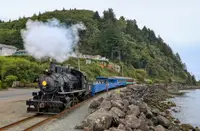
- Oregon Coast Scenic RailroadGaribaldi · 501(c)3 non-profit heritage railroadOregon Coast Scenic Railroad (OCSR) is 501(c)3 non-profit heritage railroad, offering interpreted train rides along the Tillamook Coast that tell the story of the area by giving passengers a journey back in time.
- Rockaway Beach 4th of July CelebrationRockaway Beach · Annual 4th of july celebrationThe Fourth of July in Rockaway Beach, Oregon: a parade on Highway 101, dachshund races, and fireworks launched by the volunteer fire department over the Pacific.
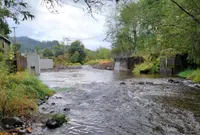
- Cedar Creek HatcheryHebo · Hatchery visitors' centerA state fish hatchery on Three Rivers east of Hebo, Oregon, in production since 1925, where visitors feed trophy rainbow trout in a show pond beside the salmon raceways.
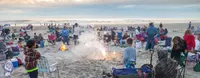
- Dory DaysPacific City · Annual celebration of local dory fishing culturePacific City, Oregon's July festival for its dory fleet, held since 1959, with a parade, a fish fry, and boats that launch straight off the beach at Cape Kiwanda.
- Nehalem Bay WineryNehalem · A smallA small, family owned winery on the Coast with 3 generations of Oregonians making Oregon wine since 1974.
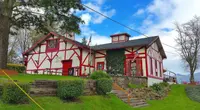
- North Nehalem HatcheryNehalem · Fish hatcheryA state fish hatchery on Oregon's North Fork Nehalem River, where coho and steelhead return to the trap each fall and winter, an eighth of a mile from Umbrella Falls.
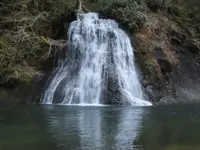
- Sunset Springs FountainSunset (on Hwy 26 near Seaside) · Roadside springTwo spring-fed drinking fountains on either side of U.S. 26 in Oregon's Coast Range, where drivers have filled jugs from a hillside spring since about 1925.
Nearby towns: Hillsboro. All the towns of Oregon. More of Oregon: Town Festivals, Factory Tours, and Fairs & Rodeos.
Sources
- Tillamook Cheese oregonencyclopedia.org/articles/tillamook_cheese
- Tillamook, Oregon tillamookor.gov/history
- About Tillamook County www2.co.tillamook.or.us/Various/About.htm
- The Oregon Encyclopedia oregonencyclopedia.org/articles/tillamook
- Tillamook Bay oregonencyclopedia.org/articles/tillamook_bay
- Tillamook County History & Records sos.oregon.gov/archives/provisional-guide/pages/tillamook.aspx
- Tillamook County (historical marker) hmdb.org/m.asp?m=113079
- Beals Building (historical marker) hmdb.org/m.asp?m=113075
- Tillamook Hotel (historical marker) hmdb.org/m.asp?m=113077
- Tillamook Cheddar Cheese oregonhistoryproject.org/articles/historical-records/tillamook-cheddar-cheese
- Oregon: End of the Trail (1940), p. 368 archive.org/details/oregonendoftrail00writrich/page/368
- Tillamook Burn oregonencyclopedia.org/articles/tillamook_burn
- National Register nomination, Tillamook, OR npgallery.nps.gov/GetAsset/d362271a-ce09-4f8b-9694-04233705f21e
- Naval Air Station Tillamook / Tillamook Air Museum oregonencyclopedia.org/articles/naval_air_station_tillamook_tillamook_air_museum