Cedar Creek Hatchery
Hebo, Tillamook County, Oregon. Hatchery visitors' center.
Details

- Where
- 33465 Hwy. 22, Hebo, OR 33465. Directions
- When
- Dawn to dusk; 7 days a week.
- Season
- June to March for adult Chinook salmon and steelhead.
- Getting there
- 21 miles west of Valley Junction on Hwy. 22, and 1.5 miles east of Hebo on Hwy. 22.
- Fees
- Free self-guided tours.
- Access
- Facilities: camp host, restrooms.
- Walk-in or reserve
- Self-guided tours are welcome from 8:00 a.m. to 4:00 p.m.; call the hatchery to schedule group tours.
- Phone
- (503) 392-3485
- Website
- myodfw.com
- Managed by
- Oregon Department of Fish & Wildlife, owner of the weir and hatchery facility.
- Established
- Construction began in 1924; production started in 1925 by the state of Oregon.
- Coordinates
- 45.2158, -123.8453.
From December through October, the show pond at Cedar Creek Hatchery holds trophy-sized rainbow trout, and the public is invited to feed them. Beyond it are the holding ponds, two concrete basins 94 feet long. From July through February, adult steelhead and Chinook salmon collected for spawning are on view there.
The hatchery stands 1.5 miles east of Hebo on Oregon Highway 22, beside Three Rivers, a tributary of the Nestucca. It covers 35.33 acres about 43 feet above sea level in Tillamook County. Hebo itself sits at the confluence of Three Rivers and the Nestucca and at the junction of Highway 22 and U.S. 101. A 2005 county roundup counted 231 people there and listed a beauty parlor, a sporting goods store, one restaurant, a Forest Service district office, and the hatchery.
The grounds are open dawn to dusk every day. Free self-guided tours of the working hatchery run from 8 a.m. to 4 p.m., and the visitors’ center explains the life history of salmon. A camp host stays on site, and there are restrooms. Eagles, ospreys, herons, cormorants and mergansers work the area around the ponds. The Oregon Department of Fish and Wildlife runs the hatchery on state funding with three full-time employees.
Raceways, trap and spawning house
Water reaches the hatchery by gravity from Cedar Creek, through upper and lower intakes original to the facility. In the low flows of summer it is also pumped from Three Rivers. The adult trap sits on Three Rivers just above the mouth of Cedar Creek. The spawning building there, built in 1970, encloses the fish ladder and the pools used for trapping. ODFW’s 2024 plan lists rearing units from many decades:
concrete abatement ponds from 1954 concrete raceways from 1974, 1979, 1989 and 2016 * an asphalt rearing pond from 1999
Four runs pass through the hatchery:
Spring Chinook reach it between May and September and are spawned mostly in September. Summer steelhead come in from May through December and spawn in February. Fall Chinook arrive between October and December, with peak spawning in November. Winter steelhead broodstock are wild Nestucca fish, caught by angling in the Nestucca River from mid-December to April.
The plan sets yearly targets of 230,000 spring Chinook smolts for the Nestucca basin and 215,000 for the Trask. It calls for 90,000 summer steelhead smolts for the Nestucca, Three Rivers and South Fork Wilson, and 140,000 winter steelhead for the Nestucca and Three Rivers. The fish are fin-clipped before release.
ODFW’s Northwest Zone report for October 1, 2026, says Cedar Creek has been recycling summer steelhead to increase angler opportunity in the Nestucca. The hatchery’s work also widened after the agency lost funding for the Salmon River Hatchery. KDRV reported on September 8, 2025, that Cedar Creek would rear Salmon River fall Chinook and Siletz River summer steelhead, and that its own production would decrease to make room. “Robust fisheries are extremely important to us,” said Shaun Clements, ODFW deputy director.
Below the deadline on Three Rivers
Anglers reach Three Rivers from the hatchery and park in its lot. A deadline marker below the hatchery marks the upper end of the open water. From June 1 to July 15, the stretch from that deadline down to a marker below the Gauldy Mountain Road Bridge is for youth only. Kids fish there for hatchery spring Chinook and summer steelhead as they return. In fall the same water opens to wild Chinook. From October 1 through November 30, 2026, the limit from the mouth of Three Rivers to the deadline is one adult a day and two for the period.
One account describes the fishing hole just below the hatchery, though it places the spot 3 miles south of Hebo. It says the land beside the hole is publicly owned and fills with anglers when the season is open. A few yards downstream, a thick wire is strung across the river. The wire marks private land, and according to the same account the owners have sued anglers for trespassing along that stretch.
From 1925 to the Obermeyer weir
The state of Oregon began building the hatchery in 1924, and production started in 1925. In approximately 1947 a staff residence was moved onto the grounds; it reportedly had a flat roof at first. A survey of estuaries lists the hatchery as operated by the OSGC in 1970. That year it released 712,404 summer steelhead, winter steelhead and spring Chinook.
Fall Chinook dropped out of the program in the early 1990s, cut to save money during budget shortfalls; the management plan places the end after 1993. Volunteers brought them back. Beginning with the 1999 brood year, hatchery staff spawn and incubate the fall Chinook and start their rearing. In mid-April they hand the fingerlings to the Nestucca Anglers at Rhoades Pond, a lined earthen pond 5.5 miles east of Hebo. The volunteers feed the fish, clean the pond and mark them. In September they release them as smolts into Three Rivers and the Nestucca. The 2016 plan names Dave Morrison as the Nestucca Anglers’ hatchery manager, and Ron Byrd has served as the group’s president.
The hatchery closed to the public on June 17, 2016. Five Rivers Construction of Longview, Washington, then built four new raceways and the show pond and upgraded the pollution abatement system. Joshua Rist was hatchery manager. In late October the site was still closed, and construction delays pushed completion to the beginning of the new year.
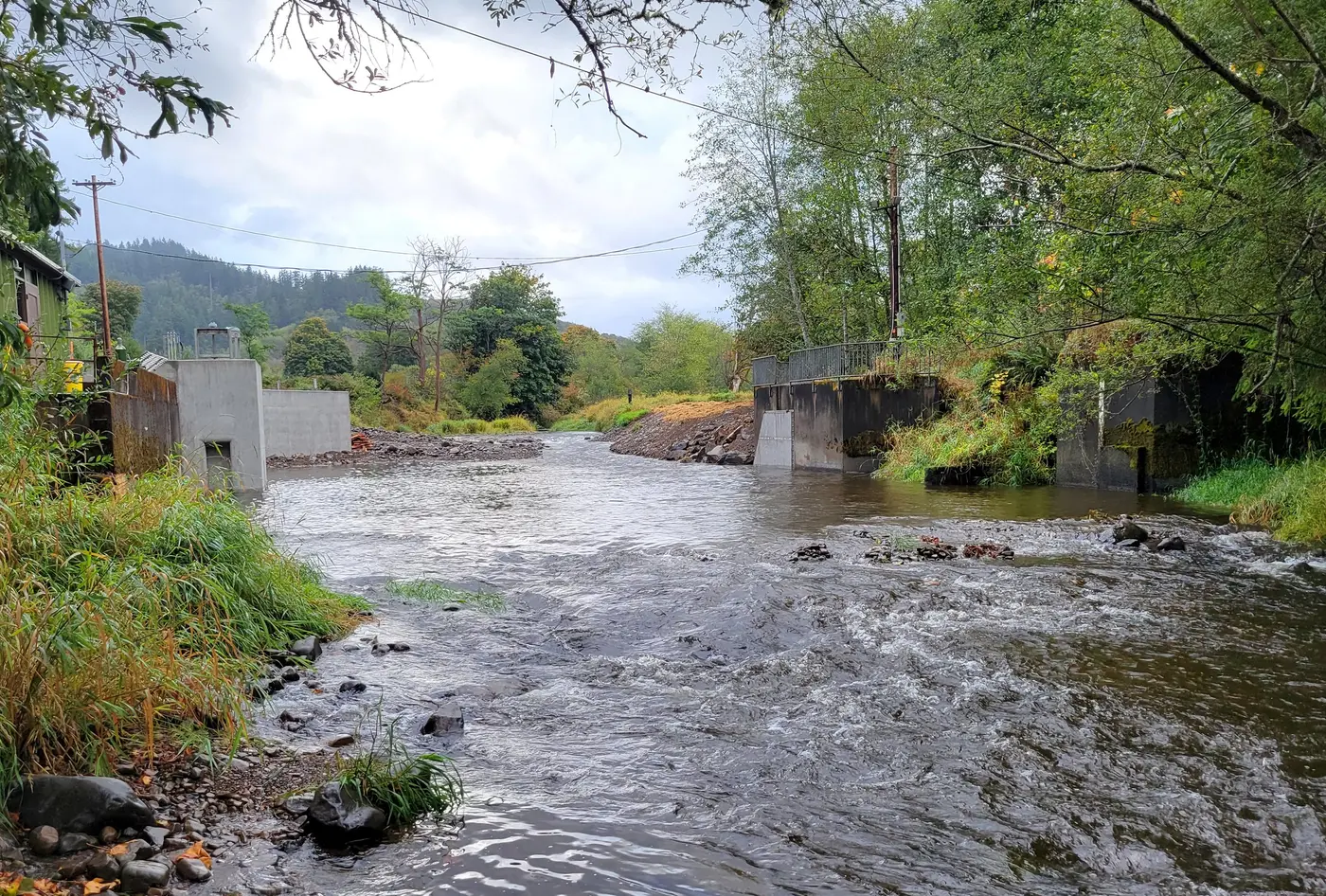
The river was next. The old weir across Three Rivers had a 15-foot concrete apron and a 3-foot stem wall running the full width of the stream. Hydraulic picket panels mounted below it could be raised, making the barrier 9 feet high. The Salmon SuperHwy partnership says the panels were up nine to ten months of the year and cut fish off from more than fourteen miles of habitat. ODFW’s statewide priority list ranked the weir among the top two remaining fish barriers on the North Coast.
In 2006, ODFW worked with U.S. Fish and Wildlife, NOAA and the consultant Tetra Tech/KCM on a study of options for replacing the trap. Construction began in June 2021 and was finished that October. The picket weir came out. In its place went an adjustable Obermeyer weir with an inflatable pneumatic bladder, a new fish ladder built for lamprey and juvenile salmon, and a fish screen. The project cost more than $2.8 million, $2.3 million of it from ODFW. “ODFW is excited to see this project completed — which will generate significant benefits to natural fish production and hatchery management,” said Alan Ritchey of the department. In 2022 the 18th Annual State Land Board Awards, presented October 11 in Salem, honored the project for a design that opens passage to all species of fish, Pacific lamprey among them.
An ODFW grant application, last revised in September 2025, asks for four more rearing ponds at Cedar Creek. Its main funding source is $4.5 million in pending hatchery maintenance bond funds. The application gives the new ponds a life expectancy of more than 50 years.
Notable Events
- 1924Work to build the state hatchery began in this year, one year before production started. myodfw.com
- 1925The hatchery's upper and lower intakes are gravity feed systems on Cedar Creek and are original to the facility, which the report states was established in that year. web.archive.org
- 1947Residence 3 on the site was relocated there in approximately 1947; reportedly the building originally had a flat roof. web.archive.org
- 1970The estuaries survey lists releases of anadromous fish from the hatchery during 1970 as totaling 712,404, of summer steelhead, winter steelhead and spring chinook. govinfo.gov
- 1970The Spawning Building at Three Rivers was built in that year; it covers and encloses the fish ladder and the pools used for trapping fish. web.archive.org
- 1990sThe fall Chinook Salmon program was terminated as a cost saving measure during budget shortfalls, and the plan puts the cut more precisely: the fall chinook program was dropped after 1993. dfw.state.or.us
- 1999The STEP Rhoades Pond fall Chinook program began with that brood year and operates in conjunction with Cedar Creek Hatchery, whose staff handle spawning, incubation and early rearing while volunteers rear, mark and release the juveniles. dfw.state.or.us
- 2006ODFW teamed with U.S. Fish & Wildlife, NOAA and an independent engineering consultant, Tetra Tech/KCM, to develop the Three Rivers Trap & Passage study, which outlines needs and options for a trapping, holding and passage facility to replace the existing trap. dfw.state.or.us
- 2008A pump station and pipeline installed then addressed most of the rearing pond effluent concerns, and waste water could be diverted to a large unused rearing lake for settling and dilution. web.archive.org
- 2016In 2016 extensive renovation took place which included addition of 4 new rearing raceways, show pond, and upgrades to the current pollution abatement system. dfw.state.or.us
- 2016The hatchery near Hebo was closed to the public while ODFW upgraded the salmon-rearing facility, and the construction was being completed by Five Rivers Construction of Longview, Washington. dfw.state.or.us
- 2021The Open Rivers Fund project page for the Three Rivers weir, part of the Cedar Creek Fish Hatchery, lists its status as dam removal anticipated in 2021. openriversfund.org
- 2022A restoration project at ODFW's Three Rivers-Cedar Creek Hatchery won honors for a design that opens access for all species of fish, including Pacific lamprey; Oregon's State Land Board announced the award on October 11. fws.gov
- 2025After ODFW lost the funding for the Salmon River Hatchery, the agency shifted production to other facilities: Cedar Creek Hatchery in Hebo now rears Salmon River fall Chinook and Siletz River summer steelhead, and its own production decreases to make room. kdrv.com
- The channel-spanning picket weir associated with the ODFW Cedar Creek Hatchery was removed and replaced with an adjustable Obermeyer weir, new fish ladder, and fish screen. salmonsuperhwy.org
People
- Dave Morrison, Hatchery Manager for Nestucca Anglers, the volunteer organization in the Cedar Creek Hatchery / Rhoades Pond STEP fall Chinook program.
- Joshua Rist, hatchery manager at Cedar Creek Hatchery, quoted on the upgrade project and given as the contact for it (2016).
- Robert Bradley, District Fish Biologist, ODFW - lead management contact for the Cedar Creek Hatchery / Rhoades Pond program.
- Ron Byrd, Nestucca Anglers Association President, the volunteers whose fall Chinook are reared at Cedar Creek Hatchery and released by its staff.
Sources
- myodfw.com/cedar-creek-hatchery-visitors-center
- dfw.state.or.us/fish/HGMP/docs/2024/Cedar%20Creek%20Hatchery%202024.pdf
- myodfw.com/recreation-report/fishing-report/northwest-zone
- dfw.state.or.us/news/2016/06_June/061716c.asp
- ncph.org/phc/2018-annual-meeting-topic-proposals/salmon-design-oregons-heritage-fish-hatcheries
- web.archive.org/web/20230601152359id_/https://www.oregonlegislature.gov/citizen_engagement/Reports/2011_ODFW_HB3489%20Plan%20to%20Reform%20Department%20Operated%20Fish%20Hatcheries%20on%20the%20Oregon%20Coast.pdf
- govinfo.gov/content/pkg/CZIC-gc856-d44-1974/html/CZIC-gc856-d44-1974.htm
- openriversfund.org/projects/three-rivers-nestucca-river
- salmonsuperhwy.org/three-rivers
- dfw.state.or.us/news/2016/10_oct/102616.asp
- tillamookheadlightherald.com/tillamook-county-towns-from-north-to-south/article_c99c4c5c-2a62-527b-abd9-9fcfee8d3aaa.html
- tillamookheadlightherald.com/news/local-volunteer-salmon-hatcheries-celebrate-milestones/article_1dfaeb62-3677-11ef-8eaa-83563c9e3584.html
- thenewsguard.com/news/recognized-fish-hatchery-honored/article_9994ddf8-4a3a-11ed-afab-5b2994e28db5.html
- kdrv.com/news/local/odfw-shifts-fish-production-to-cedar-creek-amid-salmon-river-cuts/article_652991d0-764f-4e0e-9c9f-bde86dbe90e2.html
- dfw.state.or.us/fish/HGMP/docs/2016/Cedar_Ceek_Hatchery_and_Rhoades_Pond_STEP_ChF_HGMP_7-22-16_to_NMFS.pdf
- tillamookheadlightherald.com/community/nestucca-anglers-clip-100000-fall-chinook-for-nestucca-river/article_c63d8fc4-d2b0-11eb-a9a5-f3f76eabe877.html
- fws.gov/story/2022-12/pacific-lamprey-biggest-winner-award-winning-oregon-fish-passage-project