Latimer Quilt & Textile Center
Tillamook, Tillamook County, Oregon. Living, working museum.
Details

- Where
- 2105 Wilson River Loop, Tillamook, OR 97141. Directions
- When
- Tuesday-Saturday 10:00 AM to 4:00 PM; closed Sunday/Monday except open house dates.
- Getting there
- Just off Wilson River Loop Road in Tillamook.
- Fees
- $4.00 general admission; $3.00 senior (62+); free for members and children 13 and under.
- Access
- Sits in a flood zone; emergency closures are posted on the doors and announced on Facebook/Instagram.
- Phone
- (503) 842-8622
- Website
- latimerquiltandtextile.com
- Managed by
- Friends of Latimer Quilt & Textile Center; a non-profit operated by volunteers, managers and a nine-person volunteer board of directors.
- Established
- 1991.
Fridays at the looms
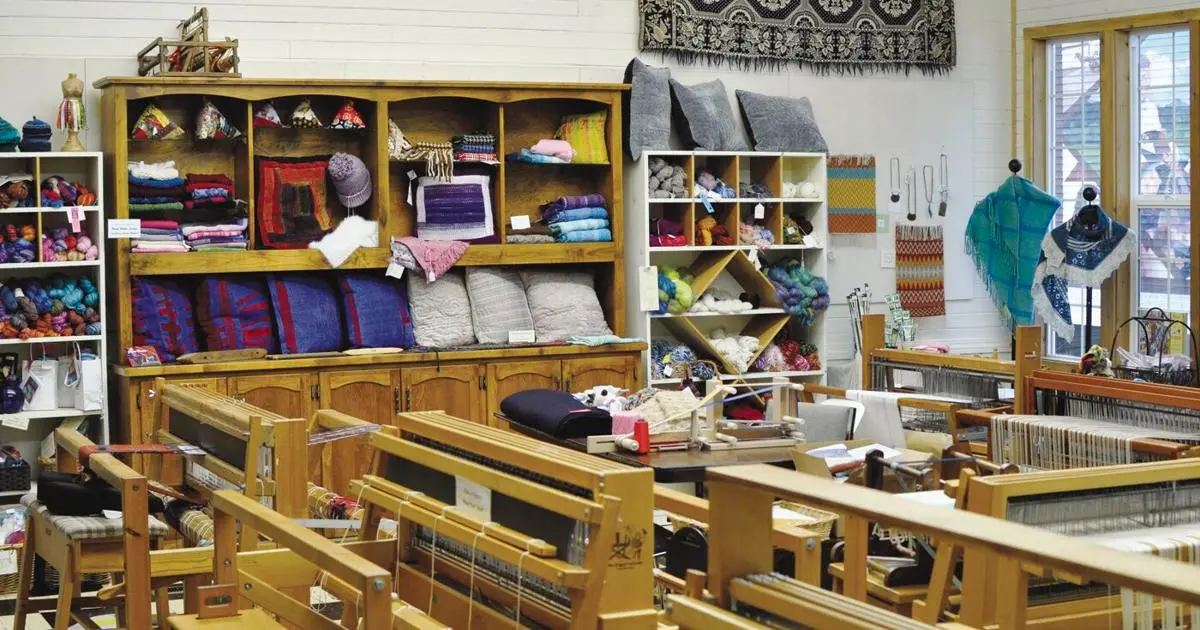
In the West Room of the old Maple Leaf School on Wilson River Loop Road, anywhere from one to nine looms are in use at once. One of them, an AVL loom donated in October 2024, is kept busy making tea towels that are sold in the building. Spinning wheels stand on display. A public loom is set up for anyone who wants to try it. Tapestries from the center’s own collection run along the ceiling and are changed every couple of months.
The Latimer Weavers sit at the looms every Friday from 10 to 4, and anyone may come in to ask questions and see what weaving looks like. On the same Fridays the Ocean Breeze Rug Krafters meet from 10 to 2, with a lunch brought from home. Thursdays belong to Cordelia’s Knitters, who began at Cordelia’s shop in downtown Tillamook and moved here when the shop closed in 2008. The day knitters meet from 1 to 3 and the night knitters from 5:30 to 7:30. The Tillamook County Quilters Guild meets at 10:30 on the third Thursday of each month, and the Oregon Coast Fiber Artisans hold a weekly day of spinning, quilting and knitting. One report on the center names a Tillamook spinner, Carole Reichert, who helps others with their projects. It also names a knitter, Candy Allen, starting a plain-weave sampler under Shirley Medsker, and a flight attendant, Jon Rodriguez, who brings his knitting in on his days off.
Marilyn Anderson, a volunteer and weaving instructor, has been with the center since it opened in 1991. “People come in here and ask us how long it takes,” she told the Headlight Herald in 2016. “And we tell them we haven’t the slightest idea. We just know we started doing (a project), and we’re still here.”
Drawers, a stage and a stencil-dyer
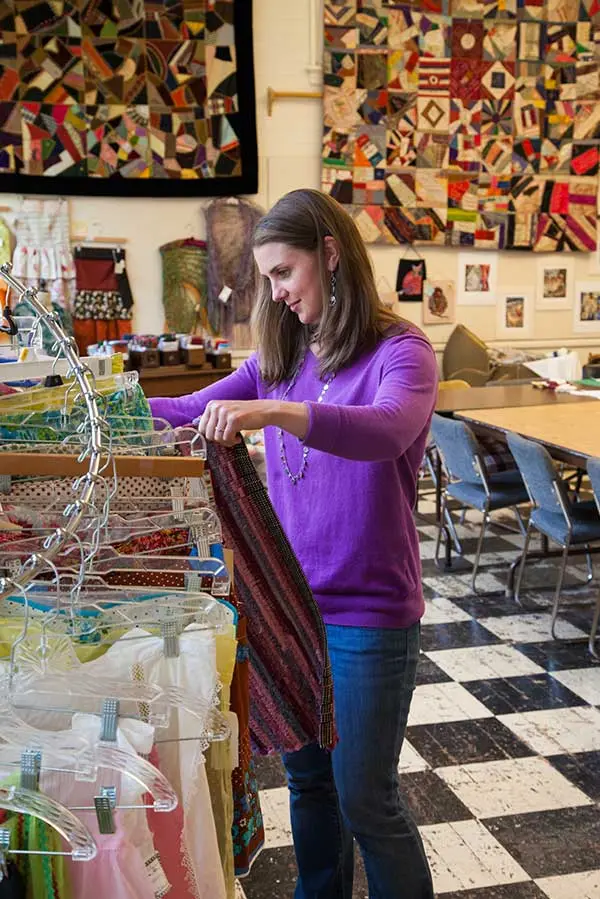
Across the building, the East Room hangs antique quilts from the Latimer Collection beside contemporary and art quilts. One wall is lined with a bank of glass-covered drawers installed in 2001. Each drawer holds a small exhibit of cigar silks, buttons, guild pins and souvenirs, purses, needle keepers, hankies, tatting and hardanger. One quilt here, “At First Light,” came from a 2010–2011 challenge. A photograph of Portland by Dale Archer was divided into six sections, and each section was interpreted by a different maker: Jo Barry, Sally Hopkins, Nancy Harvey, Cheri Jolivette, Meg Shaw and Robin Hill. The room also serves as the meeting hall for member guilds.
The school’s auditorium is now the gallery, with a new exhibit every two months. Through October 31, 2026, it holds the katazome work of Karen Illman Miller, who was for many years a marine biologist at Oregon State University. Katazome uses a paper stencil to lay down a rice-paste resist before the fabric is dyed or painted. Miller was introduced to it in 1994, and her interest in all things Japanese traces to her grandfather, a zoologist who lived and worked in Japan at the turn of the century. La Rayne Woodward’s “Something to Treasure” follows for November and December 2026, with an open house on November 7. That same day the center’s First Saturday stitch-in resumes, a monthly social day when visitors may bring a quilting, spinning or other fiber project and pay no admission.
Behind the stage, where the library moved in 2011, are books, many rare and out of print. The shelves also hold a large collection of quilt patterns, newspaper needlework clippings, and pamphlets on everything from rug hooking to basketry, all for use on site only. The library is closed from October 13 to November 10, 2026, while the books are taken down and the room rearranged. Beginners’ classes under the Textile Discovery Project meet on Saturday mornings: embroidery on October 10, paper piecing with Helene Knott on November 14, and English paper piecing with Kim Schauss on December 12. In 2016, associate manager Gail Grier recalled a teenager from the alternative high school who learned basic sewing here. “He was so excited and said, ‘Now I can wear my pants!’” she said. He ran home at lunch and came back with a torn pair to mend.
Outside, the building carries the first mural of the Tillamook Quilt Trail, painted in 2012 to a design by Breanna Moran. It shows a quilter sewing before an agricultural landscape, bordered by images of Tillamook’s historic creameries.
Turning the beds
Most of the collection lives out of sight in the La Rayne Woodward Quilt Repository, built in 1996. It has conservatorial lighting, hermetic temperature control and acid-free boxes, and its holdings are catalogued in Past Perfect. It holds quilts from the mid-nineteenth century to the present, along with coverlets, clothing, looms and spinning wheels. The Bromleigh and Mary Louise Lamb Collection has quilts of the Hall and Faulders families dating from the mid-1800s to about 1930. A 2016 newspaper account put the oldest items back to the 1700s. Other holdings include crochet of the 1930s and 1940s and hand-woven samples with drafts prepared by Wallace Hickman in the 1950s and 1960s. The repository is visited by appointment, when volunteers are free.
The collection reaches the public mainly through the bed turning, which is arranged in advance. Robert G. Russell described one held for the Tillamook County Historical Society in 2022. The hosts, Carol Weber and Lorraine Woodward (the center’s own pages spell the name La Rayne), led the group down into storage rooms shelved floor to ceiling with bagged quilts. Woodward explained that wool and silk had been frozen to rid them of molds and critters. In the last room stood a single bed. “A bed turning is how we show quilts and tell their stories,” Woodward said, peeling back the top quilt, a crazy quilt that took more than two years to make.
Next came a quilt said to have been made by Rosa Kilchis. A paper with it identified her as the daughter of Chief Kilchis, though the group discussed whether that was accurate. “The story goes that the lines in this piece represent important pathways the tribe used as ways of escape,” Weber said. Over 45 minutes the two showed another 15 or 20 quilts, pieced from late-1800s shirt fabrics, flour sacks and old curtains. Weber, Linda Machuta and La Rayne Woodward later took a bed turning to the “Quilts by the Sea” show in Newport in 2025.
Maple Leaf University
The quilts are kept in what was a country school on James and Permelia Latimer’s homestead. He was born in Missouri in 1841 and she in Indiana in 1843, and they married in Kansas in 1863. When the school began is uncertain. The center believes some form of school existed about 1870. Margaret Frances Elliott is thought to have begun teaching at Wilson River School in 1872 as its first certified teacher. Born in Nashville in 1854, she had crossed the plains to East Portland with her family and came over the Trask River Trail to Tillamook at seventeen. The second teacher, Thomas H. Goyne, arrived in Tillamook in August 1876 by the center’s timeline and family pages. Its Maple Leaf School page gives August 1886, at age 22. He married Daisy Evelyn Latimer in 1888.
In 1892 the Latimers gave a parcel for a school. The deed required that the land return to their heirs when it was no longer used as one. A one-room building was hauled to the site by wagon, and there is some evidence it came from the Buttz place. Goyne described it in 1896 as “a one room building with little furniture, no books, or maps or other equipment.” Around then the name changed from Wilson River School to Latimer School. In March 1899 the Headlight Herald complained that the stove was a fire risk and that children had been “almost smoked out,” asking: “Who is gritty enough to start a subscription on a new stove?”
An L-shaped two-room school followed around 1900, and the center’s timeline gives it the name Maple Leaf. Fire destroyed the old building in 1917. School reopened in one room in 1918, and a three-room schoolhouse was completed in 1920. The accounts of the present building differ. The center’s family page says it went up with two rooms and gained a third near 1930. Its “About Us” page dates the current building to the 1930s. A 2016 newspaper article said the schoolhouse was originally built in the 1880s.
The teachers left the stories. Rose Tilden Anderson, who taught there from 1923 to 1926, recalled that the school board would not buy fire equipment. Then a fire in the basement sent flames up through the wall registers, and the older boys, with no hose or buckets, put it out with water carried in their boots. The purchase was then authorized. The Wilson River flooded the basement often enough to give many unscheduled winter holidays. Rose Schild, who taught twelve first- and second-graders from 1930 to 1934, said the gym was a long walk off on “plain, packed dirt,” so in the rain her pupils “often played around a large, sturdy, raised sand box at the back of the classroom.” In 1939 a WPA project added a stage and auditorium to the northernmost classroom, which had been the primary room.
Harold V. Lewis taught the upper four grades from 1939 to 1941 and served as principal and head janitor. “On my first school teaching job we jokingly called the school ‘Maple Leaf University,’” he wrote. The softball team of boys and girls practiced in a neighbor’s cow pasture, where “very early on in the game everyone learned not to slide in to second base.” He boarded with August and Dorothy Boquist until he married in December 1940. “I didn’t have to do dishes at the Boquist’s,” he recalled.
Forty heirs and a museum employee
The last classes met in 1959, taught by Orella Chadwick, Marie Simmons and Gloria Rickward. The district used the building for storage and repairs until 1985. In 1989 the gymnasium, built in the late 1930s, was so far gone that it was burned. The property reverted under the old deed to more than forty Latimer heirs, none of whom lived in Tillamook County. Thomas W. Goyne, son of the second teacher and Daisy Latimer and once a pupil at the school, gathered deeds from them all. The heirs gave the property to the Tillamook County Pioneer Museum Foundation, in 1985 by the center’s timeline and in 1989 by its other pages.
Clara Fairfield, an employee of the Pioneer Museum, saw a place where fiber artisans could demonstrate, teach and produce their work. The Friends of Latimer Quilt & Textile Center formed in 1991 and opened the building on Memorial Day that year. A memorial dedication on 30 May 1993 honored the Latimers and Fairfield. Half the roof was replaced in 2005 and the other half in 2012. Walls, windows, siding, gutters, heating and the front stairs were redone between 2013 and 2016, and every light in the building was changed to LED in 2026. The center still sits in a flood zone; when the river rises, the closing is posted on the doors. Van Moe, a local broadcaster, said of the old school, once overrun by blackberries and birds, that its supporters “have not disappointed anyone but the birds and the blackberries.”
Notable Events
- 1870Some form of school is believed to have begun approximately 1870; the year is uncertain. latimerquiltandtextile.com
- 1872Margaret Frances Elliott began teaching around 1872 at Wilson River School. latimerquiltandtextile.com
- 1876Thomas H. Goyne, the second teacher, arrived in Tillamook. latimerquiltandtextile.com
- 1886The second teacher was Thomas H. Goyne who arrived in Tillamook in August 1886 (22 yrs old). He later married Daisy Evelyn Latimer in 1888. latimerquiltandtextile.com
- 1892James and Permelia Latimer donated land; a one-room building was hauled to the site. latimerquiltandtextile.com
- 1892The Latimers gave land for a school; the deed required return to family heirs when no longer used as a school. latimerquiltandtextile.com
- 1900An L-shaped two-room structure was built and called Maple Leaf School. latimerquiltandtextile.com
- 1917Fire destroyed the old building. latimerquiltandtextile.com
- 1918School opened with one room. latimerquiltandtextile.com
- 1920The three-room schoolhouse was completed. latimerquiltandtextile.com
- 1920Maple Leaf School was built specifically as a school and opened in 1920. tillamookheadlightherald.com
- 1930sThe stage was added in the late 1930s. latimerquiltandtextile.com
- 1930The present building had two rooms, with a third added near 1930. latimerquiltandtextile.com
- 1930sA new structure with two classrooms and an auditorium was built in the late 1930s. latimerquiltandtextilecom.sites.qwestoffice.net
- 1939The auditorium was added. It was WPA project which added a stage and additional area onto the northern most class room, which had formally been the primary room for the school. latimerquiltandtextile.com
- 1959The current school building, built in the 1930s, became a maintenance repair facility in 1959. latimerquiltandtextile.com
- 1959Due to changing education needs and ideas the school was finally closed. latimerquiltandtextile.com
- 1959The last classes were held in 1959. latimerquiltandtextile.com
- 1985The Latimer heirs donated the land and building to the Tillamook County Pioneer Museum Foundation in memory of James and Permelia Latimer. latimerquiltandtextile.com
- 1985The consolidated school district used the building as a maintenance-repair facility until 1985. latimerquiltandtextile.com
- 1989The school district allowed the property to revert as required by the original deed; the heirs donated it to the Tillamook County Pioneer Museum Foundation in memory of James and Permelia. latimerquiltandtextile.com
- 1989The gymnasium built in the last 1930s was in such bad repair that it was burned. latimerquiltandtextile.com
- 1991In 1991, the Friends of Latimer Quilt & Textile Center was formed and assumed responsibility for the daily operation of the Center. latimerquiltandtextile.com
- 1993The fully restored building was dedicated in memory of the Latimers and in honor of Clara Fairfield. latimerquiltandtextile.com
- 1993The site memorial was dedicated in memory of James and Permelia Latimer. latimerquiltandtextile.com
- 1996The Textile Repository building was completed with the installation of regulation museum storage facilities. latimerquiltandtextile.com
- 1997MAP I, the first phase of the American Association of Museums Assessment Program, was completed. latimerquiltandtextile.com
- 2001A new cabinet with pullout drawers for small-item display was installed. latimerquiltandtextile.com
- 2003A new computer and Past Perfect software were installed in the repository. latimerquiltandtextile.com
- 2004New lighting was installed in the weaving room, quilting room and gift shop area. latimerquiltandtextile.com
- 2005Most of the repository collection was professionally assessed, lighting installed in the library and office, and half the roof replaced. latimerquiltandtextile.com
- 2008New shelving was placed in the West Room and gift shop. latimerquiltandtextile.com
- 2011The library moved to the back of the auditorium stage; shelving expanded storage and separated it from the gallery, creating meeting and workshop space. latimerquiltandtextile.com
- 2012The second half of the roof was replaced. latimerquiltandtextile.com
- 2012The Quilt Trail expanded to murals and selected Latimer for its first mural, designed by Breanna Moran. latimerquiltandtextile.com
- 2013Fundraising began to repair deteriorating walls and windows. latimerquiltandtextile.com
- 2013Latimer joined the Pioneer Museum, Oregon Coast Scenic Railroad, Tillamook Air Museum, Kilchis Point Reserve and Garibaldi Museum to offer A Step Back in Time. tcpm.org
- 2014Exhibit hall walls, east and west room windows, and north walls were replaced; fundraising continued for the south and east main-building walls. latimerquiltandtextile.com
- 2016South and east walls were finished, siding and paint completed, new gutters and HVAC installed, and front entry stairs replaced. latimerquiltandtextile.com
- 2025Interior work was done in the repository because of a roof leak. latimerquiltandtextile.com
- 2026All light fixtures throughout the museum and repository were changed to LED. latimerquiltandtextile.com
People
- Arlene Sachitano, Board member.
- Carol Weber, Board chair.
- Clara Fairfield, Pioneer Museum worker who revived the future textile center with volunteers.
- Kathy Park, Board secretary.
- LaRayne Woodward, Board member.
- Linda Machuta, Presented the center's quilts in a bed turning at the Newport quilt show (2025).
- Marilyn Roossinck, Board member.
- Rhoda DeGiovanni, Board vice president.
- Tamara Yingling, Board member.
- Gloria Rickward, Teacher in school's closing year (1959).
- James Latimer, School land donor with Permelia (1892).
- Margaret Frances Elliott, First certified teacher; believed to have begun teaching at Wilson River School in 1872 (born June 9, 1854).
- Marie Simmons, Teacher (1955-1956).
- Orella Chadwick, Maple Leaf School teacher interviewed for the center's historical video.
- Permelia Latimer, School land donor with James (1892).
- Rose Schild, Teacher of first and second grades (1930-1934).
- Thomas H. Goyne, Second teacher (arrived August 1886).
- Albert Wilson, Teacher for grades five through eight during Margaret Perry Fountain's tenure except her last year.
- Alberta Wilson, Teacher (1929-1937).
- Amanda Tinnerstet Haberlach, Teacher (1909-1910).
- August Boquist, Boarding host for school teacher Harold V. Lewis (until December 22, 1940).
- Birdie Perkins Kerreman, Teacher (1899).
- Daisy Latimer, Married early school teacher Thomas H. Goyne.
- Dorothy Boquist, Boarding host for school teacher Harold V. Lewis (until December 22, 1940).
- Dr. Dyer, Teacher (1899).
- Edith Perkins King, Teacher (1899).
- Elsie Lamb, Teacher (1912).
- Elsie Scovell, Teacher (1906).
- Esther Munson Near, Teacher (1909-1910).
- Evelyn Steidinger, Teacher of third, fourth and fifth grades (1931 (roster)).
- Floyd Culberson, Teacher.
- Frank Pinkstaff, Teacher (1912).
- Frankie Steinbach, Teacher (1920).
- Gladys Aberding, Teacher (1943-1956).
- Gloria Rickard, Teacher (1959).
- Grace McNeil, Teacher.
- Harold V. Lewis, Teacher of upper four grades, principal and head janitor (September 1939 - May 1941).
- LaVern Dahl, Teacher.
- Lelia Doty, Teacher (1920).
- Lillian Buel, Teacher (1916).
- Lillian Keyte Logan, Principal; taught sixth, seventh and eighth grades (1923-1926).
- Lottie Price, Teacher (1905-1907).
- Margaret Perry Fountain, Began teaching at Maple Leaf in fall 1934, grades one through four (1934-1940 (roster)).
- Marguerite Zink, Married school teacher Harold V. Lewis during his Maple Leaf tenure (December 22, 1940).
- Marian Dick, Teacher (1941).
- Marjorie Maxwell, Teacher (1946-1949).
- Mary Roberts Dunn, Teacher (1927-1930).
- Maude Miller Johnson, Teacher (1921).
- Mildred Criswell, Teacher.
- Miss Cherry, Teacher.
- Miss Daggett, Teacher (1917).
- Miss Findley, Teacher (1949-1950).
- Mr. Braley, Teacher.
- Mr. Bryan, Teacher (1912).
- Mrs. Dibble, Teacher (1954-1956).
- Mrs. Erickson, Teacher.
- Mrs. Hall, Teacher (1928).
- Mrs. Harriett Ford, Teacher (1912).
- Mrs. Myers, Teacher (1902).
- Mrs. Robbins, Teacher (1928).
- Mrs. Rose Clawson, Teacher (1929).
- Mrs. Tinnerstet Burge, Teacher (1912).
- Mrs. Wingarer, Teacher.
- Myrtle Fletcher, Teacher (1954-1956).
- Orda Hammer, Teacher (1946-1947).
- Otta Biggs, Teacher (1945-1946).
- Retta Boquist, Teacher (1925).
- Rose Tilden Anderson, Teacher of third, fourth and fifth grades (1923-1926).
- Sylvia Rowe Hoskins, Teacher (1916, 1944-1945).
- Thomas W. Goyne, Son of Thomas H. Goyne and Daisy Evelyn Latimer; instrumental in obtaining deeds from all Latimer heirs for the museum foundation.
- Tom Goyne, Grandson whose efforts secured heirs' donation of the property to the museum foundation.
- Velda Williams Dahl, Teacher.
- Breanna Moran, Designer of the Quilt Trail's first mural at Latimer (2012).
- Bromleigh, Name attached to the Bromleigh and Mary Louise Lamb Quilt Collection.
- Ella Hall Smithson, Quilts from this person are held in the Lamb collection.
- La Rayne Woodward, Presented quilts at the Newport quilt show; name attached to the center's quilt repository (2025).
- Marjorie Green, Name attached to a collection of weaving samples and reference material.
- Mary Eliza Faulders, Quilts from this person are held in the Lamb collection.
- Mary Louise Lamb, Name attached to the Bromleigh and Mary Louise Lamb Quilt Collection.
- Wallace Hickman, Prepared drafts for hand-woven samples held in the Hickman Collection (1950s and 1960s).
- Daisy Evelyn Latimer, Married the school's second teacher, Thomas H. Goyne (12 October 1872 - 9 May 1937; married 1888).
- James William Latimer, Donor of homestead land for the school with Permelia (December 20, 1841 - October 22, 1904).
- Permelia Anna (Jenkins) Latimer, Donor of school land with James (October 8, 1843 - April 16, 1920).
- Thomas Henry Goyne, Second Wilson River School teacher; married Daisy Evelyn Latimer (13 October 1864 - 4 August 1944; arrived August 1876; married 1888).
- Chief Kilchis, Identified on a quilt's accompanying paper as Rosa's father, although the account says there was discussion about whether that was accurate.
- Lorraine Woodward, Long-involved Latimer host and quilt interpreter at the historical society's bed turning (many years).
- Rosa Kilchis, Said to have made a displayed quilt; accompanying paper identifies her as Chief Kilchis's daughter, an identification the group discussed as uncertain.
- Gail Grier, Latimer associate manager.
- Marilyn Anderson, Latimer volunteer and weaving instructor (with the center since its beginning in 1991).
- Sofie Skein-Hall, Latimer weaving student; owner of Bonjour Poupette in Garibaldi.
- Kim Schauss, Center manager.
- Barbara Trout, KTIL narrator of the historical video about the center's creation.
- Candy Allen, Knitter and brand-new weaver learning a plain-weave sampler from Medsker.
- Carole Reichert, Tillamook spinner who helps others with projects at the center.
- Denise Clausen, Textile artist interviewed for the center's historical video.
- Jo Stoltenberg, Textile artist interviewed for the center's historical video.
- Jon Rodriguez, Flight attendant who brings knitting projects to the center on his days off.
- Laurie Olmsted, Center manager.
- Shirley Medsker, Textile artist interviewed for the historical video.
- Susan Trout, Textile artist whose conversation at the county fair led Rodriguez to the center.
Sources
- latimerquiltandtextile.com
- latimerquiltandtextile.com/hours-contact-information
- latimerquiltandtextile.com/history
- latimerquiltandtextile.com/about-us--12c3c00c-2f24-46da-bd77-b8ebbdb0abf3
- latimerquiltandtextile.com/the-latimer-family
- latimerquiltandtextile.com/maple-leaf-school
- tillamookheadlightherald.com/news/history-woven-into-textile-center/article_49af59cf-315e-5939-943d-2222a2efa6a8.html