Trask River Hatchery
Tillamook, Tillamook County, Oregon. Hatchery; Fall and early winter.
Details

- Where
- 15020 Chance Road, Tillamook, OR 15020. Directions
- When
- 7:30 a.m. - 4:30 p.m. daily.
- Getting there
- From Tillamook, east on Hwy 6 2.5 miles to Olson Road, south onto Olson Rd 1/2 mile to the 3rd Street intersection, continue south onto Trask River Rd 1.5 miles to Johnson Bridge, across onto Long Prairie Rd 1/2 mile to Chance Rd, then east on Chance Rd 2.5 miles to the hatchery.
- Access
- Access road closed to unauthorized vehicles due to recent slide activity; all visitors and anglers must park outside the gate until further notice (notice updated 1/13/26); call with questions.
- Walk-in or reserve
- Group tours are available with advance arrangements.
- Phone
- (503) 842-4090
- Website
- myodfw.com
- Managed by
- Oregon Department of Fish and Wildlife.
- Established
- 1916.
Chance Road runs east from Long Prairie Road for two and a half miles and ends at the Trask River Hatchery, 19 acres on the Trask about eight miles east of Tillamook and some 100 feet above sea level. Since a slide, the access road has been closed to unauthorized vehicles. A notice the Oregon Department of Fish and Wildlife updated January 13, 2026, asks visitors and anglers to park outside the gate and walk in. Beyond the gate are concrete raceways and holding ponds, an early rearing building, a 40-by-60-foot pole building, and a hatch house finished in 2022 with offices, a conference room and two apartments.
The water in the ponds comes from Gold Creek and Mary’s Creek: nine cubic feet per second from the first and one from the second. In fall the department rates the adult salmon viewing as excellent, both in the river below the hatchery and in Gold Creek itself. Fall Chinook reach the hatchery from August through January and spawn most heavily in late November. Hatchery coho are trapped from late September into early November, and wild coho arrive from October through December. Spring Chinook come earlier, from late April through September. Outdoor signs explain the grounds, and group tours are given by arrangement. The department lists birds of prey, wading birds, waterfowl and songbirds among the wildlife, and a camp host and a restroom among the facilities.
Ten eggs, ten fathers
The 2023 management plan staffs the hatchery with three full-time employees. It rears fall and spring Chinook, coho, and winter steelhead from wild Wilson River stock, all for harvest by sport, commercial and tribal fishers. Surplus adults go to the food bank or into streams for enrichment. After the 2020 wildfires damaged the hatch house at Klamath Hatchery, Trask also took on 400,000 rainbow trout for Klamath, which it incubates until the fry are large enough to truck south. Since 2013, unmarked spring Chinook have gone into the broodstock in about the same proportion as they enter the trap.
In 2007 Craig Maddox, a Fish and Wildlife Tech 1, described the salmon work to the Tillamook Headlight Herald. Eggs were taken from 10 females at a time, mixed, and divided into 10 “family groups,” and each group was fertilized by a single male. The eggs stayed in incubator trays for about 130 days, until the egg sacs were nearly gone. The fry then moved to Canadian troughs until their bellies closed and they took feed. They were fin-clipped at 250 fish to the pound, and some were fitted with coded-wire tags. Steelhead were handled differently. They were live-trapped, spawned and turned back to the river, and most of their young went out as wild stock. Of those young, 10,000 “will get fin-clipped to be hatchery fish, and that’s what the anglers can catch,” Maddox said. That year the hatchery invited visitors to watch winter steelhead collection and spawning at 8:30 a.m. on Tuesdays in March and April, asking that they call first.
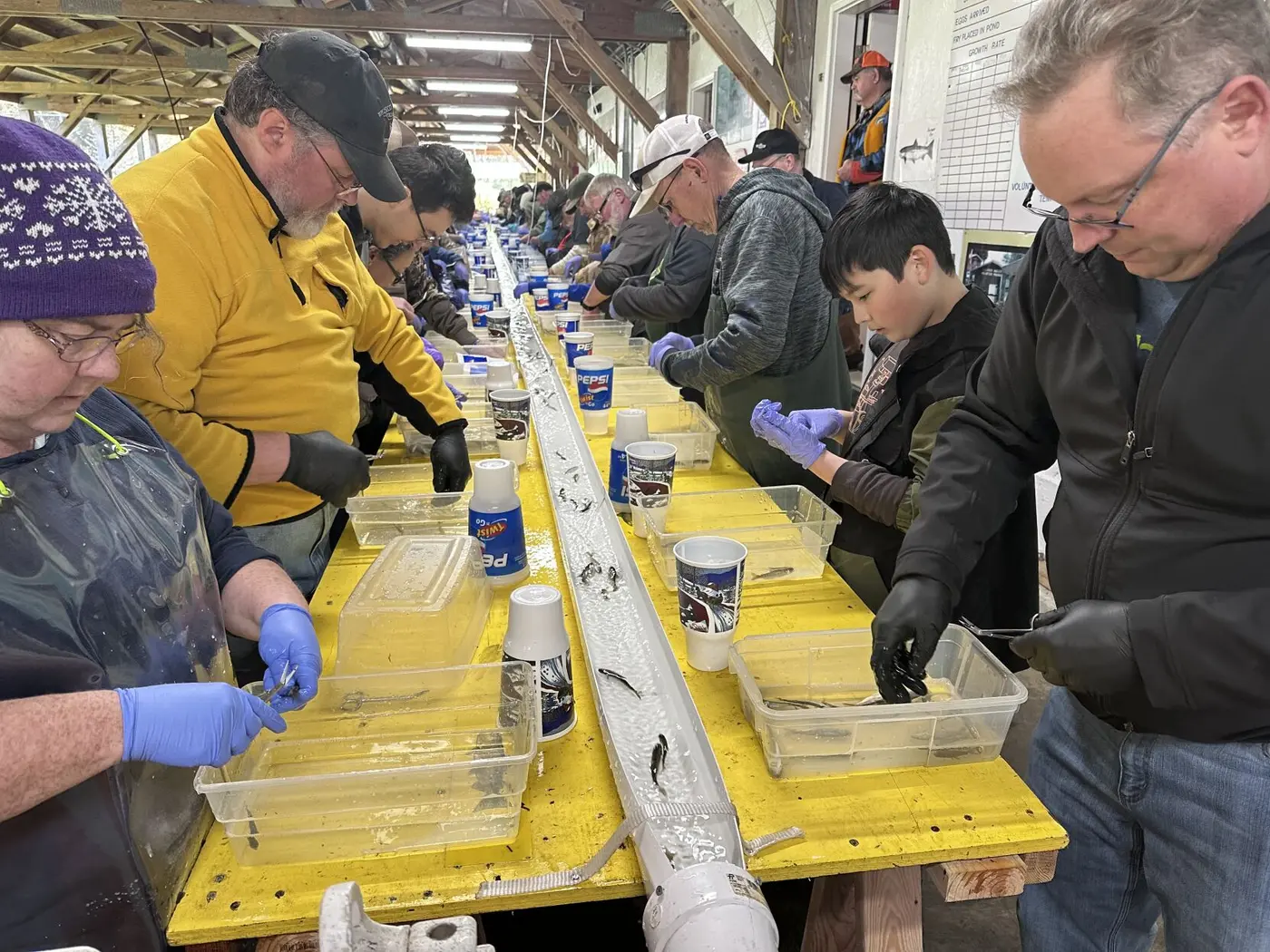
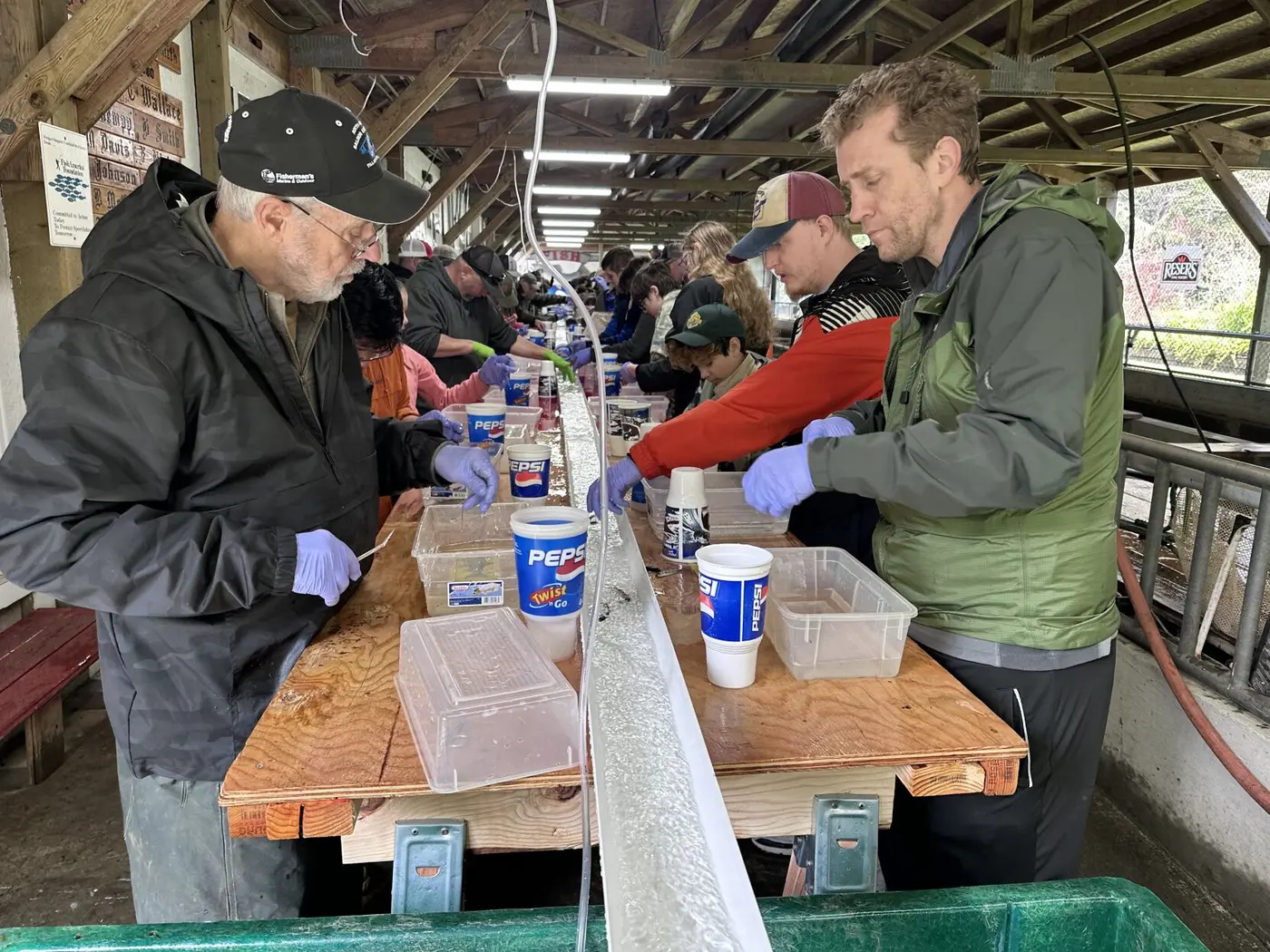
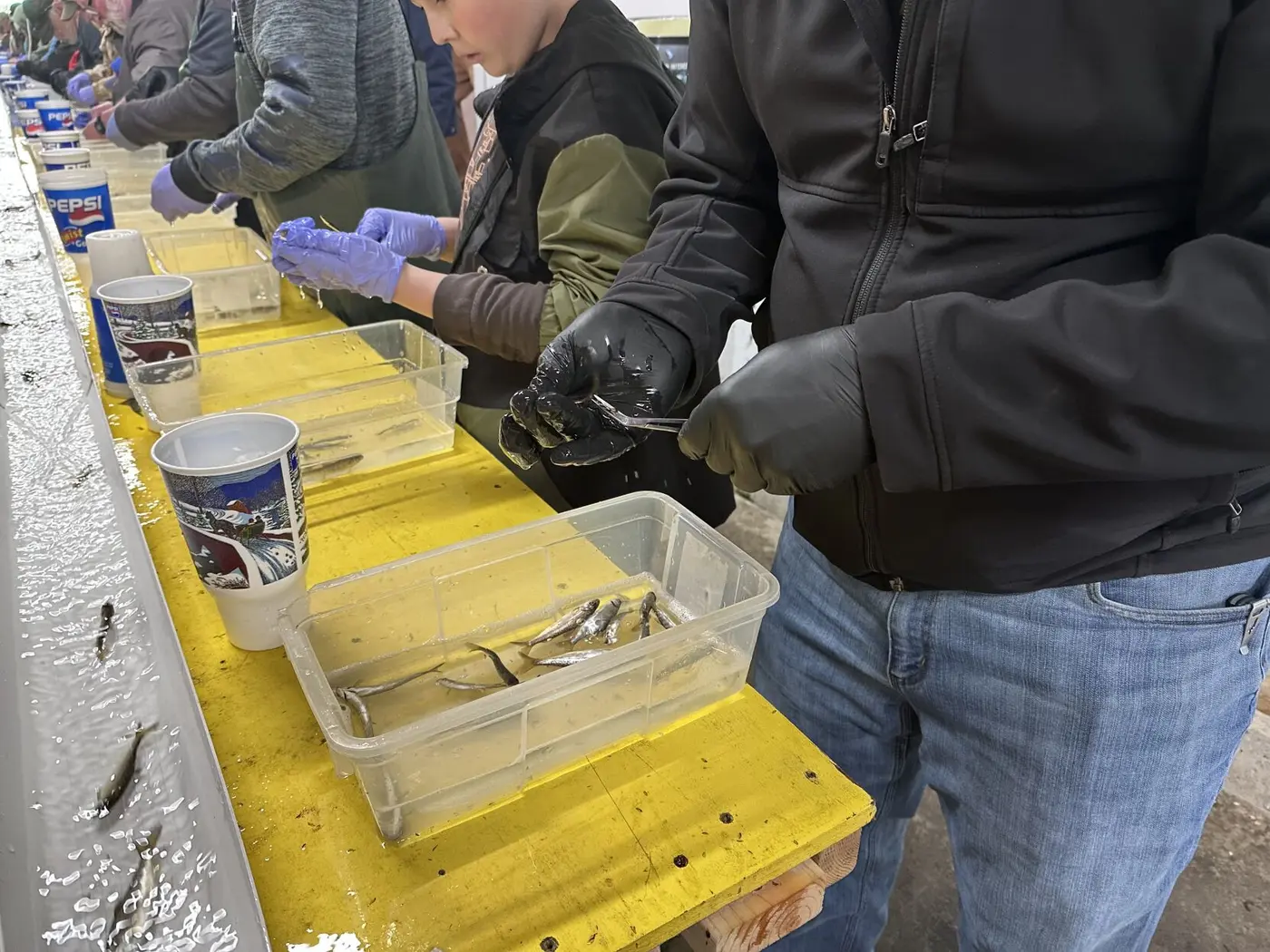
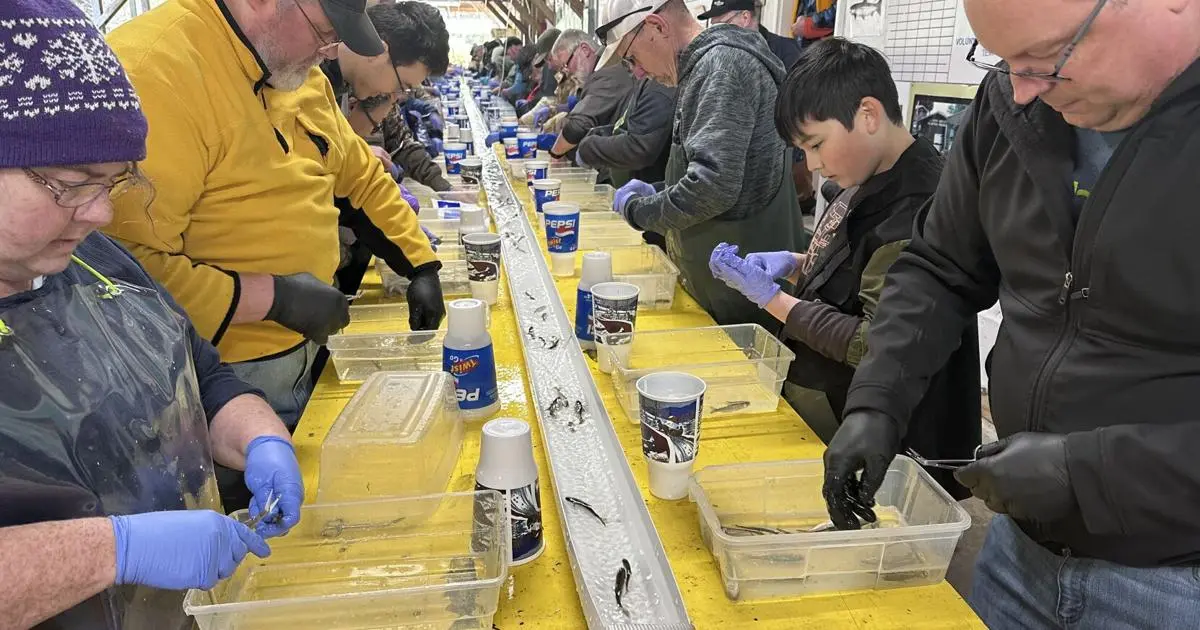
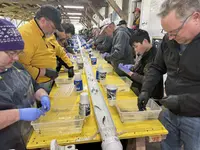
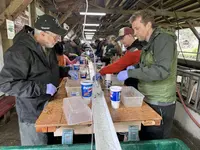
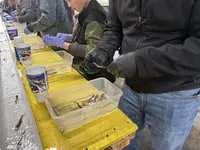
Some of the spring Chinook eggs leave as soon as they show eyes. Jim Skaar, president of the Tillamook Anglers, told the Headlight Herald in 2025 that 100,000 of the 400,000 spring Chinook raised at Trask each year go to the anglers’ Whiskey Creek Fish Hatchery on Netarts Bay. On April 12, 2025, between 250 and 300 volunteers clipped about 100,000 adipose fins there, ahead of a July release into the Trask. “That’s our future,” Skaar said. “The kids that are doing this, someday they’re going to catch these fish.”
A seine at Trask Pond
Trask Pond sits on the East Fork of the South Fork Trask, sixteen miles east of Tillamook near Trask River County Park. It was built in 1970 around a rearing pond 225 feet long. The Headlight Herald recorded a release there in March 2007. A cool mist hung in the evergreens around the pond and the water had been drawn down. Dave Tornado and Steve Warner stood in the water with a seine, and three technicians pulled it into position to herd the smolts toward the loading area. Jim Skaar, who was supervising, called the conditions nearly ideal for “liberating” fish. Each load of 20,000 spring Chinook was pumped up through a column of water, “dewatered,” and sent down a tube into a tanker truck. That day’s fish went to the Sollie Smith boat ramp on the Wilson and the U.S. 101 boat ramp on the Trask. Some 185,000 were released over two days.
A second satellite, Tuffy Creek, was built in 1988 at the South Fork Wilson River Forest Camp, about 22 miles east of Tillamook, and is operated with the Oregon Department of Corrections. Steelhead trapped there are trucked to Trask to be held until spawning. The 2023 plan names Tuffy Creek as the hatchery’s only satellite.
The Grimes hatchery on Gold Creek
The paper’s account in 2007 placed the hatchery’s start in the salmon trade. The first cannery on the Columbia opened in 1866, and demand soon threatened the runs. “Conventional wisdom” held that artificial propagation could assure abundant harvests “thereby eliminating the need for pesky catch limits.” Oregon’s first hatchery opened on the Clackamas in 1877. The Oregon Historical Society adds that hatcheries spread along the coast “trumpeted by unsubstantiated claims of success.”
According to Maddox, the Grimes family began raising salmon in the 1870s. About 1900 they built a hatchery on Gold Creek, about three miles upstream from the present site, with a fish-catching cage and weirs that steered returning salmon into a trap. There the fish were killed and stripped of eggs and milt. Maddox named the people who worked it: Will Grimes; supervisor John Sprague; Charley, Ernie, Jim, Henry, Cara and Elmer Himes; John and Jim Carpenter; Alvin Wells; Jurd Morris; and Louie Wilks.
In 1914 Grimes leased his five-acre site and hatchery to the State of Oregon. A photograph in the Oregon Historical Society collection, dated about 1914, shows a fish collecting cage and rack built across the Trask that year for a state hatchery project. The society explains the arrangement: a wooden rack across the stream stopped the spawning adults, and an opening in it led them into the cage, sometimes called a “fish box,” where they waited for hatchery staff to take their eggs and sperm. That November the Oregon Fish Commission acquired parcels conveyed by L.H. Wang and others, about three miles downstream from the Grimes property. In 1916 the new Trask Hatchery opened there, at the foot of the creek the Grimes family had worked, and the coho trap at the hatchery still bears the name Gold Creek.
Notable Events
- 1870sCraig Maddox said the Grimes family started doing fish culture for salmon during the 1870s. tillamookheadlightherald.com
- 1900The Grimes family built and opened a hatchery on Gold Creek, about 3 miles upstream from today's Trask Hatchery. tillamookheadlightherald.com
- 1914A fish collecting cage and rack were built across the Trask River in Tillamook County, Oregon, as part of a state fish hatchery project. oregonhistoryproject.org
- 1914Grimes leased his five-acre Gold Creek site and hatchery to the State of Oregon. tillamookheadlightherald.com
- 1914The Oregon Fish Commission acquired parcels conveyed by L.H. Wang and others about 3 miles downstream from the Grimes property. tillamookheadlightherald.com
- 1916Trask River Hatchery was constructed to replace an earlier hatchery three miles upstream. dfw.state.or.us
- 1970Trask Pond was constructed; the plan also anticipated a new dialer alarm system. digitalcollections.library.oregon.gov
- 1988The Tuffy Creek facility was constructed. dfw.state.or.us
- 2013Beginning in 2013, unmarked adults have been used for broodstock in approximately the same proportion they have entered the hatchery trap. dfw.state.or.us
- 2019The release reports ongoing construction of a new hatch house and office building, with grounds closed until further notice for safety and contractor access. dfw.state.or.us
- 2022Construction was completed on a new hatch house with offices, conference room and two apartments. dfw.state.or.us
People
- Alvin Wells, Active in the early hatchery, according to Maddox.
- Cara Himes, Active in the early hatchery, according to Maddox.
- Charley Himes, Active in the early hatchery, according to Maddox.
- Craig Maddox, Fish and Wildlife Tech 1; source of the article's early hatchery history.
- Dave Tornado, Hatchery worker preparing the seine to herd fish to the collection point.
- Elmer Himes, Active in the early hatchery, according to Maddox.
- Ernie Himes, Active in the early hatchery, according to Maddox.
- Henry Himes, Active in the early hatchery, according to Maddox.
- Jim Carpenter, Active in the early hatchery, according to Maddox.
- Jim Himes, Active in the early hatchery, according to Maddox.
- Jim Skaar, Supervising the day's fish release.
- John Carpenter, Active in the early hatchery, according to Maddox.
- John Sprague, Early hatchery supervisor, according to Maddox.
- Jurd Morris, Active in the early hatchery, according to Maddox.
- L.H. Wang, Conveyed parcels acquired by the Oregon Fish Commission downstream from the Grimes property (November 1914).
- Louie Wilks, Active in the early hatchery, according to Maddox.
- Steve Warner, Hatchery worker preparing the seine to herd fish to the collection point.
- Will Grimes, Active in the early Gold Creek Hatchery, according to Maddox (1914).
Sources
- oregonhistoryproject.org/articles/historical-records/fish-catching-cage-trask-river
- digitalcollections.library.oregon.gov/assets/displaypdf/226539
- tillamookheadlightherald.com/news/trask-hatchery-closure-continues-while-construction-proceeds/article_296f9e5c-4ddd-11ea-ada2-27f3d3ad48fd.html
- dfw.state.or.us/news/2020/02_feb/021220b.asp
- myodfw.com/trask-river-hatchery-visitors-guide
- tillamookheadlightherald.com/news/hatching-history-on-the-trask/article_0205c7a4-71cd-539b-a145-0675545f01fd.html
- dfw.state.or.us/fish/HGMP/docs/2023/Trask%20River%20HPMP%202023.pdf