Sunset Springs Fountain
Sunset (on Hwy 26 near Seaside), Clatsop County, Oregon. Roadside spring.
Details

- Where
- Sunset (on Hwy 26 near Seaside), Clatsop County, OR. No street address stated. Directions
- Getting there
- On U.S. 26 near milepost 28, just outside the Sunset Rest Area, with one fountain on each side of the highway.
- Access
- Very small parking lot along the Highway 26 westbound shoulder; if the lot is full, do not stop as it is not safe, per the Oregon Travel Information Council.
- Phone
- 877-527-6560
- Website
- oregontic.com
- Managed by
- Owned by the Oregon Department of Transportation and maintained by the Travel Information Council.
- Established
- 1925.
- Coordinates
- 45.7880555555556, -123.44625.
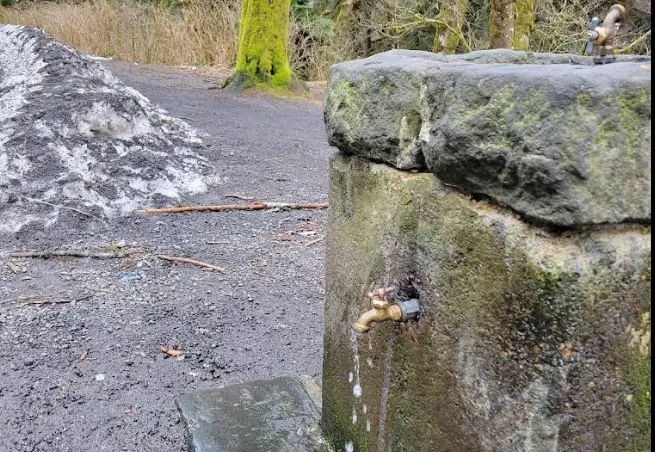
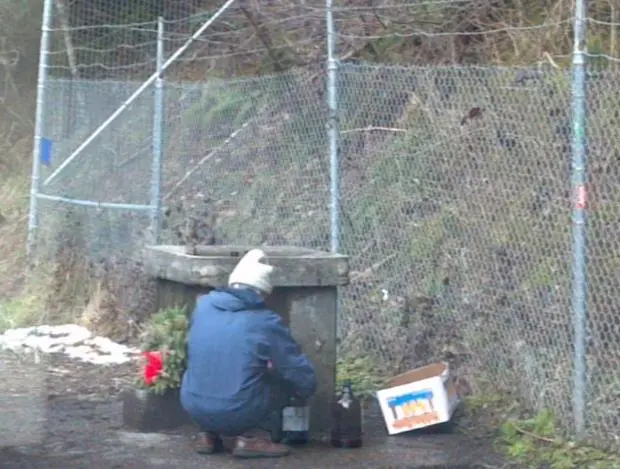
At milepost 28 on U.S. 26, just outside the Sunset Rest Area, a square block of worn concrete stands at the edge of the shoulder. Water runs from its side without stopping. A second block stands across the highway. Signs read “drinking fountain,” and mossy forest rises behind both. The Oregonian put the spot at about 29 miles from Seaside in 2014; KXL radio placed it about 31 miles short of the Oregon Coast. “On many days,” Oregon Department of Transportation spokesperson Mindy McCartt told the Salem Statesman Journal in 2026, “it’s not unusual to see four or five vehicles lined up on each side of the highway with people filling containers with spring water.”
A spring above milepost 28
The water comes from the hills of the Clatsop State Forest above the road. A gravity-fed system taps the groundwater there, and the spring can be seen cascading down the hillside toward the fountains. KXL describes the water as cleaned by mother nature with the help of basalt. The U.S. Geological Survey lists the source as Sunset Spring at Hwy 26, in Clatsop County, at an altitude of 1,537 feet in the Nehalem subbasin. On March 27, 2017, the survey took a single sample there and recorded the water’s temperature and specific conductance.
ODOT owns the fountains. The Oregon Travel Information Council maintains them and runs the rest area’s buildings, landscaping and restrooms. ODOT tests the water every quarter, and according to McCartt it has never failed a test. Mac Land of the Travel Information Council told KXL that the water now comes out of a regular faucet set in concrete walls. A very small lot lies along the westbound shoulder. If the lot is full, Land said, drivers should not stop, because it is not safe.
Nineteen five-gallon containers
Tammy and Larry Norton drive up from Albany every month or so and have done so for seven years. They bring 19 five-gallon containers and take home nearly 100 gallons, which lasts them about a month and a half. “It’s amazing,” Tammy said. “It’s probably the best water I’ve had.” Larry put it this way: “It’s the best water there is.”
Israel Adedipe brings his family from Portland about once every two months and fills about 50 one-gallon containers. He was there on a sunny April afternoon in 2026 and had been coming for two years. “When it’s cold, it’s like really fresh, crisp,” he said. “There’s no taste to it. It’s not like tap water where you have a little chlorine or whatever.”
Michelle Vance, also of Portland, bought seven-gallon jugs for the trip. “It was a few years ago someone recommended it to me,” she said, “and then I started seeing people with huge containers filling up for their farms or livestock.”
David McDaniels and his wife, Mahra, fill seven-gallon jugs too, roughly 45 to 50 gallons a visit, enough for about a month of drinking and cooking. They keep reusable bottles of it cold in a small outdoor refrigerator. “We’ve been here for 25 years,” McDaniels said. “Every time I drove by, I’d see people lined up and never thought about it. Then we finally tried it.” He gave up tap water more than a year before he spoke to the paper. Of the regulars, he said: “It’s like a religion. Spring water people.”
Dark gray stone, about 1925
The fountains have stood in some form since about 1925, according to a 2018 survey of Oregon’s historic masonry roadside fountains written by Lys M. Opp-Beckman for the University of Oregon’s Historic Preservation Program. Her inventory dates both the eastbound and the westbound fountain to about 1925. Each has a square plan with a basin at the top. Both were built of local dark gray stone, roughly hewn into square blocks and laid with very thin recessed mortar joints.
The Sunset fountains belonged to a statewide network. The report counts at least 42 spring-fed drinking fountains erected along Oregon’s highways since 1916. A period account of the fountains as a class says the State highway department’s regular maintenance crews built most of them, and contractors’ crews built some. At each spring the builders set a small reservoir of concrete or cement rubble masonry, and a pipe ran from it to a fountain of native rock. Some fountains were hand-faced stone. Others were rubble masonry made of boulders or large gravel. A 1930 publication of the U.S. Department of Agriculture, quoted by the Statesman Journal, set out the rules: “The water used is from live springs and is tested by the State to ascertain its suitability for drinking before the erection of a fountain. Signs are placed about 300 feet each side of the fountains, calling attention to drinking water ahead, and at the fountains themselves ample parking space is provided so that cars may be parked off the highway.”
ODOT asked for the survey after 2015, when a car struck and demolished another of the old fountains, one that happened to be connected to a First Nations ceremonial spring. The agency then realized it knew little about how many fountains there were, where they stood, or who cared for them. On December 18, 2017, the survey recorded both U.S. 26 fountains as heavily trafficked and poorly patched with concrete. Almost none of the original stone was visible.
Milk bottles and a Datsun 510
In 2014 the Oregonian columnist Tom Hallman Jr. asked his readers why people stopped at the fountains day and night, some of them filling as many as 20 jugs. Bob Stern remembered the place from beach trips in the early 1960s. “Used to be a true state wayside, the water wasn’t the only attraction – but the state moved that way down the road,” he wrote. “Every trip to the coast with family, we would stop and fill milk bottles (yes, glass milk bottles) on the way back to the valley.” His California relatives could not believe the state was not selling the water. More than once, Stern wrote, he used it to cool a hot-running engine.
Vic Blaine had a similar story. “Years ago that drinking fountain quenched my overheating Datsun 510 and saved me a long walk back to Beaverton. Fountain of youth? Who knows? I did get a couple more years out of it.”
Nate Sandel wrote that his wife used to “get annoyed with me stopping there every time we would go to Portland...until she tasted the cold perfection!” Another reader wrote that his wife’s family drew their drinking water at the fountains because their well water was heavy with sulfur. Mark Baker sent in the 1930 Department of Agriculture publication, titled “Drinking Fountains Along Oregon Highways.”
ODOT spokesman Lew Torres confirmed that pipes connect the fountains to a natural spring. “It’s been there for decades,” he said. “I can’t tell you when it was installed. I’m no expert on water, but it’s good. I don’t care if it is August and the temperature is 90, that water is ice cold.”
Notable Events
- 1925The newspaper says the drinking fountain has existed in some form since 1925, attributing that statement to the preservation report. aol.com
- 1925The inventory dates the eastbound Sunset Springs fountain to ca. 1925 and describes a square plan with a basin at the top. scholarsbank.uoregon.edu
- 2017The two US 26 fountains were documented as heavily trafficked and poorly patched with concrete, with almost none of the original stone visible. scholarsbank.uoregon.edu
People
- David McDaniels, Visitor who fills jugs with his wife Mahra after years of seeing people stop at the spring.
- Israel Adedipe, Portland visitor who travels to the spring with his family.
- Larry Norton, Albany visitor who travels with Tammy to the spring roughly monthly to fill up (the past seven years).
- Lys M. Opp-Beckman, Author of a report on the fountain for the Historic Preservation Program and the University of Oregon (2018).
- Mahra, David McDaniels's wife, filling jugs with him at the spring.
- Michelle Vance, Portland visitor who purchased jugs specifically for trips to the fountain.
- Mindy McCartt, ODOT spokesperson who reported the spring water's testing history.
- Tammy Norton, Albany visitor who travels with Larry to the spring roughly monthly to fill up (the past seven years).
- Mac Land, Oregon Travel Information Council representative who described the fountain's long use and regular water testing.
- Bob Stern, Remembered the fountains from trips to the beach (early 1960s).
- Lew Torres, ODOT spokesman who described the fountains' connection to the natural spring.
- Nate Sandel, Visitor who stopped after wondering about the drinking fountain.
- Vic Blaine, Recalled using the fountain water to quench his overheating Datsun.
Sources
- oregontic.com/for-businesses/rest-areas
- aol.com/articles/did-know-theres-secret-mountain-120124000.html
- kxl.com/sunset-spring-fountain-continues-to-flow-with-fresh-clean-drinking-water
- statelibraryeclips.wordpress.com/2026/05/20/from-hillside-to-waterbottles
- web.archive.org/web/20160909141038id_/http://www.oregonlive.com/pacific-northwest-news/index.ssf/2014/04/the_history_of_the_drinking_fo.html
- waterdata.usgs.gov/monitoring-location/USGS-454717123264701
- usatoday.com/story/news/local/oregon/2026/05/20/oregon-coast-highway-26-fountain/89787129007
- scholarsbank.uoregon.edu/server/api/core/bitstreams/31cc4384-d8d8-43ad-b005-dfffe8c5b59b/content
- carsandracingstuff.com/library/p/publicroads011-02.pdf