
Robin Hood Festival
Sherwood, Washington County, Oregon. Summer Festival.
Details

- Where
- 22560 SW Pine Street, Sherwood, OR 22560. Directions
- When
- Last held July 17–18, 2026; next year’s date not yet stated.
- Season
- Annual summer festival on the third weekend of July.
- Getting there
- Parade starts at Langer's Entertainment Center, turns west onto SW Century Boulevard, then onto Sherwood Boulevard and into town along Pine and First Streets.
- Fees
- FREE.
- Hours
- Friday 5pm-10pm, Saturday 9am-10pm.
- Access
- Castle contest drop-off at Veterans’ Memorial Park Saturday July 18th, 7 AM to 9 AM; no pre-registration required.
- Phone
- (503) 625-4233
- Website
- robinhoodfestival.org
- Managed by
- Sherwood Robin Hood Festival Association.
- Established
- 1954.
Knighthood at Veterans’ Memorial Park
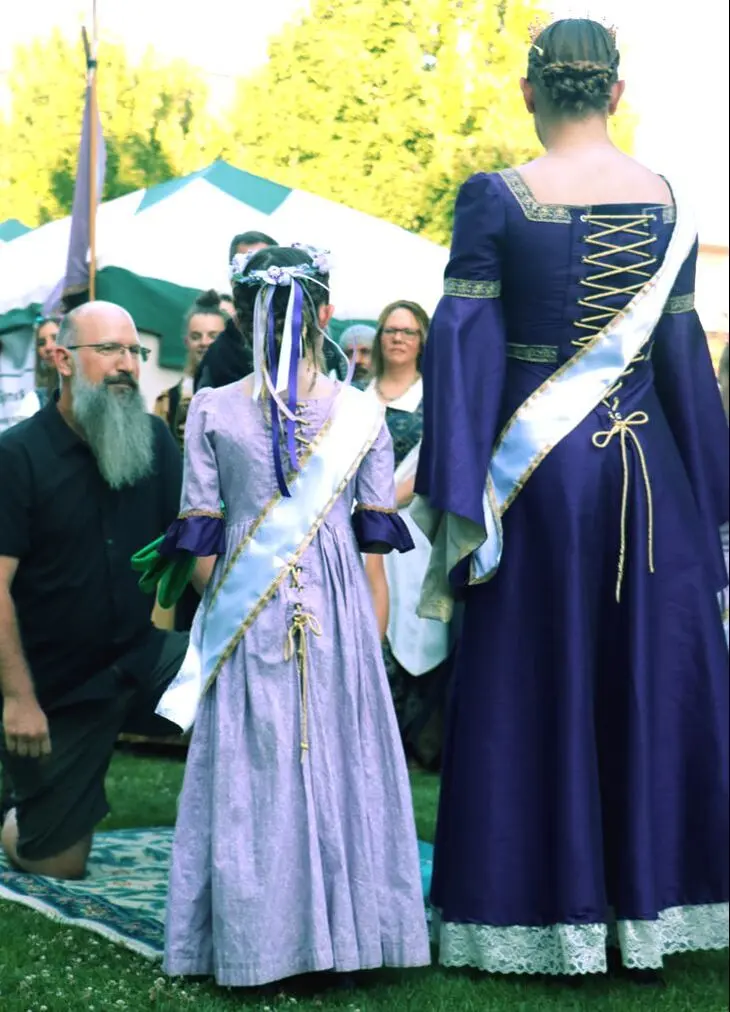
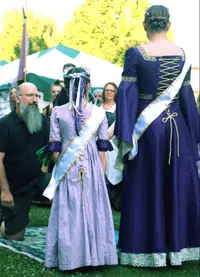
The Sherwood Robin Hood Festival opens at six o’clock on a Friday evening on the Family Stage in Veterans’ Memorial Park, at SW 1st and Main Streets in Old Town Sherwood. There Maid Marian knights residents of the Sherwood area for their community service and gives each the title “Sir” or “Lady.” Robin Hood and his Merry Men attend her, along with costumed villagers and the Sherwood Renaissance Singers, who sing for a quarter hour before the ceremony begins. The ceremony also names the winner of the Hidden Medallion Hunt, and the Mayor of Sherwood then pronounces the festival open.
The festival fills the streets around Sherwood City Hall, 22560 SW Pine Street, in a town southwest of Portland on Highway 99W. The 2026 festival was the 73rd. It ran Friday and Saturday, July 17 and 18, under the theme “Robin Hood Festival, The People’s Choice.” Admission is free. The festival association’s own site puts the summer crowd at nearly 20,000.
The knighting itself is younger than the festival. In 2014 the festival association’s publicist, Susan Danz, counted that year’s ceremony as the 26th and its 15 honorees as joining more than 350 people knighted since the tradition began. The association’s site now gives more than 450 individuals over more than 35 years. Ray Pitz, who covers Sherwood for The Times, was among them. He wrote that he was knighted by the 2012 Maid Marian, “sword placed on both shoulders and me on one knee.” His son refused to call him “sir,” and when he was older he said he wished the honor had come with royal property holdings.
Saturday on Pine and First
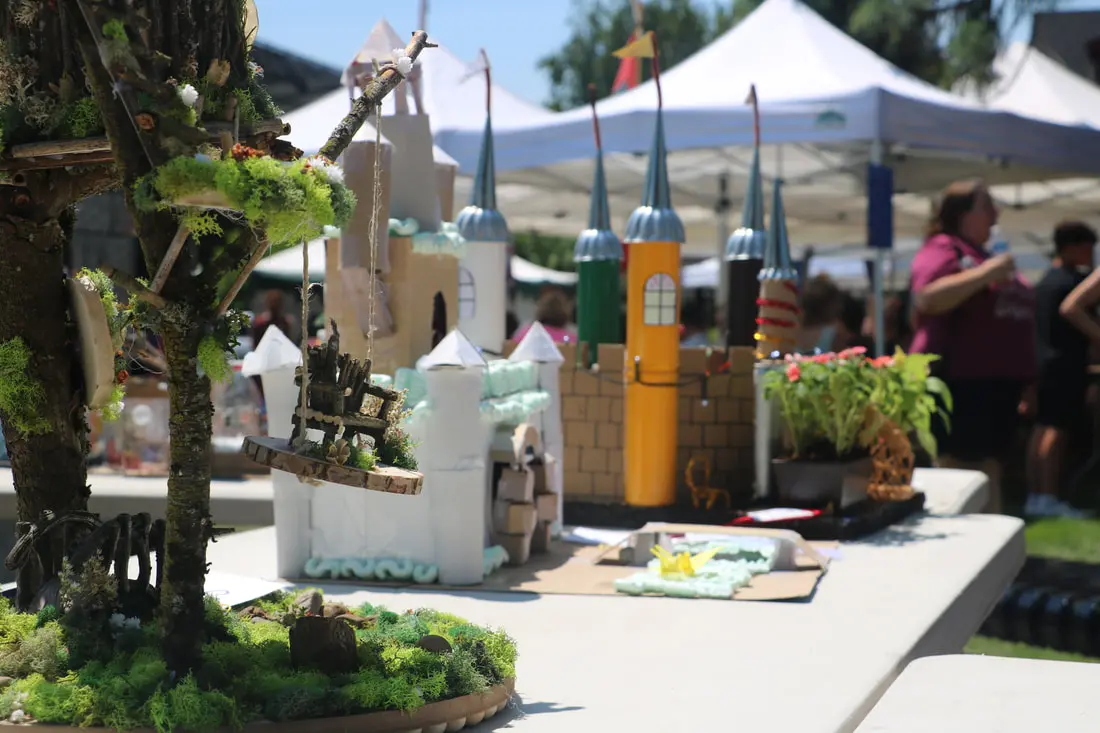
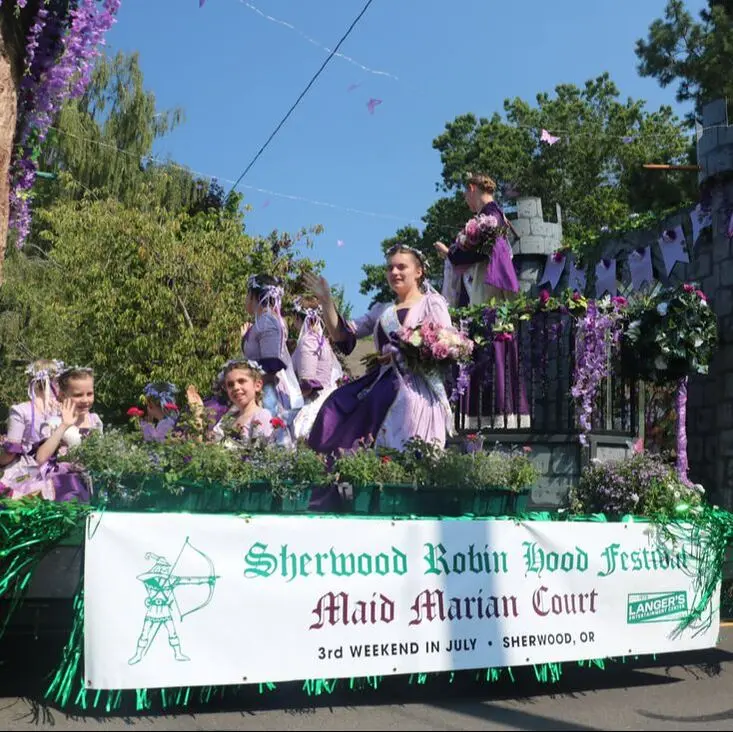
Saturday’s program begins before the crowd arrives. From 7 to 9 a.m., residents carry castles into Veterans’ Park for the Castle Building Contest. Each castle stands on a base no larger than 18 inches square and may rise as high as its builder can make it stand. Past entries have been built of checkers, dog biscuits, Monopoly money, cotton balls, seashells, playing cards, and Legos. Chocolate, crayons, and marshmallows are discouraged because they soften in the heat. The castles are judged after the parade and stay on display through the day. In the afternoon the Maid Marian Court announces the winners from the Family Stage.
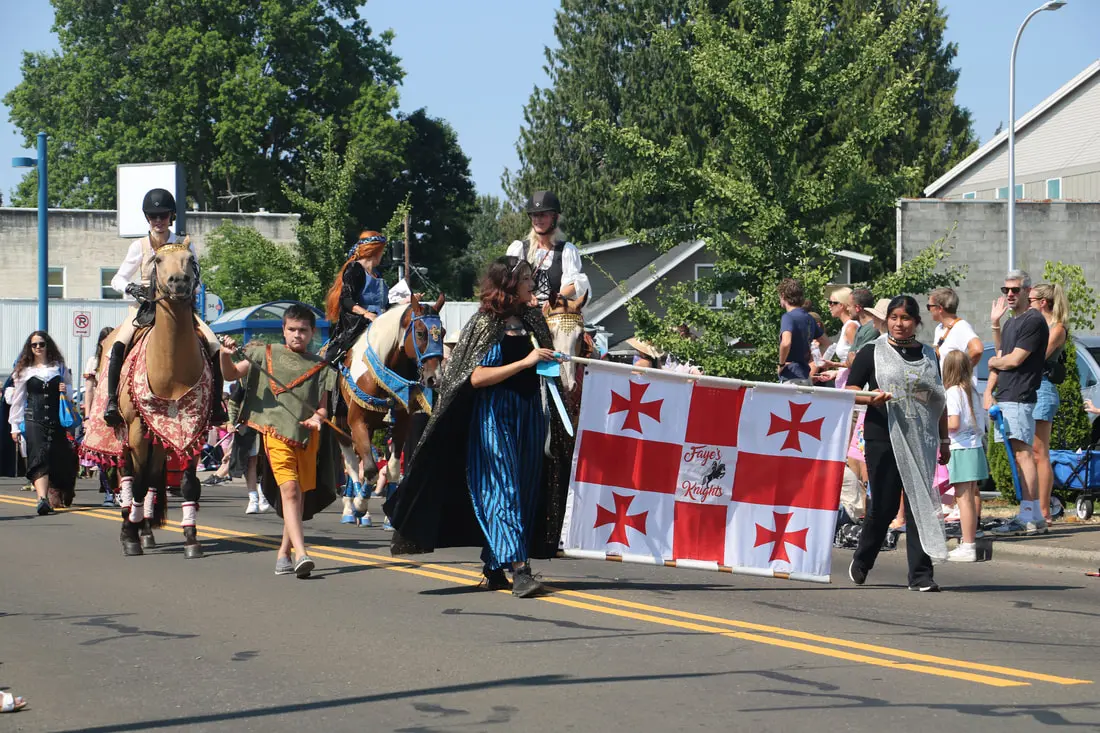
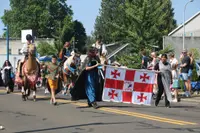
The parade steps off at 10 a.m. from Langer’s Entertainment Center, the festival’s title sponsor. It turns west onto SW Century Boulevard, then onto Sherwood Boulevard, and comes into town along Pine and First Streets. The festival asks spectators to come early and claim a place along the route. Entrants wear medieval or modern costume. The 2026 grand marshal was the Sherwood Renaissance Singers, who have performed at the festival since the late 1990s. Betsy Wilberg, a resident who moved to Sherwood in June, saw the parade as her first event in her new town and wrote that “the SHS band in their Robin Hood hats was a big hit!” Pitz remembers riding a float years ago for the now-defunct Sherwood Gazette, his wife and two young children aboard the decorated trailer on Sherwood Boulevard. The children’s chief delight was throwing candy to the children lining both sides of the street.
After the parade the Renaissance Village fills with medieval music and demonstrations through the afternoon. On the Family Stage in 2026, the Seattle Knights, a theatrical jousting and combat-choreography troupe, staged swordfights three times on the Saturday. NW Armizare gave swordfighting demonstrations twice. The Sherwood Dance Academy and the performers Curtis Carlyle and Spencer Sprocket filled the slots between. Pitz photographed Robin Hood sparring with Little John in one Seattle Knights show. Afterward he spoke with the troupe’s Friar Tuck, a gray-bearded man who would give his name only as Edward. Edward had been with the Knights for 22 years and said the group always loves coming to Sherwood.
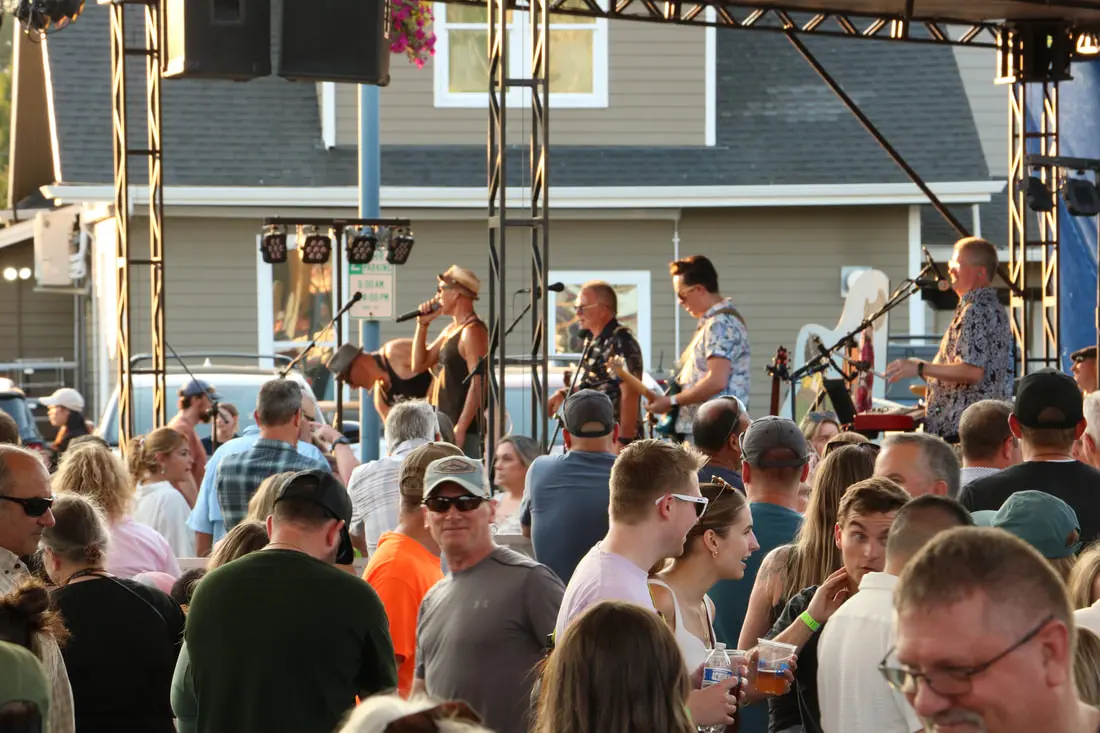
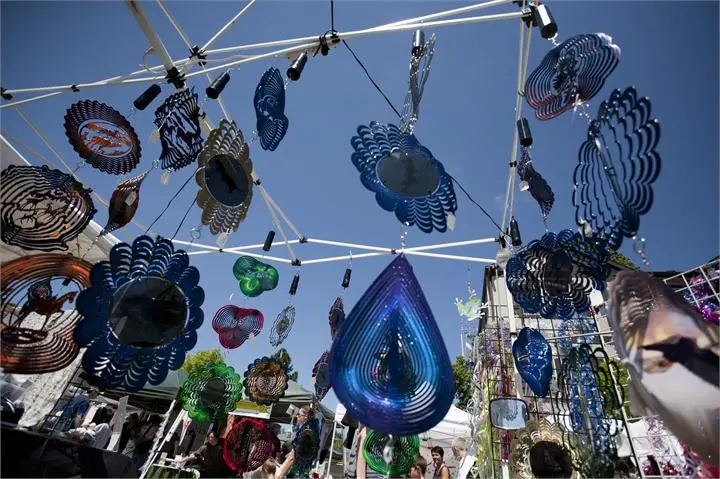
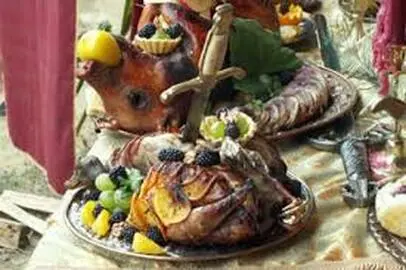
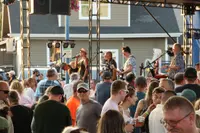
Two blocks of Old Town carry the rest. The Main Stage stands at SW 1st and SW Pine Streets. On the Saturday of the 2026 festival it ran from Melody Guy at 11:15 a.m. through TapWater, the Glensiders, and SuperWave, to Hit Machine, who played from 7 until 10 p.m. Friday night had belonged to Lincoln’s Beard and Baz Moto. The beer garden is near the Main Stage, by the Tack Room at Langer’s. Robin Hood Plaza, a covered seating area added several years ago, gives shade to people listening to the bands. A third stage, the Sherwood Village Stage, is at Attrell’s Funeral Chapel near 1st and Main. Food vendors set up in the U.S. Bank parking lot near SW 1st and SW Washington Streets, selling dishes from street entrées to sweets, with craft beers and wines. The Vendor Village runs to more than 100 booths. A costumed Medieval Village stands alongside the Sherwood Village. On Friday night the Family Stage closes with a teen dance from 8 to 10.
The Maid Marian Court writes the medallion hunt and posts its clues in rhyme on the festival website and in the July festival guide. The 2026 hunt began:
Hear ye, hear ye, the 2026 medallion hunt is upon us quest through old town sherwood, but you must be cautious
The volunteers of Sherwood
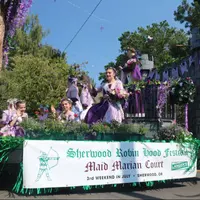
Volunteers run the festival entirely, under the Sherwood Robin Hood Festival Association, a nonprofit. Its proceeds go back to the town, including a scholarship each year for a graduating Sherwood High School senior. Maid Marian and her court are chosen from the high school and a Junior Court from the grade schools. They serve as official ambassadors of Sherwood at events through the year. The association also holds a Holiday Festival on the first Saturday of December. The 2026 edition was set for December 5 at 4 p.m., with a parade, a tree lighting, free cocoa, and Santa.
Pitz names two people as the longest hands in the work. Phil McGuigan served as festival president for 11 years before stepping down in 2017, and Pitz was told that McGuigan still books the activities and musicians. Sandy Wallace has worked on the festival for more than five decades and is the primary liaison for the archery match with Nottingham. She was knighted in 1988 as a past festival president and as liaison between the Sherwood and Nottingham archers since 1975.
Smockville, the Merry Men, and Maid Marian
The town had to become Sherwood first. James C. Smock had come west over the Oregon Trail at the age of four. He built a grain mill and supply store beside the family log mill. By 1890 he and his family had surveyed and platted nine square blocks and called the place Smockville. A U.S. post office opened in 1891. That same year the citizens renamed the town Sherwood at the suggestion of resident Robert Alexander, who, it is reported, likened the area to Sherwood Forest. The town incorporated in 1893. For most of the next century it lived by orchards, onions, a brickyard, and a cannery that closed in 1970. In 2020 it had about 20,450 residents.
The sources tell the festival’s beginnings in slightly different ways. The Oregon Encyclopedia says that from 1945 to 1949 young men in the newly formed Kiwanis Club and other community groups started a “Band of Merry Men,” complete with all the characters of the legend. They went as Sherwood’s ambassadors to parades and summer festivals in other Oregon towns. By the encyclopedia’s account, residents had created the “Robin Hood Festival” by 1952. Between 1953 and 1954, Sherwood High School changed its mascot and became “Home of the Bowmen.”
The association tells it through Danz’s 2014 account. In that version, World War II veterans returning home formed Robin Hood and his Merry Men and organized the first Robin Hood parade in 1946. In the fall of 1952 they launched a harvest festival. A Sylvan Archers pamphlet describes the original club as friends gathered “in the name of fun and high jinx.” That account says that in 1954 the Sherwood Chamber of Commerce, the Sherwood Kiwanis, and Robin Hood and His Merry Men of Sherwood, Inc. formed the first Robin Hood Festival Association, and in July of that year the event officially became the Robin Hood Festival. Danz writes that the Maid Marian Court began in the early 1950s, before the first official festival. For the 60th festival in 2014, the first Maid Marian, Janice (Swenson) Becker, served as grand marshal, and her granddaughter sat on that year’s court.
A Tiffany bowl for Nottingham
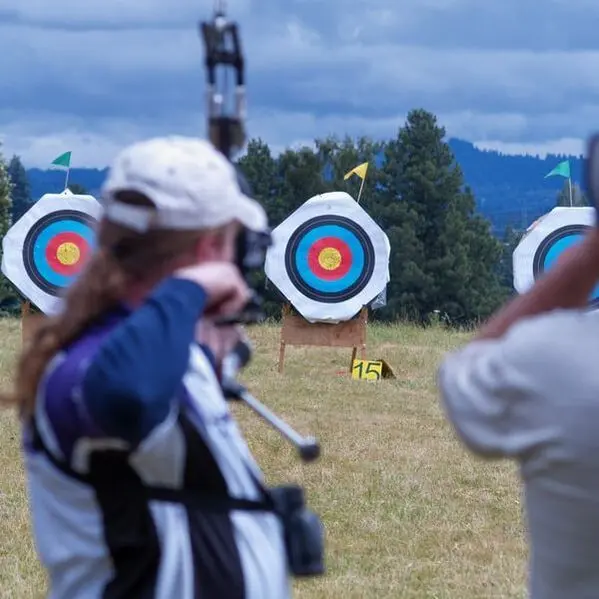
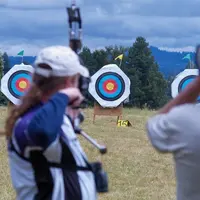
The archery tournament is shot apart from Old Town, on the JV baseball field at Sherwood High School, 18800 SW Haide Road. Observers are welcome. The 2026 tournament, the 71st, was shot July 18 and 19. Sylvan Archers host it. The club was founded in 1933 by Portland doctors and attorneys, bought land in Sherwood in 1951, and calls itself the oldest archery club in Oregon.
The match began with a letter. In February 1956 the president of the Robin Hood Festival Association challenged the yeomen of Nottingham, England. To seal the bond, Sherwood sent 50 redwood oak trees to Nottingham as a living memorial. Nottingham accepted in March. The archers agreed on a double American 810 round: 90 arrows at 60, 50, and 40 yards. In July 1956 Sherwood mailed Nottingham a picture of the trophy, a silver Tiffany bowl engraved by Stefans Bercs. The Sylvan pamphlet says Bercs was known for engraving for the court of the Czar of Russia. Both towns shot on the same day, with Nottingham drawing eight hours later by the clock. Sherwood’s recurve team took the first match by 81 points.
The match has changed over the years since. In the 1960s Sherwood had more archers than room, and it limited its team to Oregon and Vancouver, Washington. By the 1980s it had too few and opened the team to all of Washington and Oregon again. A compound team began in 1985. In 1989, the pamphlet records, Sherwood “discovered” that the Nottingham compound shooters were using release aids, though “we were to believe that the challenge was for fingers only.” Longbow, junior, masters, and barebow teams followed. In 1968 rain and lightning cut the match to one round. In 2009 weather in England cancelled it. In 2025 a Silver Bowl Plaque replaced the Tiffany bowl as the winners’ trophy. Each archer on every team receives a medallion from both Sherwood and Nottingham. Since that first summer, the Mayor of Sherwood has sent the challenge every year.
Notable Events
- 1890By 1890, the Smocks had surveyed and platted nine square blocks of the town, dubbing it Smockville; they moved an old house Hall had built earlier to the middle of the blocks, the first milled lumber building in the town. oregonencyclopedia.org
- 1891A U.S. post office opened in 1891; that same year, the citizens changed the name of the town to Sherwood as suggested by resident Robert Alexander, who reportedly likened the area to the Sherwood Forest. oregonencyclopedia.org
- 1946The first Robin Hood parade was organized in 1946 by returning World War II veterans who banded together to form a group called Robin Hood and his Merry Men; the group began to show up throughout the state at festivals and parades. portlandtribune.com
- 1952In fall 1952, the Robin Hood and his Merry Men group launched a harvest festival. portlandtribune.com
- 1956Sherwood sent 50 redwood oak trees to Nottingham as a living memorial; the silver Tiffany bowl trophy was donated by the Robin Hood Festival Association; the first competition between Sherwood, Oregon and Nottingham, England was held. sylvanarchers.com
People
- James C. Smock, founder of Smockville (now Sherwood); he immigrated to the West at the age of four by way of the Oregon Trail with his mother and the Halls; he bought land, built a grain mill and supply store near the log mill, and married Mary Ellen Sebastian in 1868 (1868).
- Robert Alexander, resident of Smockville who suggested the town rename to Sherwood, reportedly likening the area to the Sherwood Forest (cited).
Sources
- robinhoodfestival.org
- robinhoodfestival.org/summer-festival.html
- robinhoodfestival.org/parade.html
- robinhoodfestival.org/archery-competition.html
- robinhoodfestival.org/about.html
- robinhoodfestival.org/contact.html
- robinhoodfestival.org/main-stage.html
- robinhoodfestival.org/family-stage.html
- robinhoodfestival.org/castle-building-contest.html
- robinhoodfestival.org/knighting-ceremony.html
- robinhoodfestival.org/vendors.html
- facebook.com/USARobinHood