
-1.jpg)
-3.jpg)
-6.jpg)
-4.jpg)
-7.jpg)
Paul Bunyan Statue
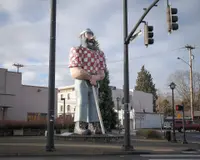
Portland, Multnomah County, Oregon. 31-foot-tall concrete and metal sculpture of mythical logger Paul Bunyan.
Details

- Where
- SW corner of N Denver Ave. and N Interstate Ave., Portland, OR 97217. Directions
- Getting there
- SW corner of N Denver Ave and N Interstate Ave.
- Managed by
- Kenton Neighborhood Association.
- Established
- 1959.
- Coordinates
- 45.583817, -122.686598.
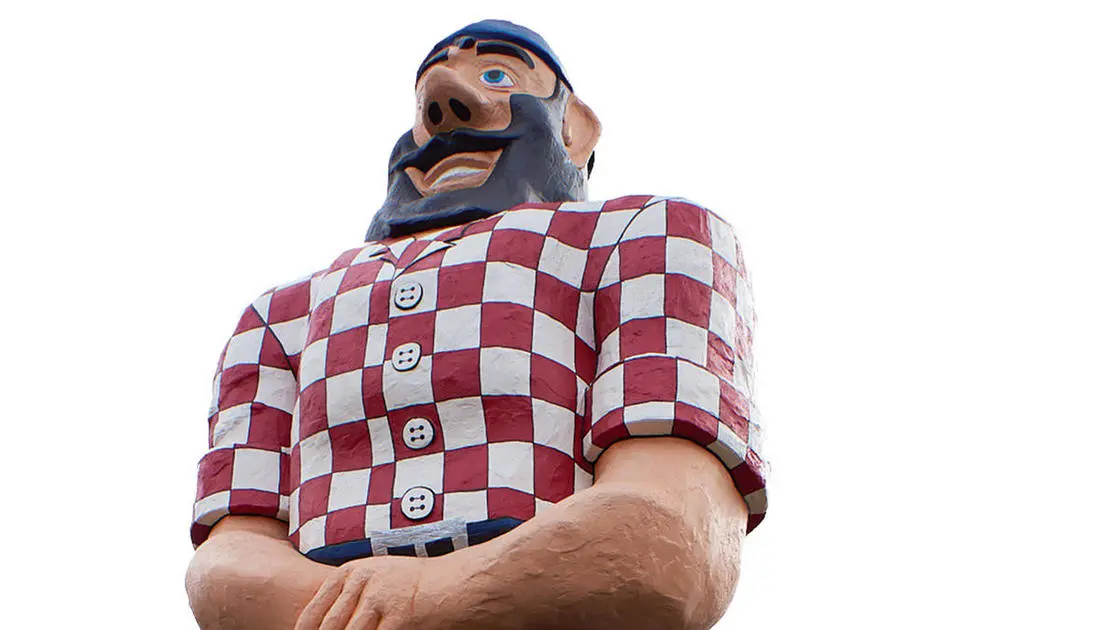
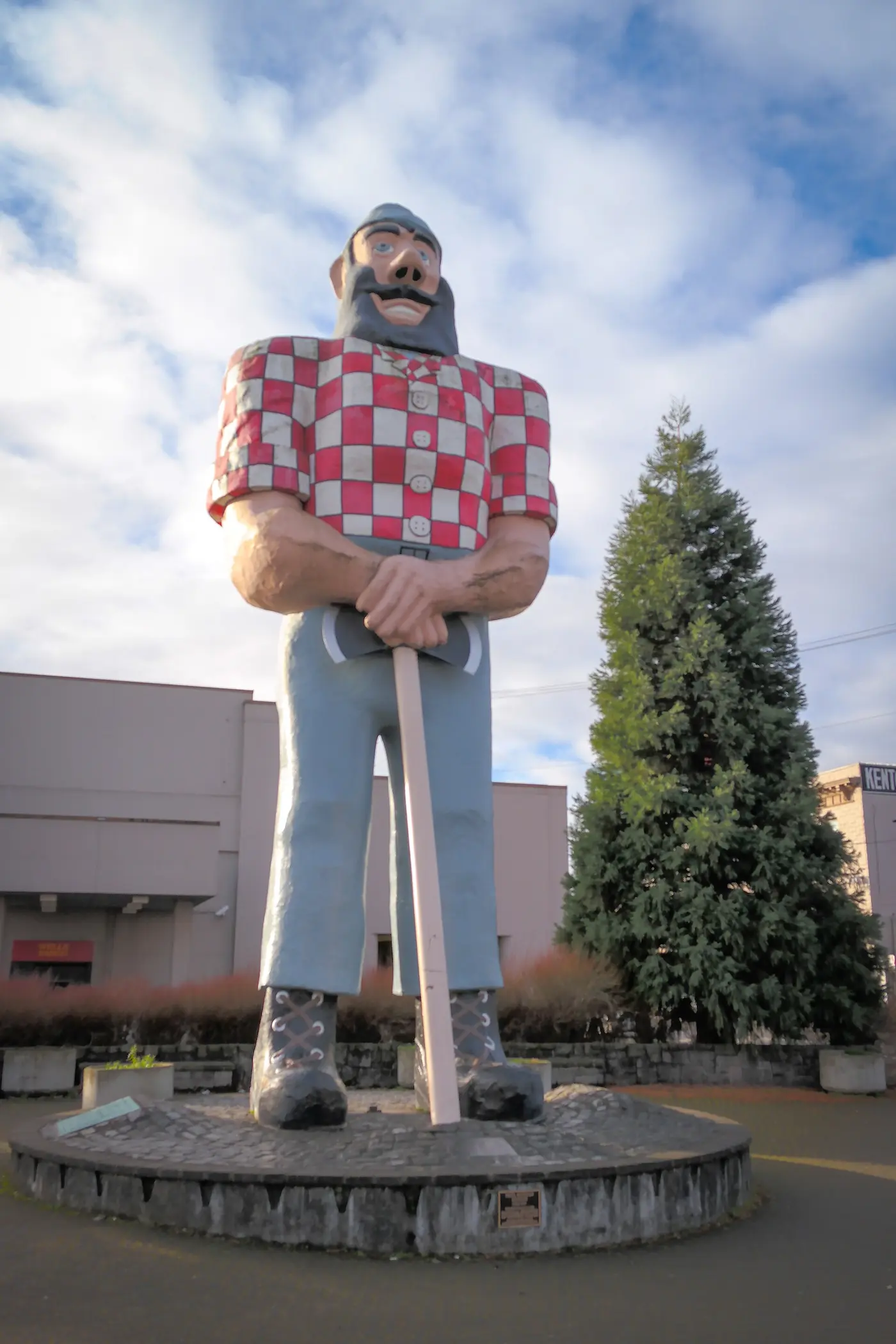
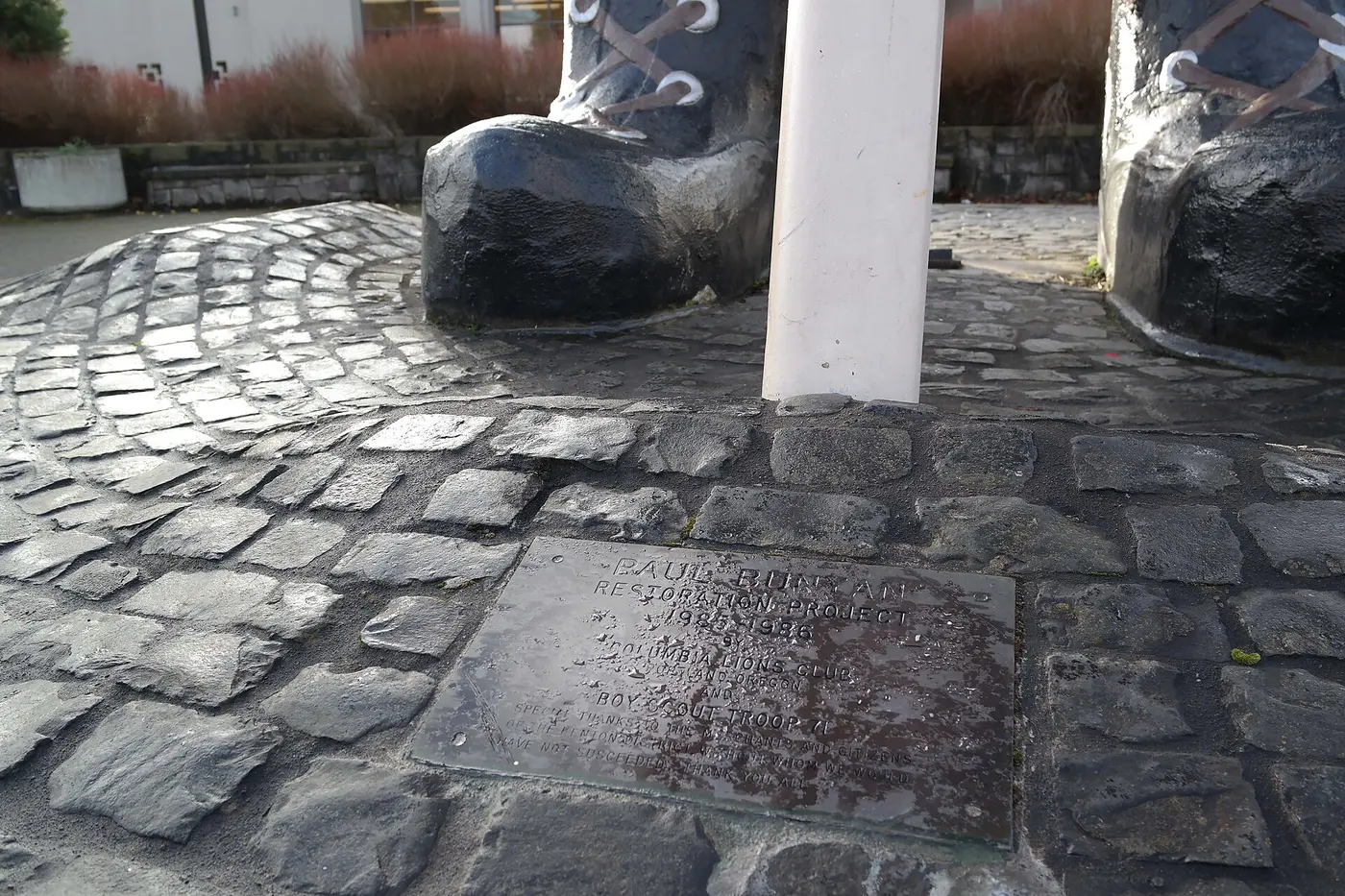
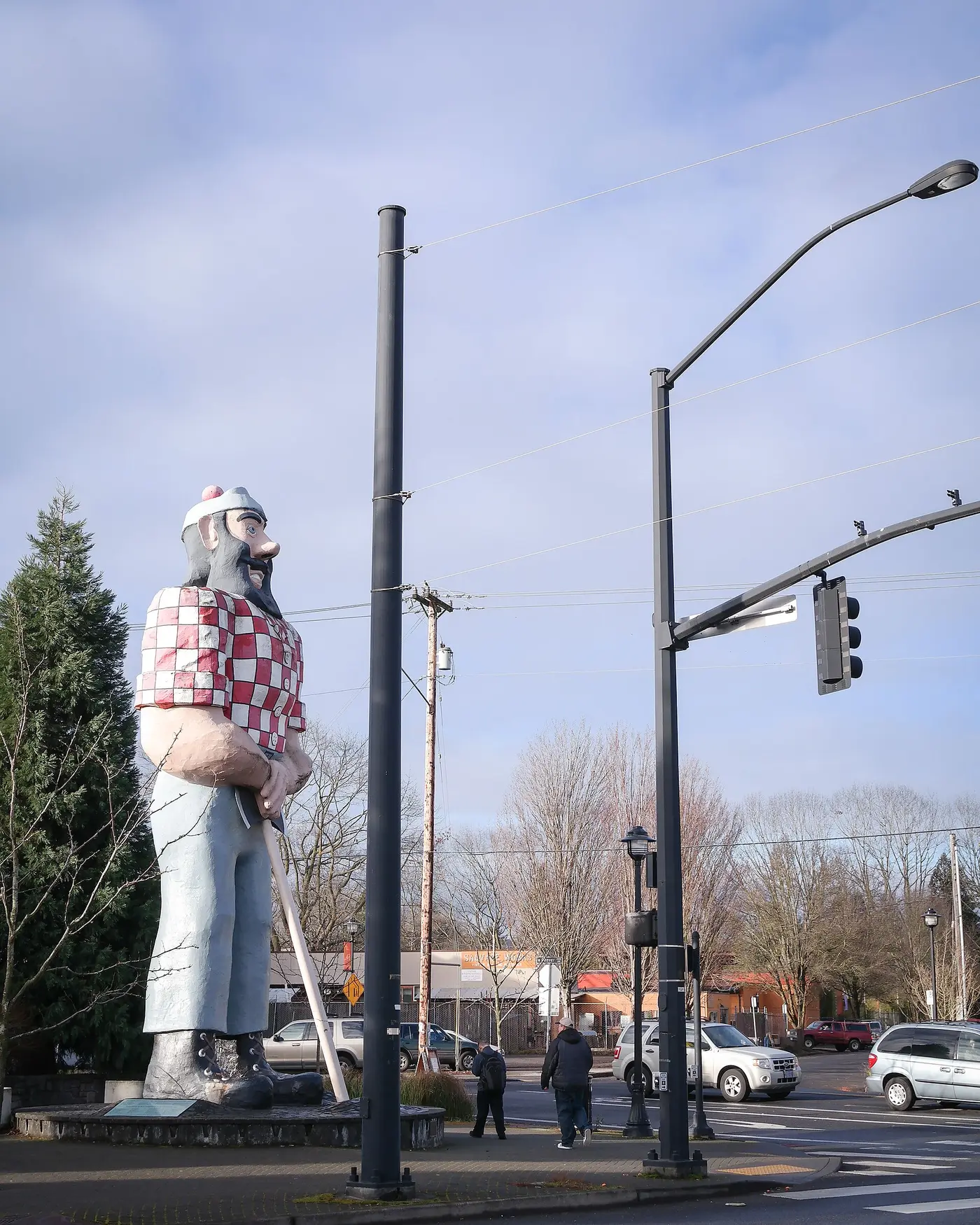
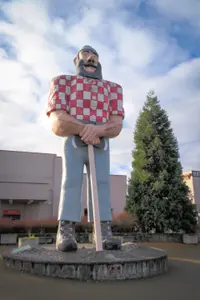
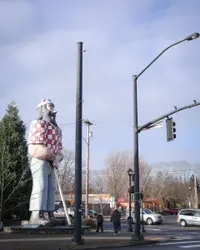
Paul Bunyan stands thirty-one feet tall at the southwest corner of North Denver and North Interstate Avenues in North Portland. He faces north, broad-shouldered, feet slightly apart. His hands rest one over the other on the head of a double-bit axe at his midsection. The steel haft angles out from there, and its knob end is planted in the “dirt” a few feet ahead of his boots. The boots are six feet long and painted black, with soles, heel plates, top stitching, and crisscross laces sculpted into the plaster and the laces picked out in white.
He wears a collared shirt in red-and-white checks outlined in black, with the sleeves rolled to just above the elbow. Four white buttons, each with four holes, are sculpted down the front. His light blue boot-cut pants just skim his boot tops. Round the back, pockets are scored into the plaster, a red handkerchief hangs from the west hip pocket, and a black belt shows only from behind. A smooth black mullet, bobbed at about chin length, runs into a full beard and a wide mustache. On top sits a solid blue lumberjack cap with a red ball. Under bushy eyebrows are a ski-jump nose, sculpted blue eyes, high round cheeks, and a large smile with white teeth. His ears break out through the hair on either side. The state’s survey of the statue calls the oversized ears, nose, forearms, and barrel chest deliberate, “obvious and whimsical.”
The plaza at Denver and Interstate
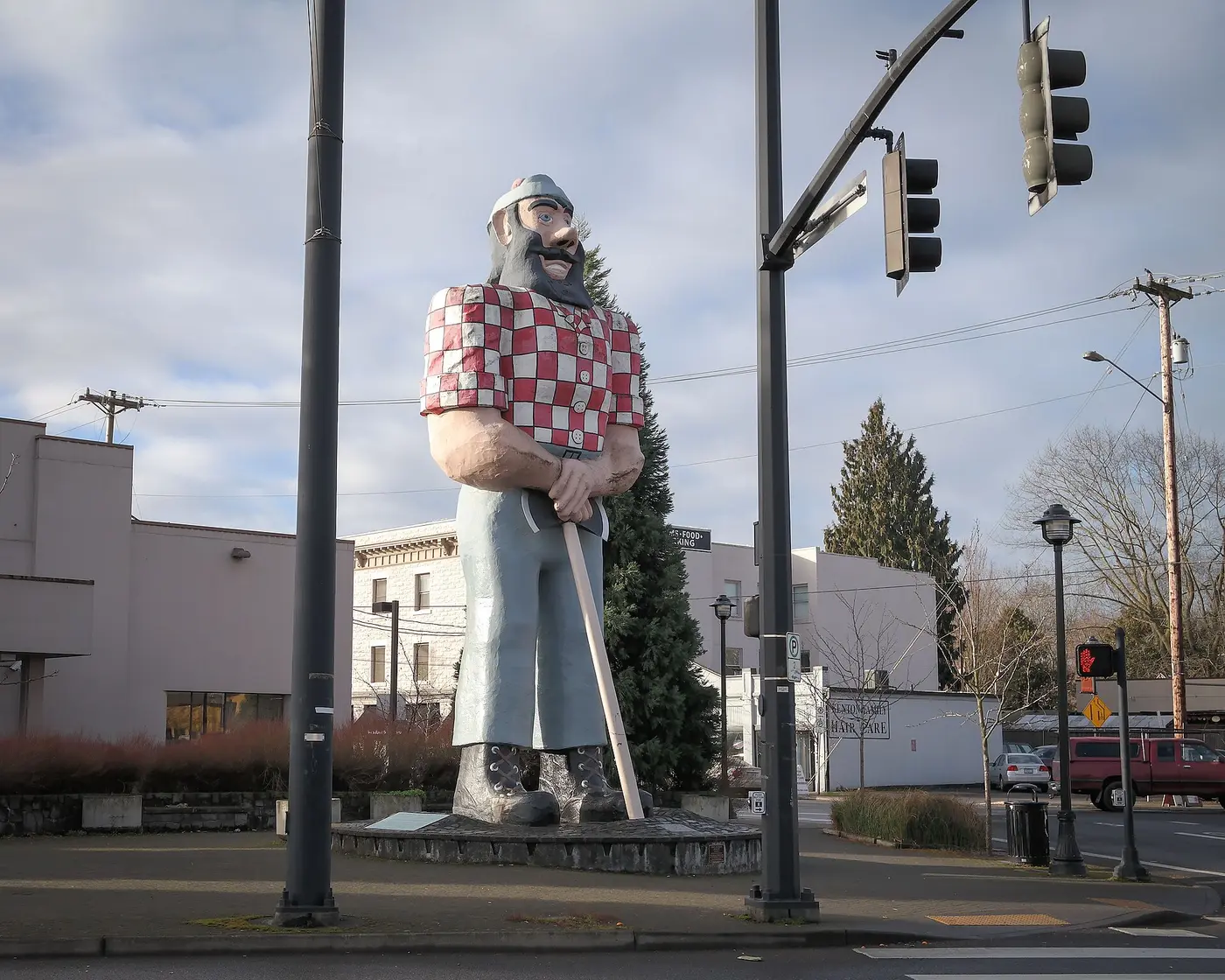
The figure stands at the north tip of a block shaped like a right triangle, at the north end of the Kenton Historic District. Around him is a small cone-shaped plaza of concrete pavers laid in regular rows. A low, curved stone wall closes its south side, with three concrete benches set into it, and three round concrete planters ring the statue. Behind the wall, a two-and-a-half-story moderne commercial building has stood at Paul’s back since 1959. The intersection itself carries cobra-head streetlights, curb bump-outs, and the canopies, tracks, and railings of a light-rail station.
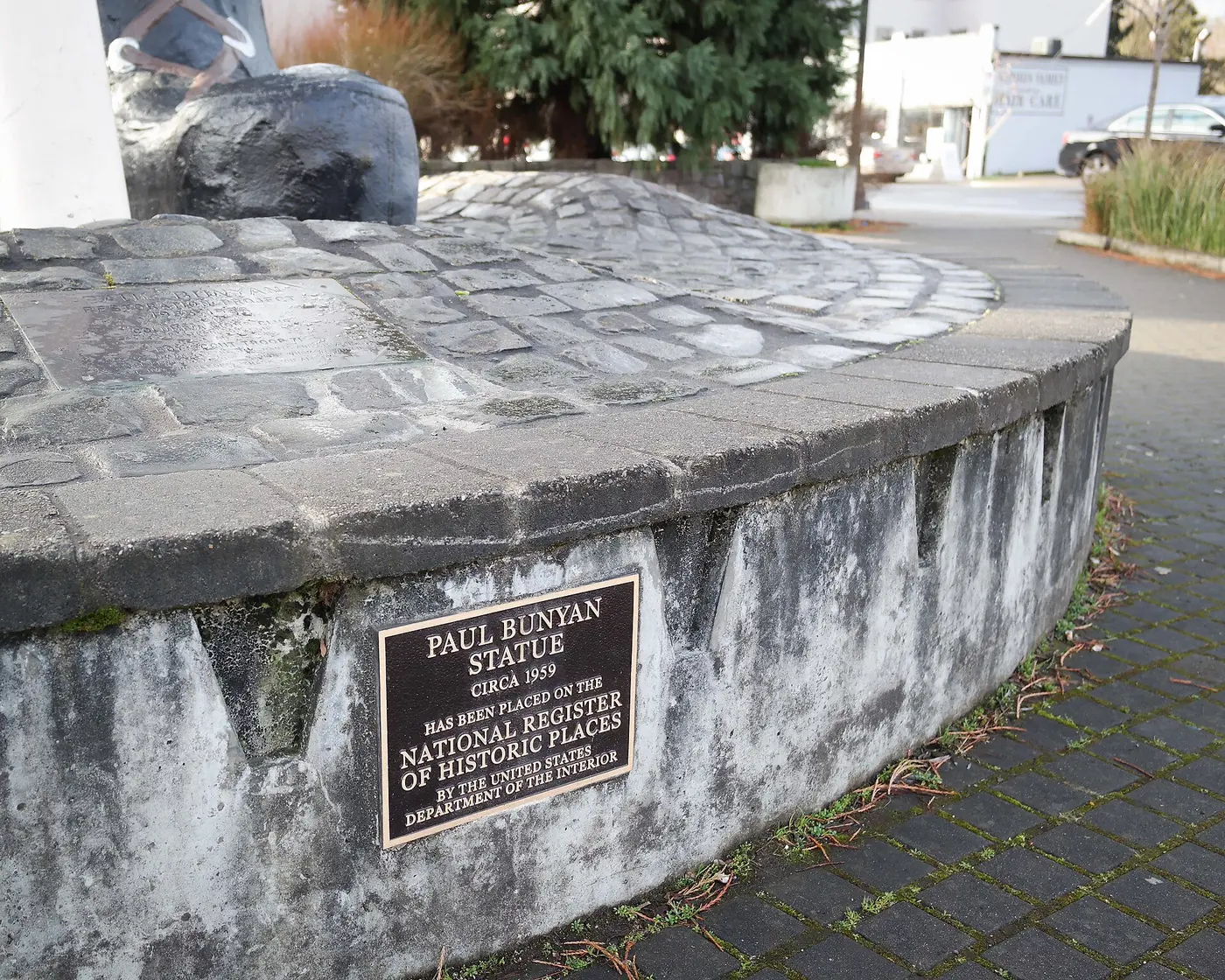
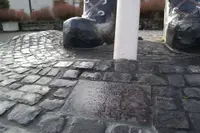
Paul’s base is a low round wall of poured concrete, seven to eighteen inches high, filled with a hilly ground of mortared rough-cut basalt blocks. Three plaques sit on inclined stone platforms on the east, north, and west sides. The north plaque is bronze and the other two are Plexiglas. Together they record the statue’s construction, its restorations in 1985 and 1999, and its history.
Directly across Denver Avenue is a one-story building. In 2008 it housed Converting Machines Inc., and before that Kenton Machine Works, the shop in which the statue was designed and its frame built. Four blue bollards shaped like cloven hooves stand in front of it, for Babe the Blue Ox.
A logger for the centennial
Kenton began as a Swift & Company meat-packing town, and until 1928 cowboys on horseback drove cattle up Denver Avenue to market. Sawmills came later. According to the Kenton Neighborhood Association, those mills inspired the statue.
Oregon’s centennial year opened on February 14, 1959. Its anchor event was the Oregon Centennial Exposition and International Trade Fair, held for 100 days, June 10 to September 17, near where the Portland Expo Center stands today. Interstate Avenue, then U.S. Route 99, was the main gateway into Portland, and fairgoers would pass through Kenton. The Kenton Businessmen’s Club wanted a part in the celebration. By February 1, 1959, the club planned a Paul Bunyan statue for the Denver and Interstate intersection, along with welcome banners and bunting. Gay Taylor led the fundraising drive, with help from Al Bertro and Marion Hassferder.
Accounts differ on who designed it. The Oregonian in 2008 credited the elder Victor Nelson with conceiving the figure. In 2009 the paper named father and son, Victor R. and Victor A. Nelson, owners of Kenton Machine Works. The National Register form lists Victor R. Nelson as designer and the Machine Works as manufacturer. The neighborhood association’s history says the business association designed it.
Volunteer iron workers and welders built the steel frame in the Nelsons’ shop. A crane truck carried it, with the axe head and boot frames already attached, to its first site at Interstate and Argyle. There apprentices from the plasterer’s union formed the body in cement plaster. Paul was dedicated on the afternoon of June 6, 1959, four days before the fair opened. He was meant to stand for six months.
“Paul Bunyan was a really popular figure at the time,” Ian Johnson, a historian at the State Historic Preservation Office, told The Oregonian. “Even though Paul Bunyan is a Minnesota legend, it made sense to folks out here because the timber industry was really important in Oregon.” In the Oregon stories cited in the statue’s nomination, Bunyan is said to have made the Columbia River, Mount Hood, and Crater Lake.
Fifty-nine feet south
Interstate 5 was built through Kenton in the early 1960s, and the neighborhood stopped being a gateway for motorists. The state gave up the tourist information booth it had kept there. The statue stayed. He was repainted from time to time, and local civic groups restored him in 1985 and 1999. The nomination’s own conclusion gives 1989 for the first of those. At some point his shirt was painted solid red. The nomination records the change and says the checks were later restored. Portland Monthly calls the solid shirt apocryphal and says it covered the checks only briefly.
In 2002 TriMet moved Paul fifty-nine feet south to make room for the Interstate MAX, the Yellow Line. He was set on a new base, facing the same direction, across the street from his first site and still beside the shop where he was made. The plaza and the hoof bollards date from that move. Victor R. Nelson died in 2004 and left money in his will for the statue’s upkeep.
In February 2008 a businessman offered to buy the statue and move it to North Carolina. The neighborhood association’s board turned him down. The sources disagree on ownership. The Oregonian and the nomination form name the association as owner. Portland Monthly says the association does not own Paul but has taken on his care. The association itself says he is not in the Portland Public Art Collection and so is maintained by the neighborhood.
That same year Bette Davis Nelson, Victor R. Nelson’s widow, then 75 and living in Lake Oswego, proposed listing the statue on the National Register. “I wanted to honor my husband,” she said. “Vic was so proud and thankful for the statue and what it stands for.” Maiya Martin, a University of Oregon anthropology student from Irvington, took the nomination on as a class project, because the statue “was part of my family’s collective consciousness growing up.” The two helped the state office prepare the nomination. In October 2008 the State Advisory Committee on Historic Preservation, meeting in Astoria, voted unanimously in favor. The statue was listed on January 28, 2009, as Oregon’s only roadside architecture on the Register. The only other Paul Bunyan there was an 18-footer in Bemidji, Minnesota, listed in 1990. “The National Register doesn’t recognize beautiful things,” Johnson said. “It recognizes historically important things.”
Paint and bones
Paul was repainted in 2009, and by 2015 the paint was cracking and coming off. That winter, when the fire department removed a stocking cap left by SantaCon revelers, they found a chunk of plaster missing from the top of his head. “What could we do to have this guy look like a respectable fella again?” asked Angela Moos, the association’s treasurer, who led the effort. The design and fabrication firm Figure Plant inspected the statue. Its office stood directly across the street, in the building where Kenton Machine Works had built him. David Frederickson of Figure Plant counted four kinds of paint failure. The 2009 coat was separating from older layers, the older layers were parting from the original surface, paint was cracking over patches, and moisture and sun had degraded the rest.
Frederickson’s team ran a camera inside the statue and searched the Oregon Historical Society’s archives. They found the 1959 builders had done good work, in the same space Figure Plant now occupied. “His bones were built in our shop,” Frederickson said. “We felt we had a folkloric duty to take part in the process.” Over six to eight weeks they stripped about 80 percent of the old coatings and patched pitted and cracked areas. They repainted the red plaid shirt and dark beard in specialty exterior commercial paint. “We chose some slightly more saturated colors that will hold up better in the sunlight,” Frederickson said. The work was finished in September 2017. The community raised $85,000 to pay for it, with help from Widmer Brothers Brewing and the Portland Timbers.
Neighbors then formed a nonprofit, Friends of Paul, to keep a fund for future repairs. Asked about the other Bunyans around the country, Frederickson said: “There’s one that’s kind of our Paul Bunyan competitor. But theirs is on a platform, and it’s really only about a 20-foot statue.”
Notable Events
- 1959The Kenton Businessmen's Club planned a Paul Bunyan statue alongside welcome banners and bunting at the Denver and Interstate intersection. heritagedata.prd.state.or.us
- 1959The steel-and-concrete-plaster statue was built for the state's centennial. savingplaces.org
- 1960sInterstate construction compelled the state to abandon the tourist information booth in Kenton. heritagedata.prd.state.or.us
- 1985The alterations section reports a civic-group restoration. heritagedata.prd.state.or.us
- 1985Local civic groups completed restorations in 1985 and 1999. heritagedata.prd.state.or.us
- 1989The conclusion reports a civic-group restoration. heritagedata.prd.state.or.us
- 1999Local civic groups restored the statue. heritagedata.prd.state.or.us
- 2002Babe's footprints were installed in front of the former Kenton Machine Works building. heritagedata.prd.state.or.us
- 2002TriMet relocated the statue fifty-nine feet south for the light rail line and station. heritagedata.prd.state.or.us
- 2004The nomination describes the statue maintenance fund Nelson set aside in his will. heritagedata.prd.state.or.us
- 2008The Kenton neighborhood landmark had been nominated for the National Register of Historic Places. oregonlive.com
- 2009The state database gives the statue's individual listing date. heritagedata.prd.state.or.us
- 2009The Paul Bunyan statue was added to the National Register of Historic Places on January 28, 2009. kentonpdx.org
- 2009The source reports a repaint, whose separating paint was identified during the later inspection. pdxmonthly.com
- 2009Paul received a spruce-up in 2009, but by 2015 was showing worrisome cracking and paint loss. savingplaces.org
- 2015The statue was showing worrisome cracking and paint loss. savingplaces.org
- 2017The most recent restoration, completed in September of 2017, is the most comprehensive one to date. savingplaces.org
- KNA board members rebuffed a businessman's offer to buy and move the statue to North Carolina. oregonlive.com
- Periodic restorations added fresh layers of paint; the source describes an apocryphal solid-colored shirt covering the original checkers. pdxmonthly.com
People
- Al Bertro, Assisted the committee's fundraising drive.
- Bette Davis Nelson, widow of Victor R. Nelson; helped nominate the statue for the National Register.
- Brenda Ray Scott, Kenton Neighborhood Association property-owner contact on the nomination.
- Gay Taylor, Led the statue committee's fundraising drive.
- Maiya Martin, University of Oregon student who helped nominate the statue for the National Register.
- Marion Hassferder, Assisted the committee's fundraising drive.
- Victor A. Nelson, co-designer; owned and operated the nearby Kenton Machine Works.
- Victor R. Nelson, co-designer; owned and operated the nearby Kenton Machine Works.
- Victor, Victor Nelson's father, also named Victor, conceived Paul Bunyan for the Kenton Businessman's Club.
- Angela Moos, Kenton Neighborhood Association treasurer spearheading the statue makeover project.
- David Fredrickson, Figure Plant representative who inspected the statue's damage.
- David Frederickson, Figure Plant owner; he and his team analyzed the statue's surface and internal structure.
Sources
- heritagedata.prd.state.or.us/historic/index.cfm?do=v.dsp_printRecord&resultDisplay=52225
- savingplaces.org/stories/portland-oregons-massive-paul-bunyan-statue-looks-better-than-ever
- kentonpdx.org
- heritagedata.prd.state.or.us/historic/index.cfm?do=v.dsp_siteSummary&resultDisplay=52225
- heritagedata.prd.state.or.us/historic/index.cfm?do=main.loadFile&load=NR_Noms/08001393.pdf
- pdxmonthly.com/news-and-city-life/2015/11/north-portland-s-iconic-paul-bunyan-statue-is-getting-some-love
- oregonlive.com/portland/2008/10/kenton_historic_moment_for_pau.html
- kentonpdx.org/kenton-history
- kentonpdx.org/kenton-portland-oregon