Yakima
Yakima County, Washington. County seat.
Yakima, county seat of Yakima County, grew up around a Northern Pacific depot after more than 100 buildings were moved north from Yakima City.1,2
Details
- Founded
- The Northern Pacific platted a new townsite, and in early 1885 plats were filed for the new town, called North Yakima, and lots were offered to Yakima City residents willing to move.1,2
- Name
- The name comes from the Yakama Indians of the region, and it has been translated as black bear or as runaway.2,3
- County seat
- Yakima is the county seat of Yakima County, and the seat moved there from Yakima City in 1886.1,3
- Last checked
- October 6, 2026.
Point at a dot to see the place.Tap a dot to see the place. Road map of Yakima.
In Yakima
- Swede Hill DistillingYakima · Craft distillerySwede Hill is located deep within the beautiful apple orchards of the Yakima Valley in Central Washington State. We take pride in the fact our spirits are made with fruit from our family's farm, as well as locally sourced ingredients.
- Yakima Valley TrolleysYakima · Interurban electric railroadEnjoy regularly scheduled rides all summer, or book a private event year-round!
The Calendar
History
Below the Mouth of the Naches
Yakima stands on the banks of the Yakima River just below the mouth of the Naches River and is the county seat of Yakima County.1 In 2009 its population was estimated at 84,850, and many of its major employers were fruit-packers, beef processors, and canneries.1 The county history translates the name as black bear, from yah-kah, or as runaway, after the rushing waters of the Yakima River or a tribal legend about a Yakama chief’s runaway daughter.3 A history of the valley’s Japanese settlers gives the meaning to the Yakama people as “beautiful land,” which the Issei rendered as Burning Horse.4
Yakima City on Ahtanum Creek
The site of the first Yakima City, where the Yakima River cuts through a gap in the Ahtanum Ridge, was a tribal winter gathering place.1 The first white settlers were cattle ranchers who wintered their herds on the stream-bank grasslands, and the F. Mortimer Thorp family reached the Moxee Valley, just outside the present city, in 1861.1 Two accounts say Yakima City was established in 1861, while the city’s history says settlers began calling a small village with two stores by that name in 1870.1,2,3 In the 1870 vote on the county seat, Yakima City, also known as Mount Ottawa, won with 89 votes to 20 for Flint’s Store and 18 for Selah.5 Accounts of its size differ: the city’s history gives close to 2,000 people by around 1880, the account of the railroad’s arrival about 500 in 1884, and the First Baptist Church nomination 400 at incorporation in 1883.1,2,6
Buildings on Rollers
On December 17, 1884, the Northern Pacific’s Cascade Branch reached Yakima City, just after the company had announced that its trains would not stop there.2 The railroad built its depot at a new townsite called North Yakima instead, which one account places about five miles to the northwest and another four miles north.1,2 The Northern Pacific thought Yakima City too swampy and hemmed in by ridges, or, by other accounts, too slapdash and poorly laid out.1 The company gave landowners as many lots in the new town as they had held in the old one and paid the cost of moving their buildings.2 Through the winter and spring of 1884-1885, more than 100 buildings went north on trucks and rollers, and hotels and a bank reportedly stayed open for business along the way.2 When the Yakima City Signal building was raised on blocks for the move, an anonymous diehard set off a charge of dynamite in it at night, but the owner gathered up the lumber and rebuilt in North Yakima.1 Some accounts say Paul Schulze, the railroad’s land manager, laid out the streets roughly on the plan of his native Baden-Baden, Germany, while others say the model was Salt Lake City; canals ran beside some of the main streets.1 North Yakima was incorporated in 1886, and the county seat moved there from Yakima City.1 At the U.S. Post Office’s request, the legislature renamed the old Yakima City Union Gap, effective June 7, 1917, and dropped “North” from the new town’s name, effective January 1, 1918.1
Hops, Orchards, and the Interurban
Wine grapes were first planted in the valley in 1869, hops in 1872, and the first commercial fruit orchard in 1887.3 In the hard times of 1894, a Pacific Northwest contingent of unemployed Coxeyites heading east by freight train camped near the North Yakima railyards, and a fight with marshals ended with two marshals shot and forty-nine Coxeyites arrested.1 A booster booklet of 1904 listed a huge lumber plant, a flourmill, and a fruit-and-vegetable canning factory in the city.1 The city’s history says the trolley system was founded in 1906, while the line’s register nomination says its first three miles of streetcar track opened in 1907.1,7 A subsidiary of the Union Pacific Railroad bought the Yakima Valley Transportation Company in 1909, and by 1920 its 48 miles of track carried freight from Yakima farms to the rail lines in the city.7 The city later boasted that its Produce Row, a line of refrigerated warehouses along the tracks, was the largest in the nation outside New York and Chicago.1
Field Hands, Ash, and Old North Yakima
In 1928 a Japanese directory counted 150 Issei in Yakima running 43 businesses, among them hotels, bath houses, and laundries, in a one-block area next to the Chinatown district near the railroad station.4 In 1921 eight field hands started the Yakima Ameikai, or Yakima Croaking Society, which the same history calls the first reading circle for senryũ poets in the United States.4 In 1941 the U.S. Army opened the Yakima Anti-Aircraft Artillery Range in the sagebrush hills east of the city, now the Yakima Training Center, and in 1942 more than 1,000 people of Japanese descent were forcibly removed from the Yakima Valley to internment camps.1 Mexican American farmworkers from Texas began arriving in the early 1930s, and by the 2000 census 33 percent of Yakima’s residents were of Hispanic or Latino origin.1 On May 18, 1980, ash from Mt. St. Helens washed into the city’s sewers until the wastewater treatment plant failed, and a new park was later built where the ash was dumped.1 The Old North Yakima Historic District was listed on the National Register on May 2, 1986, and it includes the Hotel Sydney, built in 1909-1910 for Mrs. Julia Miller for $35,000.00 to serve traveling businessmen at $1.00 a day.8 The Richardsonian Romanesque First Baptist Church, designed by Newton C. Gauntt and completed in 1909, is called in its nomination the fourth oldest church from downtown Yakima’s first important period of development, after St. Michael’s Episcopal Church of 1889, St. Joseph’s Catholic Church of 1905, and First Christian Church of 1907.6 The city has since grown so far south that little now marks the line between Yakima and Union Gap, and the old Yakima City and North Yakima have melted into one.1
Within 30 Miles
Measured in a straight line from the town, nearest first.
- Selah Community DaysSelah · Annual celebrationSelah Community Days, held the third weekend in May in Selah, Washington, began in 1926 with a parade of flower-festooned autos to a new high school's picnic grounds.
- Pioneer Power Show, Swap Meet and Flea MarketUnion Gap · Show & swap meet / flea marketSee the equipment of yesteryear with vintage trucks and engines on display and watch the equipment parade. Learn about blacksmithing and watch demonstrations of the turn of the century sawmill and the apple packing line, with quilt displays, a bread shack, tractor pulls, and draft horse buggy demonstrations.
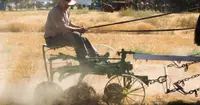
- Moxee Hop FestivalMoxee · Annual moxee hop festivalThe Moxee Hop Festival is a three-day August gathering in Moxee City Park, Washington, begun in 1948 to pay for the town's swimming pool.
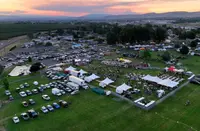
- American River Guard StationNaches, WA · Historic guard station rentalA 1941 Civilian Conservation Corps log cabin on the American River in the eastern Cascades, rented by the Forest Service and opened with a combination mailed to each guest.
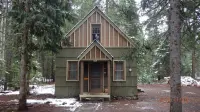
- Harrah Fall FestivalHarrah · Fall festivalThe Town of Harrah's festival in Yakima County, Washington, held the second Saturday of September, began as the Sugar-Beet Festival and took a new name when the industry went away.
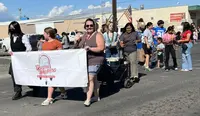
- Wild West ParadeToppenish · ParadeA free downtown parade of horses, wagons, floats and classic cars in Toppenish, Washington, held on the rodeo's Fourth of July weekend and billed locally as the "original" Western parade.
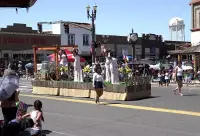
- Yakama Scenic BywayToppenish · Scenic bywayThe byway begins at a point where arid desert hills drop into productive plains—the Yakima Valley is one of the world’s leading agricultural regions. Then the byway leaves farmland behind and begins a slow climb into the desolate beauty of the hills leading into the Simcoe Mountains and across Satus Pass.
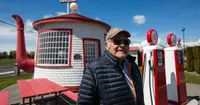
- Teapot Dome Service StationZillah · Historic landmarkThe building, which was vacant for many years and slowly deteriorating, was renovated and brought back to life. The new site was designed to mimic the Teapot Dome's long-time gas station operation.
- Zillah Community DaysZillahThe annual weekend celebration in Zillah, sponsored by Zillah Associated Clubs with activities run by city clubs and individuals including the Chamber of Commerce.
- Toppenish MuralsToppenish · Outdoor mural collection and self-guided walking tourToppenish, Washington, has painted roughly 80 historical murals on its downtown walls since 1989, many in a single day while townspeople watched from lawn chairs and bleachers.
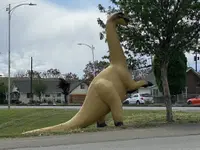
- Dinosaur TownGranger · Townwide dinosaur collectionGranger, a Yakima Valley town where the city's Public Works crew has built life-size wire-and-concrete dinosaurs since 1994, and townspeople help coat them in cement each June.
- Granger Cherry FestivalGranger · Cherry festivalThe Granger Lions Club's three-day festival in Granger, Washington, a Yakima Valley town that took the cherry as its emblem, with a carnival at Stoney's Plaza and a Saturday parade.
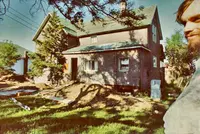
- Dick and Jane's SpotEllensburg · Art site, home, and studioDick and Jane's Spot, at First and Pearl in Ellensburg, Washington: a home and yard begun in 1978, seen from the fence, studded with over 10,000 bottle caps.
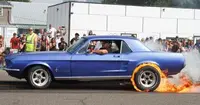
- Kruisin’ Kittitas Car Show & BurnoutsKittitas · Car show & burnoutsClassic cars, community, and burnouts in the City of Kittitas.
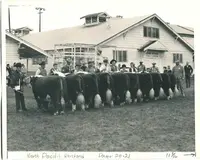
- Kittitas County FairEllensburg · County fairThe Kittitas County Fair in Ellensburg, first held in 1885 as part of a Civil War veterans' reunion, fills grounds that volunteers graded with horses and Fresno scrapers in 1923.
2 more within 30 miles on the road map.
Nearby towns: Ellensburg and Cle Elum. All the towns of Washington. More of Washington: Fairs & Rodeos and Train Rides.
Sources
- Yakima -- Thumbnail History historylink.org/file/9187
- Northern Pacific reaches Yakima City, where it declines to build a station, on December 17, 1884. historylink.org/File/5237
- Yakima County -- Thumbnail History historylink.org/file/7651
- Japanese Immigration and Settlement in the Yakima Valley (1890s-1941) historylink.org/File/23236
- Yakima County is established on January 21, 1865. historylink.org/File/7487
- NPS Form 10-900 OMB No. 1024-0018 1 United States Department of the Interior dahp.wa.gov/sites/default/files/FirstBaptistChurch_Yakima_FINAL_combined2.pdf
- National Register nomination, Yakima Valley Transportation Company npgallery.nps.gov/GetAsset/82bc214f-553e-49bd-aa30-ace24f4e05a0
- Senator Apartments (Hotel Sydney) (historical marker) hmdb.org/m.asp?m=129408