.jpg)
Toppenish Murals
Toppenish, Yakima County, Washington. Outdoor mural collection and self-guided walking tour.
Details

- Where
- 504 S. Elm Street, Toppenish, WA 98948. Directions
- When
- Mural-in-a-Day held the first Saturday in June.
- Getting there
- I-82 Exit 50 to Toppenish.
- Access
- Free, outdoor, self-guided walking tour; the visitor center hosts the OtoCast app and printed mural map.
- Phone
- 509-865-3262
- Website
- visittoppenish.com
- Managed by
- Mural Society.
- Established
- 1989.
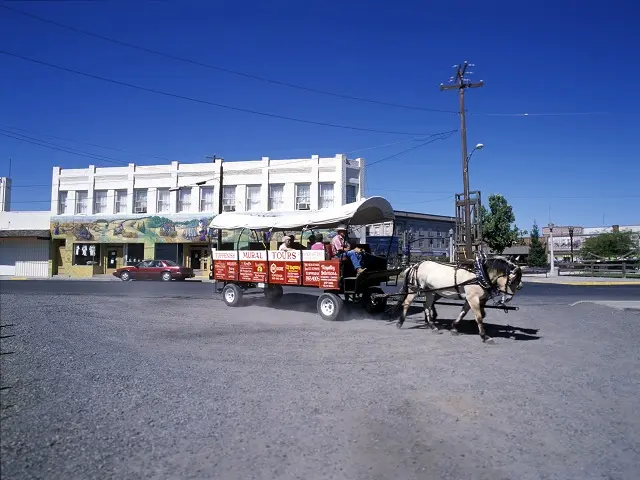
The walking tour starts at the Mural Office, 504 S. Elm Street, which shares its address with the Toppenish Chamber of Commerce. The printed mural map is kept there, along with the artists’ original paintings for the walls. The map numbers the murals from 1, “Clearing the Land,” to 80 and 81, “Bob & Agnus Campbell Story.” Two of the numbers are marked “Removed Blank.” A visitor who would rather listen can follow the OtoCast app, which shows where each mural stands and has a recorded description of every one in English and Spanish. The route is outdoors and free.
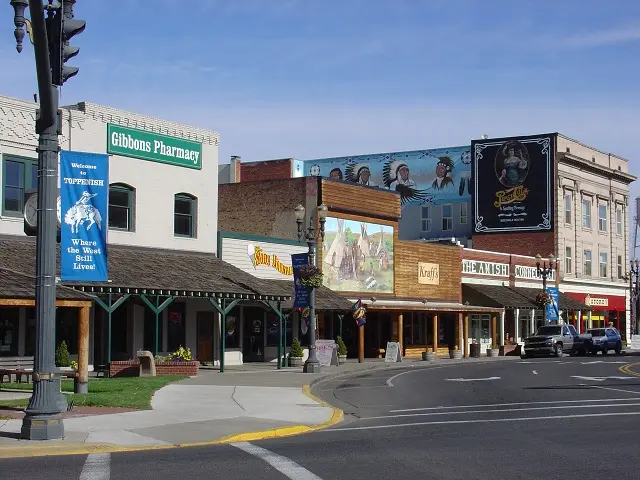
Toppenish is a city of almost 10,000 in the Yakima Valley, and it lies entirely within the boundaries of the Yakama Indian Reservation. The approach from I-82 is Exit 50. The number of murals depends on the source. One Chamber listing gives 76. The city and the Chamber’s own site say 78 have been completed since the first. The Yakima Herald-Republic says nearly 80.
Walls between 1840 and 1940
The Toppenish Mural Society chooses the subjects. According to the Chamber, its board of 10 to 12 meets once a month and holds every mural to one rule: it must be historically accurate to the area, from “1840 ish -1940 ish.” Each design goes through what the Chamber calls a rigorous proofing process before an artist is commissioned. The painters have been local, regional and national, and many have worked on more than one wall. The society runs on private donations, grants and fundraising events. No tax dollars are used to put up or keep up the murals.
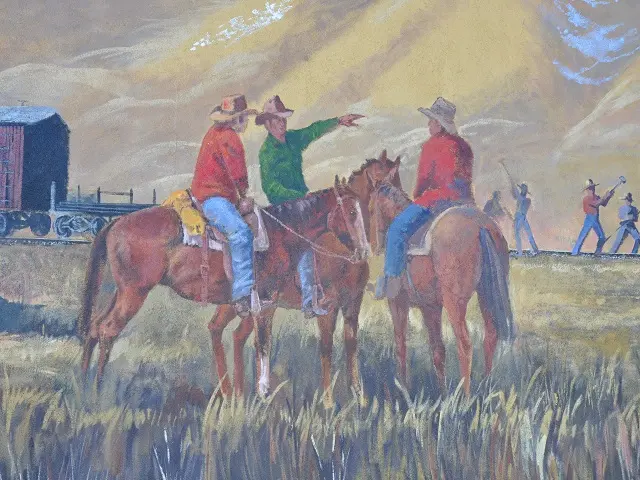
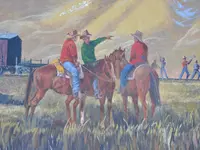
Many of the murals record work and trade. Robert Thomas’s “When Hops Were Picked by Hand” shows Native Americans from across the Northwest camped beside the fields at harvest. The hop industry paid for that mural and for Old Timers Plaza next to it. At the American Hop Museum, Eric Allen Grohe painted a trompe l’oeil that makes the plain stucco look like architectural arches, each framing a hop scene. Don Crook spent six weeks on “Newell’s Drive,” a 70-foot horse round-up led by the pioneer Charlie Newell. Janet Essley’s “Patterns of Life,” on the Toppenish Pawn and Trade building, reproduces Yakama basket designs. The map calls basketry the oldest continuous art form in the Valley and says it is still practiced. George Flett painted “The Prairie Chicken Dance.” Its name, the map says, comes from a legend of Indian boys playing warrior games on the prairie who looked over a bluff and saw prairie chickens dancing.
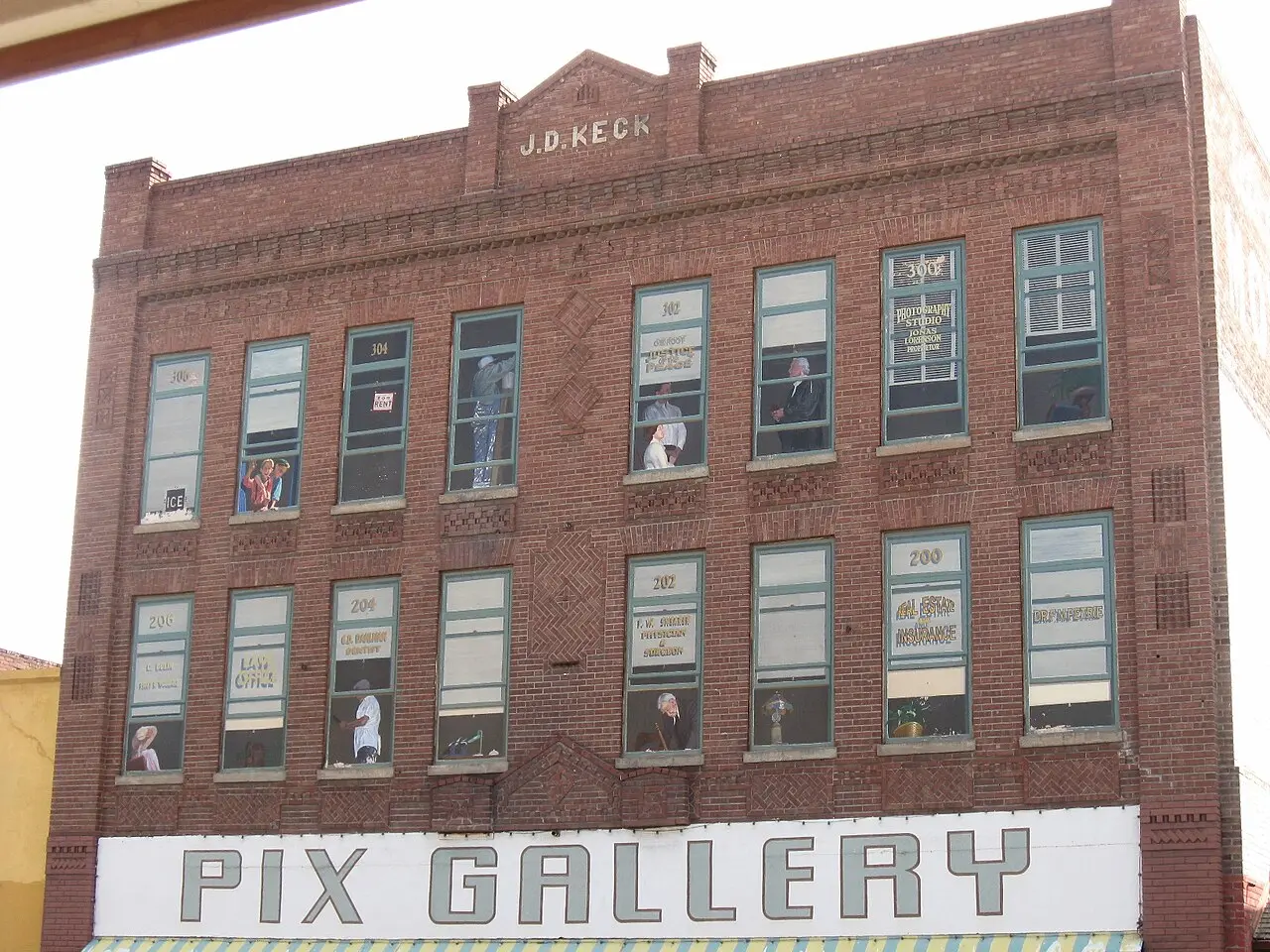
Some walls are jokes. Newman Myrah painted “Rodeo” as a time-worn poster with brick showing through. A photograph of him on a ladder in a straw hat, working on it, appeared in local, regional and national publications, and Myrah later came back and painted himself into the mural on the ladder. Betty Billups put the ladies of “Western Hospitality” in the second-floor windows of the Logan Building on Division Street. Two Mural-in-a-Day paintings from 1996 cover the “Public Westrooms.” In one, a mother hangs out the wash while a father reads a catalog in the “library.” On the east wall of the city jail, “Presumed Innocent” shows the trial of a farmer charged with diluting milk. “Irish Dick,” by Bill Ross and Jan Sovak, tells of a hard-drinking shepherd who in about 1910 traded a pet bear cub to a saloon-keeper for whiskey. Months later the grown bear escaped, and the shepherd offered to put it back on its tether. The fight on Main Street ended with the bear unharmed and the Irishman taken to the hospital.
Several murals are portraits of local women. The sources do not describe them in the same way. The map credits Maud Bolin as one of the first female pilots, the first woman to parachute out of a plane, and a rodeo rider at Madison Square Garden. The Herald-Republic calls her a Toppenish philanthropist and the first Native woman licensed as a pilot in Washington. The map’s Ruth Parton rode broncos and relay races and was inducted into the Cowgirl Hall of Fame. The paper names her Ruth Parton Webster and says she is considered the “Mother of Thoroughbred Racing.” According to the map, Estelle Reel Meyer was appointed Director of Indian Education by President McKinley in 1898, the first woman in that post. The paper calls her national superintendent of Native American boarding schools and a benefactor of the Toppenish Museum. Josephine Lillie, who platted much of the town, is remembered as the “Mother of Toppenish.” She and Nevada Lillie built the 10-room house shown in “The Old Lillie Mansion” in 1893.
Lawn chairs at the Western Auto store
The program began when the town was in trouble. The Herald-Republic’s history column says the U&I Sugar Plant, once the city’s largest employer, had closed ten years earlier because of cheaper imported sugar. Washington’s centennial in 1989 brought state seed money to small towns. A group in Toppenish used it to plan historical murals under the city’s theme, “Where the West Still Lives,” hoping to bring in tourists and their wallets.
The first mural was painted on June 3, 1989, in a single day, in front of an audience. Phil Kooser of Yakima designed it, and 15 western artists painted the 40-foot scene under his direction. Kooser did not announce the subject in advance. According to the column, dozens of people brought lawn chairs to the Western Auto Parts store and waited to see what the picture would be, while musicians and Native dancers performed. The artists laid in the background first, and the image came up out of it: a man with a horse pulling vegetation from the ground, with tipis behind them. It was titled “Breaking Ground” then. It is now called “Clearing the Land,” and it stands on a single-story building at South Toppenish and Washington avenues, across from Old Timers Plaza.
Fred Oldfield, one of the painters that day, did the next mural in October. “Haller’s Defeat” went on the side of the Les Schwab tire store, and Schwab approved the design himself. It shows the 1855 battle at Toppenish Creek between Yakama warriors and federal troops under Maj. Granville Haller. The map says the troops came from Fort Dalles in Oregon and faced an estimated 1,000 Yakama. According to the column, Haller had come to demand that the Yakama surrender the man accused of killing Indian Agent Andrew J. Bolon, and the Yakama routed his force. Oldfield painted his own past as well. In his “Christmas at Logy Creek,” two Indians share their fire and food with a cowboy friend.
The one-day format became an annual event on the first Saturday in June. Kooser designed the second, “Fifteen Miles & a Change of Horses,” which shows the 1880s stagecoach depot that burned in 1928, and the third, a cattle branding. Myrah designed the fourth, a red and green chuckwagon. The 1997 pair recalls the start of rural mail delivery in 1907, when a postman supplied his own horse and buggy for a route of about 23 miles. In 1998 the subject was the Marion Drain, the flood-control channel on the reservation. “The Old School Barns,” first painted in 1995, was repainted as the 24th Mural-in-a-Day on June 1, 2013. On June 6, 2015, the 26th, Don Brown painted the 1920s fire department on the roll-up garage doors of the fire station in Pioneer Park. The Sunnyside Sun gives that mural’s title as “The Old Firefighting Days.” The Sun counts about 26 murals made at these events in all. The Chamber says hundreds came to watch.
Weather on the walls
When the series stopped depends on the source. Janet Mayer, president of the Mural Society, and the Herald-Republic’s news report both say the 2015 fire station was the last Mural in a Day. The paper’s history column says the program took a hiatus in 2017. Further down, the same column says the June tradition continued until 2018 and was then cancelled because of declining board participation.
Without regular maintenance, the murals weathered. In 2022 an effort began to revitalize the society and preserve the walls. Some murals were painted directly on plaster that is now breaking down. Others were painted on plywood panels that have developed holes. Snow, rain and wind all wear on them. “The sun is the worst,” Mayer said. “The sun beating down on some of these murals, it peels the paint.” She said one recent restoration of a 12-by-24-foot mural cost more than $1,100 for labor and materials before taxes.
“We have been tirelessly working to refurbish our murals in town, rather than concentrating on creating new ones,” Mayer told the Sunnyside Sun. “But the community has missed these one-day events where they could watch artists in action create a masterpiece on one of their buildings in town.”
Repainting “Clearing the Land”
The 2026 Mural in a Day was held on Saturday, June 6, at the first wall. After 37 years in the weather, “Clearing the Land” was flaking and faded. Karen Gulley, one of the 1989 painters, had prepared the brick beforehand. She took off the loose paint with several kinds of scrapers, then caulked and primed where it was needed. The Toppenish Lions Club served breakfast at Old Timers Plaza, and small bleachers were set up across the street.
The weather was sunny that morning, with a slight breeze. Mayer said mural painting needs temperatures above 40 degrees, and the days cannot be too hot or rainy. The artists were paid $500 each and worked in acrylic from a photograph of the original mural. Gulley worked on scaffolding. Below her on the sidewalk, Lisa Whitefoot filled in ground cover. She is the daughter of Jan Whitefoot, another of the original painters, who also worked that day. Janet Essley touched up the woman in the picture, and Herb Leonhard repainted the horse. Allyson Leonhard, Oscar Ramirez, David Craig, Lisa Wise and Brittany Windsor also painted. Toppenish High School students worked with their art teacher, Oscar Martinez, who had worked on some of the murals himself as an art student.
Phil Kooser died in 2007. His son Greg drove over from Bothell that morning and stood with Mayer by the bleachers. “It’s wonderful,” he said. “This is our first time repainting an original mural,” Mayer said. The finished wall was to receive a custom sealant, as other restored murals have. The society says it will hold Mural in a Day at least every other year. A new mural is planned, paid for by donations in honor of Mike Chandler, owner of Chandler Distributing, who died in a snowmobile accident in March 2024. It will show the history of oil in the area. Meanwhile the resealing continues. “We’re going to have to completely redo at least two or three of them,” Mayer said.
That afternoon Gulley and Lisa Whitefoot looked closely at the faded lettering of the original artists’ names on the wall. “I’m going to repaint them,” Gulley said.
Notable Events
- 1989The Toppenish Mural Society was established and subsequently created a collection of historically themed murals and outdoor art. toppenish.gov
- 1989The first mural was painted in a single day while an audience watched; Phil Kooser's subject was not divulged publicly in advance. yakimaherald.com
- 2007Kooser died; family members later attended the restoration, including his son Greg Kooser. yakimaherald.com
- 2015According to board president Janet Mayer, the last Mural in a Day event was held in 2015, when artists painted "The Old Firefighting Days" on the city's fire station. sunnysidesun.com
- 2017The column's introduction says the program took a hiatus in 2017 and resumed with touch-up work on the first mural. yakimaherald.com
- 2018The column says the June tradition continued until 2018, when declining board participation caused cancellation; the collection was around 80 murals. yakimaherald.com
- 2022With the murals weathering without regular maintenance, efforts were launched to revitalize the society and preserve the murals. yakimaherald.com
- 2026Volunteers and artists held Toppenish's first Mural in a Day event in more than a decade, restoring the first mural. sunnysidesun.com
- Fred Oldfield, who helped paint Breaking Ground, painted the next mural, Haller's Defeat, on the Les Schwab tire store; Schwab personally approved the design. yakimaherald.com
People
- Janet Mayer, President of the Toppenish Mural Society; described the return as refurbishment of the first mural.
- Greg Kooser, Son of Phil Kooser who came from Bothell to watch the restoration.
- Jan Whitefoot, Original Clearing the Land artist and participant in its restoration.
- Karen Gulley, Original Clearing the Land artist and participant in its restoration.
- Lisa Whitefoot, Artist and Jan Whitefoot's daughter, hired to help restore Clearing the Land.
- Mike Chandler, Planned honoree of the next mural; his family has ties to Toppenish and the proposed mural would highlight area oil history, according to Mayer (Died in March 2024).
- Oscar Martinez, Toppenish High School art teacher guiding students at the restoration; had previously worked on murals as an art student.
- Phil Kooser, Artist whose first-mural subject was withheld publicly while the audience watched it emerge (June 3, 1989).
- Alex McCoy, Named subject of the Alex McCoy mural by Beryl Thomas and Jack Fordyce.
- Andrew J. Bolon, Indian Agent whose killing figured in the conflict depicted by the mural.
- Beryl Thomas, Artist of the Alex McCoy mural with Jack Fordyce.
- Don Brown, Painted the depiction of the city's fire department during the 1920s on the fire station doors in Pioneer Park (June 6, 2015).
- Estelle Reel Meyer, Depicted in a mural; benefactor of the Toppenish Museum and national superintendent of Native American boarding schools.
- Fred Oldfield, Helped paint Breaking Ground and painted the next mural, Haller's Defeat.
- Jack Fordyce, Artist of the Alex McCoy mural with Beryl Thomas.
- Les Schwab, Personally approved the design of Haller's Defeat on the side of his tire store.
- Maj. Granville Haller, Federal troop commander in the battle depicted by a mural.
- Maud Bolin, Depicted in a mural; Toppenish philanthropist and first Native woman to be a licensed pilot in Washington.
- Ruth Parton Webster, Depicted in a mural; considered the Mother of Thoroughbred Racing.
- Allyson Leonhard, Worked on refurbishing the first mural, Clearing the Land (June 6, 2026).
- David Craig, Artist seen painting during the restoration photo coverage (June 6, 2026).
- Herb Leonherd, Touched up the horse in Clearing the Land during the single-day refurbishment (June 6, 2026).
- Janet Essley, Touched up the woman in Clearing the Land during the single-day refurbishment (June 6, 2026).
- Oscar Ramirez, Worked on refurbishing the first mural, Clearing the Land (June 6, 2026).
Sources
- cdn.visityakima.com/pdf/travel-maps/muralMapFrBk-web.pdf
- scenicwa.com/poi/toppenish-the-city-of-murals
- toppenish.gov/community/page/toppenish-murals
- visittoppenish.com/blank
- yakimaherald.com/news/local/first-toppenish-mural-restored-with-efforts-of-several-artists/article_fdd9f561-6160-4e6f-b02e-90887d1f00e9.html
- yakimaherald.com/news/local/happened/it-happened-here-first-toppenish-mural-painted-in-a-day-in-1989/article_329e9c87-7475-4614-a44d-1314fb123c4a.html
- yakimaherald.com/news/photos-artists-refurbish-first-toppenish-mural/collection_951b5ff1-d90c-4839-952c-819d17d5fd16.html