Dinosaur Town
Granger, Yakima County, Washington. Townwide dinosaur collection.
Details

- Where
- 102 Main St., Granger, WA 98932. Directions
- When
- First Saturday of June each year, Dino-n-a-Day at Hisey "Dinosaur" park.
- Fees
- Free.
- Access
- Free self-guided Dino Drive between dinosaurs at Hisey park and downtown; annual Dino-n-a-Day refurbishes one statue.
- Phone
- (509) 854-1725
- Website
- grangerwashington.org
- Managed by
- City of Granger Public Works Department.
- Established
- 1994.
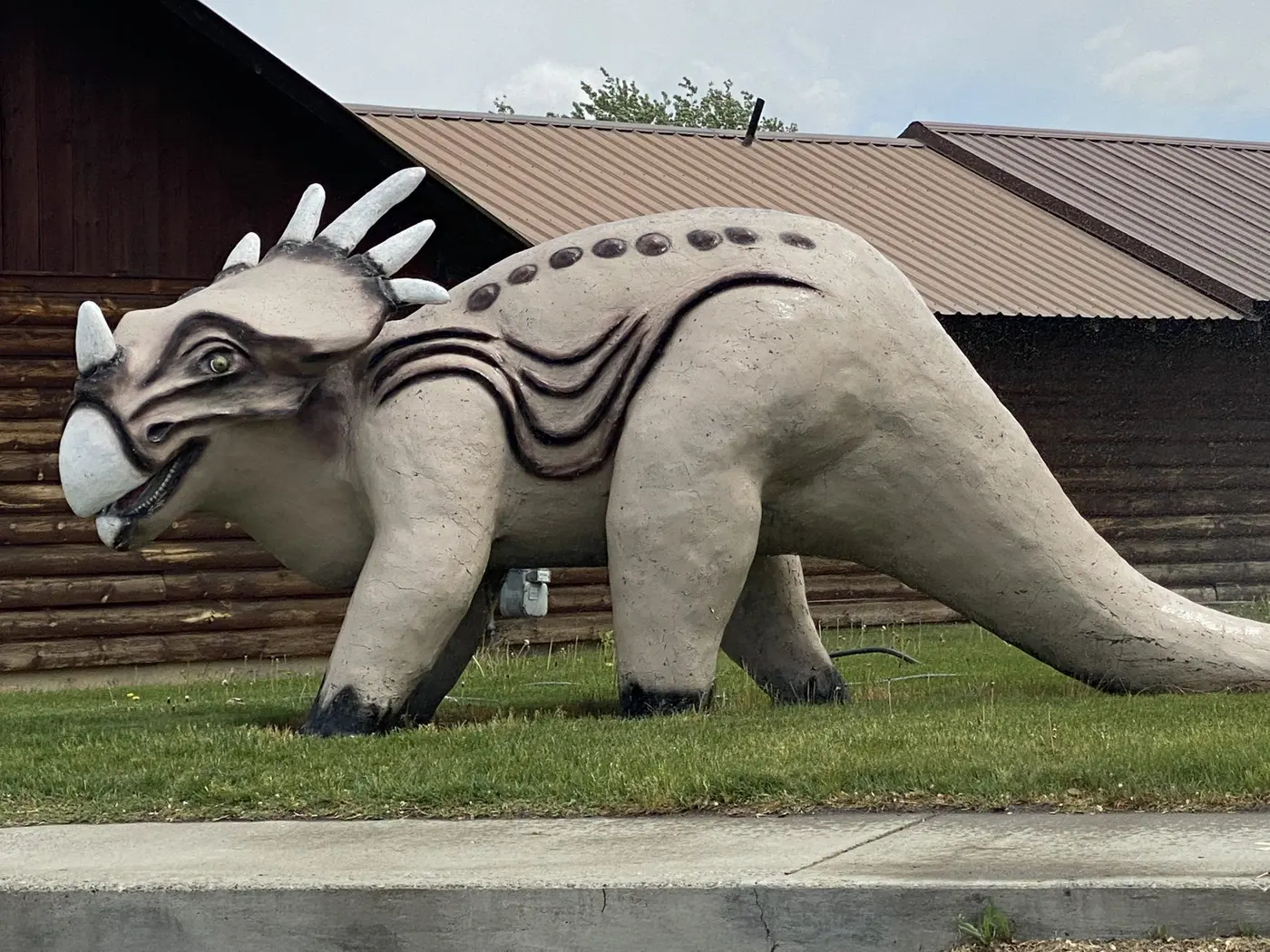
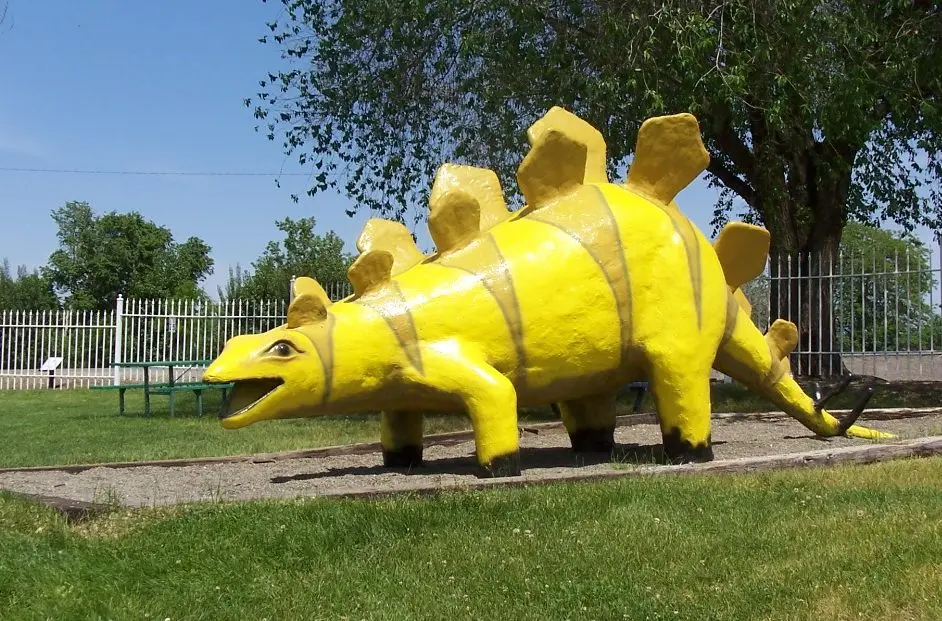
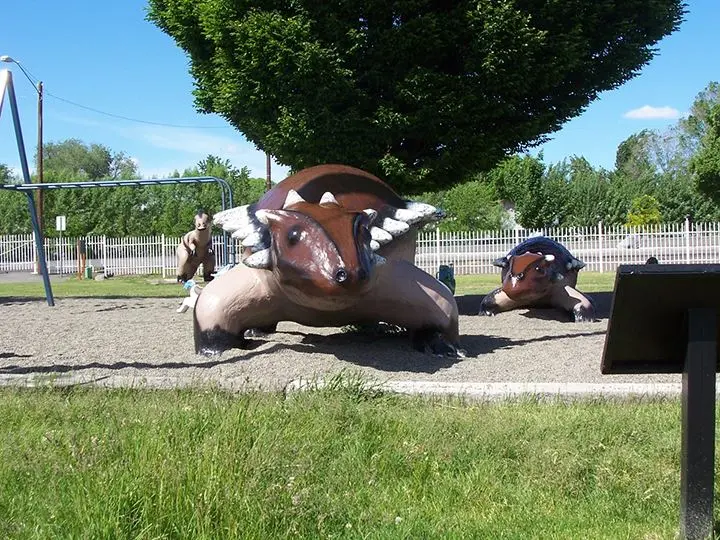
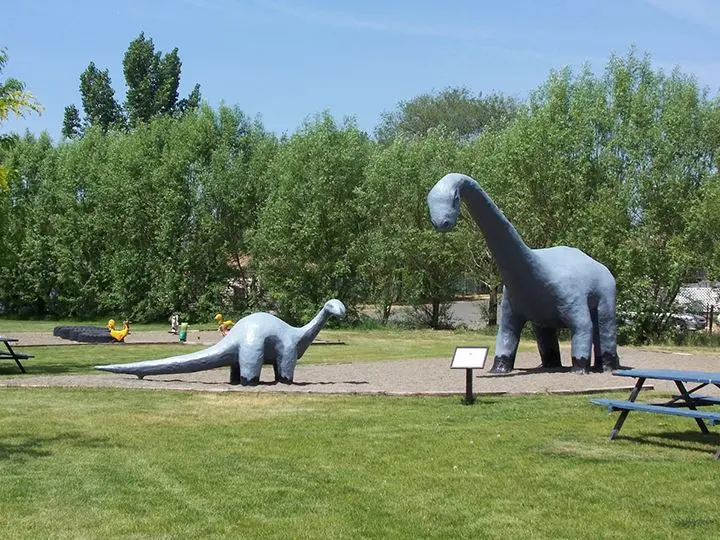
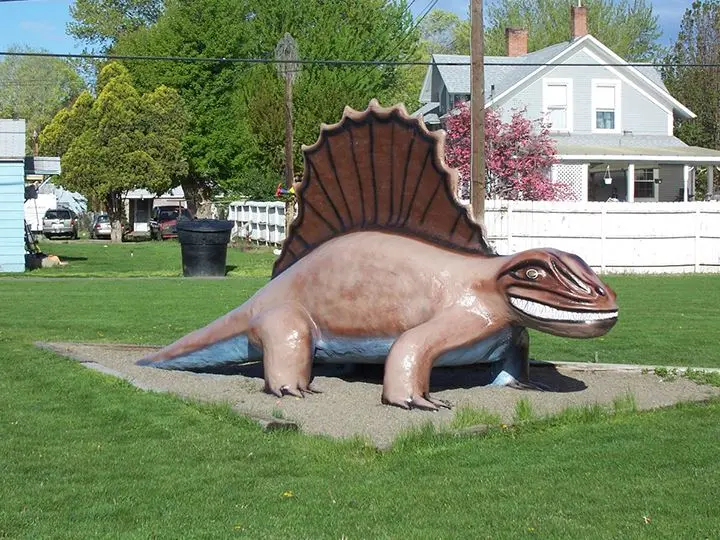
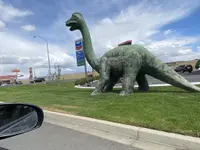
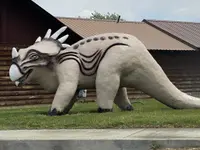
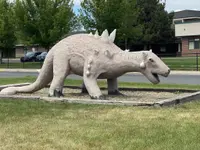
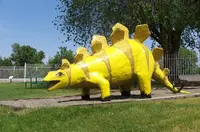
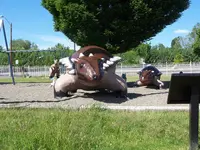
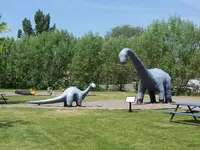
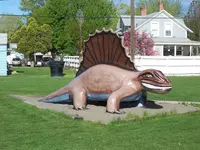
A Plesiosaurus rides in the pond at Hisey Park, where Main Street meets Highway 223 in Granger, Washington. Around it on the grass stand a Stegosaurus, a Brachiosaurus, a Triceratops, a Parasaurolophus, a Dimetrodon, a family of Ankylosaurus, and a family of Megalosaurus near the corner of Main and the highway. The concession stand and restrooms share a building shaped like a volcano, according to the Yakima Herald-Republic. The Oregonian reported in 2017 that the park’s Dino Store serves food and drinks during community events. In 2010 the town dedicated an amphitheater in the park for community gatherings.
The sculptures are life-size, and the City of Granger Public Works Department builds and maintains them. Sources disagree on the count. The city’s own page put it at 33 as of 2019. A 1889 Magazine piece in 2017 said thirty-two. The Oregonian in 2017 gave both 31 and 33 in the same article, and a PBS segment in 2019 said 32. HistoryLink wrote in 2013 that Hisey Park alone held more than two dozen. The town’s motto is “where dinosaurs roam.”
Along Main Street and Highway 223
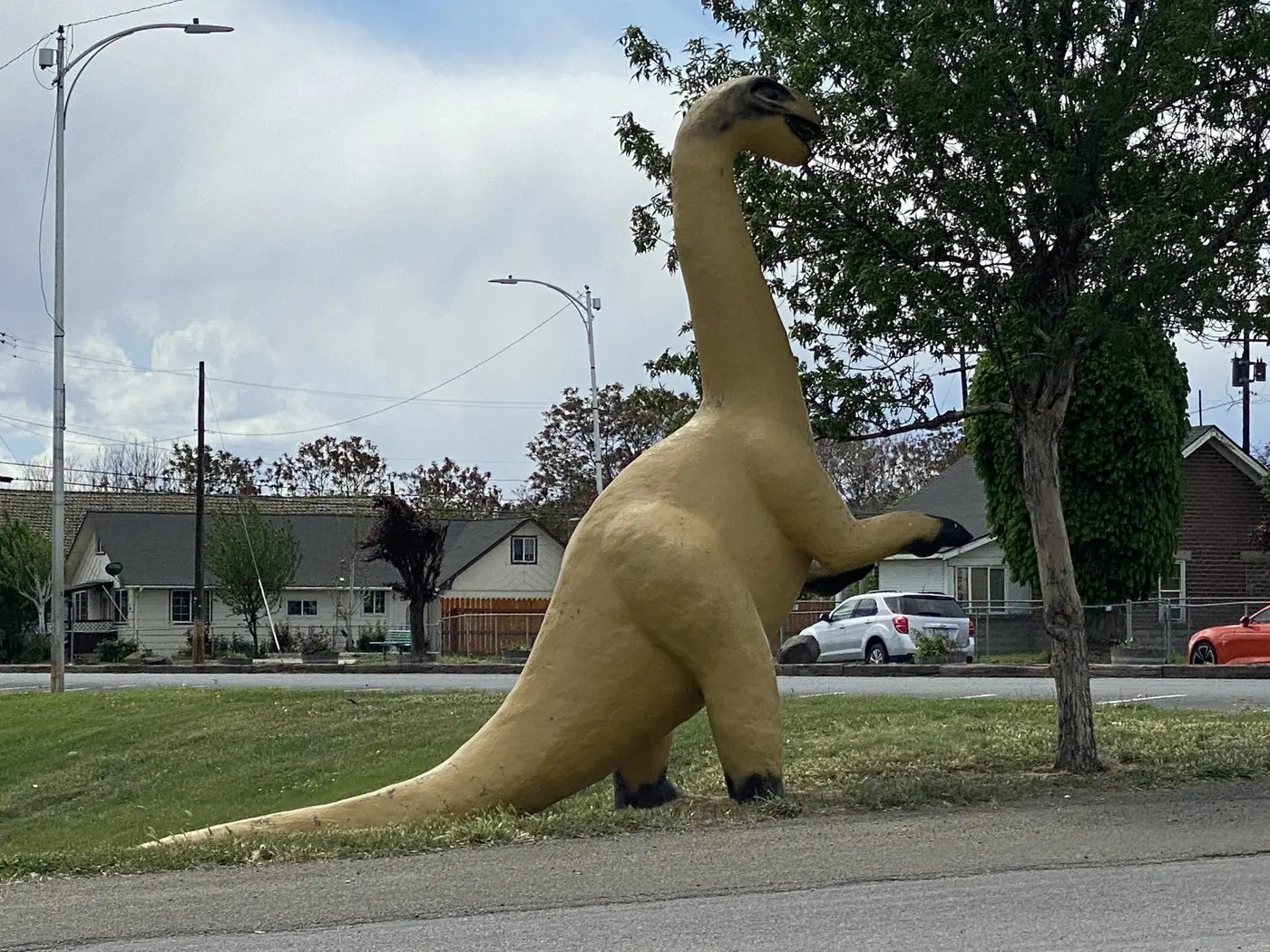
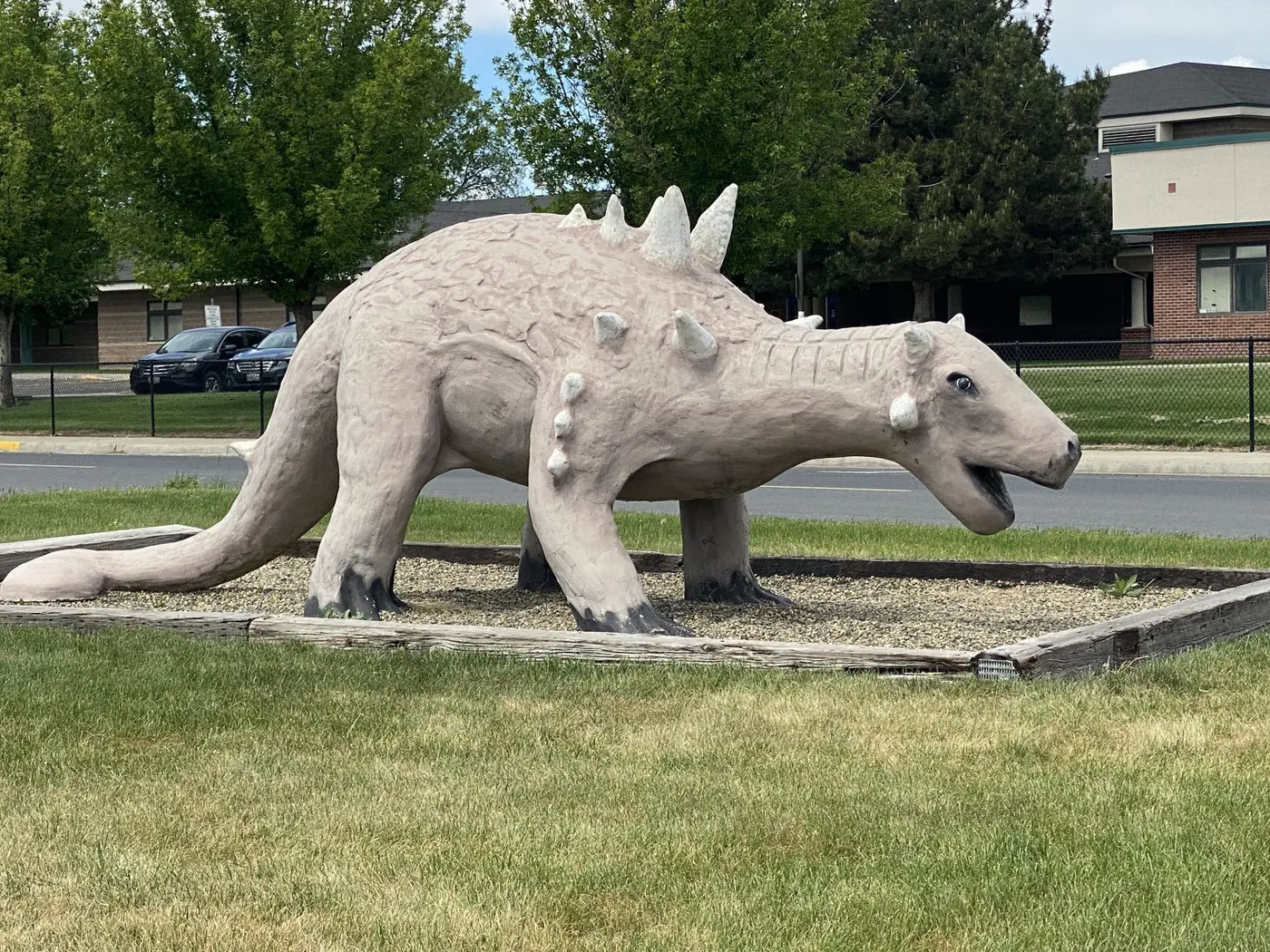
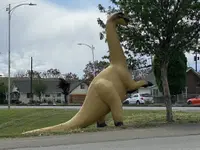
The dinosaurs started in the park and have since spread through downtown. The city prints a DinoDrive Brochure map for a free self-guided drive between downtown and Hisey Park. A family of Maiasaura nests at the Granger Public Library, which the city lists as its 2003 addition, and a Euplocephalus stands there with them. A Chasmosaurus is at City Hall. A Pachycephalosaurus and a Protoceratops stand by the Fire Department. Along Main Street at Main City Park, the Oregonian wrote, an Apatosaurus “stands on its hind legs to munch of the leaves of a tree.” Raptor Park holds a family of Brontosaurus and a pack of Velociraptors. A Corythosaurus stands at Highway 223 and 3rd Street, and a Dilophosaurus stands near the 9/11 Memorial off the same highway.
The city lists its Tyrannosaurus Rex at the Public Works shop. The Oregonian described a Tyrannosaurus “bloodied and roaring” in the grass near Highway 223. The Herald-Republic counted a Sauropelta among the town’s dinosaurs as well.
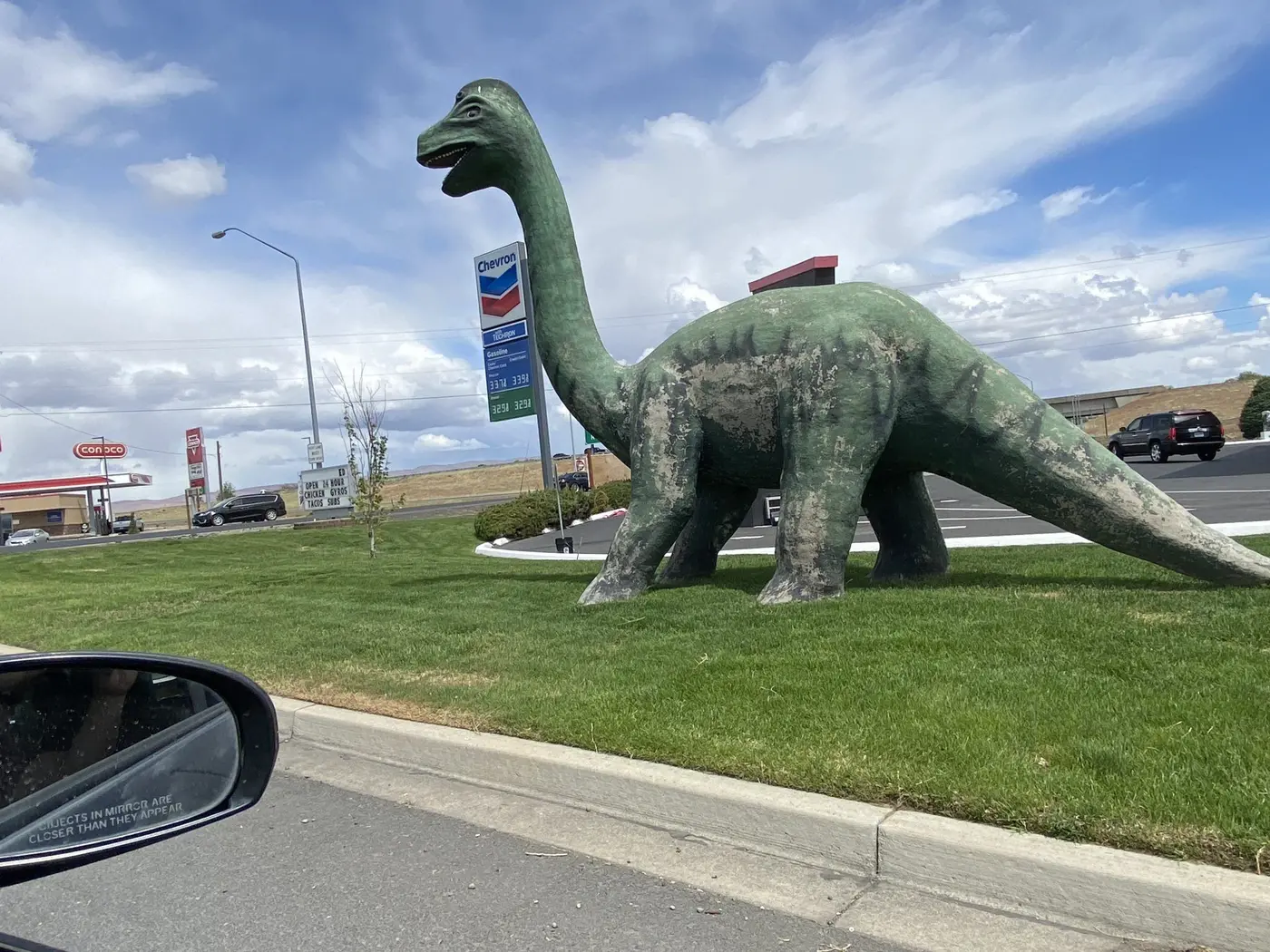
Each account names a different dinosaur at the edge of town. The city places a Spinosaurus at the entry to Granger at Bailey Avenue and SR 223. 1889 Magazine wrote of two Megalosauri welcoming cars. The Herald-Republic described a wire and metal dinosaur greeting drivers coming in, and an Oregonian photograph shows one at a gas station near Interstate 82. The Granger police department wears a dinosaur’s skull on its shoulder patches.
Mammoth tusks in a clay pit
No dinosaur fossils have ever turned up in Granger, the Herald-Republic noted: “The bones of a mammoth, yes. but no dinosaurs.” Those bones came out of the clay that made the town. Walter Granger (1855–1930) helped dig the Sunnyside Canal in the 1890s. The Granger Land Company laid out a town midway between Zillah and Sunnyside in 1904 and named it for him, and Granger incorporated on September 28, 1909. The Granger Clay Products Company had opened a brickyard in 1903. In one of its clay pits, HistoryLink records, woolly mammoth bones and tusks were unearthed.
The brickyard closed in the 1960s when the clay ran out, and farm work thinned as well. By the 1980s Granger was one of the poorest towns in the state. It was also one of the youngest: in 1990 it had 2,053 residents with a median age of 24.1. Wine was drawing visitors into the Lower Valley, but Granger had no wineries or tasting rooms, the Herald-Republic wrote, and needed some other hook.
The city’s account traces the idea to a community planning meeting a couple of years before construction, called to choose a theme and revitalize Main Street. 1889 Magazine dates the meetings to around 1993. Several themes were offered, including a Spanish/Mexican theme and historical preservation of the old brick buildings made from the local clay. The town chose dinosaurs, with the mammoth find in mind. “We were just looking for something to be different,” Jodie Luke, later the public works director, told the Herald-Republic in 2017. He told the Oregonian the same year: “We just thought with dinosaurs, you can’t go wrong there. It just gives us an identity.”
The baby Brontosaurus
In the early part of 1994 the town gave the job to its Public Works Department. The city says the crew suited the work because it had been largely responsible for the community float, which had taken top honors all over the Northwest for three or four years running. Construction began around April 1994. The first dinosaur was a baby Brontosaurus of wire and concrete. It went into Hisey Park, in the Herald-Republic’s words, “with no fanfare, but it became a hit.” The crew experimented with the process on that first one and has since, by the city’s account, “very much refined the steps.”
More followed about one a year. The city lists the Stegosaurus and the Ankylosaurus family from 1994, the Tyrannosaurus Rex from 1995, the Velociraptors from 1996, and the Dimetrodon from 1997. The Dimetrodon first stood at Veteran’s Memorial Park and was later moved to Hisey Park. The Brontosaurus family followed in 1998. By May 2001 the Ellensburg Daily Record was running a story headlined “Has Dinosaur Theme Run Amok?”
A Kentrosaurus on its back
The building became a public event called Dino-N-A-Day, held at Hisey Park on the first Saturday of June. Families come to apply concrete over a wire frame. The city’s page now invites people to help refurbish a member of what it calls “the Granger dinosaur family.” 1889 Magazine described the day as either building a new dinosaur or restoring older ones.
The event has missed a year. In May 2014 the City Council approved the department’s request to cancel the 17th annual Dino-In-A-Day, which had been set for June 7, for that year only. Public Works Director Jack Burnes had retired in March. Jodie Luke, the employee who usually made each wire frame, was filling in as director.
Two years later Luke was director. The Sunnyside Sun found him in the city shop in the days before the 2016 event, helping his crew wrap chicken wire around the rebar frame of a Kentrosaurus, the city’s 32nd dinosaur. The rebar and wire had come from scrap gathered during the city’s annual spring clean-up. “We don’t have to invest a lot of money in it,” Luke said. He estimated the frame took about three days to build. The animal lay on its back in the shop while the crew finished the wiring and put a coat of cement on its belly. “We don’t want wet cement dripping on the kids when they work on it Saturday,” Luke said.
The Kentrosaurus would stand seven or eight feet high and weigh about a ton once the cement was on. The animal it copied, the Sun noted, had been 16 to 17 feet long and weighed one or two tons. That Saturday began at 9 a.m., and the city handed out gloves to anyone who wanted to help spread cement over the frame. The next June, the Oregonian reported, the city planned to pour cement for a new Megalosaurus. After each event, the Public Works crew finishes the dinosaur and paints it.
Notable Events
- 1994The first dinosaur constructed was a baby Brontosaurus. grangerwashington.org
- 1994The town assigned its Public Works Department to produce a dinosaur theme. grangerwashington.org
- 1994Townsfolk began building wire-mesh and concrete dinosaurs and placing them throughout Granger. historylink.org
- 2010Granger dedicated a new amphitheater in Hisey Park for community gatherings. grangerwashington.org
- The annual event was cancelled in part because of strain following Jack Burnes's March retirement. yakimaherald.com
People
- Jodie Luke, Granger public works director who explained the city's search for a distinctive theme.
- Jack Burnes, Retiring Public Works Director; his departure contributed to cancellation of the annual dinosaur-building event (retired in March).
Sources
- grangerwashington.org/254/Dinosaurs
- 1889mag.com/explore/trip-planners/granger-dinosaurs
- grangerwashington.org/255/History
- yakimaherald.com/news/local/happened/it-happened-here-granger-becomes-the-place-where-dinosaurs-roam/article_6c146e6d-ed3e-598f-afff-ee27b9a1a6e3.html
- oregonlive.com/travel/2017/05/dozens_of_dinosaurs_roam_a_sma.html