Kittitas County Fair
Ellensburg, Kittitas County, Washington. County fair; Every Labor Day Weekend.
Details

- Where
- 901 E. 7th Ave., Ellensburg, WA 98926. Directions
- When
- Last held September 3–7, 2026; next year’s date not yet stated.
- Getting there
- From I-90 eastbound (Seattle): take exit 106 Ellensburg/Wenatchee, continue onto W University Way 2.8 mi to parking at E University Way and Alder; ticket booth at 8th and Maple.
- Fees
- Children 5 & Under and Active Military FREE every day; Monday, September 7: FREE ADMISSION ALL DAY; Thursday, September 3: Super 1 Foods Day $5 admission tickets at Super 1; Friday, September 4: Patriot Day, all veterans FREE; all tickets nonrefundable.
- Hours
- Thu 10:00AM-10:00PM; Fri-Sat 10:00AM-11:00PM; Sun 10:00AM-10:00PM; Mon 10:00AM-6:00PM.
- Access
- Fair-week parking is $20 per day in the Premium Parking Lot at University and Alder, or $10 per day at the CWU designated lots.
- Walk-in or reserve
- Pre-sale admission and carnival tickets on sale from July 1st until the day before the Fair.
- Phone
- 509-962-7639
- Managed by
- Kittitas Valley Event Center.
- Established
- 1885.
Under Craig’s Hill
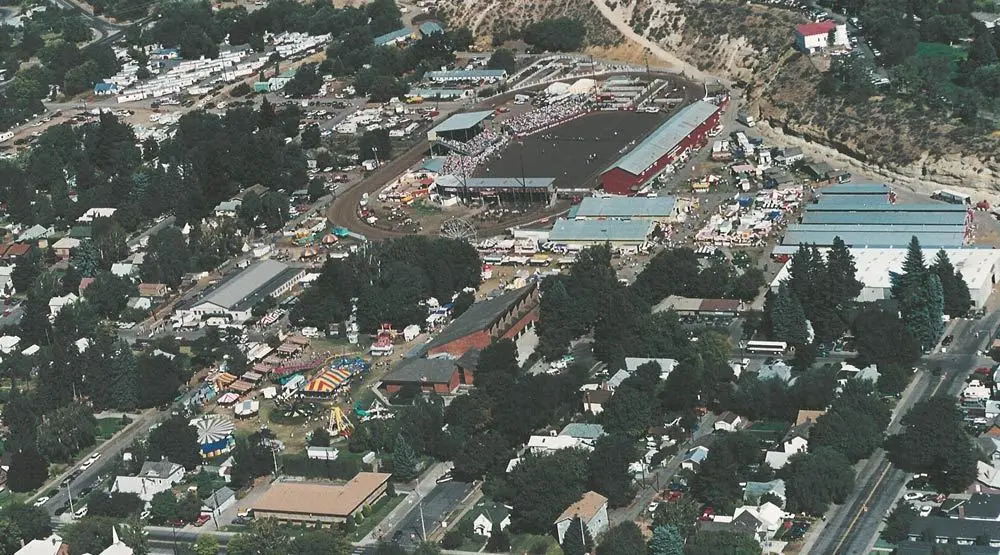
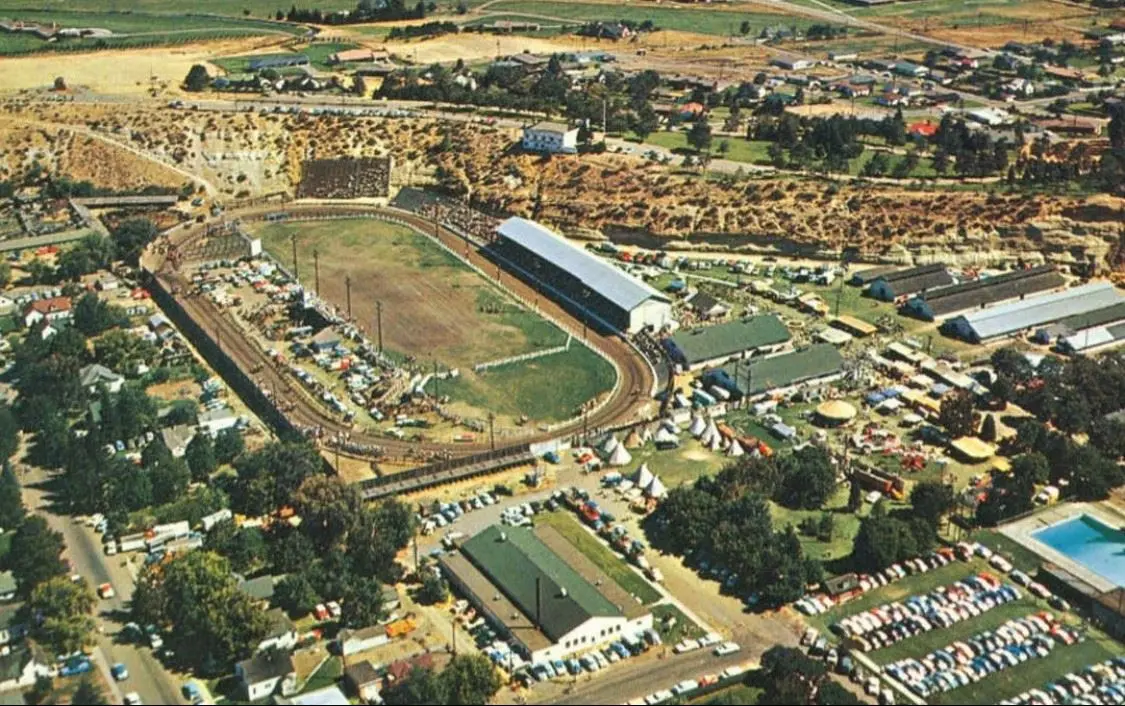
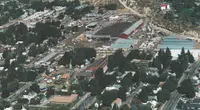
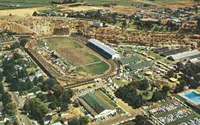
The Kittitas County Fair runs five days over Labor Day weekend, Thursday through Monday, on the county fairgrounds in Ellensburg. The 2026 fair ran September 3 through 7. The grounds sit against Craig’s Hill, an alluvial bank fifty to sixty feet high that forms a natural amphitheater for the rodeo arena below. The Ellensburg Rodeo runs in that arena alongside the fair, before a covered wooden grandstand facing north. The Fairgrounds Historic District is on both the Washington State and National Registers of Historic Places, and the county finished a $3.5 million renovation of its older buildings in 2001.
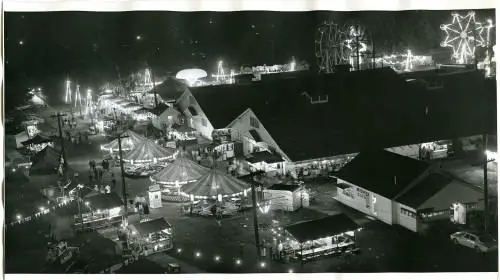
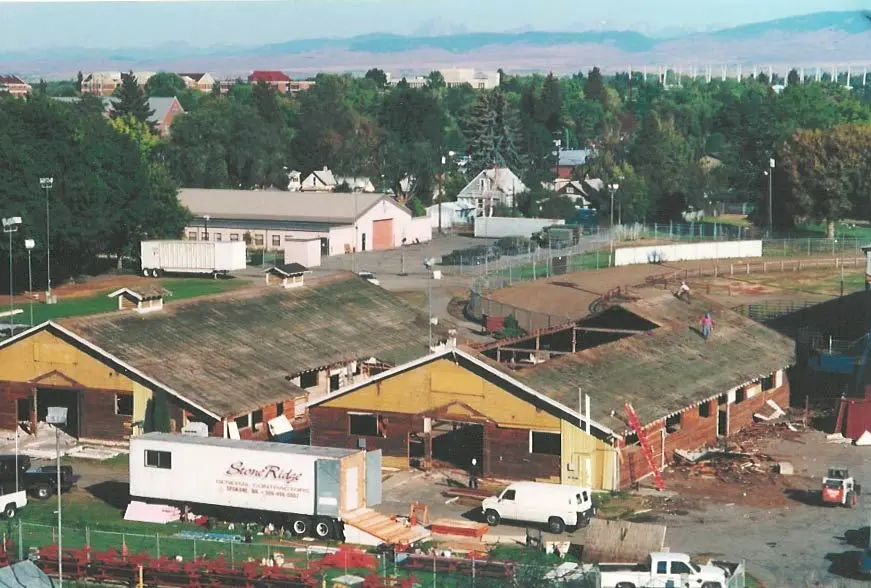
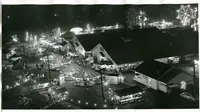
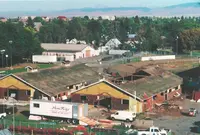
Behind the grandstand, two original wood-frame exhibition halls face a row of three livestock barns across a broad green. Most of the buildings went up in the 1920s, 1930s, and 1940s. They keep their gable roofs, bracketed eaves, ridge ventilators, rustic drop siding, and paint of barn red with white trim. Inside the three early barns the framing is long, clear-grained fir. Early photographs show that green as the fair’s first midway, and Wilson Creek runs beneath it in a straightened channel. The larger carnival rides now stand to the west among the maples of the city’s Memorial Park. Since 2021 they have come from Paul Maurer Shows, which brought a new ride called the Freak Out to its first Ellensburg fair.
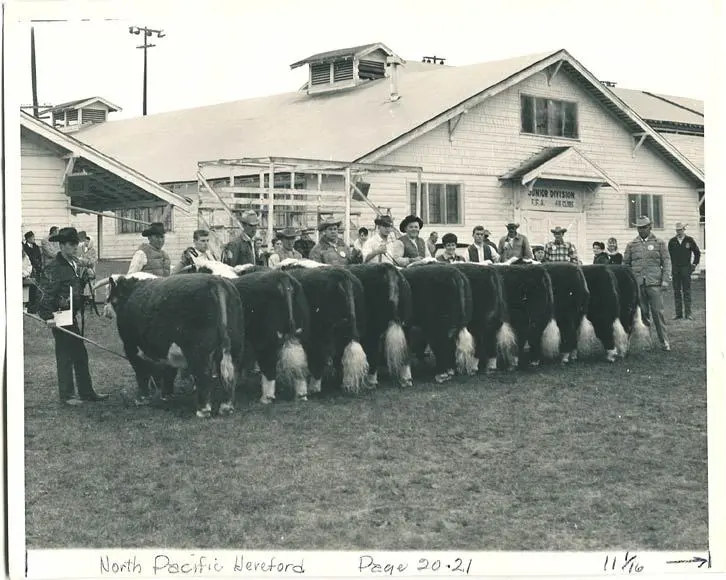
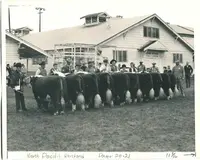
The fair calls itself “a good old-fashioned county fair” with games, contests, judged exhibits, and “an abundance of livestock.” Much of that is the work of county youth in 4-H, FFA, and Grange. Baking entries are judged and given ribbons by score. On Friday the youth Livestock Show and Market Sale fills Bloom Pavilion, an indoor riding arena built in 1978. The 2026 sale raised over $700,000, which the fair reports as the largest in its history, and the fair says proceeds often pay for college.
At the base of Craig’s Hill, a wood-fenced enclosure holds Frontier Village, a cluster of pioneer buildings moved in from around the Kittitas Valley. Fair Board members envisioned it in the early 1980s as an authentic setting for fairgoers. Near the hill the Yakama Nation keeps its encampment. In the fair’s early years Yakama families camped in a “teepee village” in Memorial Park, and the village now stands farther east and north. Each year the tribe makes its entrance on Craig’s Hill during the rodeo’s opening ceremonies.
The fair opens Thursday with a ceremony honoring the Farm Family of the Year. In 2026 that was the Riegal family. It closes Monday at 6 p.m. Labor Day admission is free, and the day brings the Mutton Bustin’ finals and the Bale Bucking Contest.
Mud, cats, and three knives
Rain soaked the 2026 fair over the weekend, and the sun came back for Monday, the Ellensburg Daily Record reported. At Sunday’s rodeo, Justin Dellinger of Ellensburg, in his fifth year at the wild cow milking, felt the rope slip through his hands and went down. He came out with mud from the bottom of his right boot to his shoulder. “It’s muddy out there,” he said.
The same Sunday, the 4-H cat costume contest packed a small room in the Heritage Center. Donna Kirckoff judged the decorated kennels in a sweater that read “MY CAT IS A NATIONAL TREASURE.” She gave the audience her customary warning: if anyone yells “Door!”, close the door, so no loose cat makes a dash for the fairgrounds. There had been a close call the year before. Jensen Fleming came as a diver in mask and snorkel, with his domestic shorthair Bells as a clown fish. “My cat and I are ‘Finding Nemo,’” he said. Emery Grieb was a vampire and her cat Cups a bat. One cat went as a soldier, to suit its name, War Crimes. Juliara Carvo won Judge’s Choice for a kennel done up as the Kitty Cat Candy Cafe, dressed as Batman with her cat Gretta as Robin. “I won!” she said in a hushed scream to the 4-H’er beside her. Back at her kennel she told her cat, “Good boy.”
The weather served Jennifer Hunter, who makes the drive from her store in Yakima to sell Fresh Start Candles, among them a lavender-and-vanilla candle in a purple-and-white ombré. “People running and hiding from the rain have definitely helped us,” she said. Lynn Britton of Kent, marking her 50th year of attending rodeos, had seen her first one in her hometown of Ellensburg and came back “for the parties.” Ellensburg High School cheerleaders worked the grounds selling pink bandanas for the rodeo’s “Tough Enough to Wear Pink” Day. Asked for her favorite ride, Harper Bononcini named the Freak Out. “My stomach dropped.”
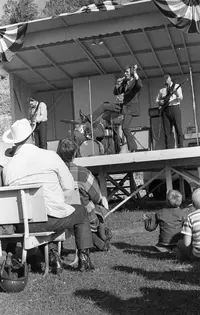
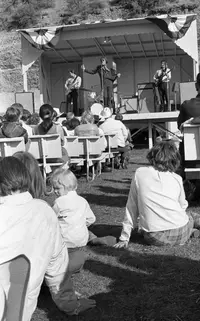
On Monday, juggler Paul Isaac kept three knives in the air while cracking jokes, and Tinned Fish, a strings band, played in Frontier Village.
A fifteen-pound beet at Leonard’s Bridge
According to HistoryLink, the first Kittitas County Fair ran three days, September 30 to October 2, 1885. The county itself had been established only two years before. The fair was one part of the celebrations for a reunion of 18 veterans of the Grand Army of the Republic, the Union Army in the Civil War, hosted by Ellensburg’s James Parsons Post, Number 11. It was held near Leonard’s Bridge over the Yakima River, a spot HistoryLink placed in 2005 at Exit 106 on I-90, the exit travelers from Seattle take for the fair today. The fair’s verse history, written by Edward R. Cook in 1999, spells it Leonhard’s bridge and puts the fair “in a grove, one mile from town.” Kittitas County’s own page gives a different year: it says the first fair was held on the outskirts of Ellensburg in 1886.
Samuel T. Sterling served as secretary and J. L. Brown as superintendent, and admission was $1.00. In a 1972 Daily Record article, valley historian Leta May Smith described the preparations: “Ranchers and townsmen offered to help. All working together, the ground was cleared of brush, the uneven part was smoothed, a fine racetrack was built ... tables were erected in the shade of the trees and a few benches placed in a row for seats was a grandstand.”
Those tables held grapes, apples, wine, pickles, and preserves. They also held a red beet weighing 15 pounds, which one fairgoer called “fine to look at but no good to eat.” Women showed knitting, tatting, embroidery, and hair work, the wreaths, crosses, and chains made from human hair. Mrs. C. W. Stuart entered ornamental hair work in chains. There were hogs, sheep, cattle, chickens, and horses, along with foot races and horse races, a greased pole, and a greased pig. The old soldiers demonstrated bugle calls and kept the grounds tidy. On the last night the county held a ball at Johnson House downtown. By Cook’s account, the event lost money.
Store windows, a tent, a woolen mill
For years afterward the fair was held only intermittently, in HistoryLink’s account, and the National Register nomination calls its beginnings “sporadic,” with informal events through the 1890s. In 1906 it was a downtown street fair, with exhibits in storefront windows. Cook dates the “First Annual Kittitas County Fair” to 1912, still without grounds of its own. In 1914 a huge tent held the exhibits, and games and races ran at the old ball park.
In 1915 a Harvest Festival took the fair’s place. Fifty local businesses set out to feed everyone on a ton of meat, some bread, and more. They ran out and had to buy food from every store in town. “The businessmen laughed at their mistake,” Cook wrote, “as their wallets shed a tear.” World War One canceled the fair from 1917 through 1919. From 1920 through 1922 the displays went into an old brick woolen mill next to downtown, with a carnival set up in the streets. Cook says the mill became the Boise-Cascade building.
June 14, 1923
West of town near Thorp, ranchers had begun holding informal “Sunday rodeos” that drew hundreds of spectators. Kittitas Valley rancher Ben Ferguson recalled how his family started one: “(We) had all them horses and, my brother and a couple of friends put on a rodeo. … They got a wagon load of poles and made the corral and made the arena (and) chutes.” Their success showed that a rodeo could become a yearly part of the fair.
Leonard Davis, the county’s first extension agent, began pressing for permanent grounds in 1922, and newspaper editor Clifford Kaynor joined him. State law would not let counties buy land, so Senator McCauley introduced a bill to allow it. The Daily Record reported in 2019 that in April 1923 the county commissioners budgeted $10,000 for 18 acres, an arena, and bleachers. The 2016 county master plan instead credits a $10,000 infusion from the state. The tract lay just outside the city limits and held sagebrush and a winding, flood-prone creek. Native peoples reportedly once corralled and pastured horses there during their annual gatherings. Cook calls it Shwoowtookpama, the spot beneath the hill.
On June 14, 1923, by Cook’s account, every business and office in the county closed. Local cattleman Lou Richards organized the crews, and five hundred men arrived with over two hundred horses and “Fresno” scrapers. They fenced the grounds, moved Wilson Creek closer to the hill, graded the race track, and built bridges, and the women provided the feast. A quarter-mile driveway was cut along the face of Craig’s Hill, and it is still partly used as an entry into the arena. County engineer W. T. Bowman laid out the arena, oval, and exhibit grounds in the plan the fairgrounds still follow. Richards went on to direct the rodeo arena.
The first fair on the new grounds ran September 13 through 15, 1923, with a Wild West Rodeo as its main attraction, and over 500 would-be spectators were turned away for lack of room. Game warden Frank Bryant, who spoke Chinook Jargon, arranged for the Yakama to attend, and 150 tribal members came. By 1937 more than 20 tribes were represented. The south and west grandstands were finished in 1927. During World War Two, gas shortages called off the rodeo. In its place the Ellensburg Rodeo Posse, the state’s first chartered rodeo posse, held a horse show and pageant on the fairgrounds. Bryant stayed with the rodeo into the 1940s and worked with the Yakamas to make sure they came back for the first event after the war, in 1945.
Notable Events
- 1885From September 30 to October 2, 1885, the first Kittitas County Fair ran three days near Ellensburg, attracting celebrants from throughout the Kittitas Valley with livestock, produce and handicraft exhibits. historylink.org
- 1886The county states the first fair was held on the outskirts of Ellensburg in 1886, and calls the fair one of the oldest in the State of Washington. co.kittitas.wa.us
- 1906The fair took the form of a downtown street fair with exhibits housed in storefront windows. npgallery.nps.gov
- 1912The First Annual Kittitas County Fair was held in 1912, with no official fairgrounds. co.kittitas.wa.us
- 1915In 1915 the Harvest Festival was held in place of the fair, leaving 50 local businesses scrambling; it ran out of food and had to buy more from every local store. co.kittitas.wa.us
- 1917The fair was canceled from 1917 through 1919 because of World War One. co.kittitas.wa.us
- 1920For three years, from 1920 through 1922, an old brick woolen mill adjacent to the downtown held displays, with a carnival set up in the streets. npgallery.nps.gov
- 1923Local business owners and ranchers joined the Fair Board and in April 1923 convinced the Kittitas County Commissioners to budget $10,000 for 18 acres adjacent to the fairgrounds, plus an arena and bleachers. dailyrecordnews.com
- 1923The grounds were bought and prepared in one summer for the first rodeo, which took place in September 1923; over 500 would-be spectators were turned away for lack of room. dailyrecordnews.com
- 1923After years in which the fair was held only intermittently, a permanent fairground site was established in 1923 and many buildings erected; from that year the fair was an annual Labor Day weekend event and the Ellensburg Rodeo was organized officially to run concurrently. historylink.org
- 1923With the building of the rodeo arena and the first permanent buildings on the fairgrounds in 1923, the beginnings of the permanent location for the combined County Fair and Rodeo took hold. kittitasvalleyeventcenter.com
- 1923Five-hundred men arrived with over two hundred horses and "Fresno" scrapers to fence the grounds, re-route Wilson Creek, grade the race track and build bridges. npgallery.nps.gov
- 1980sThe village was envisioned during the early 1980's by Fair Board members who wanted to create an authentic experience for fairgoers. kittitasvalleyeventcenter.com
- 1999The Kittitas County Fairgrounds property was listed in the National Register of Historic Places. npgallery.nps.gov
- 2001Kittitas County undertook a $3.5 million historic renovation of the buildings that had their beginnings over 75 years ago; the project was completed in 2001. kittitasvalleyeventcenter.com
- The land bill passed in the early days of June the very next year and the county purchased 18 acres within the week. co.kittitas.wa.us
- World War II caused the rodeo to be called off over gas shortages; the Ellensburg Rodeo Posse organized a horse show and pageant at the fairgrounds in lieu of the rodeo, and community support kept it going through the hiatus years. dailyrecordnews.com
People
- Clifford Kaynor, Editor of the Ellensburg Evening Readers who joined the drive for permanent fairgrounds.
- Senator McCauley, Introduced the bill that let counties purchase or own land for fairgrounds.
- W. Leonard Dave, The county's first extension agent, who became involved with the fair after World War One and drummed up interest in permanent grounds.
- Ben Ferguson, Kittitas Valley rancher whose family took part in the Sunday rodeos whose success led the fair to add an annual rodeo.
- Frank Bryant, ERHOF inductee and game warden who coordinated the Yakama tribe's attendance at the first 1923 rodeo (active until the 1940s).
- J. L. Brown, superintendent of the first fair (1885).
- Leta May Smith, Kittitas Valley historian who described the first fair's preparations in the Ellensburg Daily Record (1972).
- Samuel T. Sterling, Secretary of the first Kittitas County Fair (1847-ca. 1931).
- Leonard Davis, county extension agent who was the catalyst for creation of a permanent fairgrounds (1923).
- Lou Richards, local cattleman who organized the Field Day work crews and would become the rodeo arena director (1923).
- W. T. Bowman, county engineer who established the fairgrounds layout (1923).
Sources
- kittitasvalleyeventcenter.com/p/at-the-fair
- kittitasvalleyeventcenter.com/p/tickets
- kittitasvalleyeventcenter.com/p/at-the-fair/carnival
- kittitasvalleyeventcenter.com/p/at-the-fair/contest-center
- kittitasvalleyeventcenter.com/p/about/directions-and-parking
- kittitasvalleyeventcenter.com/p/at-the-fair/market-sale
- facebook.com/KittitasCountyFair
- dailyrecordnews.com/kittitas-county-fair-comes-to-a-sunny-finale/article_b730e1f3-85c4-4e87-b47c-904874764763.html
- dailyrecordnews.com/ellensburg/fair-thee-well-kittitas-county-fair-wraps-up-as-weather-frowns-turn-upside-down/article_9e98aa01-ec0c-489e-a84f-e1bda57656ef.html
- kittitasvalleyeventcenter.com
- kittitasvalleyeventcenter.com/p/at-the-fair/fair-hours-and-admission
- kittitasvalleyeventcenter.com/p/about/contact-us
- dailyrecordnews.com/news/ellensburg-rodeo-history-rooted-in-civic-involvement/article_28285003-232c-592b-bc90-91eaceb14b9d.html
- co.kittitas.wa.us/uploads/bocc/agenda-files/6208/files/Kittitas%20Valley%20Event%20Center%20Master%20Plan%20-%20FINAL.PDF
- kittitasvalleyeventcenter.com/p/about/history
- historylink.org/File/7558
- npgallery.nps.gov/GetAsset/b78651e9-cf9a-4f9a-ae51-e7b71fd782a7
- co.kittitas.wa.us/kvec/fair.aspx
- kittitasvalleyeventcenter.com/p/at-the-fair/frontier-village