Cle Elum
Kittitas County, Washington.
A Kittitas County town on the upper Yakima River that grew on coal and the railroad and, in the 1920s and 1930s, a ski jump that drew thousands.1
Details
- Founded
- Gamble staked a claim on April 28, 1883, and Reed filed on the quarter-section just west of it that June; that summer both built cabins and became the town’s two founding families.1
- Name
- Reed and his wife, with Gamble and Johnson, named the town for the river, from the Indians’ word Tle-el-Lum, said to mean swift water.1
- Last checked
- October 6, 2026.
Point at a dot to see the place.Tap a dot to see the place. Road map of Cle Elum.
In Cle Elum
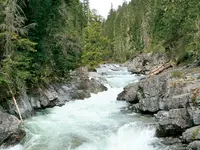
- Swiftwater CorridorCle Elum · State bywayThe Swiftwater Corridor rambles through back roads from Roslyn east of Snoqualmie Pass to Vantage on the Columbia River, past historic towns, logging camps, mines and ranches.
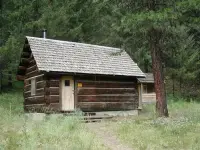
- Teanaway Guard StationCle Elum · CabinTeanaway Guard Station is a cozy log cabin retreat for two.
The Calendar
History
Tle-el-Lum and the Claims of 1883
Cle Elum stands on the upper Yakima River in Kittitas County, about 30 miles east of Snoqualmie Pass, on Interstate 90, the state’s main highway route across the Cascades.1 For centuries the Kittitas band of the Yakama Tribe lived on this land, and in an 1855 treaty the Yakamas ceded it; by 1859 most of the band had been forced onto the Yakama Reservation.1 The 1950 state guide names the first settler as Thomas L. Gambel, a prospector, who came in 1870.2 The encyclopedia history spells him Gamble, a pioneer from Yakima, and dates his claim to April 28, 1883, a quarter-section on what is now the eastern part of the city.1 On June 4, 1883, his old friend Walter J. Reed filed on the quarter-section just west, and that summer both men built cabins and became the two founding families.1 Reed and his wife, with Gamble and fellow pioneer Tom Johnson, named the town Cle Elum from Tle-el-Lum, the Indians’ word for the river, said to mean swift water; the 1950 guide has it named for the river that tumbles down from Lake Cle Elum.1,2
Reed’s Depot and Gamble’s Coal
The settlement came alive in 1884, when coal was found in the hills around what is now Roslyn, just as the Northern Pacific was pushing west for Stampede Pass and needed coal for its locomotives and timber for ties, trestles, and tunnels.1 In 1884 Reed persuaded the railroad to move its proposed depot here from Teanaway, and he and Tom Johnson built a sawmill to supply lumber for the railroad and its Stampede Pass tunnel.1 The first train reached the new depot on October 11, 1886, and that year Reed platted 60 acres as a townsite, by some accounts with wide boulevards because his wife, Barbara Steiner Reed, believed the town might become another Pittsburgh.1 In 1888 a miners’ strike spread from Roslyn and crowds demonstrated outside the Reed House, and in 1889 the Northern Pacific withdrew most of its crews after finishing the Stampede Pass tunnel.1 In 1894 coal was found on Gamble’s own property, Gamble sank a shaft, and the population rose to 762 by 1900.1 The 1950 guide tells it otherwise, crediting new coal veins found in 1889 with keeping the town alive after a forest fire and the removal of its sawmill.2 The town incorporated on February 24, 1902, with Gamble as first mayor, though the city’s own page gives the date as February 12, 1902.3,4 As word of mining jobs spread, Italians, Croats, Poles, and Slovaks arrived by the hundreds, and the 1910 census counted 2,749 people, which the encyclopedia history calls the town’s all-time high.1,3 John A. Balmer, a former professor of floriculture at Washington State College who later served as mayor, grew roses in fields and greenhouses and shipped them by rail to Puget Sound cities.1 In 1906 John and Letizia Pricco, from the Piemonte region of Italy, opened the Cle Elum Bakery and baked bread in a wood-fired brick oven stoked with four-foot fir and pine logs.1
The Fire of 1918 and the Fall of Coal
On June 25, 1918, a fire that began in a rubbish pile outside a movie theater destroyed 205 homes and half the business district and left an estimated 1,800 people homeless.1 Firefighters from Roslyn and surrounding districts fought it with water and dynamite, and the Priccos rebuilt their bakery and had it debt-free within two years.1 The coal economy peaked during World War I and collapsed in 1919, and by 1933 coal production in Cle Elum and Roslyn had fallen by more than half.1 During the Great Depression hoboes jumped off freight trains for bread at the bakery, and Bernardo Pricco, son of the owners, recalled that his parents never turned one away.1 In 1950 the state guide found the coal market reduced, partly by the development of water power, though mining was still important and the town shipped lumber and farm and dairy products.2 Mining was gone by the 1960s, logging had peaked, and by 2010 the population was 1,872.1
The Summit Jump
In 1921 John “Syke” Bresko, Russell Connell, and John Koester organized the Summit Ski Club, renamed the Cle Elum Ski Club when it incorporated in 1928.5 Members made their own skis and laid out the Summit course two miles north of town on 40 acres leased from the Northern Pacific, with runs called Devil’s Dive and Hell’s Dive.5 To host the 1932 Pacific Northwest National Ski Tournament, the club put up a new 75-foot tower, and merchants paid $5,000 for the new jump and recontoured hill; there John Elvrum of Portland jumped 202 feet, a new Northwest record.5 The 1933 tournament was the club’s last; the Snoqualmie Pass highway had been kept open through the winter since the 1931-1932 season, and the club and its ski area faded after 1936.5
The Carpenter House and the Munro Marker
The city describes the Carpenter House as a 1914 mansion with a third-floor ballroom that holds the story of Cle Elum’s first successful banker and his family.4 A marker in Cle Elum recalls Douglas A. Munro, who was in charge of landing craft evacuating Marines from Guadalcanal, used his boat to cover the last men’s escape, and was fatally wounded minutes after the last Marine was safe.6
Within 30 Miles
Measured in a straight line from the town, nearest first.
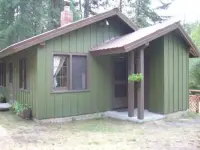
- Taneum CabinThorp · CabinThe Taneum Cabin is located in the Okanogan-Wenatchee National Forest, approximately 20 miles from Ellensburg, Washington. The cabin is accessible by car and provides many of the same comforts of home. Guests only need to bring a few of their own amenities for an enjoyable stay.
- Yakima River Canyon Recreation Sites (BLM), Kittitas/Yakima County, WAEllensburg · Developed river access sitesThe gentle Yakima River winds through rolling desert hills and basalt cliffs, some rising more than 2,000 feet, for 27 miles between Ellensburg and Yakima, Washington. The canyon offers excellent wildlife watching, fishing for Blue Ribbon trout, family-friendly rafting, and camping. The BLMs crevices and cliffs make a perfect home for the densest concentration of nesting hawks, eagles, and falcons in the state.
- Yakima River Canyon Scenic BywayEllensburg · Scenic bywayThe short and sublime Yakima River Canyon Scenic Byway, also known as Canyon Road, this byway is a dazzling alternative to driving I-82 between Ellensburg and Yakima. A trip that is scenic yeararound, Canyon Road follows the Yakima River on a lonely, curvy twolane road between high-desert sage-covered hills.
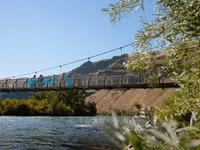
- Dick and Jane's SpotEllensburg · Art site, home, and studioDick and Jane's Spot, at First and Pearl in Ellensburg, Washington: a home and yard begun in 1978, seen from the fence, studded with over 10,000 bottle caps.
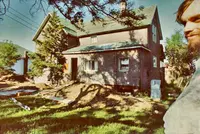
- Kittitas County FairEllensburg · County fairThe Kittitas County Fair in Ellensburg, first held in 1885 as part of a Civil War veterans' reunion, fills grounds that volunteers graded with horses and Fresno scrapers in 1923.
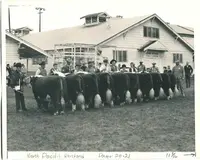
- Franklin Falls TrailheadSnoqualmie Pass · TrailheadA trailhead off I-90 Exit 47 near Snoqualmie Pass, where a one-mile path reaches a 70-foot falls and a loop follows the last mile of the 1860s wagon road.
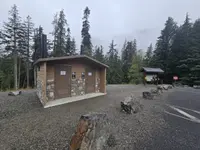
- Leavenworth National Fish HatcheryLeavenworth · Public u.s. fish & wildlife service facility (national fish hatchery)A 1940 national fish hatchery on Icicle Creek near Leavenworth, Washington, whose cool summer water still runs from a valve beneath Snow Lake, opened by hand each year.
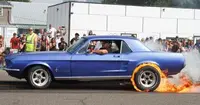
- Kruisin’ Kittitas Car Show & BurnoutsKittitas · Car show & burnoutsClassic cars, community, and burnouts in the City of Kittitas.
Nearby towns: Ellensburg, Yakima, Enumclaw, and Snoqualmie. All the towns of Washington. More of Washington: Town Festivals, Scenic Drives, and Lookouts & Cabins.
Sources
- Cle Elum -- Thumbnail History historylink.org/file/10646
- Washington: A Guide to the Evergreen State (1950), p. 317 babel.hathitrust.org/cgi/pt?id=mdp.39015010545013&seq=403
- Cle Elum is incorporated on February 24, 1902. historylink.org/File/10647
- City of Cle Elum cleelum.gov/about_cle_elum
- Cle Elum Ski Club historylink.org/File/10169
- Douglas A. Munro (historical marker) hmdb.org/m.asp?m=62785