Coupeville
Island County, Washington. County seat.
Coupeville, the Island County seat on Whidbey Island, rests along Penn Cove, grew from Thomas Coupe’s 1852 claim, and lies inside a national historical reserve.1,2,3
Details
- Founded
- Sea captain Thomas Coupe founded the town, arriving in Puget Sound in 1852 and filing a 320-acre donation land claim on the site.3
- Name
- The town is named for sea captain Thomas Coupe, who arrived on Puget Sound on the bark Success.4
- County seat
- Coupeville has been the seat of Island County since 1881.4
- Last checked
- October 6, 2026.
Point at a dot to see the place.Tap a dot to see the place. Road map of Coupeville.
In Coupeville

The Calendar

History
Captain Coupe’s Claim on Penn Cove
Coupeville stands on the south side of Penn Cove on Central Whidbey Island, where 19th-century false-fronted commercial buildings still line Front Street.2,5 The National Park Service says it is the only town located within Ebey’s Landing National Historical Reserve.1
Before settlement, Lower Skagit people built three permanent villages on Penn Cove, the largest of them bah-TSAHD-ah-lee (snake place), where Coupeville now stands.4 After the Point Elliott Treaty of 1855, HistoryLink says, many Lower Skagit people were placed on the Tulalip reservation and a few stayed in Coupeville; the National Park Service says the treaty relocated them to what is now the Swinomish Tribal Community in La Conner.2,4
Sea captains and merchants from New England came for the protected harbor and for timber valued for shipbuilding.2 The town was established in the early 1850s after several sea captains who had worked the waters of Puget Sound decided to retire there; Thomas Coupe, captain of the bark Success, settled at Penn Cove in 1852.3,4 Coupe had startled his peers by sailing a full-rigged ship through Deception Pass, and in 1852 he claimed the 320 acres that later became the town.2 His wife, Maria, and their family joined him in 1853, but settler C. H. Ivans claimed the same ground, so Coupe filed on April 3, 1854, and paid Ivans to clear the title.4 The Coupe land became the eastern part of the town and John Alexander’s claim the western part.4
Blockhouses and the Haller House
Unrest after the treaty signing in January 1855 led Whidbey settlers to build four blockhouses, the murder of the settler Isaac Ebey spurred three more, and four of the seven remain.2,4 John Alexander, Sr. built one on his claim in about 1855, though its marker says it may have been used instead as a root cellar, and in the 1930s residents moved it beside the Island County Historical Museum.6 The Writers’ Program guide to Washington counted the houses of Major Granville O. Haller and Captain Thomas Coupe at Coupeville among the New England Colonial type the settlers brought west.7 The Haller House in downtown Coupeville joins a portion built by Raphael Brunn in 1859 to a two-story I-house the Hallers added in 1866.8
County Seat and Steamer Port
Coveland, at the head of Penn Cove, held the county seat from 1853 to 1881, when Coupeville took it and began to look like a real town, with more homes, stores, and churches.4 Mosquito Fleet steamers ran from Coupeville to Bellingham in the 1890s, and the town prospered from shipbuilding and from shipping fish, produce, lumber, and timber.4 John Sprague of the Northern Pacific Railroad bought 20,000 acres in Island County and set off rumors of a West Coast terminus at Coupeville, but the railroad chose Tacoma.4
Fort Casey, the Wharf, and Incorporation
Coupeville had about 300 people in 1900 when the opening of Fort Casey in 1901 added a floating population of more than 300 men.4 Local merchants and farmers built a 500-foot dock into Penn Cove at the foot of NW Alexander Street in 1905, and in 1906 Howard B. Lovejoy bought the sternwheeler Fairhaven and began runs to Seattle.4,5 Some residents feared lost farmland and higher taxes, but on April 2, 1910, the town voted 41 to 36 to incorporate and elected Charles H. Lyon mayor.9 J. H. Parker, chosen town marshal and street commissioner, got as his first task raking the rocks out of Main Street, and by the end of 1911 Coupeville had telephones and street lights.9
From Ferry Landing to Historic District
In the Depression the town used federal funds from the Works Progress Administration and the Civilian Conservation Corp for roads, an extended water system, and its first sewage treatment plant.4 The automobile and the completion of Deception Pass Bridge in 1935 ended the water era, and passenger ferry service at Coupeville was suspended in 1936.5 Explosive growth in the 1950s and 1960s threatened Whidbey’s rural life, islanders grew more dependent on the Naval Air Station at Oak Harbor for jobs, and between 1953 and 1979 Coupeville annexed 11 times, reaching nearly 700 acres.4 In 1967 port commissioners planned a large modern marina, and residents made it clear they did not want one as a backdrop to their new historic district.5 About 8,000 acres including the town became the Central Whidbey Island Historic District in 1972 and went on the National Register in 1973, and in 1978 the district joined Ebey’s Landing National Historical Reserve, which HistoryLink calls the first of its kind in the nation.4 Elmer Calhoun bought the wharf in 1909 and added a grain tower, which came down in 1985 when the east end of the wharf building became a marine store and delicatessen.5 In 1998 the crew filming Practical Magic painted the entire length of Front Street white, and Coupeville Liquor kept the false front applied to its exterior.10
Within 30 Miles
Measured in a straight line from the town, nearest first.
- Holland HappeningOak Harbor · Two-day spring celebrationThe Holland Happening & International Festival is Oak Harbor's April weekend honoring Whidbey Island's Dutch settlers, where small wooden shoes race down a water-filled canal at Windjammer Park.

- Jefferson County FairPort Townsend · County fairThe Jefferson County Fair runs three August days at the fairgrounds in Port Townsend, Washington, where in 2026 a sixteen-year-old ran the poultry department.

- Rhododendron FestivalPort Townsend · FestivalRhody Week events include trike races, the Pet Parade, Grand Parade, Kiddie Parade, Bed Races, beard judging, golf tournaments and a downtown store window display contest.
- Festival of American Fiddle Tunes (Centrum), Fort Worden, Port Townsend WAPort Townsend · All-day music festivalA week of fiddle classes, dances and late jams at Fort Worden State Park in Port Townsend, Washington, whose concerts fill a converted balloon hangar.

- Eaglemount Wine & CiderPort Townsend · Tasting room, event space, and innCidery, winery, inn, and dance hall on the Arcadia estate outside Port Townsend, Washington, pouring cider from an 1883 homestead orchard in a former yacht club.

- Finnriver Farm & CideryChimacum · Cider gardenorganic farm, orchard and craft cidery located along a salmon stream in the Chimacum Valley on the north Olympic Peninsula of Washington

- Stanwood-Camano Community FairStanwood · Community fairA three-day agricultural fair on Pioneer Highway just south of Stanwood, Washington, begun as a Stillaguamish Grange harvest day in 1932 and still run almost entirely by volunteers.
- Hierophant MeaderyFreeland · Tasting roomA botanical meadery by Double Bluff Beach on Whidbey Island, Washington, where two herbalists infuse honey wine with nettle and fir tips and mark the seasons with bonfires.

- Whidbey Island FairLangley · Old-fashioned country fairAn old-fashioned country fair of four July days in Langley, on Whidbey Island, held around a log-trussed Pole Building the WPA paid for in the 1930s.
- Festival of Family FarmsMt Vernon · Two day self guided tour through the beautiful skagit valleyA free two-day October tour of working farms across Skagit County, Washington, where in 2026 nine families opened gates from a Samish Bay oyster bed to an apple orchard open only that weekend.

- Silvana Community FairSilvana · One-day community fairA one-day youth livestock fair held since 1947 in the hayfield behind Viking Hall in Silvana, Washington, where children 12 and under climb a greased pole at 12:15.

- Skagit County FairMount Vernon · FairThe Skagit County Fair runs four August days at the county fairgrounds in Mount Vernon, Washington, and its own organizers have counted its age from at least four different years.

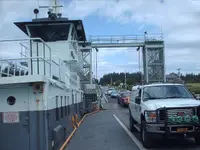
- Guemes Island FerryAnacortes · Vehicle and passenger transit serviceSkagit County's car ferry from Anacortes to Guemes Island, the island's only public access, a five-minute crossing made since 1979 by the same diesel boat.
- Walker Valley Geode SiteMount Vernon · Geode localityDNR-land rockhounding site held under a valid Washington State Mineral Council mineral lease and still accessible for collecting its geodes.

- Chuckanut Drive Scenic BywayBurlington · State bywayChuckanut Drive, State Route 11 between Burlington and Bellingham, Washington, is a 1916 highway cut partly by convict crews into sandstone cliffs above Samish Bay and the railroad.

7 more within 30 miles on the road map.
Nearby towns: Port Townsend, Friday Harbor, Bremerton, and Snoqualmie. All the towns of Washington. More of Washington: Town Festivals and Scenic Drives.
Sources
- Historic Coupeville (U.S. National Park Service) nps.gov/thingstodo/ebey-s-reserve-historic-coupeville.htm
- Ebey’s Landing National Historical Reserve (U.S. National Park Service) nps.gov/ebla/learn/historyculture/index.htm
- Island County -- Thumbnail History historylink.org/File/7523
- Coupeville -- Thumbnail History historylink.org/file/9587
- Island County commissioners authorize Port of Coupeville on August 15, 1966. historylink.org/File/9735
- Keeping the Alexander Blockhouse alive!!! (historical marker) hmdb.org/m.asp?m=60986
- Washington: A Guide to the Evergreen State (1950), p. 156 babel.hathitrust.org/cgi/pt?id=mdp.39015010545013&seq=194
- HALLER HOUSE COUPEVILLE, WASHINGTON HISTORIC STRUCTURES REPORT dahp.wa.gov/sites/default/files/Haller_Book_20140610_sm.pdf
- Coupeville voters approve city incorporation on April 2, 1910. historylink.org/file/9579
- Filming of movie Practical Magic begins on Whidbey Island on A historylink.org/File/11238