Skagit County Fair
Mount Vernon, Skagit County, Washington. Fair; August.
Details

- Where
- 501 Taylor Street, Mount Vernon, WA 98273. Directions
- When
- Last held August 6–9, 2026; next year’s date not yet stated.
- Getting there
- From I-5 South take exit 226 for WA-536 W/Kincaid St toward the south entrance with parking at 501 Taylor Street, Mount Vernon.
- Fees
- Adults (16+): $16.00; Family $56.00.
- Hours
- Thursday, Friday, Saturday 10 AM - 10 PM; Sunday 10 AM - 9 PM.
- Access
- Main South Gate car entrance at 501 Taylor Street; Cleveland Park Gate at 1401 Cleveland Ave is pedestrian only.
- Phone
- 360-416-1350
- Website
- skagitcounty.net
- Managed by
- Skagit County.
Cars come in off Taylor Street at the South Gate. Walkers can also use the Cleveland Park Gate on Cleveland Avenue, which admits no cars. On the Thursday of the 2026 fair, the Cleveland Park Gate also served as the drop point for the Stuff the Bus diaper drive, from ten in the morning to five. Inside, for four days each August, the Skagit County Fair runs from ten in the morning to ten at night, closing an hour earlier on Sunday. The 2026 fair ran August 6 through 9 under the poster title “Let’s Wing It!” The La Conner paper headlined its story “Skagit County Fair hatches 127th year of egg-citing family fun.” Skagit County runs the fair and the grounds, which lie south of the Mount Vernon city center.
Four days off Taylor Street
The carnival belongs to Paradise Amusements and keeps its own clock. It opens at noon and runs until eleven on Thursday, Friday, and Saturday nights. After ten on those nights, rides are sold by ticket only. Fair admission is required to reach the midway. The county’s own advice is to go earlier in the day for a less crowded carnival. Advance gate tickets were sold at the Skagit Farmers Country Store in Burlington, Mount Vernon, and Sedro-Woolley.
The fair runs three stages: the Main Stage, the Community Stage, and the Latin Entertainment Stage. In 2024 the Cascadia Daily News called the Latin stage “a welcoming space for a diverse community.” There are also a horse arena, the barns, and a list of what the program calls Fun Fair Events. Some performers return year after year. Michael Boss, who writes the Tales of the Magic Skagit column for Meyer Sign, names Wren the Juggler and Sunday Speedtrap among the long-time acts. In 2022 and 2023, Boss and Don Wick ran a fair history booth sponsored by Meyer Sign. With help from the Skagit Valley College radio station KSVR, they recorded fairgoers’ memories for a podcast called “All in Love is Fair.”
Ribbons, barns and the auction ring
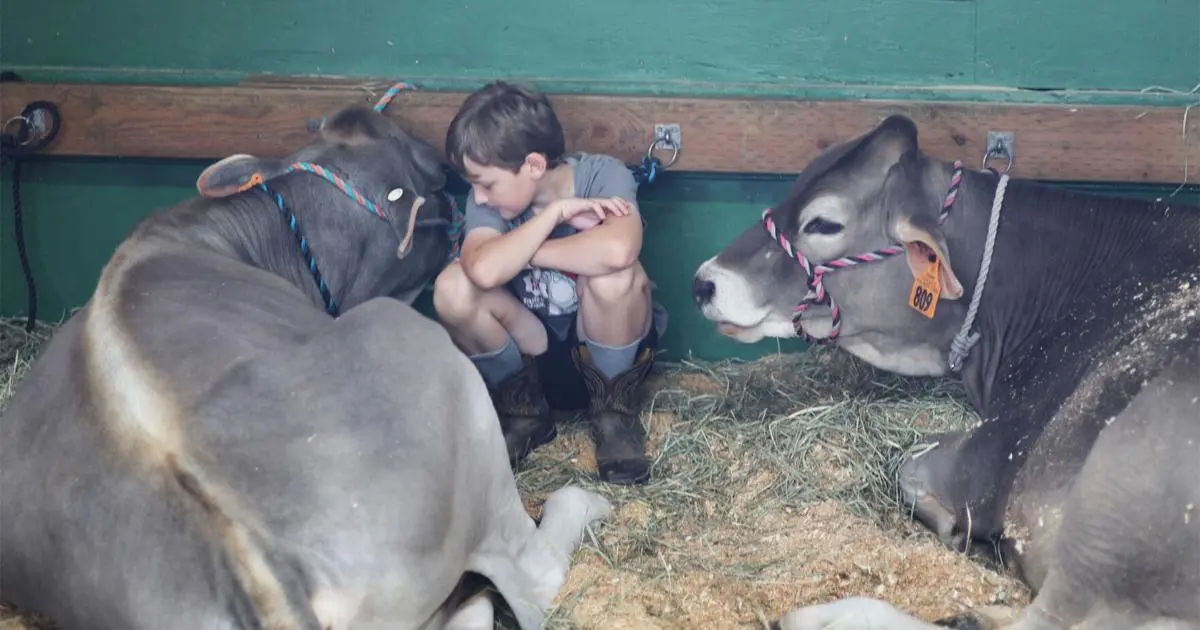
The barns hold the 4-H and FFA animals: beef and dairy cattle, goats, sheep, swine, poultry, rabbits, horses, dogs, cats, and cavies. FFA also runs an exhibit called Old McDonald’s Farm. Indoors, the categories include 4-H needle arts, foods, photography, and shooting sports, along with FFA agricultural mechanics. The open class takes entries from anyone in baking, canning, honey, floriculture, quilts, and sewing. Quilts, sewing, and needlework are checked in at Building B. Jars of preserves, baked goods, honey, cut flowers, and farm produce go to Building D.
Youth entries are judged against a set standard, not against each other. For that reason each division awards many white, red, and blue ribbons. The highest-scoring entries go on to the Washington State Fair. Skagit County’s five Granges also compete, in produce booths and in project booths, and payment rises with the color of the ribbon. At the end of the fair, 4-H and FFA members bring their animals into the ring for the junior livestock sale. Country Store, a farm-supply company that bids at auctions across the Northwest, wrote of the 2026 sale: “The live auction was exhilarating.”
The grounds stay busy after August. In September 2026 the fairgrounds held its 32nd Annual Fall Garage Sale and its 12th Annual Fall Car Showdown, which drew about 170 cars. The Skagit County Fairgrounds Foundation ran its first Stitch-A-Fair quilting retreat that month. A Veterans Stand Down followed on October 2 and 3. Near the stage are the bricks the Foundation has laid, each carrying the name of a donor. The next fair is set for August 12 to 15, 2027.
A race track on sandy ground
The Washington Territorial Legislature created Skagit County in 1883. Washington became a state in 1889, and in 1890 came the first attempt at a county fair. That year a company called the Skagit County Agricultural Society formed to hold an annual fair and stock show at Bayview. W. J. McKenna was one of its prime movers. The enterprise did not succeed. Skagitonians to Preserve Farmland describes the county of that time as having very few roads and no bridges. Most travel went by river, and Fir Island could be reached only by ferry. Families who went to a fair camped there for several days and picnicked with their neighbors.
A good harvest in 1898 brought a fair that opened October 6 and lasted three days. The local historian Dick Fallis quoted an account of it in a 1981 article: “The beautiful and varied displays showed the great resources of Skagit County to be such as the inhabitants themselves had not realized. The attendance during the three days was fully six thousand.”
Early in September 1901, a new fair association formed with representatives from Anacortes, Bayview, Fidalgo, La Conner, Mount Vernon, Sedro-Woolley, and Skagit City. It raised fifteen thousand dollars in capital stock to buy ground and put up buildings in Mount Vernon. N. J. Moldstad was president and John L. Anable secretary, and H. A. March and Emerson Hammer were among the founders. H. R. Hutchinson served as general superintendent of the first fair. That fair opened weeks after the association formed, before any buildings stood. The 1906 county history gives its dates as October 3, 4, and 5. Sebring’s Skagit County Illustrated, published in 1902, calls it “a most successful four-days exposition” and describes the grounds just outside town:
“The track is pronounced by experts to be the best winter race course in the state, on account of the sandy soil which constitutes the track. The exhibition building is 150 feet in size and built in Maltese cross style. The grand stand will be sufficient to hold 8,000 people.”
In 1911 the fair moved across the Skagit River toward Burlington, to ground now occupied by a Fred Meyer store. It was known there for horse and harness racing, car races, band concerts, and farm exhibits. After the 1930 fair, the Great Depression cut it back sharply. There was no money to maintain the grounds, and the event shrank into the Skagit County and 4-H Fair. Boss places it at Union High School in Sedro-Woolley in 1938. In 1941 it moved to the “new 4-H Fair Grounds in Mount Vernon,” south of the city center, and was billed as the “Tenth Annual.” Gaps in the premium books suggest it was suspended for most of World War II. By 1945 the grounds had been renamed the “Evergreen Classic Pavilion,” and that year’s fair was the “Twelfth Annual.” The pavilion name was dropped after 1959. From 1960 on, the place has been the Skagit County Fair Grounds. The fair has been held in October and in September, as befits a harvest festival, but most often in August.
Counting the years
Michael Boss’s comment on the wartime numbering was: “Skagit County Fair organizers appear to have been math challenged.” For most of the twentieth century, each official program counted back to 1911, the first Burlington year. The 1986 fair took the theme “75 Years and On The Month.” Around that time “Fair Grounds” was shortened to “Fairgrounds.”
In the 1990s the count moved to 1900, and the 1995 theme was “We’re 95 in ‘95.” The reason for that date is a premium book. Kelly Moldstad, the grandson of N. J. Moldstad and vice-president of the Fair Advisory Board, owns a copy of the 1902 book, titled the Second Annual Fair and Races.
Bret Lunsford, a former fairgrounds manager and a local history buff, went back further still. Writing in the 2010 Fair Guide, he named 1898 as the first year. “It depends,” he wrote, “on what year you count from.” The 1998 fair was declared the Centennial Fair, and Lunsford counted the 2010 fair as the 112th. Boss carried that count forward, subtracting a year for the pandemic, and called the 2023 fair the 124th. When Boss’s column appeared, Lunsford wrote back to point him to another source: the 1981 Dick Fallis piece, titled “News of Skagit Fair dates back to 1873.”
Notable Events
- 1883Skagit County was created by an act of the Washington Territorial Legislature in 1883. skagitonians.org
- 1889Six years later, in 1889, Washington gained statehood and the very next year, the first effort was made to hold a county fair. skagitonians.org
- 1890A company, the Skagit County Agricultural Society, was formed with the object of holding an annual county fair and stock competition at Bayview; the enterprise did not succeed. archive.org
- 1901Early in September a new fair association formed to purchase ground and erect buildings for annual exhibitions and sports; the county fair was held October 3d, 4th and 5th. archive.org
- 1901The Skagit County fairgrounds were established in Mount Vernon. historylink.org
- 1902N. J. Moldstad's grandson Kelly has a copy of the 1902 fair premium book, titled the Second Annual Fair and Races, which pushed the starting point back two years earlier. meyersign.com
- 1911In 1911 the Skagit County Fair moved across the Skagit River towards Burlington, to the site now occupied by Fred Meyer. skagitonians.org
- 1930Following the 1930 Skagit County Fair, the Great Depression caused the fair to be scaled back substantially, and prior to World War II it was referred to as the Skagit County and 4-H Fair. meyersign.com
- 1938In 1938 the fair was located at Union High School in Sedro-Woolley, where it was hosted for most of the decade. meyersign.com
- 1941In 1941 the event was relocated to the new 4-H Fair Grounds in Mount Vernon for what was then called the Tenth Annual fair. meyersign.com
- 1945By 1945, the fairgrounds had been renamed the Evergreen Classic Pavilion for the Twelfth Annual fair. meyersign.com
- In the fall the people celebrated their good fortune by holding a county fair, which began October 6th and lasted three days, proving a grand success. archive.org
People
- H. R. Hutchinson, general superintendent of the 1901 fair.
- N. J. Moldstad, president of the fair association.
- W. J. McKenna, one of the prime movers of the Skagit County Agricultural Society (1890).
- Aric Gaither, Skagit County Fairgrounds manager who shared the Bret Lunsford article (earlier).
- Bret Lunsford, former Skagit County Fairgrounds manager and local history buff (earlier).
- Emerson Hammer, co-founder of the new Skagit County fair association (1901).
- H. A. March, co-founder of the new Skagit County fair association (1901).
- John L. Anable, secretary of the Skagit County Fair Association (1901).
- Kelly Moldstad, grandson of N. J. Moldstad; vice-president of the Fair Advisory Board; holder of the 1902 fair premium book (earlier).
- Michael Boss, creator of Tales of the Magic Skagit column (earlier).
Sources
- skagitcounty.net/Departments/Fair/Tickets.htm
- skagitcounty.net/Departments/Fair/main.htm
- skagitcounty.net/Departments/Fairgrounds
- skagitcounty.net/Departments/Fairgrounds/directions.htm
- facebook.com/SkagitFair
- skagitonians.org/blog/news/the-dirt-issue-29-the-skagit-county-fair
- meyersign.com/2023/07/tales-of-the-magic-skagit-dear-skagit-county-fair-how-old-did-you-say-you-were
- skagitcountywa.gov/living-in-skagit/historical-society-and-the-skagit-county-museum