Port Townsend
Jefferson County, Washington. County seat.
Port Townsend, at the northeast corner of the Olympic Peninsula, boomed in 1889-1890 on the promise of a railroad that was completed as far as Quilcene.1,2,3
Details
- Founded
- Alfred A. Plummer and Charles Bachelder settled on April 24, 1851, and in October 1851 they agreed with Loren Hastings and Francis Pettygrove to start the town.4,5
- Name
- The town is named for its bay, which Captain George Vancouver named on May 8, 1792, for the Marquis of Townshend; the “h” was later dropped.5,6
- County seat
- Port Townsend was named seat of Jefferson County when the county was established on December 22, 1852.3
- Last checked
- October 6, 2026.
Point at a dot to see the place.Tap a dot to see the place. Road map of Port Townsend.
In Port Townsend
The Calendar
- Rhododendron FestivalFestivalevery third week of May; May 13-17 (91st festival).
- Festival of American Fiddle Tunes (Centrum), Fort Worden, Port Townsend WAAll-day music festivalSaturday, July 4, 12:30 to 7 p.m.

- Jefferson County FairCounty fairAugust 13-15th 2027, the Second Friday in August (90th Annual).
History
Water Street and the Bluff
The Port Townsend Historic District, roughly bounded by Scott, Blaine, Walker, and Taft streets and the waterfront, holds over 700 residences and 60 commercial structures and went on the National Register in 1976.1,7,8 The town is the seat of Jefferson County, on the Quimper Peninsula at the northeast corner of the Olympic Peninsula, near where the Strait of Juan de Fuca meets Admiralty Inlet.3,6 In 1950 the state guide found the business section along the water front, its main streets lined with substantial old buildings from the boom days, and the houses on the level top of the bluff above.9
The Cabin Below Point Hudson
The Klallam called the place Kah Tai, a name reportedly meaning “to carry” or “pass through,” in reference to portaging canoes.3,5 In 1850 Alfred Plummer, a native of Maine, was running a hotel in San Francisco when a guest, Lafayette Balch, who commanded the brig George Emery, told him of Puget Sound, and Plummer and his friend Charles Bachelder were convinced.5 From Steilacoom the two paddled an Indian canoe back up the Sound, landed on a beach below Point Hudson on April 24, 1851, and built a two-room log cabin at what is now the corner of Water and Tyler streets.5 In October 1851 Loren Hastings and Francis Pettygrove found them there, and the four agreed to start a town; Pettygrove had cofounded Portland.3,5 On May 8, 1792, Captain George Vancouver had named the bay “Port Townshend, in honor of the noble Marquis of that name,” a British general.6 The Wilkes expedition of 1841 charted it as Port Townsend, without the “h,” and the founders named their town for the bay.5,6 Hastings and Pettygrove brought their families in February 1852 on a schooner that one HistoryLink account calls the Mary Taylor and another the Mary Hastings.3,10
Port of Entry
Jefferson County was established on December 22, 1852, with Port Townsend as county seat, although, HistoryLink notes, it may not legally have been a town at all.3 In 1854 the Puget Sound Customs Collection District moved there from Olympia, and every ship from a foreign port had to stop.8 The Territorial Legislature incorporated the city on January 16, 1860, the fourth in Washington to incorporate.4 In 1862, after Congress authorized moving the headquarters, customs collector Victor Smith threatened to shell Port Townsend from the lighthouse tender U.S.S. Shubrick unless the files were turned over, and he carried them to Port Angeles.3 HistoryLink has the town reclaiming the headquarters in 1866 after Smith drowned; the National Register nomination gives July 25, 1866, and another HistoryLink entry a bill of July 25, 1865.1,3,11 In 1871 nearly all the Indians in Port Townsend were ousted, their beach dwellings burned and their canoes towed to the Skokomish Reservation, but Chetzemoka soon brought most of his band back to Indian Island across from the town site.3 In the eighties John Muir wrote of the port: “The winds stir the flags of every civilized nation, while the Indians, in their long-beaked canoes, glide about from ship to ship.”9
The Port Townsend & Southern
James G. Swan, an agent of the Northern Pacific from 1867 to 1871, recommended Port Townsend for its western terminus, but in 1873 the railroad chose Tacoma.3 The Port Townsend & Southern Railroad was incorporated on September 28, 1887, to run south to Hood Canal and Olympia, but after construction began in early 1889 the money ran out after a mile of track.3 Later in 1889 the Union Pacific offered to make the town its northern terminus if it got the line’s franchise and the city put up $100,000, and on October 2 practically the entire population came to a groundbreaking two miles west of town.3 In 1890 real-estate transactions totaled nearly $4.6 million in a city of barely 4,500, which before that year was out had six banks, 10 hotels, 28 real estate offices, and three street-car lines.3 The construction contract was let on April Fool’s Day, 1890; by June 2,000 men were at work, and by September trains ran daily to Leland Lake, about twenty miles away.3 The Oregon Improvement Company, a Union Pacific subsidiary, went into receivership in November 1890, and the line ended at Quilcene, where, in railroad historian Steve Hauff’s words, “somebody noticed that Mount Walker was there.”3 When the Panic of 1893 hit, HistoryLink says, the population fell within months from more than 7,000 to fewer than 2,000; the National Register nomination puts the loss at nearly two-thirds.1,2
Glen Cove and City Hall
In 1913 the customs house went to Seattle, and with no ship legally required to stop, most did not.8 On July 1, 1927, James David Zellerbach announced plans for a paper mill at Glen Cove, the homestead of Albert Briggs, one of Port Townsend’s early settlers.2 Briggs had come in 1852 with 30 head of cattle, loading them on a scow at Tumwater and floating with the tide by day and beaching at night for 15 days, and he named his landing Scow Bay.9 The city voted to issue $800,000 in bonds for a pipeline from the Big Quilcene River, more than 30 miles away, and the mill started operation on October 6, 1928.2 The mill did not shut down during the Great Depression, and in 2005 HistoryLink counted about 325 employees and called it the largest single employer in Jefferson County.2 Batwell and Patrick designed City Hall in 1891 for a city of 20,000, it was completed in 1892, the year before the town went bust, and the city council still meets upstairs in what the marker calls the oldest continuously operating city hall building in the State of Washington.12
Within 30 Miles
Measured in a straight line from the town, nearest first.
- Finnriver Farm & CideryChimacum · Cider gardenorganic farm, orchard and craft cidery located along a salmon stream in the Chimacum Valley on the north Olympic Peninsula of Washington
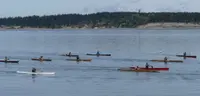
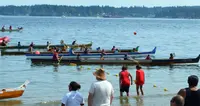
- Penn Cove Water FestivalCoupeville · FestivalAnnual tribal canoe races, Native arts and crafts vendors, storytelling, musical and dance performances, artist demonstrations, Native foods, youth activities and educational displays.
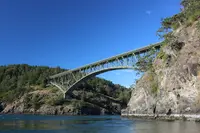
- Whidbey Scenic Isle WayCoupeville · State parkRuns the length of Whidbey Island along State Routes 20 and 525, connecting Deception Pass State Park in the north to the town of Clinton in the south.
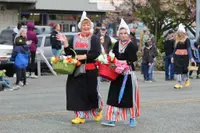
- Holland HappeningOak Harbor · Two-day spring celebrationThe Holland Happening & International Festival is Oak Harbor's April weekend honoring Whidbey Island's Dutch settlers, where small wooden shoes race down a water-filled canal at Windjammer Park.
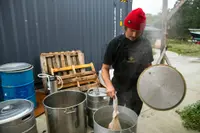
- Hierophant MeaderyFreeland · Tasting roomA botanical meadery by Double Bluff Beach on Whidbey Island, Washington, where two herbalists infuse honey wine with nettle and fir tips and mark the seasons with bonfires.
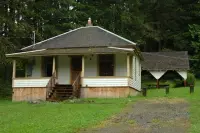
- Louella CabinSequim · CabinA four-room 1912 Forest Service guard station near Sequim, Washington, rented by the night, named by the fireguard who built it for his wife, Louella.
- Whidbey Island FairLangley · Old-fashioned country fairAn old-fashioned country fair of four July days in Langley, on Whidbey Island, held around a log-trussed Pole Building the WPA paid for in the 1930s.
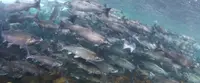
- Quilcene National Fish HatcheryQuilcene · National fish hatcheryHas a small one-room Visitor Center; the public is welcome to walk around the facility to see the fish ponds (raceways), fish ladder, fish weir, and the Big Quilcene River.
- Stanwood-Camano Community FairStanwood · Community fairA three-day agricultural fair on Pioneer Highway just south of Stanwood, Washington, begun as a Stillaguamish Grange harvest day in 1932 and still run almost entirely by volunteers.
- Silvana Community FairSilvana · One-day community fairA one-day youth livestock fair held since 1947 in the hayfield behind Viking Hall in Silvana, Washington, where children 12 and under climb a greased pole at 12:15.

- Festival of Family FarmsMt Vernon · Two day self guided tour through the beautiful skagit valleyA free two-day October tour of working farms across Skagit County, Washington, where in 2026 nine families opened gates from a Samish Bay oyster bed to an apple orchard open only that weekend.

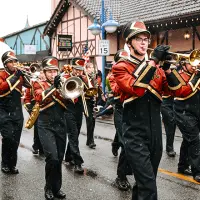
- Viking FestPoulsbo · Annual festivalA free three-day festival on the Liberty Bay waterfront of Poulsbo, Washington, begun in 1969 for Norway's Constitution Day, with a parade and a lutefisk eating contest.
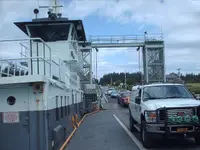
- Guemes Island FerryAnacortes · Vehicle and passenger transit serviceSkagit County's car ferry from Anacortes to Guemes Island, the island's only public access, a five-minute crossing made since 1979 by the same diesel boat.
- Skagit County FairMount Vernon · FairThe Skagit County Fair runs four August days at the county fairgrounds in Mount Vernon, Washington, and its own organizers have counted its age from at least four different years.

- Chief Seattle DaysSuquamish · 3-day public festivalThe Suquamish Tribe's free three-day August festival in Suquamish, Washington, held since 1911 and centered on a Saturday honoring at Chief Seattle's grave above the Salish Sea.
3 more within 30 miles on the road map.
Nearby towns: Coupeville, Friday Harbor, Bremerton, and Snoqualmie. All the towns of Washington. More of Washington: Wineries, Old-Time Music, Fairs & Rodeos, and Town Festivals.
Sources
- National Register nomination, Port Townsend, WA npgallery.nps.gov/NRHP/GetAsset/NHLS/76001883_text
- Crown Zellerbach’s National Paper Products Mill in Port Townsend starts operation on October 6, 1928. historylink.org/file/7475
- Port Townsend -- Thumbnail History historylink.org/File/10752
- The Washington Territorial Legislature incorporates the city of Port Townsend on January 16, 1860. historylink.org/File/9055
- Alfred A. Plummer and Charles Bachelder settle on the site of future Port Townsend on April 24, 1851. historylink.org/File/5290
- Captain George Vancouver names Port Townsend on May 8, 1792. historylink.org/File/5291
- National Register record, Port Townsend Historic District npgallery.nps.gov/AssetDetail/NRIS/76001883
- Jefferson County voters approve establishment of Port of Port Townsend on November 4, 1924. historylink.org/File/9490
- Washington: A Guide to the Evergreen State (1950), p. 547 babel.hathitrust.org/cgi/pt?id=mdp.39015010545013&seq=661
- The first non-Indian families arrive at the new settlement of Port Townsend on February 23, 1852. historylink.org/File/5289
- Port Townsend Post Office, Court and Customs House opens on March 1, 1893. historylink.org/file/9480
- Historic City Hall (historical marker) hmdb.org/m.asp?m=129357