Festival of Family Farms
Mt Vernon, Skagit County, Washington. Two day self guided tour through the beautiful Skagit Valley.
Details

- Where
- 15867 Beaver Marsh Rd, Mt Vernon, WA 15867. Directions
- When
- Two days, Saturday and Sunday, 10 a.m. to 4 p.m.
- Season
- Annual — Oct. 3rd & 4th, 2026 (28th annual).
- Getting there
- Self-guided drive among nine host farms spanning from the La Conner area to the Rockport area; download the official farm map from the festival site.
- Fees
- Free Admission & Parking.
- Hours
- 10 a.m. to 4 p.m.
- Access
- Working farms and an outdoor event: dress for the weather; free hand-washing stations at each farm; wash hands after touching animals; no smoking; some activities on limited schedule and subject to weather; activities free unless noted ($).
- Walk-in or reserve
- No tickets or reservations required for the free tour; optional Festival VIP bag by minimum $25.00 donation.
- Phone
- 360-421-4729
- Website
- festivaloffamilyfarms.com
- Managed by
- Skagit Valley Festival of Family Farms, registered non-profit 501(c)3 with Washington State.
An orange flag at the gate marks each stop, lettered “Official Farm of The Skagit Valley Festival of Family Farms.” On October 3 and 4, 2026, from 10 a.m. to 4 p.m., nine farms flew one. They lay between the La Conner area and the Rockport area, according to the Skagit Valley Herald. Admission and parking were free, and most activities were free as well; the festival marks the exceptions with a dollar sign. There are no tickets and no set route. The visitor takes the festival’s farm map, picks an order, and drives. Most farms lie about twenty minutes apart. With the car radio tuned to 1630 AM, a program called “InFARMation” gives crop reports and farm history, and explains why local farmers call the valley the “Magic Skagit.” Each farm keeps a free hand-washing station near the animals, and the festival asks that no one smoke. The 2026 weekend was the 28th annual festival. Its organizers describe it as a hands-on lesson in “what it takes to run a farm, from growing crops to feeding animals.”
Oysters, cheese, and bulbs on the flats
The farthest west stop is Taylor Shellfish, on Chuckanut Drive north of Bow. The entrance is in the corner of the Oyster Creek Inn parking lot. From there a one-lane road crosses a bridge and a railroad track and drops down the hill to an oyster bar and shellfish market in a historic oyster processing facility. Beyond it lie 2,000 acres of shellfish beds in the tidelands of Samish Bay. The Steele family’s Rock Point Oyster Company grew oysters and clams on these tidelands for 70 years. The Taylor family of Shelton bought the farm in 1991. Their company had been farming shellfish in southern Puget Sound since 1890. On festival weekend, farmers shuck oysters and quiz visitors on shellfish trivia, and steamed mussels and clams are handed out free. The farm also shows what it calls the world’s only lighthouse made of oyster shells. A farm placard notes that one adult Pacific oyster can filter as much as 65 gallons of water a day.
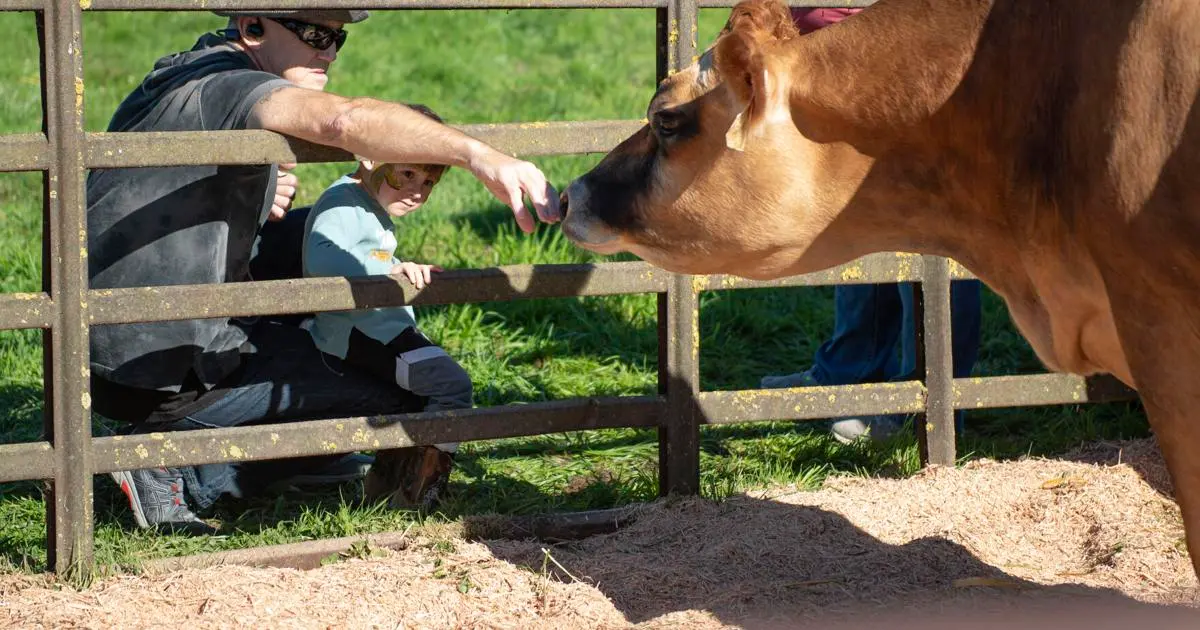
Inland on Field Road, Golden Glen Creamery offers a farm petting zoo and an artificial cow named Squirty Gertie for milking practice. Children make their own ice cream, and the creamery sets out cheese samples, including the curds it sells as “Squeaky Cheese.” Norma Ruiz owns it. The Herald describes a 350-cow dairy. The creamery’s own history says it began making farmstead cheese in 2004 and added butter in 2006, and that in 2024 “we had to sell our cows and bring milk from Lynden.”
West of Mount Vernon the farms crowd closer. At RoozenGaarde, a giant windmill stands over a display garden of more than five acres. Visitors in October watch the crew lay out and plant it with more than a million bulbs of over 200 varieties, all for the spring bloom. Children hunt the garden for a scavenger list, and a “Guess the Weight” contest pays out in bulbs. The parent company, Washington Bulb Company, was founded in 1955 by the Dutch emigrants William and Helen Roozen on five acres. The family now farms nearly 2,000 acres, and RoozenGaarde followed in 1985 as its retail shop and display garden.
On McLean Road, Gordon Skagit Farms sets its harvest out in large autumn displays. It turns pumpkins into vases for flower arrangements, and Eddie Gordon talks with visitors about life as an artist and a farmer. JuneBug Ferments pours samples of beet kvass, and the farm grows more than 110 kinds of squash, gourds, and pumpkins combined. Ed and Amelia Gordon founded the farm in 1936. Their son Ed and his wife Betty took it over in 1955. In 1969 Todd and Eddie began growing pumpkins, and in the 1980s they took over the farm. They now plant more than 60 acres of them. One season the festival brought Katherine Lewis to the farm to demonstrate willow basket-making. Cole Gordon, a fourth-generation farmer, also works the place.
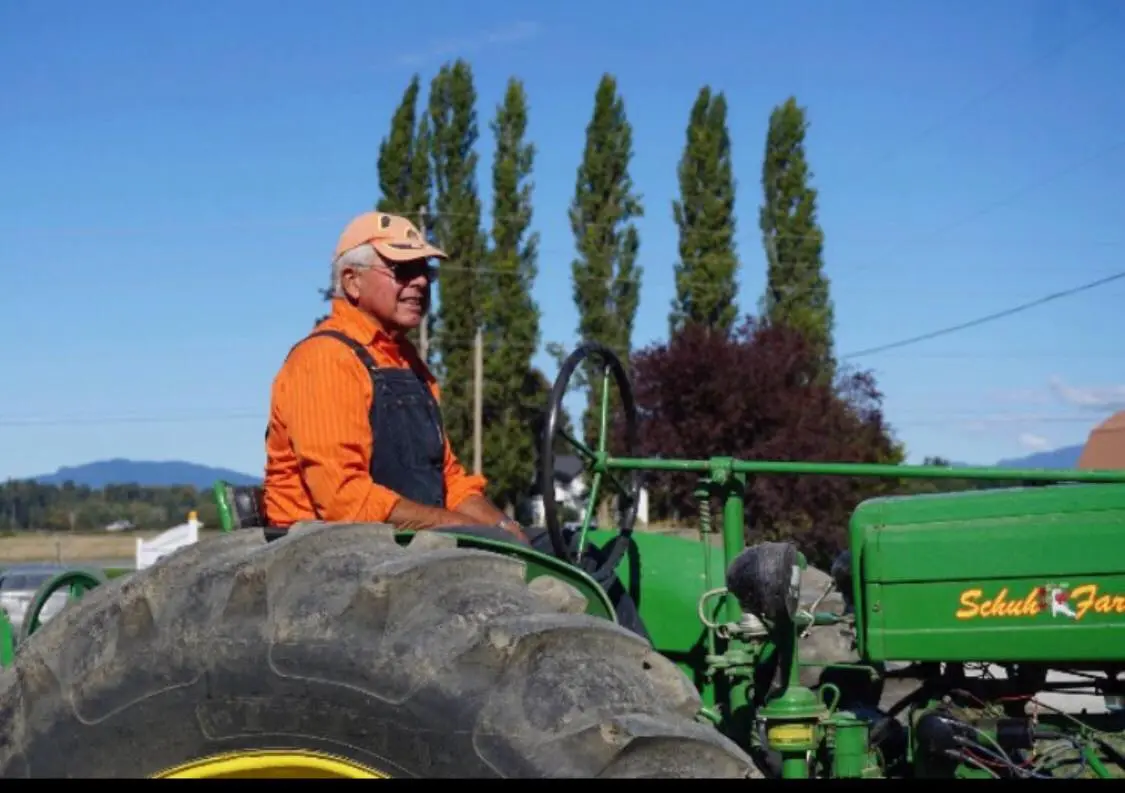
Down State Route 536, Schuh Farms runs a Yellow Brick Road, a hen house with chickens and goats, and a path under mature Gravenstein apple trees from the Cedardale Orchard. Farmer Stephen leads educational hayrides, and every rider gets a free ear of corn on the cob. The paid side, the Great Pumpkin Patch, has a corn maze and tractor-train and barrel-train rides. That ground was once a small dairy, homesteaded by the Hansen family and held by them for four generations. The Schuh farm itself grew only green peas in 1963, for three local processors. Its own figures trace the decline. Skagit farms grew 32,300 acres of peas in 1968 and 5,307 acres in 2001, and by 2010 the last processor had left the valley. The farm’s sign gives the explanation as “Why the change? Ask Farmer Stephen on the hayride tour.”
Blueberries, flowers, and seed toward Fir Island
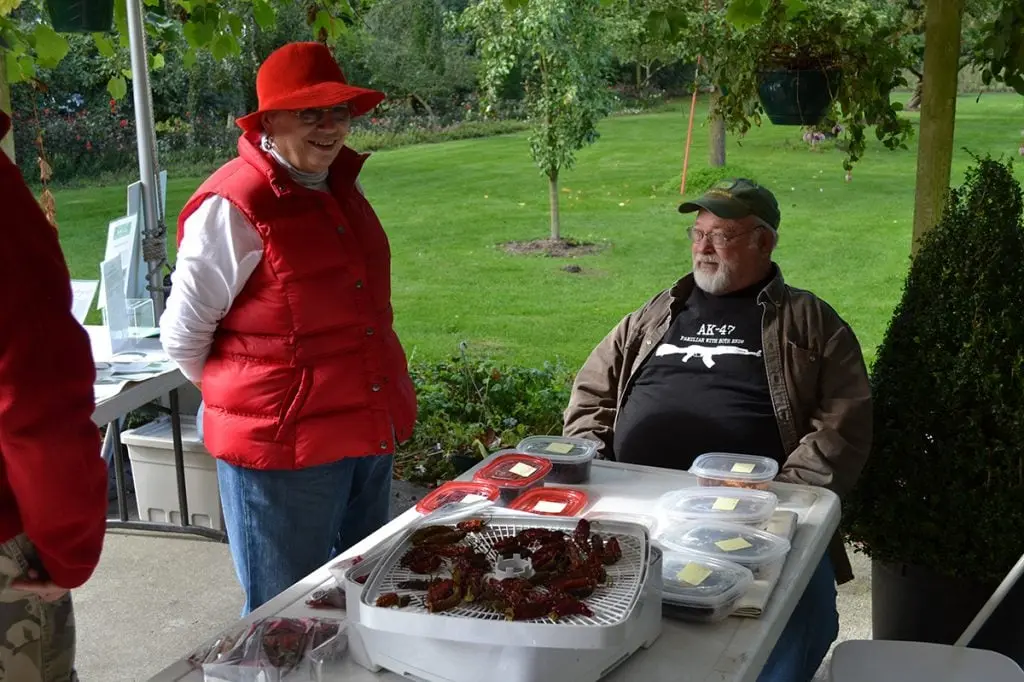
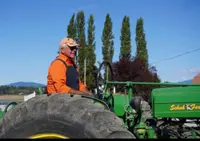
North of Fir Island, a big red barn marks Beaver Marsh Blueberry Co. Antique tractors stand on show there, a haunted house charges admission, and a chili cook-off runs from noon to 1 p.m. on Sunday with visitors judging. Pie comes whole or by the slice, alongside blueberry lemonade and a taco truck. Todd and Talea Lenning run it as the fifth generation. Joseph Scharffenberg arrived in the valley in 1878 and built a small house in 1904, the same farmhouse the family lives in now. The place began as a dairy. Its grain was floated down the Skagit River to the mill at Mount Vernon. Joan Scharffenberg married Bud Lenning, and the two grew peas, broccoli, cauliflower, and seed crops of cabbage, spinach, and mustard. The first blueberries went in in 1991. There are now more than 100,000 plants.
At the east entrance to La Conner, on the south side of the roundabout, Hedlin’s Family Farm offers hayrides, flower-field walks, vegetable and flower art, and Veggie Racers. The farmstead keeps its original 1913 house. Rasmus and Pothea Koudal founded the farm in the early 1900s, and the farm’s line is “since 1906.” Dave Hedlin and Serena Campbell revitalized it in the mid-1970s and still farm about 400 acres. Kai Ottesen and Jules Riske, of the fourth generation, grow 20 acres of certified organic crops and keep the farm stand. Among the farm’s crops is cabbage seed, and its placard explains why that matters: “If you eat sauerkraut in Germany, coleslaw in New York, or kimchee in Korea there is a good chance the seed that produced that crop was grown in the Skagit Valley.”
Up the Skagit to the Sauk
The two eastern farms sit about 30 miles off Interstate 5, reached by Highway 20 to Concrete and then across the bridge onto Concrete Sauk Valley Road. Double O Ranch runs a hayride through pastures, cattle, and timberland where deer and elk can be seen. Its other attractions include Champ the Clydesdale, a “mud puddle mules” wagon display, and a display called “Cow in my Marshmallow.” Grass-fed hamburgers are cooked to order while Joel Aaron Wright plays for tips. James T. Ovenell and Harold Pierson bought the original 713 acres in the 1940s as the P&O Hereford Ranch. In 1944 the Ovenells signed one of the county’s first conservation plans. By 1960 James T. and Mary Ovenell owned it alone and had renamed it. The ranch now runs 100 pairs of Maine-Anjou cattle and rents log cabins as Ovenell’s Heritage Inn.
Eight miles on, Sauk Farm sits at the confluence of the Sauk and Skagit rivers under Sauk Mountain. The festival weekend is the only time it opens to the public. The Berger family grows organic apples there, among them Honeycrisp, Cosmic Crisp, Ambrosia, and Evercrisp. They press cider and make purée and dried apples on site. Visitors walk the orchard on their own or take a guided tour through the food processing. The farm samples all of its products and runs its retail stand for those two days of the year. Griffin Berger manages the farm. His parents, Carol and Jesse, live on it and help as needed.
An Extension project of 1999
Accounts of the beginning differ in emphasis. “It started with a group of local farms that wanted to be able to share the generational history of their farms,” Tricia Plymale, the festival’s executive director, told Bellingham Alive in 2025. A Washington State University report credits WSU Skagit County Cooperative Extension. It says the Extension organized the first festival in 1999 with Skagitonians to Preserve Farmland and the Skagit Valley Herald. The work traced to 1997, when the USDA’s SARE program awarded $113,000 to the Extension for a project called “Building Community Support for Agriculture on the Urban Edge.” Dyvon Havens was its principal investigator. The festival grew out of the project’s Agricultural Speakers Bureau and its public farm tours, which were meant to show how agriculture tied into the community’s quality of life. The first name was “Celebrating Skagit Harvest: A Festival of Family Farms.”
That first year the county marked the occasion. Commissioner Robert Hart read a proclamation of Skagit Harvest Day for October 2, 1999, and moved its adoption. Commissioner Harvey Wolden seconded, and the motion passed unanimously. At the same meeting Havens presented the festival’s newspaper insert. Rose Merritt went over the activities planned at Merritt’s Apples. Ken Osborn described a self-guided tree-farm tour at Grandy Lake Forest. Ten farms opened their gates that fall with tours, food, children’s activities, displays, videos, and music. At one of them Claus Svendsen and his students led wildlife habitat walks on woodland mammals and amphibians. In 2000 there were twelve farms. The Extension report announced that from 2007 the event would be called “Skagit Valley Farm Tour: A Festival of Family Farms,” to identify it more correctly. The 19th annual festival ran October 7 and 8, 2017. Over the years the roster has changed, and an earlier stop was Cascadian Farm, managed by Harlyn and Jim Meyer. By 2025, when the 27th festival ran October 4 and 5, Bellingham Alive counted around 14 farms.
The pause and the return
The festival took a break during the coronavirus pandemic. Jen Schuh, chair of the festival board, explained that the group chose not to encourage visitors before a vaccine was available. When the tour came back, Roozengaarde, Schuh Farms, and Gordon Skagit Farms were on the roster, but Hedlin’s, a longtime participant, was not. Brent Roozen remarked on the absence of the Hedlin tours, pony rides, and vegetable races. David Hedlin said he missed the festival, but he was harvesting vegetables and getting tired. At Gordon’s that year, Kristin Loffer Theiss, a Mount Vernon artist, came back for her twelfth year to see regular visitors. She talked about how the valley’s farmland shaped her palette and imagery. Chris Theiss sold whirligigs nearby. Rachel Sobczak sold Water Tank Bakery cookies and pastries, hoping to draw customers to her new bakery at the Port of Skagit. At Schuh’s, the farm stores carried John Thulen’s Pioneer Potatoes potatoes and beets, and Hadley Shears, a La Conner High School junior, was helping out.
Hedlin’s flag was back on the 2026 map. In Plymale’s account, the visitor goes “to see the difference in the land and ecology and hear what their great-grandparents might have raised, compared to what they’re raising now.”
Notable Events
- 1997USDA SARE awarded $113,000 to WSU/Skagit County Cooperative Extension for Building Community Support for Agriculture on the Urban Edge, the project that developed the festival. projects.sare.org
- 1999Ten farms opened their gates for educational tours, food, children's activities, educational displays and videos, music, and other activities. projects.sare.org
- 1999Commissioner Hart read the Skagit Harvest Day proclamation and moved its adoption; Commissioner Wolden seconded, and the motion passed unanimously. skagitcounty.net
- 2000Participating farms increased from ten in 1999 to 12 in 2000, offering public educational farm tours and other activities. projects.sare.org
- 2007The report says the festival will be referred to as Skagit Valley Farm Tour: A Festival of Family Farms beginning in 2007, to more correctly identify the event. s3.wp.wsu.edu
- 2017The 19th annual Festival of Family Farms takes place on October 7th and 8th 2017. lovelaconner.com
- 2025plan to join us for our 27th annual festival on Oct. 4th & 5th, 2025! web.archive.org
- The event took a break as a result of the coronavirus pandemic. laconnerweeklynews.com
- Roozengaarde, Schuh Farms and Gordon Skagit Farms were announced as participants; longtime participant Hedlin Family Farms was not on the roster. laconnerweeklynews.com
People
- Tricia Plymale, Festival executive director; described its origins in sharing generational farm histories.
- Cole Gordon, Fourth-generation farmer at participating Gordon Skagit Farms.
- Eddie Gordon, Ran participating Gordon Skagit Farms with Todd Gordon.
- Harlyn Meyer, Manager of participating Cascadian Farm with Jim Meyer.
- Jim Meyer, Manager of participating Cascadian Farm with Harlyn Meyer.
- Katherine Lewis, Gave willow basket-making demonstrations at Gordon Skagit Farms during the festival.
- Todd Gordon, Ran participating Gordon Skagit Farms with Eddie Gordon.
- Brent Roozen, Commented on the absence of Hedlin farm's usual festival tours, pony rides and vegetable races.
- Chris Theiss, Sold whirligigs while his wife sold printed shirts, scarves and masks.
- David Hedlin, Said he missed the festival but was harvesting vegetables and getting tired.
- Hadley Shears, La Conner High School junior helping at Schuh's during the festival year described.
- Jen Schuh, Chair of the Festival board; explained the group's decision not to encourage visitors before a vaccine was available.
- John Thulen, Pioneer Potatoes producer whose potatoes and beets were offered by the Schuh farm stores.
- Kristin Loffer Theiss, Mount Vernon artist returning to Gordon's to see regular visitors and discuss how valley farmlands influenced her palette and imagery (twelfth year).
- Rachel Sobczak, Festival artisan hoping that selling Water Tank Bakery cookies and pastries at Gordon Skagit Farms would draw people to her new Port of Skagit bakery.
- Claus Svendsen, Led on-farm wildlife habitat tours with his students, teaching visitors about woodland mammals, amphibians and habitat.
- Dyvon Havens, WSU Cooperative Extension representative who presented the festival newspaper insert and reviewed the need for public education about Skagit agriculture.
- Harvey Wolden, County commissioner who seconded adoption of the harvest-day proclamation.
- Ken Osborn, Spoke about Grandy Lake Forest activities, including a self-guided tree-farm tour.
- Robert Hart, County commissioner who read the harvest-day proclamation and moved its adoption.
- Rose Merritt, Represented Merritt's Apples and reviewed proposed activities at her farm on October 2.
- Ted W. Anderson, Skagit County commissioner present at the meeting.
Sources
- festivaloffamilyfarms.com
- festivaloffamilyfarms.com/farm-tour-info
- facebook.com/FestivalofFamilyFarms
- goskagit.com/skagit-valley-festival-of-family-farms-set-for-this-weekend/article_e76ed766-119f-4599-9823-5882625d18ac.html
- bellinghamalive.com/lifestyle/preserving-heritage-feeding-community-skagit-valley-festival-of-family-farms
- s3.wp.wsu.edu/uploads/sites/2073/2014/03/2006-ag-stats.pdf
- projects.sare.org/project-reports/sw97-043
- skagitcounty.net/CountyCommissioners/Documents/Minutes/1999/09/19990920MIN.pdf
- laconnerweeklynews.com/story/2021/09/29/community/make-festival-of-visiting-family-farms-this-weekend/6749.html
- grownorthwest.com/2011/09/skagit-valley-festival-of-farms-october-weekend-highlights-14-farms
- web.archive.org/web/20241211051333/https://festivaloffamilyfarms.com
- lovelaconner.com/get-ready-festival-family-farms