Gold Beach
Curry County, Oregon. County seat.
Miners named this Curry County seat at the Rogue River’s mouth for gold in its sands; the Mary D. Hume was built here in 1881.1,2
Details
- Founded
- Miners settled at the mouth of the Rogue River after finding gold in its sands in the early 1850s, and the Oregon Encyclopedia says the town, then called Ellensburg, was incorporated in 1853.1,3
- Name
- The name comes from the gold that placer miners found in the beach sands at the mouth of the Rogue River; the earlier name, Ellensburg, honored Sarah Ellen Tichenor.3
- County seat
- Gold Beach is the seat of Curry County, a role the Oregon Encyclopedia dates to 1858 and the town marker dates to 1859.3,4
- Last checked
- October 6, 2026.
Point at a dot to see the place.Tap a dot to see the place. Road map of Gold Beach.
In Gold Beach
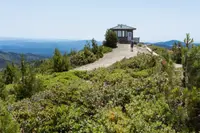
- Lake of the Woods LookoutGold Beach · Fire lookout rentalThe lookout, a one-room cabin with windows that provide 360-degree views, accommodates one to four people.
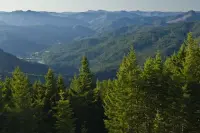
- Rogue-Coquille Scenic BywayGold Beach · Scenic bywayThis discovery drive provides scenic ocean views and an unforgettable experience of the true ruggedness and beauty of remote Oregon along its wild rivers and vast forests. The portion between Gold Beach and Myrtle Point is aptly named the Rogue-Coquille Scenic Byway
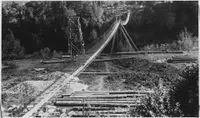
- Snow Camp LookoutGold Beach · CabinA cabin-type fire-lookout structure with a catwalk destroyed in the 2002 Biscuit Fire and rebuilt by Don Hartley of Don Hartley Construction in Crescent City, California.
The Calendar
History
Black Sand at the Mouth of the Rogue
Gold Beach sits just south of the Rogue River, about forty miles north of the California state line, and in 2020 it had 2,341 residents.3 The coast here was home to the Athapaskan-speaking Tututni of the Lower Rogue, who fished for salmon, trout, and lamprey and built plankhouses and ocean-going canoes from western red cedar.3 The Oregon Encyclopedia says placer miners found gold in the sands near the river mouth in 1852, and the city’s own history says it was in the early 1850s.1,3 The gold came out of black sand, which also held platinum.5
The camp was named Ellensburg for Sarah Ellen Tichenor, daughter of the sea captain William Tichenor, who had established Port Orford about thirty miles to the north.3 The town’s historical marker lists Prattsville before Ellensburg, while the 1940 Federal Writers’ Project guide said the town was first called Ellensburg, then Sebastapol.4,6 In February 1856, Tututni led by Enos, an Iroquois from Canada, attacked local miners and settlers, who held out at Miner’s Fort about a mile and a half north of Ellensburg.3 A mob hanged Enos, and by the end of 1856 the U.S. government had forced most of the local Natives onto the Siletz and Grand Ronde Reservations.3
Ellensburg Becomes Gold Beach
The Oregon Encyclopedia says Ellensburg was named county seat in 1858 because Port Orford had failed to pay for an adequate courthouse, but the town’s marker gives 1859.3,4 The 1940 guide recorded that the county’s first courthouse was a log-cabin saloon where gold passed freely across the counter.6 The same guide said the floods of 1861 swept the beach deposits into the ocean.6 The 1870 census counted 207 people in Ellensburg.7 On March 25, 1890, the postmaster renamed the post office Gold Beach to avoid confusion with Ellensburg, Washington, and the name of the town was officially changed on January 23, 1891.3 The Oregon Encyclopedia says the town was incorporated in 1853, but the marker says it became an incorporated city in 1945.3,4
Hume’s Salmon and the Mary D. Hume
In 1876 R.D. Hume of Astoria moved his salmon fishing, processing, and shipping business to the mouth of the Rogue.2 In 1877, a short way up a creek, he started what a marker calls the first fish hatchery in Oregon.8 After his steamer Varuna sank on the Rogue River bar in 1880, Hume found a 141-foot white cedar 13 miles upriver, and the tree was floated down to what is now the Port of Gold Beach to become the keel of a new vessel.2 The vessel was named for Hume’s wife and survived a January flood, and the marker gives her launch date as January 21, 1881, while the National Register nomination gives January 20.2,7 For ten years she hauled wool and canned salmon to San Francisco, and then on December 5, 1889, the Pacific Whaling Co. bought her for Arctic whaling.2 The National Register nomination says she was retired in 1977 as the oldest commercial vessel in service in the Pacific Northwest, and the marker says that in the summer of 1978 she sailed under her own power into the Port of Gold Beach, within a few hundred feet of her birthplace.2,7 The Oregon Encyclopedia says salmon fishing peaked in 1908 before overfishing shrank the runs, while the city’s history says commercial salmon fishing increased after 1908 and ended on the Rogue in 1935.1,3
Ferry, Mailboat, and the Patterson Bridge
A ferry began crossing the Rogue at Ellensburg in 1857, and in 1890 a wagon road connected Gold Beach with the north and south.4 The Oregon Historical Society credits the gold miner and farmer Elijah Huitt Price with the first mailboat service on the river in 1895, making weekly trips between Gold Beach and Illahe, about forty miles up from the mouth.9 The highway engineer Conde McCullough designed the 1,898-foot concrete arch bridge across the river, and construction started in March 1930.3,10 Its marker says it was the first bridge in the United States to use a construction technique developed by the French engineer Ernest Freyssinet.10 On May 28, 1932, over 5000 people came to the dedication, which began when Vice President Charles Curtis pressed a gold telegraph key at the White House, and the day went on with boat races and a salmon barbecue.10
After fishing ended, logging became the main industry, but the Champion plywood mill closed in 1986 and the town’s remaining timber mills closed after it.1,3 Civilian Conservation Corps companies and Forest Service crews built the nine original buildings of the Gold Beach Ranger Station of native wood and locally quarried stone, and the station has been in continual use since it opened in March 1937.11
Within 30 Miles
Measured in a straight line from the town, nearest first.
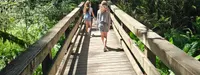
- Prehistoric GardensPort Orford · Roadside attractionA roadside park on U.S. 101 between Port Orford and Gold Beach, where 23 life-size concrete dinosaurs built by a former accountant stand in a coastal rainforest.
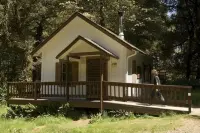
- Packers CabinBrookings · CabinPackers Cabin was originally built during the 1930s and served as the headquarters for the Forest Service packer who supplied lookouts and field crews by horse or mule pack trains.
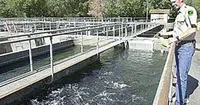
- Elk River HatcheryPort Orford · Fish hatcheryA state salmon and steelhead hatchery up the Elk River from Port Orford, Oregon, where returning fall Chinook swim through holes in a fish ladder's steps into an aluminum trap.
- Azalea FestivalBrookings · FestivalThe Azalea Festival is Brookings, Oregon's Memorial Day weekend celebration, held since 1939; its 1962 grand marshal was the Japanese pilot who had bombed nearby forest in 1942.

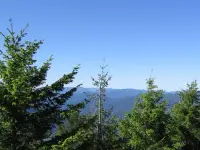
- Bald Knob LookoutPowers · Fire lookout rentalA flat-top lookout cabin on a timber tower above the Coquille near Powers, Oregon, rented by the night, on a knob where a guard built a shake shelter in 1914.
Nearby towns: Crescent City and Grants Pass. All the towns of Oregon. More of Oregon: Fairs & Rodeos, Lookouts & Cabins, and Scenic Drives.
Sources
- HISTORY OF COMMUNITY goldbeachoregon.gov/index.asp?DE=5E468501-D85E-42CA-96B5-3DC9B6E06E47&SEC=93B7C715-15A2-424E-A704-D77E23235915
- Mary D. Hume (historical marker) hmdb.org/m.asp?m=73202
- Gold Beach oregonencyclopedia.org/articles/gold_beach
- Gold Beach (historical marker) hmdb.org/m.asp?m=113220
- © Kay Atwood and Dennis J. Gray, 2003. Updated and revised by OHP staff, 2014. oregonhistoryproject.org/articles/gold
- Oregon: End of the Trail (1940), p. 386 archive.org/details/oregonendoftrail00writrich/page/386
- National Register nomination, Gold Beach, OR npgallery.nps.gov/GetAsset/62531389-2e81-4a83-84c8-40f4363172fb
- First Fish Hatchery in Oregon (historical marker) hmdb.org/m.asp?m=150606
- U.S. Mail Boat, Rogue River, Gold Beach oregonhistoryproject.org/articles/historical-records/us-mail-boat-rogue-river-gold-beach
- Patterson Bridge (historical marker) hmdb.org/m.asp?m=113391
- Gold Beach Ranger Station (historical marker) hmdb.org/m.asp?m=113206