Crescent City
Del Norte County, California.
Crescent City began in the 1850’s as an isolated north coast town that depended on its crescent-shaped harbor, and a tsunami struck it in March 1964.1,2
Details
Point at a dot to see the place.Tap a dot to see the place. Road map of Crescent City.
In Crescent City

The Calendar


History
Ta’atun and the Treasure-Seekers’ Harbor
Crescent City faces a shallow harbor edged by the arc of Crescent Beach, and a granite lighthouse stands on a small island several hundred feet offshore that can be reached from the mainland at low tide.1,3 At the time of white contact, the principal Tolowa villages of northern Del Norte County stood at Battery Point (Ta’atun), Pebble Beach (Meslteltun), south of Point St. George (Tatintun), and north of Point St. George (Tawiatun).5
The 1939 Federal Writers’ Project guide says the town was laid out in 1852, the year after a party of treasure-seekers hunting gold hidden by a legendary prospector discovered the harbor.3 The National Park Service gives 1853 instead, and describes a shipping and trade center that supplied miners who came after gold was found on the Trinity River in 1848.4 Rugged mountains and unbridged rivers hemmed the town in, so it depended on its crescent-shaped harbor, which also served as a point of entry to the gold fields of Southern Oregon.1 Before the pier was built, passengers arriving on the Oregon were moved into surf boats and then into horse-drawn carts, which hauled them over the shallow tidal flats for a $2 fee.3
According to the guide, it was a town of 800 with its own newspaper by 1854, and in 1856 the Crescentonian Club staged its first drama, The Toadies and Paddy Miles, the Limerick Boy.3 The guide says Crescent City was at first the seat of Klamath County, and when the seat moved to Orleans Bar, its people angrily forced the formation of a new county, Del Norte, to make their city its seat.3 In 1858 the Crescent City Turnpike was built along the present Elk Valley Road, over the ridge, across the Smith River to Low Divide, and on through various gold camps to Jacksonville, Oregon.6 Camp Lincoln, a United States military post on that road, was established on September 12, 1862, to keep peace between the Indians and the miners and settlers of northwestern California; it was abandoned in May 1870, and in 1962 the commanding officer’s quarters and one barracks still stood.6
The Light on Battery Point
On January 31, 1855, state lawmakers urged their representatives in Congress to fund lighthouses at Trinidad and Crescent City, and on March 3, Congress appropriated $15,000 for the Crescent City light.1 In 1856 the Light House Service began building it on Battery Point islet as a Cape Cod dwelling with a tower rising through the center, using granite shipped in and timber milled in Crescent City.1 Its National Register nomination calls it the oldest lighthouse on the north coast of California.1 Theophilis Magruder was its first keeper, and its last keeper before automation in 1953 is named Wayne Philand in the state landmark listing and Wayne Piland on the 1987 marker.6,7 The lighthouse was leased to Del Norte County that year, a light on the new harbor jetty replaced it about 1965, and in 1969 the federal government transferred it to the county.1 The Del Norte County Historical Society runs it as a museum, and since December 10, 1982, its 1,000 watt beacon has served as a private aid to navigation.1
Shingles, Fish, and Wrecks on the Rocks
The Pacific Mail steamer Brother Jonathan was wrecked on St. George’s Reef on July 30, 1865, and a state landmark memorial honors those who died.6 In 1939 the Federal Writers’ Project guide counted 1,720 people in the county seat, which shipped lumber and shingles, dairy products, and fish by boat and truck.3 On December 20, 1941, the tanker S.S. Emidio was attacked some 200 miles north of San Francisco and five crewmen were killed; the abandoned ship drifted north and broke up on the rocks off Crescent City, and its bow lay in the harbor until it was salvaged in 1950.6
Four Waves, March 28, 1964
On the evening of March 27, 1964, an earthquake on Alaska’s Kenai Peninsula sent a tsunami across the Pacific, and it reached Crescent City about four hours later, early on March 28.8 Three smaller waves pushed into storefronts and did little damage, and people began to clean up; then the big wave, cresting at nearly 21 feet, struck the downtown.2 One marker records 29 city blocks destroyed and 12 people dead, while another, put up by the Del Norte County Office of Emergency Services, puts the dead at ten.2,8 More than 289 buildings and homes were destroyed, and most of the downtown had to be demolished.2 The force of the tsunami moved a 25-ton tetrapod on display near Front Street nearly three feet off its pedestal.9 In 1967 the federal government established the West Coast/Alaska Tsunami Warning Center.2
Rebuilding the Small Boat Basin
In 2006 currents from a Kuril Islands earthquake destroyed three docks in the small boat basin.2 The tsunami from the Japanese earthquake of March 11, 2011, destroyed all of the docks and sank eight fishing vessels.2 The Crescent City Harbor District rebuilt the harbor to resist tsunamis, a $54 million job that was completed in 2014.2 Tsunami sirens are tested at 10am on the first Tuesday of each month along the waterfront from Klamath to Smith River.2
Within 30 Miles
Measured in a straight line from the town, nearest first.
- Smith River Scenic Byway (Highway 199)Gasquet · U.s. forest service scenic bywayHighlighted by white-water rapids on the Smith River, redwoods, rhododendrons, ferns and diverse geological land forms and ecosystems
- Tolowa Dee-ni’ DaySmith River · Family-friendly annual eventTolowa Dee-ni' Nation invites the community to join the annual Dee-ni' Day celebration in Smith River, California — only a few miles from Crescent City!
- Klamath Salmon FestivalKlamath · Annual salmon festivalThe Yurok Tribe's August festival on Klamath Boulevard in Klamath, California, where in 2026 salmon cooked over open fire returned to the lunch plates after four years without it.

- Azalea FestivalBrookings · FestivalThe Azalea Festival is Brookings, Oregon's Memorial Day weekend celebration, held since 1939; its 1962 grand marshal was the Japanese pilot who had bombed nearby forest in 1942.

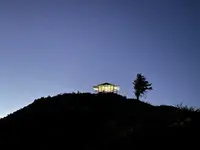
- Bear Basin Lookout and CabinGasquet · Historic fire lookout and 1930s-style cabin rentalA 1930s Forest Service fire lookout, taken down on French Hill and rebuilt atop Bear Basin Butte above Gasquet, California, rented each summer with a cedar-shake cabin.
Nearby towns: Gold Beach. All the towns of California. More of California: U-Pick Farms, Fairs & Rodeos, and Town Festivals.
Sources
- National Register nomination, Crescent City, CA npgallery.nps.gov/GetAsset/c10e3af8-cdab-42a4-b7b8-3f9828e33ba8
- Tsunamis are Synonymous With Crescent City (historical marker) hmdb.org/m.asp?m=183655
- California: A Guide to the Golden State (1939), p. 344 archive.org/details/californiaguidet00federich/page/344
- Redwood National and State Parks (U.S. National Park Service) nps.gov/redw/learn/historyculture/thenandnow7.htm
- SITE OF OLD INDIAN VILLAGE AT PEBBLE BEACH, CRESCENT CITY ohp.parks.ca.gov/ListedResources/Detail/649
- California State Parks ohp.parks.ca.gov/?page_id=21416
- Battery Point Lighthouse (historical marker) hmdb.org/m.asp?m=101692
- Crescent City Tsunami, 1964 (historical marker) hmdb.org/m.asp?m=114260
- Tetrapod (historical marker) hmdb.org/m.asp?m=181238