_(curDB4042).jpg)
Prehistoric Gardens
Port Orford, Curry County, Oregon. Roadside attraction; Open daily, hours change seasonally.
Details

- Where
- 36848 HWY 101, Port Orford, OR 36848. Directions
- When
- Spring and Fall 10am to 5pm.
- Getting there
- Highway 101 on the Southern Oregon Coast, halfway between Gold Beach and Port Orford.
- Fees
- Adults $16.00.
- Access
- Trail may close in extreme weather, especially wind — call ahead to confirm; only service dogs and small carryable dogs allowed on trail; strollers, wagons, motorized wheelchairs, scooters not permitted (strollers available to borrow); bench at trail's halfway point.
- Walk-in or reserve
- Tickets bought in Gift Shop on the day of visit; no reservations required.
- Phone
- 1-541-332-4463
- Website
- prehistoricgardens.com
- Managed by
- Kiki McGrath.
- Established
- 1955.
- Coordinates
- 42.6123672, -124.3926855.
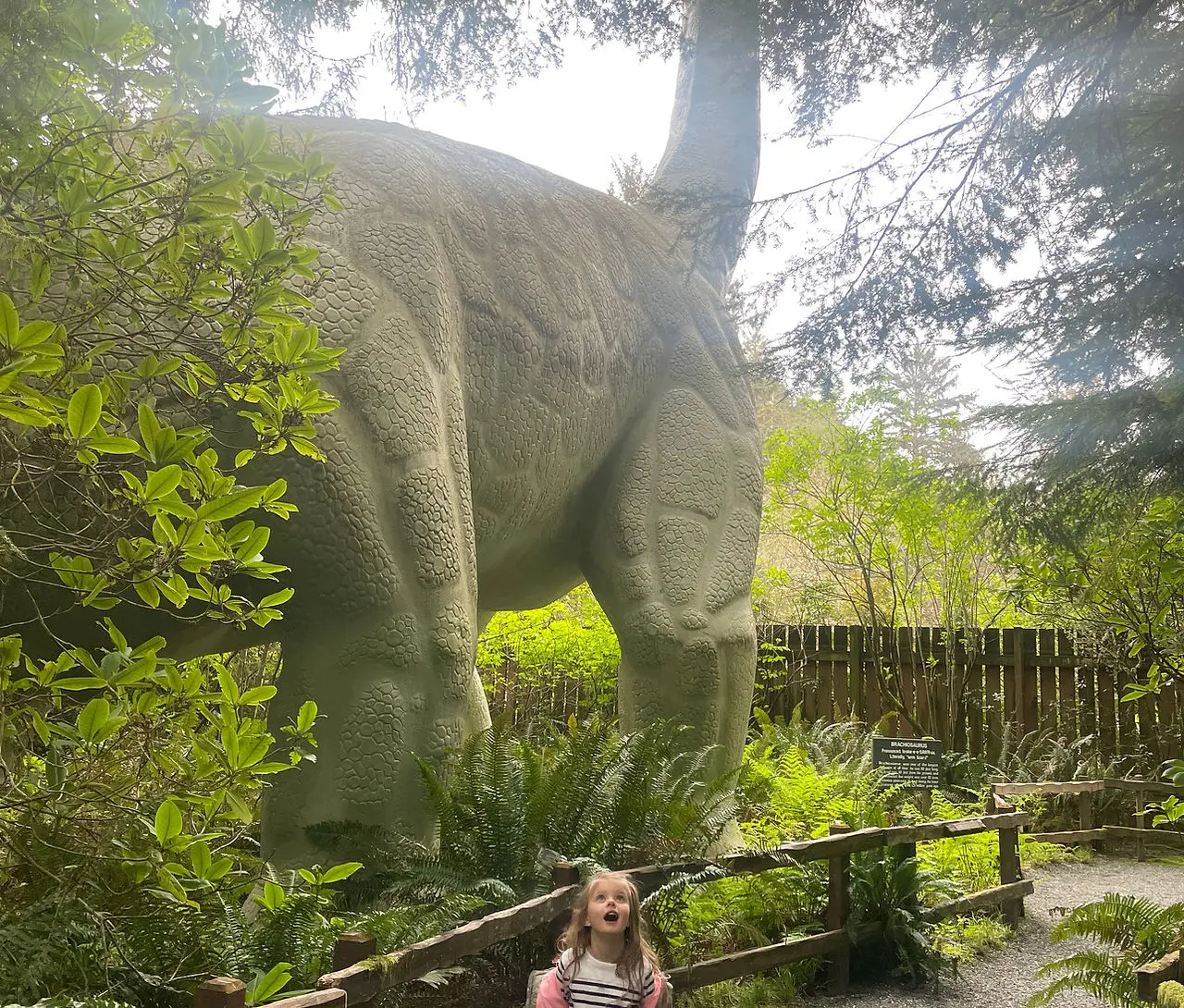
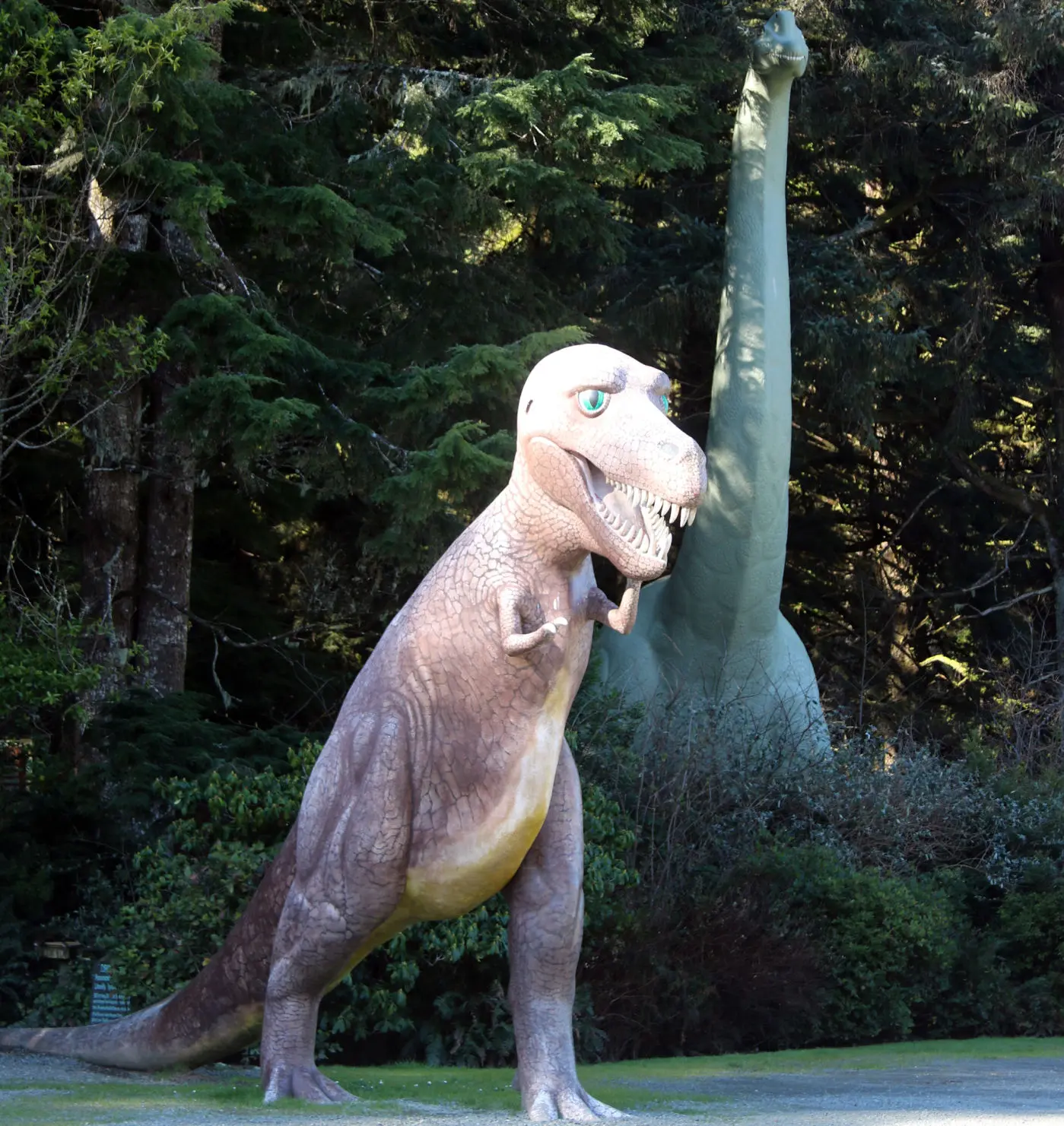
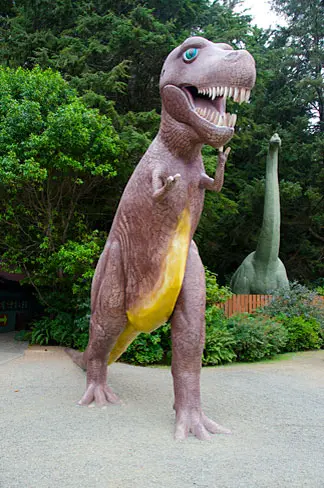
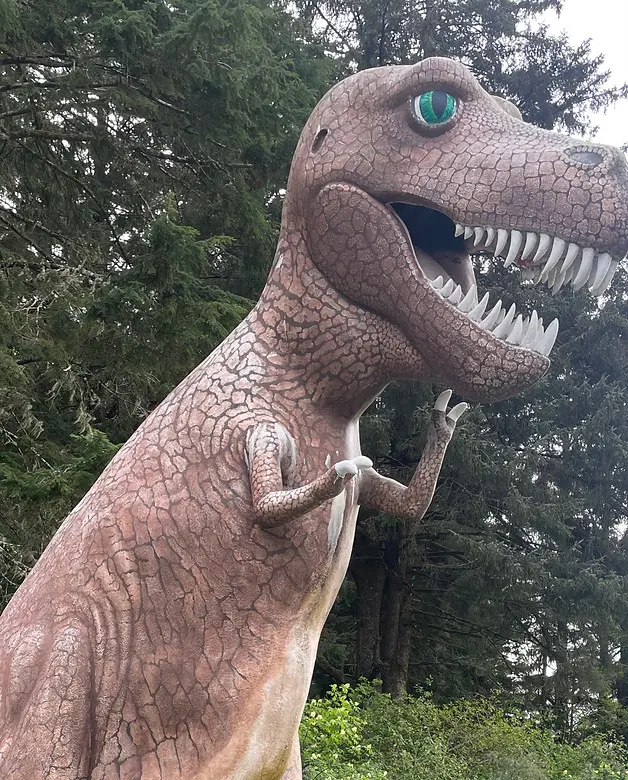
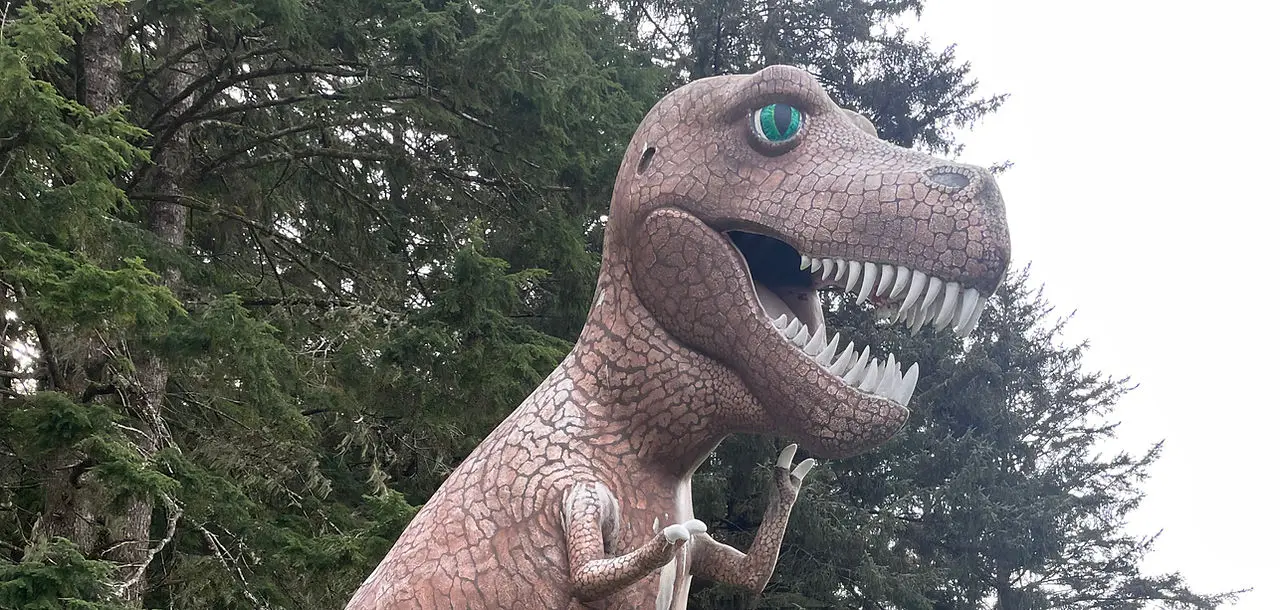
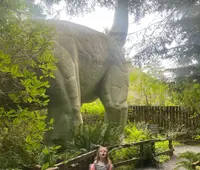
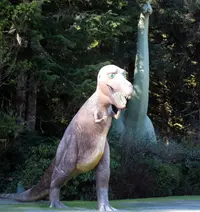
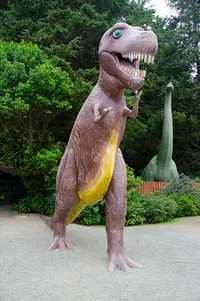
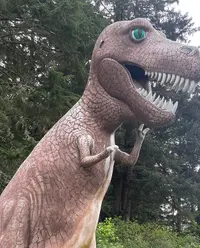
On U.S. Highway 101, halfway between Gold Beach and Port Orford on the Southern Oregon Coast, two concrete animals stand at the edge of a parking lot. A Tyrannosaurus rex, twenty feet tall by the Oregon Encyclopedia’s measure, bares its fangs at the passing traffic. Beside it, the neck of a Brachiosaurus rises from behind a wooden fence to 46 feet, and its head looks out through the foliage at the road. The Oregon Encyclopedia counts Prehistoric Gardens as a remnant of the state’s pre-freeway roadscape, when family-owned attractions along the two-lane federal highways lured drivers to stop, pay admission, and see something unusual.
Tickets are sold in the gift shop on the day of the visit, and each comes with a paper trail map. The Curry Coastal Pilot reported in 2020 that the map had been drawn by hand forty years before. Kiki McGrath, the owner, handed one to an Oregonian reporter on a January morning in 2017 with a short instruction: “Have fun. And follow the arrows. You don’t want to go backwards.”
Ferns, skunk cabbage, and a spring-fed creek
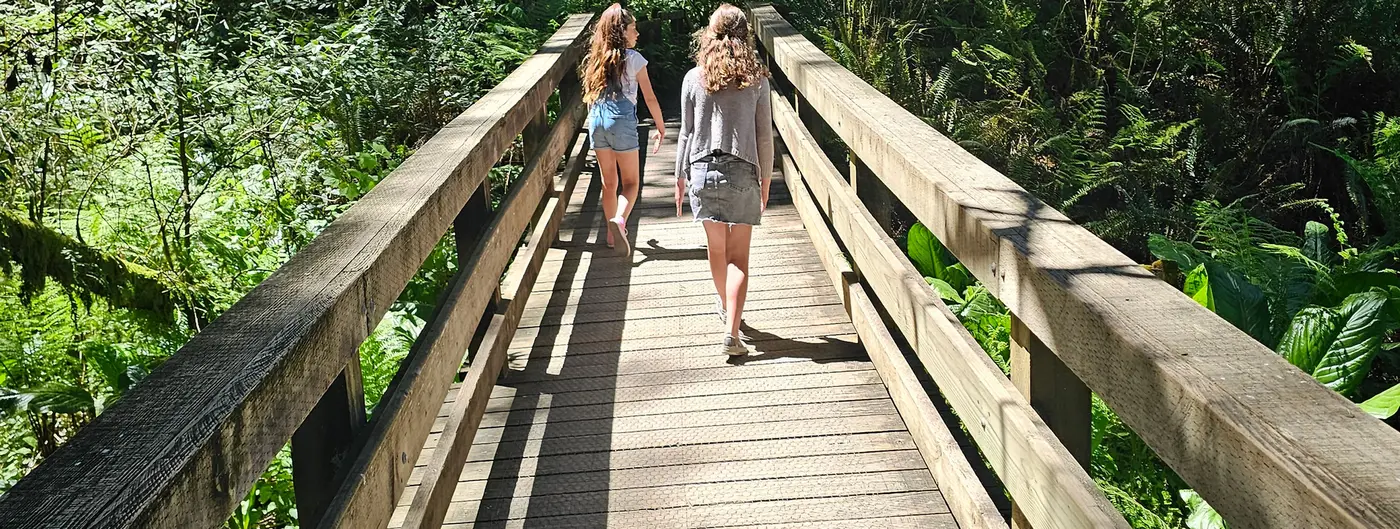
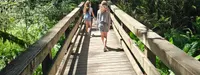
The trail is about three blocks long and generally takes twenty minutes to walk. Gravel paths wind through spruce and sword ferns and past trees the Pilot put at 350 years old, along a spring-fed creek. The Pilot gives the rainfall as six to ten feet a year. The park describes a temperate rainforest sheltered in a valley pocket from the winter storms off the Pacific, where ferns grow to gigantic size and the common skunk cabbage puts out tropical leaves. “You don’t have to water anything but we do have to cut things back when it starts growing,” McGrath told the Pilot. “Some of the skunk cabbage leaves get to be about 7 feet tall.”
The shelter has limits. The trail may close in extreme weather, especially wind. During one windstorm in the winter before the 2020 Pilot article, a giant tree fell in the park onto two of the sculptures, and they were still under repair when the article ran.
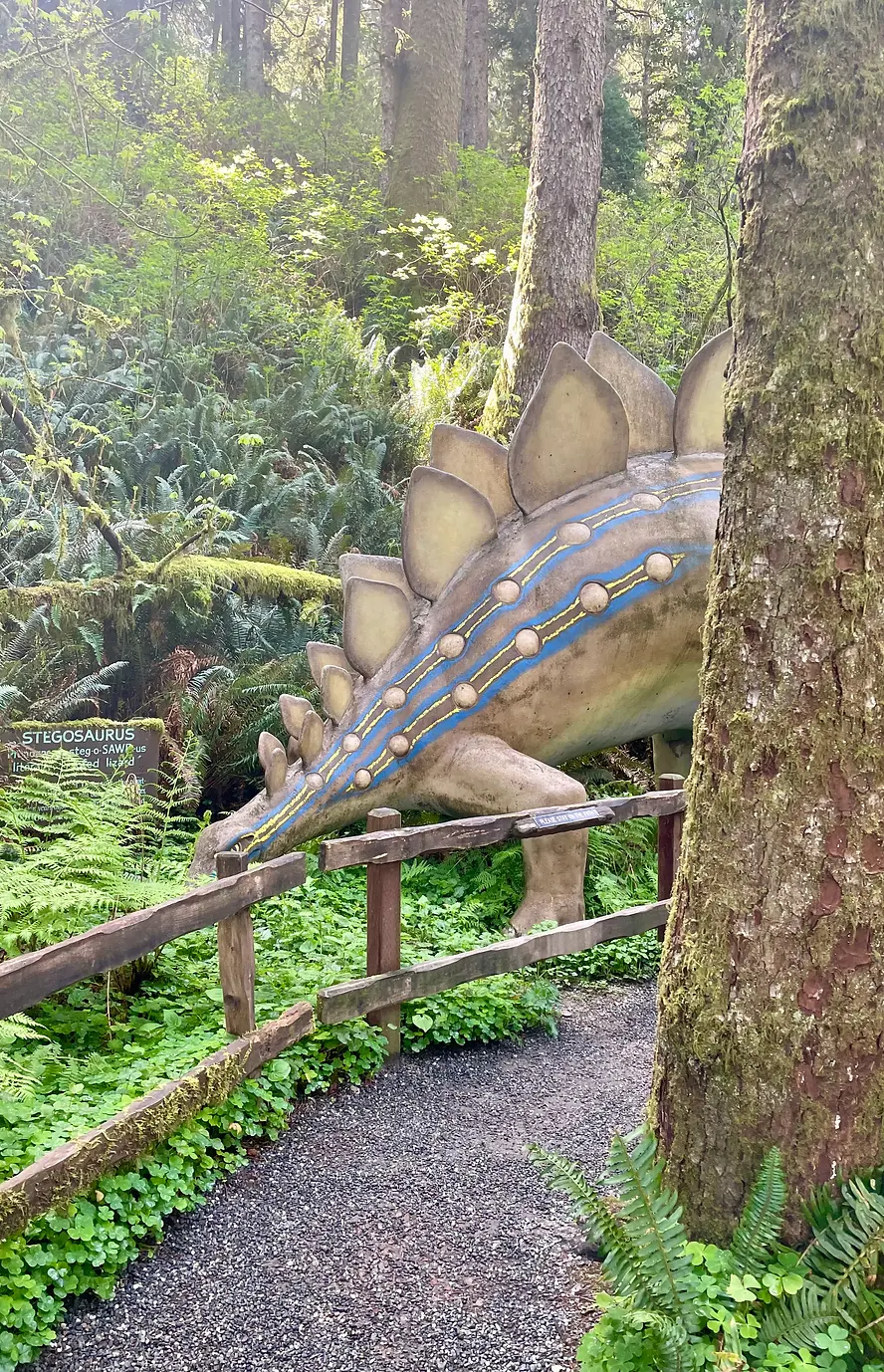
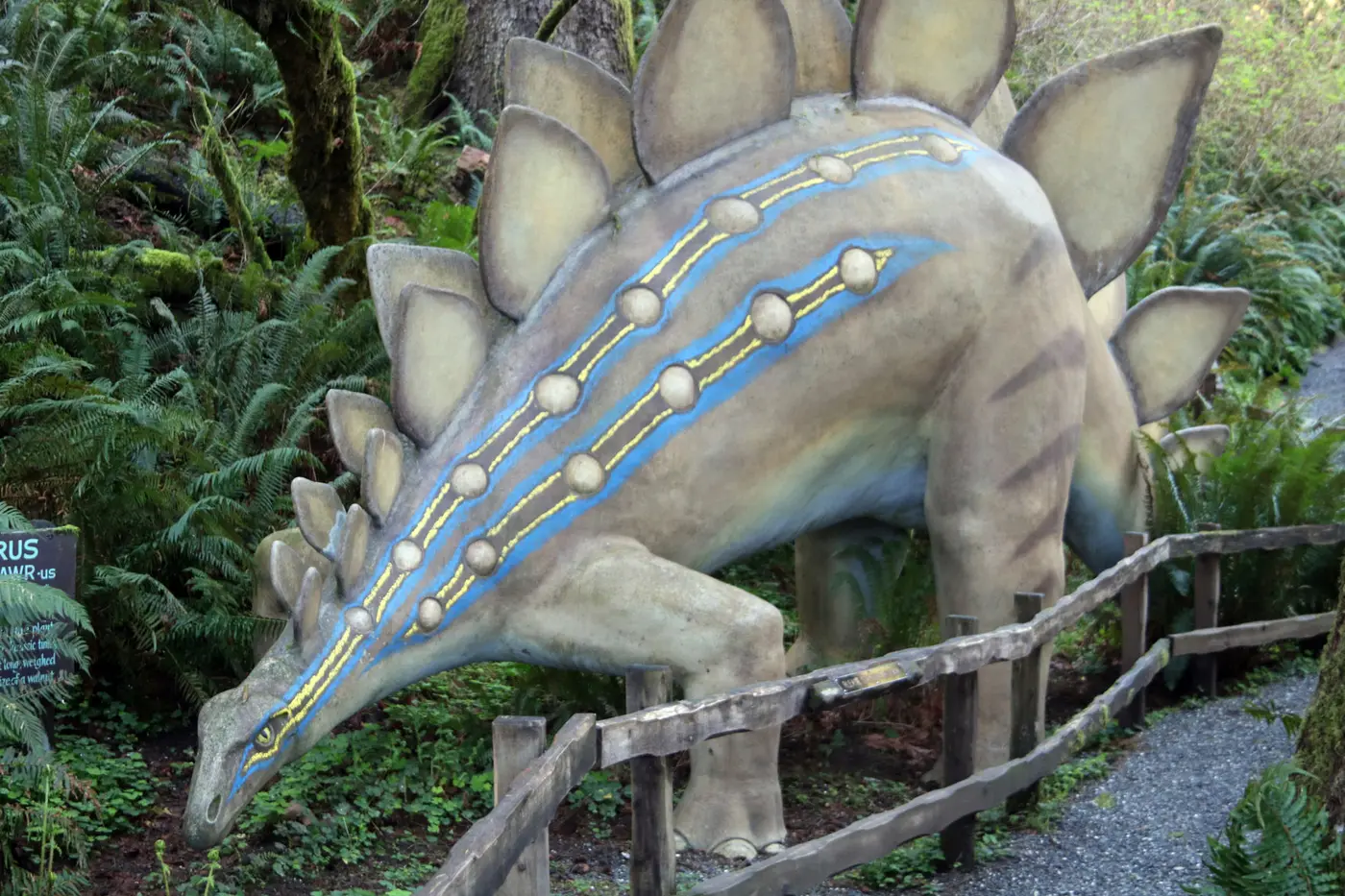
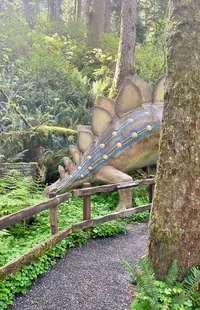
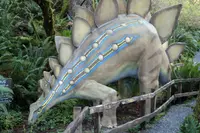
Twenty-three life-size figures of dinosaurs and other extinct reptiles stand along the path. Past the Brachiosaurus they grow smaller and more colorful. A Stegosaurus is striped in yellow and blue. A blue Ichthyosaur lies beached on the muddy creekside, and an Elasmosaurus stretches its long neck and a mouthful of teeth over the trail. Early on, a stretch of large signs traces the first life on Earth and the evolution of plant species. Each animal has its own sign, and others identify the native plants. The Brachiosaurus sign estimates the animal’s live weight at 85 tons and calls it a plant-eater of the Cretaceous, about 125 million years ago. The Oregon Encyclopedia notes that no scientific evidence shows land dinosaurs ever lived in Oregon, which was mostly covered by ocean during that era.
A bench stands at the halfway point. Strollers are not allowed on the trail, so the park lends its own. In summer, McGrath said in 2020, visitors still number about 200 a day. The path ends at the gift shop, which sells plush toys and coloring books along with fossils, agates, and apparel.
Steel, lath, and concrete
The sources describe the construction a little differently. The Oregon Encyclopedia says the figures have steel armatures for skeletons and layers of chicken wire covered with several coats of concrete. The Pilot describes steel frames with metal lath molded over them, then plastered with cement and painted. To get the anatomy right, Nelson visited natural history museums around the country, sketched skeletons, and talked with paleontologists. The park’s own history mentions a trip to the Smithsonian and “endless research.”
The colors were his own choice. The Oregon Encyclopedia lists greens, browns, and rust-reds, and the Pilot says the palette was meant to be fanciful and photogenic. “People would ask him ‘How did you know what colors they were?’ and he said, ‘Well no one knows. It’s the artist behind the paintbrush,’” McGrath recalled. “Birds are very colorful, lizards are very colorful, but we don’t know.”
Accounts also differ on the Brachiosaurus. The Pilot calls it the first sculpture Nelson made, built over four years from a scaffold. The Oregon Encyclopedia calls it the last, completed in 1969 after four years of work. McGrath keeps a framed photograph of her grandfather standing between its front legs. “The Brachiosaurus was his pride and joy,” she said.
A farm boy with a pen
E.V. “Ernie” Nelson was born in 1907 on a Minnesota farm. He read National Geographic as a boy and drew dinosaurs. “He always drew,” his daughter, Bennii Worthington, said in the 2017 Fox Business documentary Strange Inheritance. “He came out of the womb with a pen.” In the 1920s he moved with his parents and siblings to Springfield, Oregon. He married during the Great Depression and took up accounting for the security it offered. Walt Disney Studios once offered him a job as a cartoonist, and he talked himself out of it. “He had two children, so he decided he just couldn’t pick up and leave,” his daughter told the program’s host, Jamie Colby.
The sources disagree on what he left behind and how much land he bought. The park says he worked as a CPA and owned a mill machinery supply business in Eugene. The Oregonian names a successful logging supply company, given up in 1952. Strange Inheritance, as the Pilot reported it, says he and his wife, Kari, sold his accounting business and their Eugene home in the early 1950s to buy the original 77 acres. Fox Business puts the purchase at 70 acres in 1954, when he was 47. The Oregon Encyclopedia records a 26-acre tract of moist, northeast-facing forest bought in 1952, where he built a family residence and the gift shop. All agree he moved his family south from Eugene, and the Encyclopedia and the park date the move to 1953.
He chose the site with care. According to the Oregon Encyclopedia, Nelson meant to catch the tourist traffic that grew on the southern coast after World War II. He placed the business midway between Sea Lion Caves to the north and the Trees of Mystery near Crescent City, California, to the south. “Friends thought I had gone completely berserk,” he told The Oregonian in 1972. “I guess it was sort of a crazy idea, but it worked out fine.” His great-granddaughter, Rain Halcumb, put it this way: “When everybody else told him he was crazy, he just said ‘No, I’m gonna build dinosaurs.’”
Prehistoric Gardens opened on January 1, 1955. Admission was 50 cents for adults and 25 cents for children. Nelson finished five dinosaurs in the first two years and averaged about one a year after that, reaching twenty-three over thirty years. Popular Mechanics ran a piece on the park in May 1958.
Talking dinosaurs for five decades
For nearly fifty years Nelson sold the tickets, ran the gift shop, and “talked dinosaurs” with visitors. Prehistoric Gardens, he said, was the fulfillment of his “boyhood dream.” He also built life-size extinct mammals for Thunderbeast Park, which the Oregon Encyclopedia calls a less successful roadside attraction on Highway 97 near Chiloquin. His wife and children worked at the Gardens. In the 1990s, when the film Jurassic Park was popular, it employed as many as seven people.
The county’s paperwork from those years gives the park’s outline on a map. A 1997 Land Use Board of Appeals opinion about a neighboring tract describes the theme park as sitting on a 65-acre parcel. That parcel was zoned entirely Rural Commercial until 1990, when 25 of its acres were redesignated Forest Grazing.
Thirty-three acres kept
Nelson ran the park until he died in 1999 at 91. Kari died soon afterward, according to Strange Inheritance. The property went to McGrath, her mother, and her uncle, and it was listed for sale. McGrath decided she did not want to sell the park. The land was divided: the 33 acres holding the park went to her, and the other 44 acres sold for $1.6 million. Her mother had worked for years in the gift shop and her uncle had built some of the park’s features. By 2020 McGrath herself had worked there for forty years.
“I think he was hoping someone would carry it on,” she told Fox Business in 2017. Douglas Kirby, author of two books on roadside attractions, told the program why so many such places had closed. “A lot of those great parks were also the vision of a single person, and you could feel their enthusiasm in everything,” he said. “But by the third generation, there’s nobody to carry them on, and all of a sudden they’re gone.” The Oregonian wrote that year that no one stood in line after McGrath.
Three years later she told the Pilot otherwise. “I’d like to keep the legacy going,” she said. She was confident that her daughter and son would keep it going after she retired.
Notable Events
- 1950sAccording to Strange Inheritance: Dino Park, Ernie and Kari sold the accounting business and Eugene home to buy the original 77 acres. currypilot.com
- 1952Nelson purchased a 26-acre northeast-aspect forest tract and constructed a family residence and gift shop. oregonencyclopedia.org
- 1952Nelson left a successful logging supply company to work full-time building life-size concrete dinosaurs. oregonlive.com
- 1953The former accountant moved to Port Orford. oregonencyclopedia.org
- 1954At age 47 Nelson quit his desk job, bought 70 acres and began sculpting and painting life-size concrete dinosaurs. foxbusiness.com
- 1954Nelson began building dinosaurs with steel armatures, chicken wire, and several coats of concrete. oregonencyclopedia.org
- 1955The family attraction opened. currypilot.com
- 1955The owner reports opening after three years of construction, a trip to the Smithsonian in NYC and research to make the life-size replicas scientifically correct. prehistoricgardens.com
- 1969The Oregon Encyclopedia identifies the Brachiosaurus as the Gardens' last dinosaur model, built by Nelson. oregonencyclopedia.org
- 1990The county decision quoted by LUBA stated that all 65 acres were zoned Rural Commercial until 1990, when only 40 acres were allowed to remain in commercial use. oregon.gov
- 1990sDuring the popularity of Jurassic Park, the Gardens employed as many as seven people. oregonencyclopedia.org
- 1999According to Strange Inheritance, Nelson died at 91; Kari died soon afterward and the property was left to McGrath, her mother and uncle. currypilot.com
- 1999Nelson ran the park until his death at 91. foxbusiness.com
- 1999Kiki McGrath inherited Prehistoric Gardens in Port Orford. foxbusiness.com
- 1999Nelson died; he had researched the replicas by visiting natural history museums, sketching skeletons and consulting paleontologists. oregonlive.com
People
- Bennii Worthington, Nelson's daughter, interviewed about his passion in the documentary.
- Ernie Nelson, Builder of the life-size concrete dinosaurs and McGrath's grandfather (Died in 1999).
- Kari, Ernie Nelson's wife, who joined in selling their home and business to acquire the original park acreage (Died soon after Nelson, who died in 1999).
- Kiki McGrath, Successor who volunteered to keep the business going after Nelson died (From 1999).
- Bennii, Nelson's daughter, interviewed about his decision not to move for a cartoonist job.
- Rain Halcumb, Nelson's great-granddaughter, interviewed about his determination to build dinosaurs.
- E.V. “Ernie” Nelson, Originator of the park's vision; artist, sculptor, entrepreneur and dinosaur enthusiast (Moved south to build the park in 1953).
- E.V. "Ernie" Nelson, Starter of the park; according to its website, formerly a CPA and Eugene mill-machinery supply business owner.
Sources
- prehistoricgardens.com/about
- prehistoricgardens.com/plan-your-visit
- prehistoricgardens.com
- prehistoricgardens.com/about
- oregonencyclopedia.org/articles/prehistoric_gardens
- currypilot.com/news_paid/prehistoric-gardens-still-a-modern-wonder/article_a494b316-5d77-11ea-99d5-0320a7ea00b0.html
- oregonlive.com/travel/2017/02/prehistoric_gardens_evades_ext.html