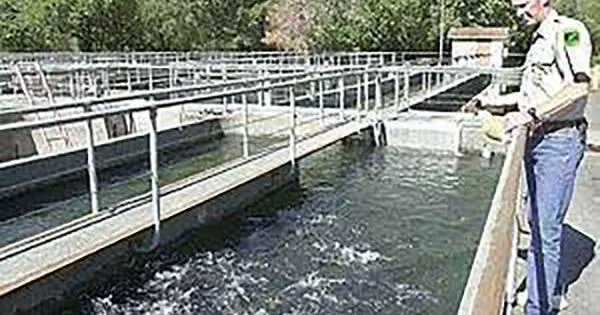
Elk River Hatchery
Port Orford, Curry County, Oregon. Fish hatchery.
Details

- Where
- 95163 Elk River Road, Port Orford, OR 95163. Directions
- When
- dawn to dusk; 7 days a week.
- Season
- December - January and July - September (best time to visit).
- Getting there
- From Port Orford, travel three miles north on Hwy. 101. Turn right onto Elk River Road and proceed 7.5 miles. The hatchery is located on the left.
- Access
- Nearby camping: Cape Blanco State Park nine miles north of Port Orford; primitive camping spots upriver from the hatchery are managed by the Rogue River – Siskiyou National Forest.
- Website
- myodfw.com
- Managed by
- Oregon Department of Fish and Wildlife.
- Established
- 1968.
Elk River Road leaves Highway 101 three miles north of Port Orford and follows the river inland. At 7.5 miles the Elk River Hatchery stands on the left. It has rearing ponds, a boat ramp into the river, a picnic area, a restroom, and outdoor signs that explain the work to anyone who walks in. A camp host lives on the grounds. The Oregon Department of Fish and Wildlife runs the place, keeps it open dawn to dusk every day, and names December through January and July through September as the best months to come. Birds of prey, deer, elk, wading birds and waterfowl use the grounds, and the department’s guide notes that the launch allows swimming. The water at the ramp is blue-green, cool and clear. The federal river description says the Elk clears far more quickly than other streams in the region.
Up the ladder and into the ponds
Returning salmon enter a passive trap at the downstream end of the 13.2-acre site. They come in on their own and work up a fish ladder whose steps have holes cut in them, so that a salmon swims through each divider instead of leaping over it. At the top is a large aluminum trap. Staff take brood fish throughout the run to keep the stock’s spread of ages and timing, and only Elk River fall Chinook, hatchery and wild, are spawned. The highest collection on record at the ladder is 4,000 adults. The 2016 management plan also allows ODFW staff and volunteers to take up to 300 wild Chinook from the mainstem by tangle net. Netting stops for the day if more than two coho come up in it.
Eggs incubate on site. A 2004 ODFW stock assessment says the young Chinook are reared about nine months and released in fall to meet the first freshet. The management plan gives the window as mid-September to mid-November, after most wild juveniles have gone downstream. A 2023 news account says the release normally comes in late October or November, when fall rains raise the river, with a small group in March. Every Chinook smolt has carried a clipped adipose fin since the 2007 release. The ponds also hold winter steelhead for the Chetco River, and rainbow trout. Four permanent employees ran the facility at the time of the 2016 plan. An ODFW summary describes the Elk’s cool, constant water as ideal for rearing. It proposed two more raceways so the hatchery could take in programs from facilities short of cold water.
The trout are the fish most likely to splash a visitor. In October 2002 The World’s outdoors editor, Rick Osborn, wrote about manager Robin Crisler sprinkling large chunks of feed into a pond. The rainbows in it were bound for Garrison Lake and Libby Pond in Curry County, for the trophy trout and Free Fishing Weekend programs. The packed fish rushed the surface before the food landed. “They’ll get you all wet if they can,” Crisler said. “These fish will eat anything that moves or falls into the water.”
The river above and below
The hatchery sits about 8 miles up from the Pacific, by the 2004 assessment. Below it, about 13 miles of private land are open to drift-boat fishing for trout, steelhead and Chinook. During the salmon and steelhead seasons, the Forest Service directs anglers to call the hatchery for fishing reports.
Above the hatchery, the river comes down from the Grassy Knob and Copper-Salmon wildernesses through a steep canyon of exposed rock. In 1988 the National Wild and Scenic Rivers System took in 17 miles of the mainstem, from the forks down to Anvil Creek, and two miles of the North Fork. The rest of the North Fork and the South Fork followed in 2009, and a string of tributaries in 2019. Much of the Forest Service stretch is closed to angling. The old growth along it shelters marbled murrelets, northern spotted owls and bald eagles. The Forest Service says these stands may hold one of the largest marbled murrelet populations in the lower 48 states. Developed campgrounds at Butler Bar, Sunshine Bar and Laird Lake lie in the corridor, and Cape Blanco State Park is nine miles north of Port Orford.
The Elk’s Chinook run late. Steve Taylor, a fisherman who lives south of Port Orford, wrote in 2002 that sand bars form at the mouths of the Elk, the Sixes and Floras Creek. The bars keep salmon out until the first big rains, usually in early to mid-November, and bright salmon stay in those rivers through December. At the river mouth, ODFW allows the Port Orford extended fishery, a commercial troll season that opens after the general ocean season closes on October 31. One aim of the hatchery is to supply it.
The river carried other cargo before salmon were raised beside it. A 2002 Curry County watershed plan cites A.G. Walling, who wrote in 1883 that the Elk mainstem moved up to 10,000 board feet of Port Orford cedar a day.
Counting Chinook since 1968
The major portion of construction was finished in 1968, and the program began that year with broodstock taken from the native Elk River Chinook. The first smolts went out in 1969. The ODFW visitors’ guide dates the final construction of an intake and ten new ponds to 1971. A separate ODFW summary puts it in the late 1970s. The stated purpose was to supplement natural fall Chinook in the Elk and Chetco rivers and winter steelhead in the Chetco. By 2002 the hatchery supplied the Elk, Chetco, Winchuck and Pistol rivers and Hunter and Euchre creeks. About 325,000 salmon a year went into the Elk and around 230,000 smolts into the Chetco.
Beginning in 1970, ODFW’s research section spent ten years on the returning run. The work included mark-recapture estimates, a statistical creel survey from 1972 to 1980, and a count of broodstock at the hatchery. The 1977 brood, released in 1978, was the first to be fin-clipped and fitted with coded wire tags, and some of each year’s production has been tagged since. Research shrank from 1981 to 1992, but spawning-ground samples and the hatchery census went on. Ron Williams, author of the 2004 assessment, credited Gary Susac and Ken Flizar with keeping the monitoring program and its database going “throughout many years when little support was given the project.” He also named Paul Reimers, Al McGie, Jay Nicholas, Tim and Kay Downey and Reese Bender among the biologists who began the early studies. Wild and hatchery fish were told apart by their scales, since naturally reared Elk River Chinook carry scale patterns of their own.
Starting with the 1990 brood, 200,000 Chinook a year were clipped and tagged under Chinook Technical Committee rules. In 1992 ODFW designated the hatchery stock an exploitation-rate indicator. Since then the Elk’s fish have stood in for wild Chinook of the Umpqua, Coos, Coquille and Sixes rivers and Floras Creek when the Pacific Salmon Commission tallies ocean harvest. “Elk River fall Chinook are used as our indicator stock for the Pacific Salmon Treaty,” Crisler said in 2002. The assessment’s estimates of the large hatchery-origin run ranged from 475 fish in 1981 to 10,821 in 2001.
Hatchery fish also spawned in the wild. The 2016 plan put their share on the natural spawning grounds at an average of 51 percent and set a goal of under 30. To get there, the plan cut the Elk release to 275,000 beginning with the 2015 release and placed weirs on Rock and Anvil creeks to remove hatchery strays.
Pink slips in 2002, ash in 2023
On September 7, 2002, the Associated Press reported a revised ODFW budget, drawn up at Gov. John Kitzhaber’s request, that would close four coastal hatcheries, Elk River among them. Ed Bowles, the department’s fish division administrator, said hatcheries were targeted every time the state hit a budget crisis. “These won’t shut down fish opportunities, because there will be fishing opportunities based on wild fish production, but the number of fish caught will decline, we feel, significantly,” he said. Louise Soliday, the governor’s natural resources adviser, was quoted asking, “Do you close schools and leave hatcheries open? Education is a priority.”
Three of the hatchery’s four staff received notices. Taylor wrote that between them they had well over 50 years at this hatchery alone. Without money, the fish would have had to be released November 1. The Legislature reached a budget deal in special session, and Taylor’s column of September 21 said the hatchery had been saved “at the last possible moment,” and not for the first time. The two sources put the cost differently: Taylor at $300,000 a year, Crisler at $122,000, citing high utility bills because the hatchery also serves as a pump station. The 2016 plan gives about $330,000. The reprieve depended on a temporary tax increase going to voters in January. If it failed, Crisler said, “There would no longer be any fish production here.” In the meantime he said of the staff, “We feel like we’re doing the right thing.”
In 2023 the Anvil Fire brought a Level 3 evacuation order. Ash and debris could clog the screens, or water could be shut off for firefighting with no one on site to keep it flowing, so the staff emptied the ponds early. About 265,000 Elk River fall Chinook smolts went into the river. Some 23,000 winter steelhead pre-smolts went into the Chetco about seven months ahead of schedule, along with 140,000 Chetco fall Chinook smolts a few weeks early. About 60,000 Umpqua fall Chinook went into acclimation pens at Winchester Bay, which the Reedsport-Gardiner STEP group assembled on short notice. Another 25,000 Tenmile Creek winter steelhead fingerlings were moved to Bandon Hatchery. The World reported on October 4 that the staff had then evacuated themselves and their families.
Notable Events
- 1968The hatchery program began with collection of fall Chinook broodstock. dfw.state.or.us
- 1968The major portion of Elk River Hatchery construction was completed in 1968. myodfw.com
- 1969The first smolts were released. dfw.state.or.us
- 1970ODFW's research and development section began extensive sampling of the returning Chinook run for a period of ten years. dfw.state.or.us
- 1970sIn the late 1970s the hatchery intake and ten new ponds completed final construction. nrimp.dfw.state.or.us
- 1972The stock assessment dates the beginning of hatchery fish returns to 1972. dfw.state.or.us
- 1977Elk River domestic stock were marked and coded-wire-tagged beginning with the 1977 brood, released from the hatchery in 1978. dfw.state.or.us
- 1981Research efforts decreased, while standardized spawning-ground sampling, hatchery-return census and intermittent fishery sampling continued. dfw.state.or.us
- 1988The Elk River was designated into the National Wild and Scenic Rivers System in 1988, with a recreational mainstem segment and a wild North Fork segment. fs.usda.gov
- 1990Beginning with the 1990 brood, 200,000 Chinook were adipose-clipped and coded-wire-tagged under Chinook Technical Committee requirements for exploitation-rate indicator groups. dfw.state.or.us
- 1992ODFW designated the hatchery stock as an exploitation-rate indicator stock, and another annual statistical creel survey was implemented. dfw.state.or.us
- 2002After the reprieve, the October feature warned that if the tax increase failed, the hatchery likely would return to its September predicament. theworldlink.com
- 2002The hatchery operated with general fund money and was one of several state hatcheries targeted for closure because of high operation costs. theworldlink.com
- 2002The September opinion account says the Elk River salmon hatchery was again saved at the last possible moment from imminent closure. theworldlink.com
- 2002A revised ODFW budget would close four coastal hatcheries, including Elk River Hatchery east of Port Orford, and reduce other conservation programs; this was a proposal, not proof of closure. theworldlink.com
- 2007Smolts began to be mass-marked with an adipose fin clip, allowing mark-selective fishing regulations, improved stray-rate monitoring and improved broodstock selection. dfw.state.or.us
- 2014The Oregon Fish and Wildlife Commission adopted a plan guiding conservation of Oregon Coast fall Chinook stocks and hatchery programs in the Coastal Species Management Unit. dfw.state.or.us
- 2015The plan specifies an annual Elk River yearling release level of 275,000, implemented beginning with the 2015 release. dfw.state.or.us
- 2015Tributary weirs were utilized. dfw.state.or.us
- 2016Temperature loggers began monitoring hatchery effluent and ambient stream temperatures to evaluate hatchery operations' effects on water temperature. dfw.state.or.us
- 2023During a Level 3 evacuation, staff released four stocks of fin-clipped fish early into local rivers and temporarily moved one stock to Bandon Hatchery. theworldlink.com
People
- Robert Rice, Elk River Hatchery Manager and hatchery contact for the management plan.
- Russell Stauff, Rogue Watershed District Manager, named as applicant responsible for the hatchery management plan.
- Scott Patterson, Fish Propagation Program Manager; lead contact for the hatchery program.
- Todd Confer, District Fish Biologist; on-site lead for the hatchery program.
- Robin Crisler, Elk River Hatchery manager, shown feeding trout.
- Bill Fisher, State senator thanked in the opinion account for helping stave off the hatchery closure's impact on regional fishing.
- Joanne Verger, State representative thanked in the opinion account for helping stave off the hatchery closure's impact on regional fishing.
- Ken Messerle, State senator thanked in the opinion account for helping stave off the hatchery closure's impact on regional fishing.
- Louise Soliday, Governor's natural-resources adviser quoted in the hatchery budget debate as asking whether schools should close while hatcheries stay open.
- Wayne Krieger, State representative thanked in the opinion account for helping stave off the hatchery closure's impact on regional fishing.
- Anne Pressentin, ODFW spokeswoman explaining the general-fund constraints behind the proposed cuts.
- Ed Bowles, ODFW fish division administrator commenting on repeated targeting of hatcheries during state budget crises.
- John Kitzhaber, Oregon governor whose request prompted the revised ODFW budget proposing hatchery closures.
Sources
- myodfw.com/elk-river-hatchery-visitors-guide
- myodfw.com/visit-odfw-hatcheries
- theworldlink.com/elk-river-hatchery-raises-more-than-just-salmon/article_1ea90c07-5bc4-519a-8b78-b30a624475eb.html
- dfw.state.or.us/fish/HGMP/docs/2016/Elk%20River%20Fish%20Hatchery,%20Fall%20Chinook%20Salmon%20Program.pdf
- dfw.state.or.us/MRP/publications/docs/salmon_9.pdf
- currywatersheds.org/wp-content/uploads/2020/02/Curry-Action-Plan.pdf
- theworldlink.com/port-orford-hatchery-to-shut-down/article_66f2db74-9878-549d-9e7b-850e24655de8.html
- theworldlink.com/in-my-view-keep-fish-hatcheries-off-the-chopping-block/article_8163e299-edca-5cb6-908e-8dd91f9894cf.html
- theworldlink.com/news/local/elk-river-hatchery-fish-released-early-due-to-anvil-fire-level-3-evacuation/article_f6e7dc18-6301-11ee-a8d0-2b10d08f6601.html
- fws.gov/rivers/river/elk-river