Joseph
Wallowa County, Oregon.
Joseph sits at the base of the Wallowa Mountains in northeastern Oregon, named for Nez Perce chiefs whose band was forced from the Wallowa Valley in 1877.1,2,3
Details
- Last checked
- October 6, 2026.
Point at a dot to see the place.Tap a dot to see the place. Road map of Joseph.
In Joseph
- B.Bright VintageJoseph · Antiques and collectibles dealerA mother-and-daughter vintage store of carefully chosen vintage items - clothing and just about everything else - sourced from local estates and buying trips.

- Hells Canyon Scenic BywayJoseph · All-american roadAn All-American Road looping some 218 miles around Oregon's Wallowa Mountains, climbing from Joseph's bronze foundries over Forest Road 39 to the rim of North America's deepest canyon.
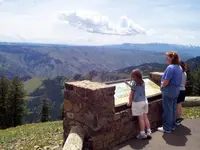
- Valley Bronze of OregonJoseph · Bronze foundryA family-owned art foundry in Joseph, Oregon, begun in 1982 in a logging-truck repair shop, that has cast bronze for Main Street and the National Archives.

The Calendar
History
Below the Wallowas
Joseph stands at the base of the Wallowa Mountains, at the southern edge of the three valleys of the Wallowa River, a mile north of Wallowa Lake.1 The Oregon Encyclopedia calls it the cultural and tourism center of northeastern Oregon and says its nickname, Little Switzerland of America, may have begun with Alpenfest, first held in 1975.1
The Valley of the Winding Waters
The ground under the town lay at the heart of the homeland of the Nimiipuu, or Nez Perce, and members of the Wallowa band lived along the shores of the lake.1 An 1855 treaty deeded the lake and the country around it to the Nez Perce as a reservation, but after gold was found in 1863 the United States government moved to renegotiate.1 The Wallowa band refused to sign, and pressure from resettlers and the government boiled over into the Nez Perce War, which ended in 1877 with the younger Chief Joseph, Heinmot Tooyalakekt, captured on his way to asylum in Canada, after which the Wallowa Lake country was opened to resettlement.1 Except for two brief visits, the younger Joseph was never allowed back to the Wallowas.4
The name Joseph entered the United States Post Office Directory in 1879, after postal authorities turned down Silver Lake and Lake City because those names were already taken.1 The Oregon Encyclopedia says the name honors either Tuekakas, known as Old Joseph, or his son Heinmot Tooyalakekt; the state guide gave it to both father and son, who ruled the Valley-of-the-Winding Waters until 1872.1,3 The same guide put the grave of Old Chief Joseph, marked by a stone shaft, on a knoll between the highway and the north end of the lake.3
Matthew Johnson’s Store
Matthew Johnson, the first postmaster and the man who suggested the name, kept a small store to supply the settlers coming in.1 Joseph became a supply center for farmers and stockmen moving into the mountain valleys, and by 1881 it had a large mercantile store, a flourishing mill, and a schoolhouse.1 The town’s first newspaper, The Chieftain, began printing in 1883 and moved to Enterprise in 1893.1 Joseph was platted in 1883 and incorporated in 1887, with E.J. Forsythe as mayor, and the First Bank of Joseph and a Presbyterian church followed.1 The council authorized a waterworks in 1888, and an electric light plant started up in 1900.1
The Branch Line and the Planing Mill
Stage lines to Elgin and to Lewiston, Idaho, were the town’s first links to the outside, until the Oregon-Washington Railroad and Navigation Company built a branch line in from La Grande in 1908.1 With the rails came timber, which became the main product of the region.1 The first major mill was the Joseph Planing Mill on the banks of the Wallowa River, owned and run by A.M. Hall & Son.1 Joseph had 237 residents in 1900, a number that tripled over the next ten years.1 In 1940 the Federal Writers’ Project guide listed Joseph at 4,400 feet with 504 people and called it an outfitting point.3
Bucking Stock and Bronze
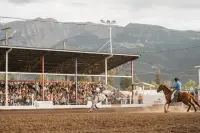
Harley Tucker, born on a ranch near Joseph in 1908, was a stock contractor in town when he started a rodeo, first held in 1946 on top of Wallowa Lake’s east moraine.5,6 The rodeo outgrew the moraine and moved to what is now the Harley Tucker Memorial Arena, just off Main Street.6 Glenn Anderson, who moved to Joseph in the mid-1970s and built a home up Hurricane Creek, founded and ran the Valley Bronze foundry.7 Artist David Manuel came from Walla Walla in 1980 to be nearer the land Chief Joseph had claimed as home.8 Farming, livestock, and timber still hold, now alongside bronze foundries and businesses that serve visitors.1 A main street project finished in 2001 refitted the downtown, and in 2020 the town counted its highest population, 1,154.1 Historian Alvin Josephy kept a ranch outside town for many years, and the Josephy Library, built on his book collection, now serves as a regional arts and culture center.1
Within 30 Miles
Measured in a straight line from the town, nearest first.
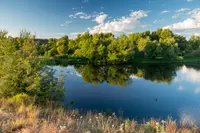
- Wallowa HatcheryEnterprise · HatcheryA state hatchery on Spring Creek west of Enterprise, Oregon, where summer steelhead end an 800-mile run in a trap and rainbow trout are raised for Wallowa Lake.
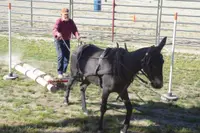
- Hells Canyon Mule DaysEnterprise · Mule showA three-day mule show at the Wallowa County Fairgrounds in Enterprise, Oregon, held since 1981 on the weekend after Labor Day, with a log pull and a flapjack race.
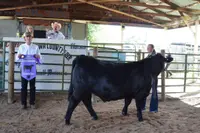
- Wallowa County FairEnterprise · County fairThe Wallowa County Fair in Enterprise, Oregon, held since 1907, offers junior rodeo, livestock barns, a fat stock sale, and Bessie Bingo, won on a cow's choice of square.
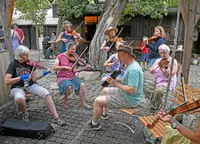
- Wallowa Fiddle Tunes Camp, Enterprise ORWallowa · Week-long camp formatWallowa Fiddle Tunes Camp began in 2005, offering affordable group instruction to individuals and families in a relaxed, week-long camp format.
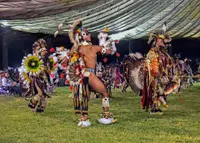
- Tamkaliks CelebrationWallowa · Three-day celebration of nez perce cultureA three-day Nez Perce powwow and homecoming each July on the Wallowa River at Wallowa, Oregon, ending in a Sunday feast of salmon, elk, deer, and buffalo.
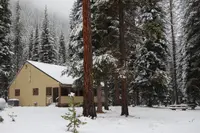
- Two Color Guard StationMedical Springs · Large cabin (forest service guard station rental)A large cabin along Wild and Scenic Eagle Creek below the Eagle Cap Wilderness, with a view from the back porch over a riparian meadow toward the creek; Two Color Campground is nearby.
- Cove Cherry FairCove · FestivalThe Cove Cherry Fair, a free all-volunteer August day on the Ascension School grounds in Cove, Oregon, revives a growers' fair that crowned a King Bing and Queen Anne.

Nearby towns: Baker City. All the towns of Oregon. More of Oregon: Flea Markets, Town Festivals, Scenic Drives, and Factory Tours.
Sources
- Joseph (town) oregonencyclopedia.org/articles/joseph
- Chief Joseph’s Own Story oregonhistoryproject.org/articles/historical-records/chief-joseph39s-own-story
- Oregon: End of the Trail (1940), p. 292 archive.org/details/oregonendoftrail00writrich/page/292
- Heinmot Tooyalakekt (Chief Joseph) (1840-1904) oregonencyclopedia.org/articles/chief_joseph_heinmot_tooyalakekt_1840_1904_
- National Cowboy & Western Heritage Museum nationalcowboymuseum.org/collections/awards/national-rodeo-hall-of-fame/inductees/harley-tucker
- Keeping it in the family lagrandeobserver.com/2013/07/26/keeping-it-in-the-family
- Remembering the life of Glenn Anderson obituaries.union-bulletin.com/obituary/glenn-anderson-1084746604?proxy=original
- Statue-Casting Foundry Giving Stature To E. Oregon archive.seattletimes.com/archive/19910818/1300436/statue-casting-foundry-giving-stature-to-e-oregon