Valley Bronze of Oregon
Joseph, Wallowa County, Oregon. Bronze foundry.
Details

- Where
- 307 W. Alder Street, Joseph, OR. Directions
- When
- Foundry tours Monday through Thursday at 11a.m., typically lasting about 1.5 hours.
- Fees
- $20 per person; children 12 and under are free.
- Hours
- MONDAY THROUGH THURSDAY 6:45am - 4:00pm.
- Walk-in or reserve
- Maximum group size is 30 people; larger groups may be accommodated with prior arrangements with the foundry.
- Phone
- (541) 432-7551
- Website
- valleybronze.com
- Managed by
- Family-owned business.
- Established
- 1982.
Valley Bronze of Oregon stands at 307 W. Alder Street in Joseph, a block or so off Main Street in Wallowa County. A photographer who came by in September 2024 noted a statue in front of the foundry and found it unnamed. Twenty years earlier a visitor located the place by walking until she spotted a bronze horse in mid-gallop.
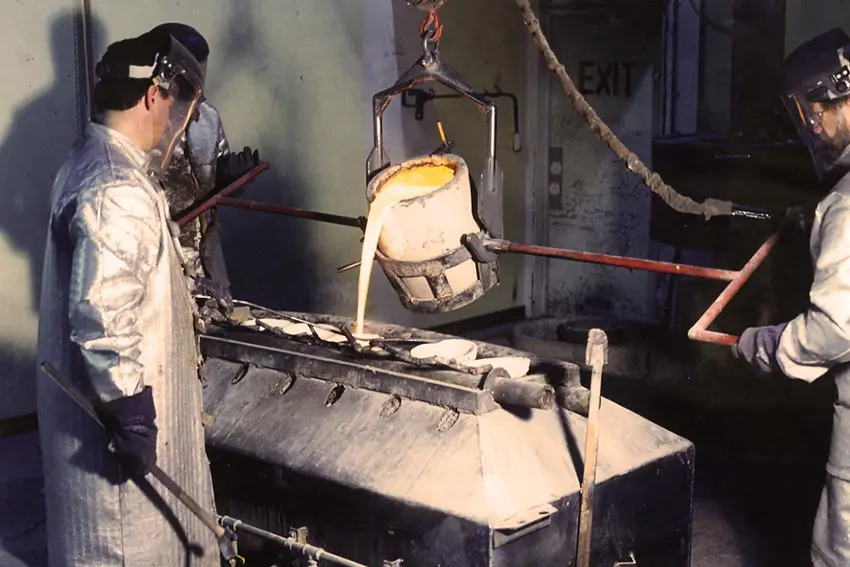
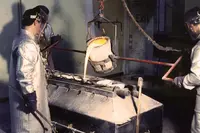
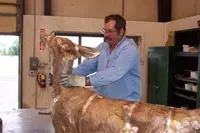
Tours begin at 11 a.m., Monday through Thursday. A foundry worker leads the group through each stage of production and shows how an artist’s original piece is molded, replicated, and cast in metal. The walk takes 60 to 90 minutes, depending on the size of the group and the questions asked. It covers the foundry’s history and current work in progress, and usually some finished pieces waiting to ship. The foundry describes itself as family-owned. It casts bronze, aluminum, and ferric and precious metals, and runs a full metal fabrication shop beside the casting floor. Its work ranges from small editions of fine art sculpture to multi-million-dollar ornamental metal contracts.
Piano wire, rubber, and a furnace
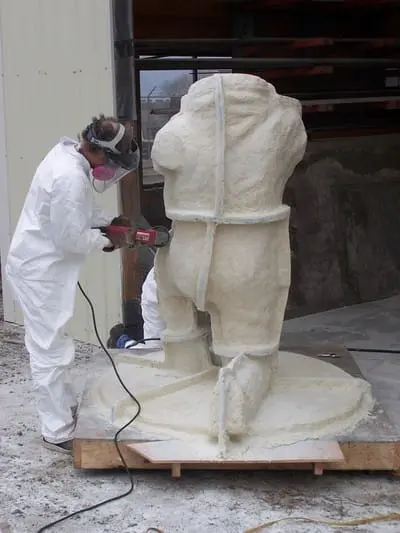
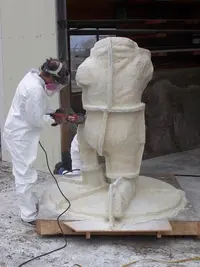
In 2013 Malcolm Phinney was showroom manager and tour leader. He told The Oregonian that nearly everyone who visits town wants to learn how bronze is made. The work starts with an artist’s clay and ends with technicians welding and polishing. Between those ends come eight or more separate processes, from cuts made with piano wire to pliable rubber molds, that turn the clay into a ceramic mold able to hold molten bronze. A piece can take two years to finish. Some artists stay with their work the whole way; others finish the clay and move on.
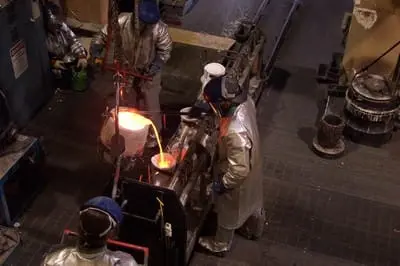
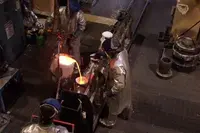
That 2013 tour passed a water buffalo and wart hogs for the Safari Club, mermaids, bear and bison heads, and many eagles. A 700-pound bronze door was for sale at $45,000. In 2017 a group stood among finished statues meant as monuments to wildland firefighters, and in the casting furnace a fire was readied to melt bars of bronze.
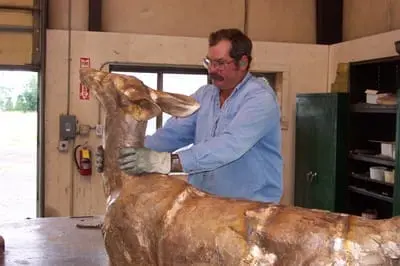
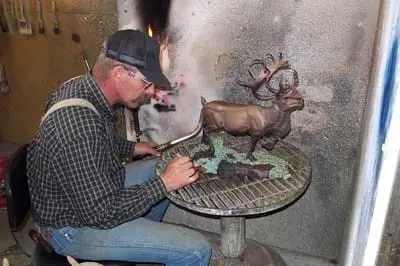
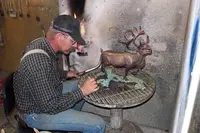
The color on a finished bronze comes from patina. In 1991 the man applying it was Dennis Brennan, who grew up on a local ranch owned by his grandfather, the actor Walter Brennan. Bending over to shoe horses had given him a bad back, and patina work let him sit down. “It pays better than cowboying,” Brennan said. “I’d rather put up with any artist than 20 below on a horse.”
Bronzes along Main Street
Much of the foundry’s output stands outdoors in town. A 12-foot Chief Joseph, sculpted by Georgia Bunn of Medford and cast by Valley Bronze, was unveiled and dedicated on Main Street on a Friday morning in July 2012. It stands across W. Joseph Street from City Hall. The Oregonian reported that it was made from 40 parts welded together. Christy R. Walton bought it, gave it to the city, and attended the dedication as a friend of the sculptor. Austin Barton’s bucking horse and cowboy, “Attitude Adjustment,” stands across the street from it.
Valley Bronze has kept a gallery on Main Street, showing sculpture by many artists whose work is cast at the foundry, along with paintings and prints. In June 2004 the gallery at 18 Main Street priced George Carlson’s bronze draft horse at $200,000 and “Run of the Salmon People,” by Jacques and Mary Regat of Alaska, at $12,975. Nario Lopez’s “Curioso,” a bony young horse meeting a turtle, was priced at $3,200. Phinney said then that 98 percent of the artists came from the Northwest, though some came from as far as Tel Aviv. A sign in the window that summer advertised foundry tours on weekdays at 3 p.m. for $5.
That same June, the Maryland sculptor Walter Matia was at the foundry while his life-size Spanish bulls were cast for the new football stadium in Houston. The 2004 account says two bulls; the foundry’s project list says three, for “Spirit of the Bull” at NRG Stadium. Matia recalled a Valley Bronze representative approaching him at a show in Oklahoma City with an offer of bids. “I said, ‘In a pig’s eye I’m going to drive to Oregon,’” he said. He checked references and began coming several times a year. “I think Joseph is probably the longest cul de sac in America, ending at the lake,” Matia said. “If it wasn’t, it would be the next Jackson Hole. Thank god it isn’t.”
A book on foundries and a truck shop
Glenn Anderson was born in Dawson, Minnesota, in 1924. He worked for the rural electric cooperative at La Pine, Oregon, and later developed land there. He and his wife Helen moved to Joseph in the mid-1970s and built a home up Hurricane Creek. In 1980 the artist David Manuel moved to Joseph from Walla Walla to be nearer the homeland of Chief Joseph. Manuel sold Anderson a set of three bronzes of Chief Joseph and two other Nez Perce leaders, and Anderson resold them at a profit. That money started the foundry in 1982.
The two men told the next part differently. As Manuel remembered it, Anderson offered to build a foundry so Manuel would not have to drive six hours to Portland to have his work cast. Anderson said Manuel talked him into it. Lyle Isaak, later the foundry’s vice president, gave a third account in 2004. He said Anderson, a collector of bronze, toured a foundry in the Portland area and “felt the building was not very complex, and that it really boiled down to good artisans and a knowledge of the casting process.”
Anderson started with a book on foundries and a half-dozen people casting statues in a corner of a logging-truck repair shop. The Associated Press reported in 1991 that local cowboys and loggers thought he was crazy. In 1982 the shop poured its first sculptures, the first from a fine arts bronze foundry in Wallowa County. “I couldn’t take my work anywhere else and get the detail I get here, right down to the screws in the guns,” Manuel said. “Other artists knew if there was a foundry that could do my work and be able to satisfy me, they must be a damn good foundry. Pretty soon, I had to wait in line.”
Steve Parks was on the team that launched it. He had learned tooling at Maiden Bronze in Walla Walla and followed that foundry to Sandy, Oregon, before hearing of a fledgling foundry in Joseph. “I decided to come check it out, and fell in love with the place,” he said. He later opened Parks Bronze in Enterprise.
Isaak’s arrival has two versions. In his own 2004 account, Anderson recruited him from a Portland-area foundry in 1986 as general manager. “I had been in Oregon 18 years, and I didn’t even know where Joseph was,” he said. In September 1986 the Wallowa County Chieftain named him the foundry’s chief administrator when the Oregon Economic Development Commission lent Valley Bronze $56,738 to double its slurry room and add a molding room, a warehouse, and restrooms. The 1991 AP story instead has Isaak coming from Maiden Bronze outside Portland as executive vice president, brought in by the new owner after a sale in 1988.
The monument facility was added in 1987, with the space, ceiling height, and equipment for larger work. The next year the foundry had grown too big to be Anderson’s hobby. He sold it to David Jackman, a lawyer who owned a cattle ranch in the north end of the county and had done the foundry’s legal work. Anderson and Helen moved to Milton-Freewater in the early 1990s and later to Walla Walla. He died on March 7, 2017.
By 1991 Valley Bronze had 65 employees and cast work for mansions, corporate headquarters, and Japanese golf courses. Storefronts in a town of 1,100 had become galleries and studios, and three other foundries had spun off in the valley. “We gear up for their Friday payroll, and boy, do we cash checks!” said Keith Lytle, president of the Bank of Wallowa County. The foundry trained local people in preference to hiring experienced hands from elsewhere. “This is the frontier,” Isaak said. “Our gourmets must be cooks.”
That year in the large-work shop, Isaak ran his hand over a larger-than-life galloping mustang from “The Freedom Horses” by Veryl Goodnight of Santa Fe. One of its six editions was bound for the Berlin Wall. “Tourists from Switzerland or England will be looking at this monument and have no idea it came from a little town in Eastern Oregon,” he said. The foundry’s project list records another Goodnight work, “The Day the Wall Came Down,” cast entirely at Valley Bronze. It was made in two monuments, one at the Allied Museum in Berlin and one at the George H. W. Bush Presidential Library in Houston. Each is 30 feet long and weighs about seven tons.
Work for the Mall and the Archives
The foundry moved into ornamental metal with an entry for Our Lady of Lourdes Cathedral in Spokane, Washington. It designed, cast, fabricated, and installed three bronze doors and their tympanums. In the spring of 2002, with Stewart Springs Ltd., Valley Bronze was contracted for the ornamental bronze of the World War II Memorial on the National Mall. The Oregonian reported that the $2.5 million contract used 40 tons of bronze for 56 wreaths, 735 grates, and a 12-foot flagpole base. The foundry also made 4,123 sterling-silver stars plated with gold. In 2004, Phinney said, the staff was casting pieces so steadily that tours ran only as scheduled. The memorial opened in May 2004. The foundry’s own page dates its Washington Building Congress Star Award to 2004; the Chieftain gives 2005.
The partnership with Stewart Springs ended in court. The two firms formed Metalmark Northwest LLC in 2002, and in April 2003 it was low bidder on bronze doors and ornamental metal for the U.S. Capitol Visitor Center. The Stewarts then moved to the Washington area, formed a new company, and received the subcontract. An arbitration in Portland in August 2005 awarded Metalmark $1.7 million. In 2006 a federal jury in Portland awarded Valley Bronze $850,000 more. By then the foundry had its own contract for the visitor center: two spiral staircases, railings, grilles, and other metalwork.
In January 2007 the staircases and a second Washington job were nearly finished on Alder Street. The second job was the cases that would hold the Declaration of Independence, the Constitution, and the Bill of Rights in the National Archives. “I woke up the other night and started thinking about the fact our bronze work will be within six inches of the Declaration and the Constitution,” Jackman said. “I thought, ‘maybe we should get some special bronze somewhere.’” Aaron Weaver of the design department said pieces of the original cases had been digitally scanned. Two other fabricators had tried and failed to reconstruct them to the Archives’ standards. The new frames followed the pattern of cases built in the 1800s. Isaak counted about 48 workers who had a hand in them.
Brian Lepper welded the stair railings with Nathan Zuercher. Each stair was assembled in the foundry, taken apart, and put together again in Washington, “like jigsaw puzzles,” Lepper said. Dan Thompson, fitting the case corners, found that hand tools sometimes worked faster than air tools.
In August 2026 the foundry posted a photograph of “The Sheep,” by Clayton Bright, bound for a residence near the coast of Maine. Bright had been casting with Valley Bronze for over 18 years.
Notable Events
- 1982Proceeds from bronzes started the foundry; Manuel and Anderson recalled differently who proposed building it. archive.seattletimes.com
- 1982Valley Bronze reports continuous production at its Joseph foundry since this year. valleybronze.com
- 1982Valley Bronze, described as Wallowa County's first fine arts bronze foundry, poured its first sculptures. wallowa.com
- 1986Anderson lured Isaak from a Portland foundry to become general manager, according to this account. spokesman.com
- 1986The Oregon Economic Development Commission awarded a $56,738 low-interest loan. Isaak said the foundry planned to enlarge its slurry room and add molding, maintenance, warehouse and restroom space. wallowa.com
- 1987Valley Bronze added a monument facility with the extra space, ceiling height, and equipment for larger bronze sculptures and major casting and fabrication projects. valleybronze.com
- 1988Anderson sold to lawyer and rancher David Jackman, who brought in Lyle Isaak from Maiden Bronze as executive vice president. archive.seattletimes.com
- 2002Valley Bronze was contracted to provide ornamental bronze work for the memorial on the National Mall. valleybronze.com
- 2002Valley Bronze and Stewart Springs formed Metalmark Northwest LLC. wallowa.com
- 2004The foundry made 4,123 sterling-silver stars plated with gold for the monument, which opened to the public. oregonlive.com
- 2004The own Projects page says Valley Bronze received the Washington Building Congress Star Award and recognition by the American Battle Monuments Commission for its memorial work. valleybronze.com
- 2005Portland arbitration resulted in an award of $1.7 million in damages to Metalmark. wallowa.com
- A Portland federal jury awarded $850,000 for lost participation in an $8.4 million Capitol Visitor Center subcontract; the report describes this as the final chapter of a three-year dispute. wallowa.com
- A 12-foot Chief Joseph sculpture was unveiled and dedicated on Joseph's Main Street; it was sculpted by Georgia Bunn of Medford and cast by Valley Bronze. wallowa.com
People
- David Jackman, Lawyer and cattle-ranch owner who purchased the foundry after doing legal work for it (1988).
- David Manuel, Artist whose bronze-sale proceeds helped start the foundry.
- Dennis Brennan, Former horseshoer applying bronze patinas.
- Glenn Anderson, Started Valley Bronze in a corner of a logging truck repair shop.
- Keith Lytle, Bank president whose bank prepared for foundry payroll checks.
- Lyle Isaak, Foundry chief administrator announcing planned expansion (Sept. 25, 1986 (archive section)).
- Veryl Goodnight, Artist whose Berlin Wall sculpture was cast entirely by Valley Bronze.
- Glenn H. Anderson, Founder and operator of Valley Bronze in Joseph (March 27, 1924 – March 7, 2017 (life dates)).
- Steve Parks, Played a key role on the team launching Valley Bronze and helped establish Joseph's art-bronze production.
- Christy R. Walton, Bought the Chief Joseph bronze, gave it to the city and attended its dedication as a friend of its sculptor.
- Georgia Bunn, Medford sculptor of Joseph's newest public bronze, cast by Valley Bronze.
- Malcolm Phinney, Identified as foundry manager, describing the artists represented at the gallery.
- George Carlson, Idaho artist whose bronze draft horse was exhibited at Valley Bronze Gallery.
- Glen Anderson, Joseph bronze collector who followed a hunch and created the foundry.
- Jacques Regat, Alaska artist, with Mary Regat, of Run of the Salmon People exhibited at the gallery.
- Mary Regat, Alaska artist, with Jacques Regat, of Run of the Salmon People exhibited at the gallery.
- Nario Lopez, Artist of Curioso, the young-horse-and-turtle bronze described in the gallery visit.
- Walter Matia, Sculpted three life-size bulls cast by Valley Bronze for NRG Stadium, according to the own Projects page.
- Chris Stewart, Stewart Springs principal who, with Janelle Stewart, moved to the Washington area and formed the company awarded the subcontract disputed by Metalmark.
- Cody Weston, Perkins Coie lawyer representing Metalmark and Valley Bronze.
- Frank L. Boggess, Janelle Stewart's father and a principal/investor in the new company; a party from whom recovery was sought in the federal trial.
- Janelle Stewart, Stewart Springs principal who, with Chris Stewart, formed the company awarded the disputed Capitol Visitor Center subcontract.
- Robert Aldisert, Perkins Coie lawyer representing Metalmark and Valley Bronze.
- Stephanie Hines, Perkins Coie lawyer representing Metalmark and Valley Bronze.
- Aaron Weaver, Foundry design-department worker explaining digital scanning and case reconstruction.
- Brian Greenlaw, Metalworker assembling components for the historic-document cases.
- Brian Lepper, Metalworker welding staircase railings at the foundry.
- Chris Asbell, Metal fabricator on the spiral-stair installation crew.
- Dan Thompson, Metalworker assembling components for the historic-document cases.
- Dave Jackman, Foundry owner discussing work for the nation's founding-document cases.
- Doug Smith, Supervisor and metal fabricator on the spiral-stair installation crew.
- Kent Weaver, Production manager making occasional trips east for the staircase work.
- Nathan Zuercher, Worked alongside Brian Lepper on staircase railings at the foundry.
- Sam Rickert, Metal fabricator on the spiral-stair installation crew.
- Zane Anderson, Metal fabricator on the spiral-stair installation crew.
Sources
- valleybronze.com/contact.html
- josephoregon.com/index.php/joseph-general-information/foundry-tours
- oregonlive.com/travel/2013/07/joseph_employs_bronze_statues.html
- wallowa.com/2007/01/17/valley-bronze-creations-to-house-historic-u-s-documents
- facebook.com/profile.php?id=61590256687978
- valleybronze.com/about.html
- archive.seattletimes.com/archive/19910818/1300436/statue-casting-foundry-giving-stature-to-e-oregon
- spokesman.com/stories/2004/jun/06/small-town-surprise
- wallowa.com/2006/07/26/jury-awards-valley-bronze-850000-in-damages
- wallowa.com/2007/08/05/wallowa-county-history
- wallowa.com/2011/09/20/out-of-the-past-state-to-build-fish-hatchery
- obituaries.union-bulletin.com/obituary/glenn-anderson-1084746604?proxy=original
- ofn.uoregon.edu/profile/steve-parks
- wallowa.com/2012/07/26/bronze-of-chief-joseph-dedicated-in-joseph
- latimes.com/archives/la-xpm-1991-10-13-me-760-story.html