Red Lodge
Carbon County, Montana. County seat.
Red Lodge is a coal town in Carbon County, Montana, at the foot of the Beartooth Mountain range, and it turned to tourists after its last mine closed in 1932.1,2
Details
- Founded
- Red Lodge began in 1884 as a mail stop on the Meeteese Trail.3
- Name
- A Montana Highway Department marker traces the name to a band of Crow Indians who painted their council tepee with red clay, and the 1939 Federal Writers’ Project guide tells a legend that the place was first called Bad Lodge after spoiled meat ruined a Crow festival.4,5
- County seat
- In 1939 the Federal Writers’ Project guide named Red Lodge the seat of Carbon County.5
- Last checked
- October 6, 2026.
Point at a dot to see the place.Tap a dot to see the place. Road map of Red Lodge.
In Red Lodge
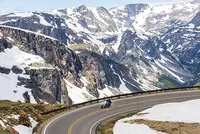
- Beartooth HighwayRed Lodge · RoadThe 68-mile Beartooth Highway climbs from Red Lodge, Montana, over a 10,947-foot pass to Yellowstone's northeast entrance, cut in the 1930s by men earning 50 to 75 cents an hour.
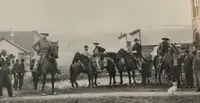
- Carbon County Historical Society & MuseumRed Lodge · MuseumCounty museum home to the Greenough and Linderman rodeo collections, the Waples family gun and projectile point collection, an immersive coal and hard rock mine exhibit, and the Carbon County archives.
- Red Lodge Farmers MarketRed LodgeThe market offers locally grown produce and meats, prepared or processed food specialties and handmade crafts. The goal of the market is to provide an enjoyable community venue for local agriculture producers to sell their products in order to help build a self-sustainable community.

The Calendar
History
A Mail Stop on the Meeteese Trail
Brick and sandstone buildings line the main street of Red Lodge, a small city on the west bank of Rocky Fork Creek in the western portion of Carbon County, southwest of Billings.1,3 Coal was discovered in the Rock Creek Valley nearly two decades before Red Lodge was established as a mail stop on the Meeteese Trail in 1884.3 The town was incorporated in 1892.1 A Montana Highway Department marker says that, according to tradition, a band of Crow Indians moved west into the foothills of the Beartooth Range and painted their council tepee with red clay, and that this gave Red Lodge its name.4 In 1939 the Federal Writers’ Project guide gave another legend: that the place was first called Bad Lodge, because meat that spoiled ruined a Crow festival.5
Coal and the Northern Pacific
In 1887 the Rocky Fork Coal Company opened the first large-scale mine at Red Lodge, and the first building boom that followed was mostly “hastily constructed shacks and log huts.”3 The historic district’s account puts the arrival of the Northern Pacific Railroad’s branch line in 1889, while the highway marker dates the line’s completion to 1890.2,3 By that same account the area became Montana’s leading coal mining region, and town lots were platted by the Rocky Fork Town and Electric Company, a subsidiary of the mining company, which the railroad in turn owned.2 Population went from 150 in 1888 to 400 the next year and 2,152 by 1900, and reached its peak of 4,860 in 1910.1 Immigrants from all over Europe worked side by side in the coal mines but settled in separate neighborhoods called Finn Town, little Italy, and Hi-bug.3 Half the town was foreign-born, and as miners poured in, some slept in shifts at the hotels until other housing became available.2 For several years “Liver-Eating” Johnston served as the town’s first constable, keeping order on his reputation and his large fists, and by the late 1890s local children called him “Dad.”6 The miners’ union, Local No. 1771 of the United Mine Workers of America, had 200 members by 1898 and more than a thousand by 1909, when it built its labor temple.7 To pay for the $36,000 building, committee chairman John Massow took the train to Butte and came back with a $10,000 loan in his pocket.7
Beer, Peas, and the Beartooth Highway
In 1910 the Bozeman brewer Julius Lehrkind and his nephews Fred and Paul incorporated the Red Lodge Brewing Company, counting on pure Rock Creek water and a ready market of thirsty coal miners.8 Prohibition closed the brewery, and after a Billings capitalist bought the building in 1925 it became a pea cannery that ran through 1975 and hired up to 300 people each season.8 Coal production fell off after World War I, and the West Side Mine closed in 1924 and the Rocky Fork Coal Mine in 1932.1,3 The Northern Pacific Railroad had opened strip mines at Colstrip in 1924, and the layoffs in Red Lodge cut the population to 2,950 by 1940.1 Daniel O’Shea built an apartment building for working-class families in 1909, its residents mostly European immigrants who worked in the Rocky Fork Coal Company’s East Bench Mine, and after the mines closed many of its tenants stayed to help build the Beartooth Highway during the Great Depression.9 The highway was finished in 1936 and linked Red Lodge directly to Yellowstone National Park.3 In 1939 the Federal Writers’ Project guide counted 3,026 people and still called Red Lodge a progressive mining town.5 The guide also described the Red Lodge Municipal Tourist Park at the southern edge of town, a project of the CWA and FERA, built of local stone and timber by Finns, Swedes, and Norwegians inside a rock wall built by Italians.5 In 1961 the local contractor Al Sloulin bought the old brick apartments and made them into the Bavarian-themed Yodeler Motel.9
Broadway and Hi Bug
The Red Lodge Commercial Historic District, on the National Register, runs roughly along Broadway from 8th to 13th Streets.10 The Rocky Fork Coal Company built a hotel in the district before the district was platted; first called the Spofford, it welcomed its first guests on July 4, 1893.11 The Hi Bug Historic District covers eight blocks in the northwest part of town, called North Red Lodge until the name Hi Bug was coined, and ninety-one percent of the structures built there by 1927 were still standing when it was nominated.1 Steve Roman, an Austrian immigrant, came to Red Lodge at nineteen in 1897 to work in the mines and in 1917 built the Roman Theatre, which its marker calls Montana’s oldest continuously-running moving picture theater.12 In 1935 he put up an eight-foot Art Deco neon marquee, and his daughter Mary managed the theater until 1977.12
Within 30 Miles
Measured in a straight line from the town, nearest first.
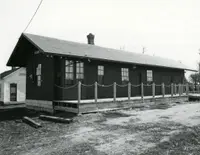
- Clarks Fork Valley MuseumFromberg · Historic railroad depotIn its new function as the Clarks Fork Valley Museum, this railroad veteran is an appropriate ambassador of the region's rich history and a significant reflection of Fromberg's roots.
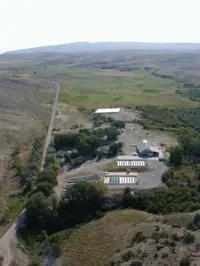
- Bluewater Springs Trout HatcheryBridger · State-run hatcheryA state trout hatchery in Carbon County, Montana, eight and a half miles east of Bridger, named for the blue spring that feeds it at 58°F.
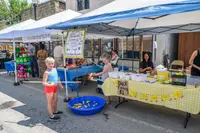
- Absarokee DaysAbsarokee · Annual one-day festivalAbsarokee Days is a one-day street festival on Woodard Avenue in Absarokee, Montana, held the last Saturday of July, whose parade has included a kazoo band.
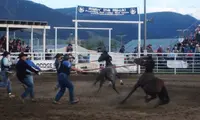
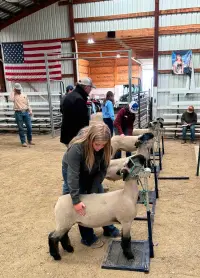
Nearby towns: Cody and Billings. All the towns of Montana. More of Montana: Scenic Drives and Fairs & Rodeos.
Sources
- NPS National Register Nomination mail.historicmt.org/files/original/1ef1c25dd1a4f5c99f077b73438014d7.pdf
- Red Lodge Commercial Historic District historicmt.org/items/show/43
- Red Lodge (historical marker) hmdb.org/m.asp?m=45250
- The Red Lodge Country (historical marker) hmdb.org/m.asp?m=45247
- Montana: A State Guide Book (1939), p. 342 archive.org/details/montanastateguid00federich/page/342
- Liver-Eating Johnston’s Cabin (historical marker) hmdb.org/m.asp?m=190093
- Red Lodge Labor Temple: Red Lodge Commercial Historic District historicmt.org/items/show/44
- Red Lodge Brewing Company ⎯⎯⎯ Red Lodge Canning Company Historic District (historical marker) hmdb.org/m.asp?m=190564
- Historic Montana historicmt.org/items/show/2340
- National Register record, Red Lodge Commercial Historic District npgallery.nps.gov/AssetDetail/NRIS/83001057
- Red Lodge Commercial Historic District historicmt.org/tours/show/8
- Roman Theatre (historical marker) hmdb.org/m.asp?m=190222