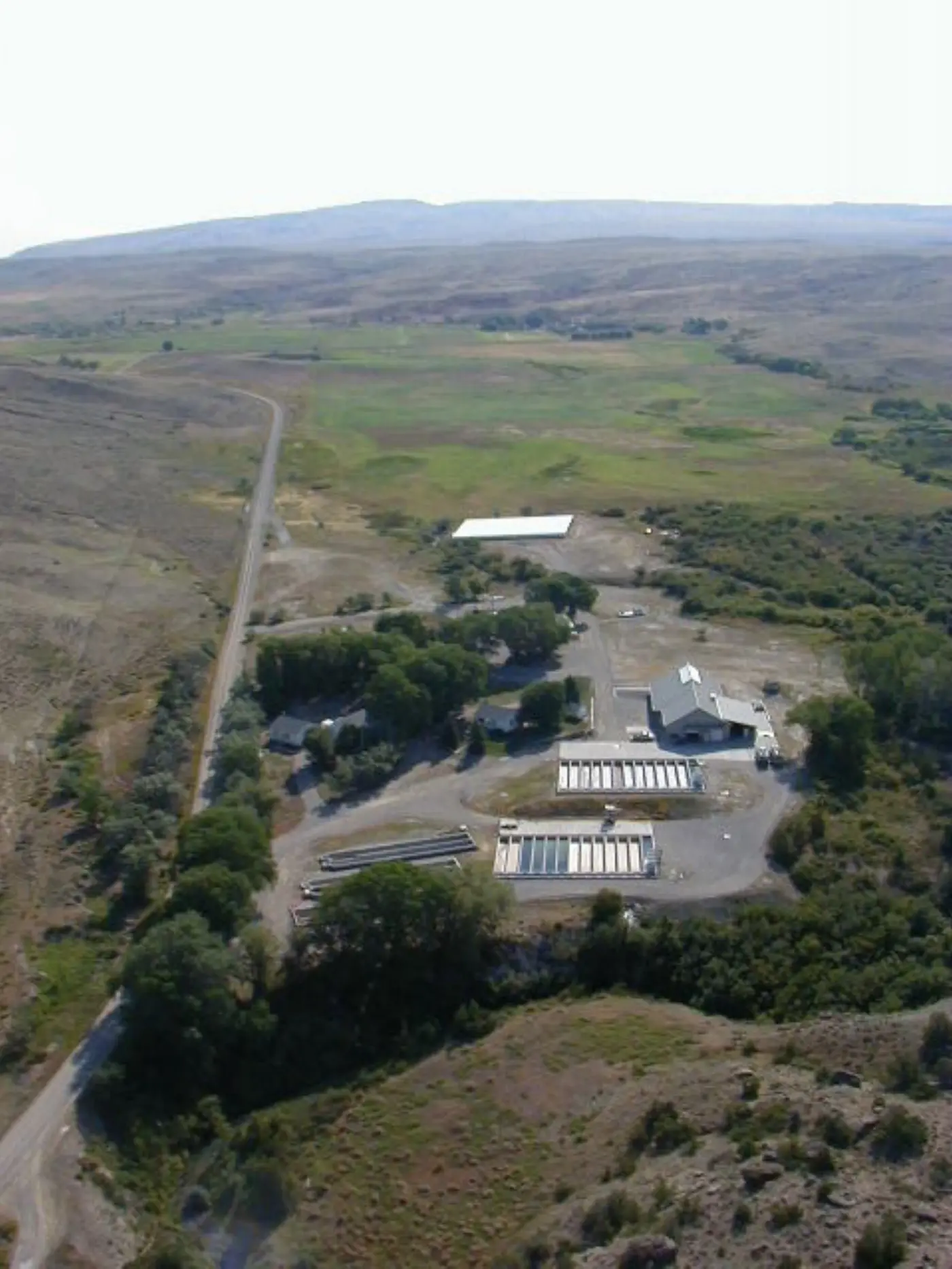
Bluewater Springs Trout Hatchery
Bridger, Carbon County, Montana. State-run hatchery.
Details

- Where
- Bridger, Carbon County, MT. No street address stated. Directions
- When
- Hatchery office hours are 8 a.m. - 5 p.m. Monday through Friday. Grounds are open to public visitation daylight to dark 7 days a week.
- Getting there
- Bluewater Springs Hatchery is located 8.5 miles east of Bridger, Montana. Turn east at the only flashing yellow light in the center of town. Cross the river and railroad tracks. Then take an immediate left onto the oil road.
- Fees
- No Site Fees.
- Access
- gravel and gumbo road.
- Walk-in or reserve
- Group Tours are arranged by contacting hatchery personnel.
- Managed by
- MONTANA FISH, WILDLIFE & PARKS.
- Coordinates
- 45.33109, -108.80016.
The last six miles to Bluewater Springs Trout Hatchery run on gravel and gumbo through sagebrush hills and flats east of Bridger. The route leaves town at the only flashing yellow light, crosses the river and the railroad tracks, and follows an oil road for a mile. It then takes East Bridger road over a hill past a power substation before the turn onto Bluewater Creek Road. The hatchery sits at 3,970 feet on 51.14 acres. It takes its name from its water supply, a spring of a distinctive blue color, which Montana Fish, Wildlife & Parks gives at 58°F.
Thurston Dotson, the state’s Hatchery Bureau Chief from 1986 to 1998, described Bluewater as a tremendous spring in a basin with a lot of springs. He called the source warm springs, not hot springs, and put the water somewhere from 50 to the low 60s. In his account the steady temperature keeps the creek cool in hot summers and warm in winter, which makes it a perfect trout hatchery.
Rainbows, cutthroat and grayling
The station rears Arlee, Eagle Lake and Erwin strains of rainbow trout each year, along with Yellowstone cutthroat and grayling. In February 2026 the Billings Gazette counted more than 1.5 million rainbow trout and 1 million arctic grayling reared annually, which makes Bluewater the third-largest fish production facility in Montana. The paper said the fish go into urban ponds, reservoirs and other public waters. FWP says the station’s fish are generally stocked in the south, central and eastern sections of the state.
The grounds are open to the public from daylight to dark, seven days a week, and there is no site fee. Pets stay on a leash. The office keeps weekday hours, and hatchery staff arrange group tours.
Snails at the intake
The facility has twice been shut down and cleaned after New Zealand mud snails were detected, the Gazette reported. In early February 2026, Mike Ruggles, the FWP Region 5 supervisor, approved redesigning the hatchery’s water intake to keep the snails out. The proposal called for upgraded infrastructure and a barrier at the water sources.
A federal bill and a $3,000 spring
The spring drew federal notice before the state owned it. On February 1, 1939, Senate Bill S1171 in the 76th Congress was referred to the Committee of Commerce. The bill sought $50,000 to build a federal fish hatchery eight miles east of Bridger. Nothing more was done until June 1943, when the U.S. Fish and Wildlife Service hatched 30,000 cutthroat eggs in the overflow of the spring. The site was again recommended for purchase as a federal hatchery.
The state moved first. On June 10, 1947, the Montana Fish and Game Commission authorized $3,000 to buy Bluewater Spring. The fisheries division’s history counts it as one of two hatcheries bought right after World War II, the other being Arlee. It says construction started at both right away, to ensure a greater output of fish. In 1948 work began on a residence, a two-stall garage, a food storage unit, a small shop and 10 outside rearing raceways. Dave Books’s centennial summary for the department dates the hatchery’s construction to 1949.
First eggs from Big Timber
In September 1949 the first state eggs reached the station from the Big Timber Hatchery, and Vern Campbell was appointed the first foreman. Campbell left in 1951 to manage the hatchery at Arlee, and by 1971 he was managing the Flathead Lake Salmon Hatchery at Somers. Nine more dirt ponds were added at Bluewater in the early 1950s. In 1956 Big Timber received Kamloops trout eggs from Canada, and 310,464 Kamloops fry were then sent to Bluewater for rearing. The 1960 annual report called the place the Bluewater Fisheries Station.
Until the 1966–68 biennium, eggs were hatched in boxes set in the large outside raceways, an arrangement the division history calls very inconvenient. A small hatchery building went up in that biennium. Another residence to house personnel followed in 1973.
Dotson joined the hatchery system in June 1971 as a fish health inspector and fish culturist, the second trained biologist on its staff. Emmett Colley was managing Bluewater when he came on. Dotson later transferred to Bluewater and worked out of it until 1977, when he was promoted to manager at Big Timber, the hatchery that had shipped Bluewater its first eggs.
Notable Events
- 1943No further federal action was taken until June 1943, when the U.S. Fish and Wildlife Service hatched 30,000 cutthroat eggs in the overflow of the spring, and the site was again recommended for purchase for a federal hatchery. myfwp.mt.gov
- 1947On June 10, 1947 the Montana Fish and Game Commission authorized $3,000 for the purchase of Bluewater Spring. myfwp.mt.gov
- 1948Construction began on a residence, a two-stall garage, a food storage unit, a small shop, and 10 outside rearing raceways. myfwp.mt.gov
- 1949Bluewater Springs Hatchery was constructed at Bridger in 1949. myfwp.mt.gov
- 1949The first state eggs arrived at the station from the Big Timber Hatchery, and Vern Campbell was appointed the first foreman. myfwp.mt.gov
- 1950sImprovements at the state fish hatcheries included nine additional dirt ponds at Bluewater. myfwp.mt.gov
- 1956After the Big Timber Hatchery received Kamloops trout eggs from Canada in 1956, 310,464 Kamloops fry were transferred to the Bluewater station for rearing. myfwp.mt.gov
- 1966A small hatchery building was constructed at the Bluewater Hatchery; before it, eggs were hatched in hatching boxes set in the large outside raceways, which was very inconvenient. myfwp.mt.gov
- 1973An additional residence was built at the Bluewater hatchery to house personnel. myfwp.mt.gov
- Right after the end of WW II two fish hatcheries were purchased, the Arlee Hatchery and the Bluewater Hatchery, and construction started right away at both to ensure a greater output of fish. myfwp.mt.gov
People
- Mike Ruggles, the Fish, Wildlife & Parks supervisor who approved redesigning the hatchery's water intake to keep out New Zealand mud snails.
- Vern Campbell, appointed the first foreman when the first state eggs arrived, and later transferred to Arlee as manager of that hatchery.
- Thurston Dotson, hatchery system biologist who transferred to Bluewater and operated out of there before his promotion to Fish Hatchery Manager at Big Timber in 1977.