Georgetown
Clear Creek County, Colorado. County seat.
Georgetown, the Clear Creek County seat on the road west from Denver, began with George Griffith’s 1859 gold find and grew into a silver camp.1,2,3
Details
- Founded
- Georgetown began with George Griffith’s gold discovery on June 17, 1859, and David Griffith surveyed and platted the town in spring 1861.2
- County seat
- Georgetown is the seat of Clear Creek County, which moved there from Idaho Springs in 1867 by the tourism bureau’s account and in 1868 by the National Register nomination’s.1,4,5
- Last checked
- October 6, 2026.
Point at a dot to see the place.Tap a dot to see the place. Road map of Georgetown.
In Georgetown
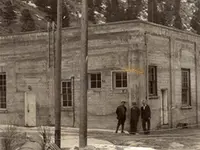
- Georgetown Energy MuseumGeorgetown · Energy museum in a hydroelectric generating plantA free museum inside the hydroelectric plant at the east end of Sixth Street in Georgetown, Colorado, where water off South Clear Creek has turned generators since 1900.
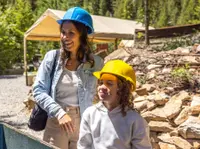
- Georgetown Loop RailroadGeorgetown · Georgetown loop historic mining & railroad park®A reconstructed narrow-gauge railroad between Georgetown and Silver Plume, Colorado, whose track crosses over itself on the Devil's Gate High Bridge to climb the steep valley.
The Calendar
History
Gold on the South Fork of Clear Creek
Georgetown stands at 8,640 feet in the upper Clear Creek valley, and in 1941 the Federal Writers’ Project guide found its 303 people walled in by high barren mountains where the valley narrows at the foot of the Continental Divide.2,6 George and David T. Griffith, brothers from Kentucky who had come to Colorado in October 1858, followed John Gregory’s May 1859 strike into the mountains, arrived too late to stake a good claim, and moved in June to the South Fork of Clear Creek.2 On June 17, 1859, George Griffith found gold, and the brothers built a cabin at their campsite, on ground that became the corner of Seventeenth and Main Streets.2 Prospectors organized the Griffith Mining District in June 1860, and by that September the town taking shape in the valley was named Georgetown after George Griffith.2 A History Colorado grant page says Griffith brought his wife and family to “George’s Town” and offered free town lots to respectable women to draw other families.7 In spring 1861 David Griffith surveyed and platted the town, which had about forty residents and at least two mills.2
Silver Camp and County Seat
The initial optimism in Georgetown soon waned as the Civil War stalled migration and new mining areas such as South Park took off, and miners were trying to extract gold out of rocks that were actually rich in silver.2 Silver was found on nearby Mt. McClellan on September 14, 1864, and by the fall of 1865 Georgetown and Elizabethtown, its neighbor to the south and said to be named after a Griffith sister or wife, were full of tents.2 The two camps agreed to combine under the name of Georgetown, and by 1870 the population had surged to 3,000.2,5 A special election moved the county seat from Idaho Springs to Georgetown, in 1867 by the county tourism bureau’s account and in 1868 by the National Register nomination’s.4,5 The Colorado Encyclopedia puts the town’s peak in 1877, when 5,000 people lived in and around it, with two newspapers, a telegraph office, a bank, five churches, and several hotels, and in August the Colorado Central Railroad arrived.2 Louis du Puy, born Adolphus Francis Gerard at Alencon, France, in 1844, came to Georgetown in 1869 and was seriously injured in a mine explosion four years later.6 Townspeople took up a collection to set him up in business, and in 1875 he bought the Delmonico Bakery building on Alpine Street, dug cellars, and added a story for eight bedrooms, doing almost all the work himself, to make the Hotel de Paris.6 The 1941 guide says Du Puy refused to pay taxes, threatened to shoot the collectors, and turned away visitors who did not please him, yet the rank and fashion of East and West still came to register.6
Leadville, the Loop, and the Fall of Silver
The 1941 guide calls Georgetown the most important silver camp in the State before the Leadville strike of 1878.6 The Colorado Encyclopedia dates the Leadville discoveries to the autumn of 1877 in its Loop article and the boom to 1878–79 in its district article, after which Leadville’s production dwarfed Georgetown’s.2,3 Union Pacific Chief Engineer Jacob Blickensderfer, as a marker at the Loop names him, planned a line up a valley that rises almost 640 feet in under two miles; the Colorado Encyclopedia’s district article calls him Robert Blickensderfer and describes a series of sweeping curves and one large loop.2,8 When chief engineer Robert B. Stanton found the Devil’s Gate bridge had been installed backwards, crews tore it apart and reassembled it, a six-week job in the dead of winter, and finished on February 28, 1884.3 The first train reached Silver Plume in March 1884, but Union Pacific had already reached Leadville by an easier route farther south; still, the Loop caught the American imagination, and tourists from all parts of the world traveled to Georgetown and over the Loop to Silver Plume.8 The repeal of the Sherman Silver Purchase Act in 1893 ended the long run: mines failed, businesses closed, and people moved away.2 A Georgetown generating plant completed in 1900, using both steam and water power, was by 1903 supplying electricity to Georgetown, Silver Plume, Idaho Springs, Black Hawk, and Central City.9,10 The Loop ran on tourist traffic for decades until 1939, when the Colorado and Southern closed the road and dismantled the track.2,8
Fire Tower, Hotel Museum, and Stone Jail
In 1941 the Federal Writers’ Project guide found that higher gold and silver prices in 1933 had reopened many mines, that livery stables had become garages and filling stations, and that the old Fire Station, a tall wooden tower, still housed a hose reel pulled by volunteer firemen.6 In 1954 the National Society of the Colonial Dames of America in Colorado bought the Hotel de Paris and turned it into a museum, and in 1966 Georgetown and Silver Plume were named a National Historic Landmark District.2 Residents formed Historic Georgetown Inc. in 1970, and the Colorado Encyclopedia says it helped the town pass the state’s first town-wide historic preservation ordinance.2 With Interstate 70 placed high on Republican Mountain to save the old grade, Navy and Army engineering units rebuilt the railway as a training exercise, and the first train crossed the completed grade on 1 August 1984.11,12 The schoolhouse that citizens pooled their money to build in 1874 served as a school until 1938 and now holds the Georgetown Heritage Center.2,13,14 The small stone jail the town built in the summer of 1883 for $700, once called the “Hotel de Barr” after town marshal Barr, is still secured by the same padlock.15
Within 30 Miles
Measured in a straight line from the town, nearest first.
- Slaymaker CellarsIdaho Springs · Award winning meaderySlaymaker Cellars is an award winning meadery located in Idaho Springs, CO. We are dedicated to using high quality ingredients, making great mead, and giving back to the community.
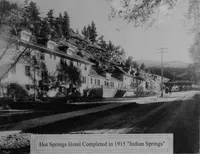
- Indian Hot SpringsIdaho Springs · Hot springs resortHistoric hot springs resort preserved since 1865, with a mineral water swimming pool, caves, outdoor tubs, spa treatments, and accommodations.
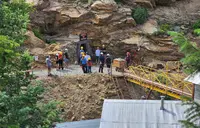
- Phoenix Gold MineIdaho Springs · Underground gold mine tourFamily-owned underground gold mine offering tours and gold panning in Idaho Springs since 1988.
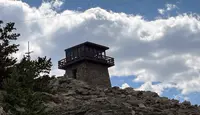
- Mestaa'ehehe Mountain Fire LookoutBergen Park · Fire lookoutElectric stove, refrigerator, heat; beds; table and chairs; cookware and dishes; exterior incinerating toilet visitors must clean and maintain; accommodates four people per night.
- Fraser Fire and IceFraser · Fire and ice festivalFraser Fire and Ice is a free February evening at Cozens Ranch Open Space in Fraser, Colorado, where donated Christmas trees feed a bonfire and an ice sculpture is set alight.

- Winter Park WineryFraser · Winery/vineyardLocated in Downtown Fraser along US Highway 40, the Winter Park Winery prides itself on its wine, small town charm and great atmosphere.

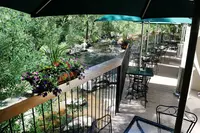
- Creekside CellarsEvergreen · Winery and mediterranean cafeA winery and Mediterranean café on Highway 74 in downtown Evergreen, Colorado, where wine from the house's own Palisade vineyard is poured on a deck above Bear Creek.
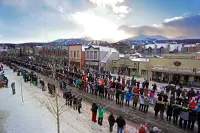
- Ullr FestBreckenridge · Annual celebration of winter and snowBreckenridge's festival for Ullr, Norse god of snow: a Main Street parade, a bonfire of old Christmas trees, and roots in the town's 1963 mock secession.
- Aspen Peak CellarsBailey · Winery and bistroA winery and bistro on the North Fork of the South Platte in Bailey, Colorado, where the riverside beach is made of the owners' own crushed wine bottles.
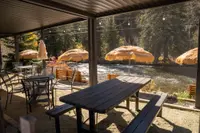
- Clear Creek tube run and whitewater parkGolden · Whitewater parkA free whitewater course on Clear Creek in downtown Golden, Colorado, which designer Gary Lacy pitched to a reluctant city council in 1996 as "a nice little amenity."
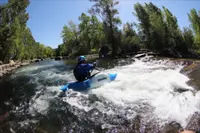
- Buffalo Bill DaysGolden · Golden's largest summer eventGolden's three-day July festival in Parfet Park and on Washington Avenue, begun in 1946 for Buffalo Bill's 100th birthday; the honoree is buried on Lookout Mountain above town.
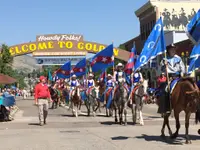
- Morrison CiderfestMorrison · Fall festivalA free one-day fall festival on a nursing-home lawn in Morrison, Colorado, where the woman who proposed it in 1989 still turns the cider press as Apple Annie.
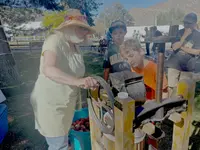
- Roberts CabinComo · CabinRobert's Cabin is located 3 miles NW of Como at CR 50 and CR 33. It dates back to the 1880s and is associated with the early Denver, South Park & Pacific Railroad. It can accommodate eight people with two double beds, two twin beds and one sleeper sofa. There is a wood stove and a port-a-potty.
Nearby towns: Boulder, Leadville, and Loveland. All the towns of Colorado. More of Colorado: Holiday Celebrations and Factory Tours.
Sources
- Clear Creek County (coloradoencyclopedia.org) coloradoencyclopedia.org/article/clear-creek-county
- Georgetown–Silver Plume Historic District coloradoencyclopedia.org/article/georgetown-silver-plume-historic-district
- Georgetown Loop (coloradoencyclopedia.org) coloradoencyclopedia.org/article/georgetown-loop
- Clear Creek County Tourism Bureau visitclearcreek.com/activities/historic-museums
- National Register nomination, Georgetown, CO npgallery.nps.gov/NRHP/GetAsset/6002ace7-d14c-4a56-8fff-ada3d1986f0a
- Colorado: A Guide to the Highest State (1941), p. 202 archive.org/details/coloradoguidetoh00writ_0/page/202
- Georgetown/Silver Plume historycolorado.org/grant-news/2006/08/01/georgetownsilver-plume
- The Georgetown Loop (historical marker) hmdb.org/m.asp?m=282681
- Georgetown Steam/Hydro Generating Plant (historical marker) hmdb.org/m.asp?m=285252
- Hydroelectric Plant (historical marker) hmdb.org/m.asp?m=282673
- The Park (historical marker) hmdb.org/m.asp?m=282686
- Georgetown Loop Project (historical marker) hmdb.org/m.asp?m=282687
- Georgetown School 1 (historycolorado.org) historycolorado.org/location/georgetown-school-1
- Georgetown School 0 (historycolorado.org) historycolorado.org/location/georgetown-school-0
- Old Town Jail (historical marker) hmdb.org/m.asp?m=39338