Loveland
Larimer County, Colorado. County seat.
Loveland, in the Big Thompson River Valley, was established in 1877 along the Colorado Central Railroad’s tracks and grew into a city around a 1901 sugar plant.1,2,3
Details
- Founded
- Loveland was established in 1877 along William A. H. Loveland’s Colorado Central Railroad, though a state marker credits his friend David Barnes with founding the town on his property.3,4
- Name
- The town was named for William A. H. Loveland, president of the Colorado Central Railroad.1
- County seat
- Loveland is not the county seat; Fort Collins became the Larimer County seat in 1868.2
- Last checked
- October 6, 2026.
Point at a dot to see the place.Tap a dot to see the place. Road map of Loveland.
In Loveland
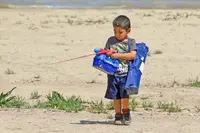
- Boyd Lake State ParkLoveland · State parkBoyd Lake State Park, a Loveland irrigation reservoir on the plains below Long's Peak, sits on the homestead of a man who helped build northern Colorado's first trans-mountain ditch.
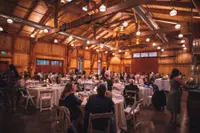
- Sweet Heart WineryLoveland · WinerySix acres on the Big Thompson. A timber-frame tasting room with the patio open to the cottonwoods and the river just past the lawn, and a property that can be handed over to one wedding.
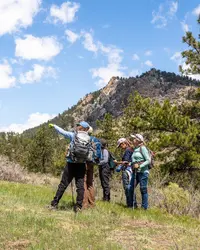
- Sylvan Dale Guest RanchLoveland · Traditional dude ranchAn authentic horse and cattle ranch in the Rocky Mountain foothills, family-owned and operated since 1946. 3,200 acres, 33 min from Estes Park, easy hour from Denver.
The Calendar
History
The Street Clock on East Fourth
The Loveland Street Clock stands on the sidewalk of East 4th Street, where it was installed in 1910 in front of the Brannan Brothers Jewelry Store at number 239.5 It is the one contributing object in the Downtown Loveland Historic District, nine square blocks of the town’s original commercial district centered on East Fourth Street, added to the National Register of Historic Places in 2015.4,5 The city lies in the Big Thompson River Valley of southeastern Larimer County, some fifteen miles south of Fort Collins, and has a population of about 71,000.1,2,4
Medina’s Crossing and Old St. Louis
The first Euro-American settlers in the area were the family of Mariano Medina, a Hispano trapper from Taos, New Mexico, who in 1858 set up a homestead, store, and bridge on the Big Thompson River.4,5 The 1931 marker of the State Historical Society of Colorado spells him Mariano Modena and calls Namaqua his home, trading post and fort, the first settlement in the Big Thompson Valley and a station on the Overland Stage route to California in 1862.6 The Writers’ Program guide spells him Modeno and says he came early in 1858 with his family and a body of retainers, built a fortified ranch house, and put the first bridge across the Big Thompson.7 A later state marker says Medina’s toll bridge and trading post overflowed with high living and tall tales from his fur-trapping days.3 When the trail moved three miles east in 1864, the settlers moved with it, gathering around Andrew Douty’s flour mill in a town called Old St. Louis.3 In 1941 the Writers’ Program guide reported a two-story hotel and stage station on St. Louis Avenue as the only remaining structure of the St. Louis settlement.7
A Tent Station in a Wheat Field
In 1877 William A. H. Loveland built his Colorado Central Railroad north from Golden toward the transcontinental route at Cheyenne, Wyoming, and the town along its tracks took his name.1,4 The 2001 state marker tells it another way: Loveland routed the tracks over the property of his friend David Barnes, who founded his own town there and named it for his benefactor.3 The Writers’ Program guide says the first station was a tent in a wheat field, and that the harvest of a bumper crop delayed platting the town site.7 When lots went on sale, the guide says, many houses were moved over from St. Louis.7 Disappointed prospectors back from the gold fields took up land and sold their produce in Denver, where, by the guide’s account, butter brought $2 a pound and eggs $1.50 a dozen.7 John L. Herzinger and Samuel B. Harter finished their two-story brick mercantile at 137-141 East 4th Street in the spring of 1878, and the district nomination calls it Loveland’s first brick commercial building.4,5 The depot and the Loveland Hotel followed within a year or two, and by 1886 East Fourth Street held banks, grocers, churches, tailors, drugstores, and the Bartholf Opera House, opened in 1884.4 The Loveland Farmers Milling and Elevator Company built its grain elevator and mill in 1891-1892 on the site of an 1880 mill destroyed by fire, and it ran as the Loveland Feed & Grain Company until shortly after the turn of the twenty-first century.5
Sugar Beets, Cherries, and the Park Road
In 1901 the Great Western Sugar Company completed its beet factory northeast of downtown, which the Colorado Encyclopedia’s article on the downtown district calls the first such facility in northeastern Colorado.4 The factory employed hundreds of workers, gave farmers a market for sugar beets, and recruited first Germans from Russia, then Japanese and Hispanos, to work in the beet fields.3 Loveland’s population more than tripled between 1901 and 1910, and three-story brick buildings went up downtown, among them the Majestic Theatre in 1903 and the Union Block, now the Lincoln Hotel, in 1905.4,5 The Colorado & Southern, successor to the Colorado Central, laid a spur to the factory and in November 1902 finished a new passenger building and freight building, setting bricks from the 1878 depot into the platform.8 Apple, cherry, and plum orchards surrounded the town from about 1900 until the 1950s.3 In 1941 the Writers’ Program guide counted 5,506 people and named a beet sugar factory and plants canning vegetables and fruits, especially cherries, as the principal enterprises.7 The guide gave the sugar factory a daily slicing capacity of 3,100 tons and about 700 workers from October to January.7 From 1906 the Loveland-Estes Park Transportation Company carried passengers from the depot to Estes Park in Stanley Steamers, and after Rocky Mountain National Park was created in 1915, downtown businesses turned to serving motorists.4,8 The Lovelander Hotel went up in 1912-1913 near the depot, replacing the Loveland Hotel of 1878, and Elks Lodge #1051 has occupied it at North Railroad Avenue and 4th Street since 1927.5,9
Hewlett-Packard, Bronze, and Valentines
Great Western ran the town’s economy until 1960, when Hewlett-Packard built a plant that the state marker says soon became the community’s largest employer.3 From the early 1970s the town added computer manufacturing and bronze statuary, and after the Great Western factory closed in 1985, casting foundries opened and downtown filled with galleries and studios.4 The depot closed in 1980 as freight declined; its passenger building now houses Sports Station American Grill, and its freight building The Armory, a shared workspace for freelancers and other professionals.8 In September 2013 floods on the Big Thompson River inundated Loveland and Estes Park.2 Every Valentine’s Day, millions of cards from across the country are routed through Loveland to receive its “America’s Sweetheart” postmark.3
Within 30 Miles
Measured in a straight line from the town, nearest first.
- Foothills Flea MarketFort Collins · Foothills flea marketA dealer mall on South College Avenue in Fort Collins, Colorado, where seventy-odd dealers, each known by a short booth code, sell antiques, vintage goods and raw yak fiber.
- Fort Collins Flea MarketFort Collins · Flea marketA family-owned flea market on South College Avenue in Fort Collins, selling clothes, furniture, tools, and antiques from dealers' booths since 1985.
- Blendings at the Hillside VineyardFort Collins · WineryA family winery and wedding vineyard on Bingham Hill northwest of Fort Collins, where visitors blend and bottle their own wine under a county permit limited to eleven cars a day.
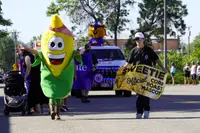
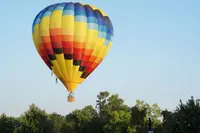
- Windsor Harvest FestivalWindsor · FestivalWindsor, Colorado's Labor Day festival of balloons, booths and a Monday parade, which began in 1921 as a carnival celebrating Weld County's first paved street.
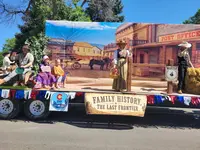
- BBQ DayJohnstownBBQ Day, Johnstown, Colorado's free June town celebration, began in 1912 as Dairy Day, when local farmers put up circus tents to judge cattle.
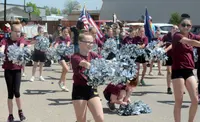
- Berthoud DayBerthoudBerthoud Day, the first-Saturday-in-June town celebration in Berthoud, Colorado, began as a pancake breakfast called Flap Jack Day and still opens with Boy Scout pancakes.
- Old Firehouse BooksFort Collins · Independent bookstoreNorthern Colorado's oldest independent bookstore, in the historic Fort Collins firehouse, with new and used books, author signings, book clubs and community events.
- MouCo Cheese CompanyFort Collins · CheeseryA family cheesery in northeast Fort Collins, Colorado, making Camembert and other soft-ripened rounds since 2001 on a Bavarian model, with weekday morning tours by appointment.
- Mead Community DayMead · Annual celebrationMead Community Day is the Northern Colorado town's largest annual celebration, a free evening in Mead Town Park that ends with fireworks over the park.
- Hunters Moon MeaderySeverance · Small family owned meaderyAn appointment-only meadery in a building behind Greg and Kim Bowdish's home in Severance, Colorado, where chokecherries from the front yard go into the Mountain Berry mead.
- Beef 'N Bean DayMilliken · Community festival dayBeef 'N Bean Day is Milliken, Colorado's second-Saturday-in-August festival of parade, bean contest, and free supper, which local lore traces to a Presbyterian minister's pot of pinto beans.
- Alluvial Farm & VineyardsFort Collins · Winery/vineyardA certified biodynamic vineyard of four and a half acres in Fort Collins, Colorado, where sheep, kunekune pigs, and chickens are turned in among rows of cold-hardy grapes.
- Barbed Wire BooksLongmontLongmont's largest book store, a wide array of local and Colorado interest books, new and used, with a Western Americana section.
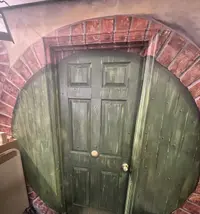
- Ten Bears WineryLaPorte · WineriesIntroduce your palate to a truly superior Colorado wine experience. Our Winemaker handselects only the finest grapes.
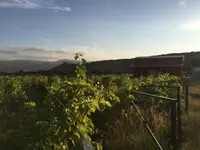
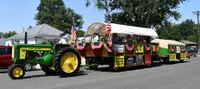
- LaSalle DaysLaSalle · 45th annual celebrationLaSalle Days is a two-day July celebration in the Weld County railroad town of LaSalle, Colorado, where parade entries may perform only in front of the Fire Department.
24 more within 30 miles on the road map.
Nearby towns: Boulder, Cheyenne, and Georgetown. All the towns of Colorado. More of Colorado: Swimming Holes, Town Festivals, and Wineries.
Sources
- Downtown Loveland Historic District (historycolorado.org) historycolorado.org/location/downtown-loveland-historic-district
- Colorado Encyclopedia coloradoencyclopedia.org/article/larimer-county
- Loveland (historical marker) hmdb.org/m.asp?m=89279
- Downtown Loveland Historic District (coloradoencyclopedia.org) coloradoencyclopedia.org/article/downtown-loveland-historic-district
- Downtown Loveland Historic District Larimer County, ... historycolorado.org/sites/default/files/media/documents/2018/5lr9700.pdf
- Namaqua (historical marker) hmdb.org/m.asp?m=51194
- Colorado: A Guide to the Highest State (1941), p. 218 archive.org/details/coloradoguidetoh00writ_0/page/218
- Loveland C&S Rail Depot coloradoencyclopedia.org/article/loveland-cs-rail-depot
- Rehabilitating the Lovelander Hotel Loveland Elks Lodge #1051 historycolorado.org/story/preservation/2017/11/28/rehabilitating-lovelander-hotel-loveland-elks-lodge-1051