Georgetown Energy Museum
Georgetown, Clear Creek County, Colorado. Energy museum in a hydroelectric generating plant.
Details

- Where
- 600 Griffith Street, Georgetown, CO 80444. Directions
- When
- Open 7 days a week 11-5, Memorial Day through Labor Day.
- Season
- Memorial Day through the first week in October.
- Getting there
- Georgetown, Colorado is just 40 miles west of Denver along I-70. Take Exit 228 and follow the signs to downtown Georgetown. The museum is located at the east end of 6th Street on the corner of Griffith Street.
- Fees
- Free to the public; donations welcome.
- Access
- Free, self-guided tour.
- Walk-in or reserve
- Walk in; bigger groups by appointment.
- Phone
- 303-569-3557
- Website
- georgetownenergymuseum.com
- Managed by
- Xcel Energy.
- Established
- 1900.
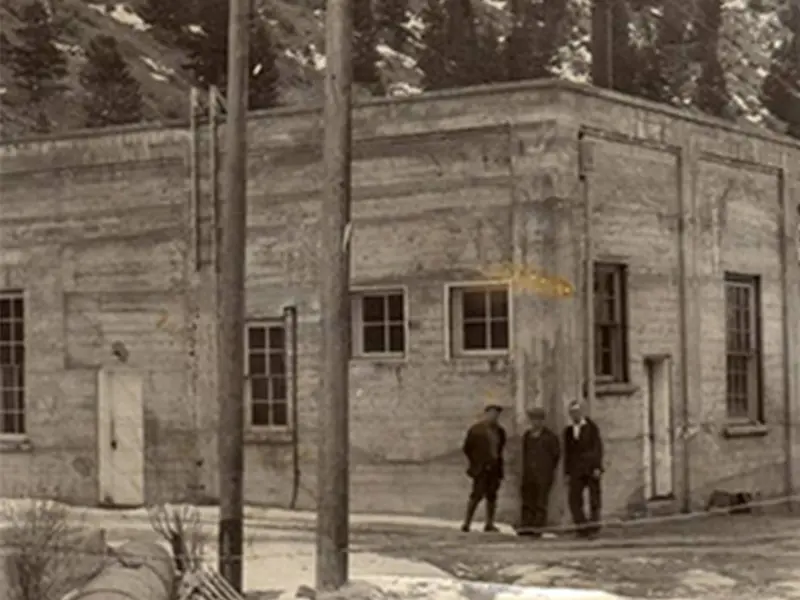
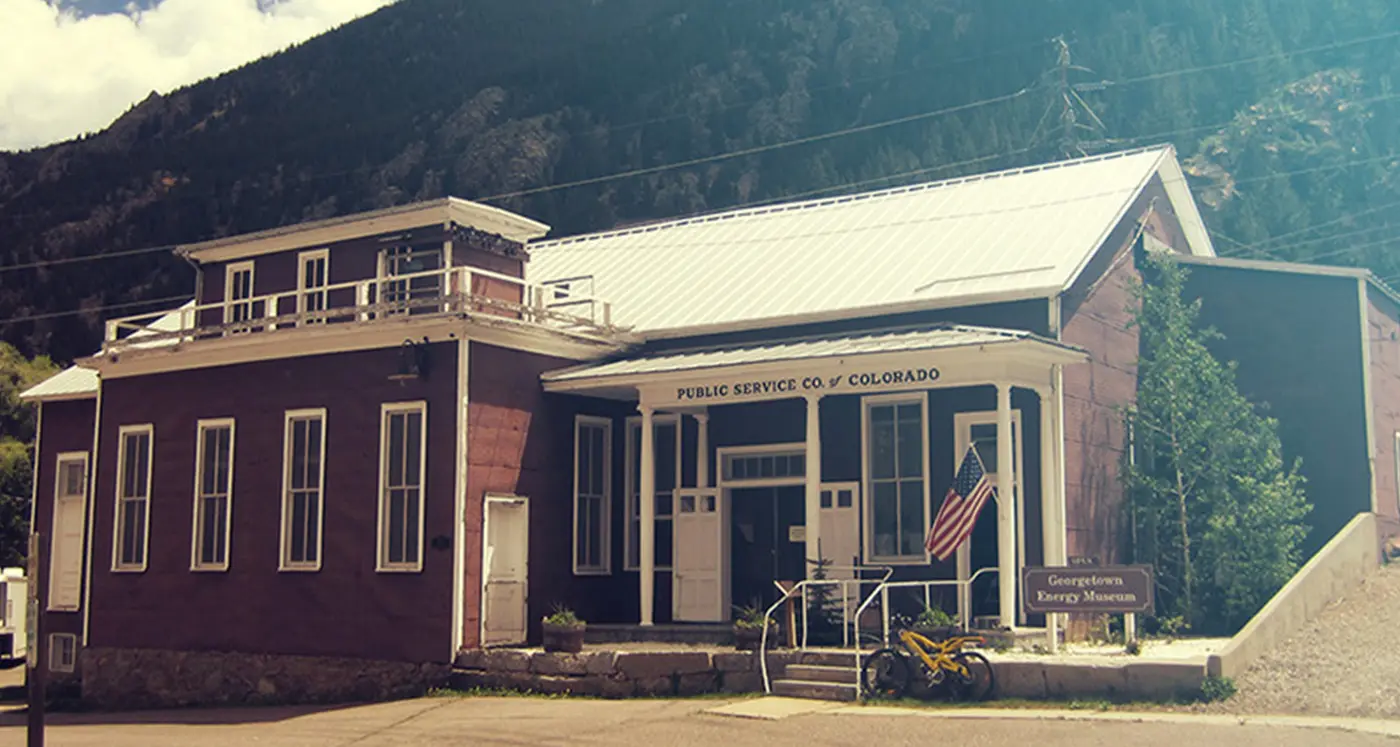
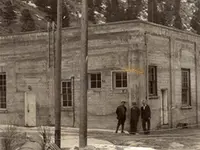
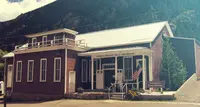
At the east end of Sixth Street in Georgetown, on the corner of Griffith Street, a power plant built in 1900 still makes electricity. Xcel Energy owns and operates the plant. The Georgetown Energy Museum, a separate Colorado nonprofit, leases part of the building from the company and opens it without charge from Memorial Day through the first week in October. The tour is self-guided, and donations help keep the door open. A Denver Post writer described the place in 2000 as a building covered with stamped tin, with a large room beside the exhibits that “smells of oil and thrums with the sound of the generators.”
The museum’s Facebook page calls it the oldest working hydroelectric plant in the United States. The marker the Town of Georgetown and Historic Georgetown, Inc. erected in 2007 at Main and Griffith makes a narrower claim: one of Colorado’s oldest alternating-current hydroelectric facilities still generating electricity.
Two Pelton wheels and a needle valve
The plant draws its water from the Georgetown reservoir, also called the forebay, about .9 mile up the canyon toward Guanella Pass. The water falls 700 feet through a 30-inch penstock and reaches the plant at 275 pounds per square inch. It drives two generator and water wheel sets of 720 kilowatts each, about 1.5 megawatts in all. The museum reckons that is enough for 700 to 1,000 homes and businesses. The wheels are of the Pelton design, which claims 90 percent efficiency.
The water arrives with more pressure than the wheels need, so a needle valve holds each one at 360 revolutions a minute. At that speed the directly coupled generator produces 60-cycle current, which can be synchronized with the grid. An electric motor at the right side of the wheel sets the valve. The motor takes its orders by computer link from Cabin Creek, a pumped-storage hydroelectric plant up the canyon, which the museum places about five miles toward Guanella Pass. All maintenance and monitoring of the Georgetown plant is done from there.
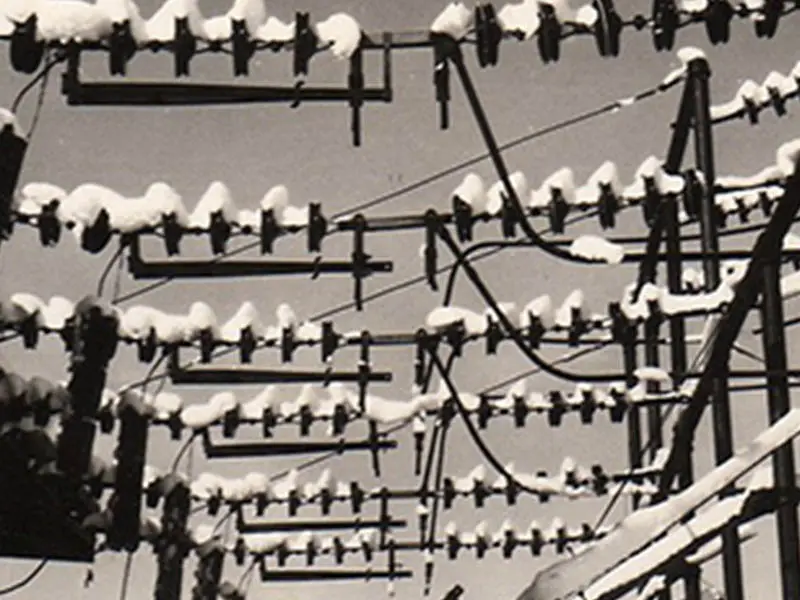
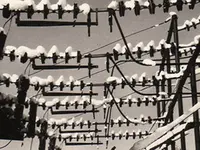
Current leaves through a substation at the south end of the building. A transmission line from the Colorado grid also feeds that substation, and from it power goes to Georgetown, to Silver Plume, and north on a line to Empire and the Henderson mining operation. The Post in 2000 followed the output as far as the Eisenhower Tunnel’s lights.
Inside each generator, twenty electromagnets spin on the rotor. Each is an iron oblong wound with copper wire, and as each one passes the fixed wires of the stator, current is induced. Dennis Seibel, the museum’s director when the Post visited, put it this way: “To create electrical energy, you just need a conductor, a magnetic field and motion between them.” That year a Plexiglas device called a Spinerator demonstrated the principle.
A brass washer and a 12,000-volt spark
Meters and relays in the control room watch the generators and the power they produce, to keep the output compatible with the rest of the grid. Until the late 1960s an operator staffed the room through the day and stayed on call through the night. The instruments are now read at Cabin Creek.
Nearby, a Jacob’s Ladder sends 12,000 volts across two copper wires. The spark jumps at their narrowest gap, heats the air to a thousand degrees, and climbs the wires as the hot air rises.
The household appliances include a brass-tub clothes washer made by the Nineteen Hundred Washer Company. It carries patent dates as late as October 1919, so the museum judges it was made in 1920 or later. Its motor, with a patent date of 1905, was belted to an agitator that rocked a tub filled by hand with warm soapy water. The motor still runs. Historic photographs trace the plant’s changes over the decades, and a separate display honors scientists who worked out the principles of electricity.
Gas lamps, stripped hills, and the move to Sixth Street
The museum’s timeline begins in 1876, when Georgetown’s gas works was established to light the streets. The Engineering and Technology History Wiki gives December 1881 as the date the Georgetown Gas Company was organized; it built a retort and supplied manufactured gas. The museum records that in 1881 the works adopted a more dependable process and came under new owners.
Electric power began around December 16, 1886, when the Electric Light Company started generating direct current from water power. By that December, 100 street lights in town ran on electricity. In March 1887, homes could have “light switches” installed. That summer the gas and electric companies competed for the street-lighting contract, and in August the gas company won it for three years.
The mines drove what followed. The wiki’s account places the gold and silver workings far from streams that could power a plant, in country without coal. Direct current could not carry over such distances. Wood was the only fuel, and the hills had been cut over for mine timbers, steam boilers, and heating, until the cost of wood was bankrupting some mines. Seibel told the Post that wood “was becoming very scarce - all of these mountains were stripped of their trees.”
Alternating current offered a way out. In 1890 the Georgetown Selectmen granted a franchise for a new hydroelectric plant at 4th and Brownell streets. The wiki states that in April 1891 The Electric Company installed a small AC plant in Hall’s Mill, used only for street lighting. The museum’s timeline records that a new AC plant in 1891 fed carbon-arc street lights, and that electricity became prevalent in the area’s mines.
In April 1893 the electric and gas companies merged as the United Light and Power Company of Clear Creek County. A line was built that year to Silver Plume; the wiki gives its length as two miles, the museum as two and a half. In August, after the crash of silver prices, the town ordered its street lighting discontinued. The gas works closed in September 1894.
The present plant went up in 1900 at the east end of Sixth Street. The old plant at 4th and Brownell was abandoned because the south fork of Clear Creek offered greater head. An Allis-Chalmers Corliss steam engine, spelled “Alice Chalmers” on the museum’s pages, was producing power by October, and two water wheel sets by November. The IEEE plaque on the site calls the plant “unusual in employing both steam and water power” and its owner “a pioneer in using three-phase, 60-Hertz alternating current and in being interconnected with other utilities.”
In July 1900 work began on a five-mile line to the mining district at Lamartine. That line led to interconnection with two other hydroelectric plants and with the Cascade Electric Company in Idaho Springs. By the museum’s account the line reached Idaho Springs in 1901, and the building was completed that April. The timeline adds that the electricity let marginal mines stay open.
Steam proved costly. There was no coal in the surrounding mountains, and all of it came up from Denver, so the engine ran only when the reservoir fell too low to turn the wheels. In 1902 United Light and Power bought land to move the dam up South Clear Creek. The move raised the head from 480 feet to nearly 670 and replaced the 16-inch penstock with a 30-inch one. Pipelines from Green Lake and Clear Lake added water, and in 1903 the dams at both lakes were being raised about eight feet.
The building grew in step. In July 1902 the company added 20 feet to the north end, after being granted the right to move Main Street 20 feet north. The same year brought a third water wheel set, a brick transformer house to the south and west, and an office and coal room at the south end. By late December 1902 the plant was supplying Central City, Black Hawk, and Nevadaville.
Motorcycles, a flood, and a man on the roof
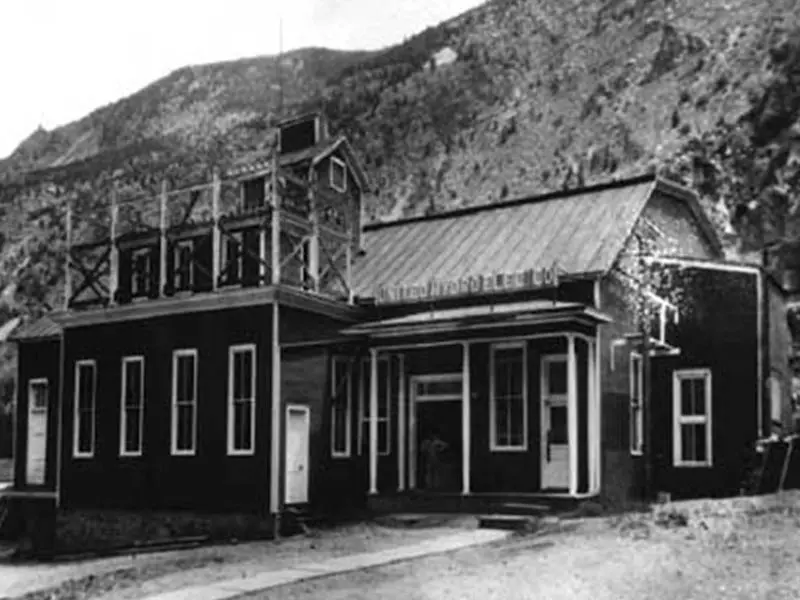
In February 1906 the Green and Clear Lakes Company, Cascade Electric, and United Light and Power merged as the United Hydro-Electric Company. That spring the plant took on more steam rather than less. Two water-tube boilers were added to run a new Parsons steam turbine and a 500-kilowatt generator, and a 90-foot stack, 5 feet across, stood by June. The Corliss engine was still in service. A Pelton wheel was installed by May on the 720-kilowatt General Electric generator, replacing the original wheel. In April work began on a 15-foot addition at the front of the plant to house new switch gear. A second Pelton wheel and a new generator followed in July 1908.
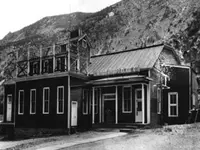
In 1909 a combining gambrel roof was built over the two earlier gables to shed the heavy snows. On September 24 of that year a flange broke on the 24-inch penstock and left the building in “knee-deep” water. In November 1911 the company bought two motorcycles, one for the repairman, Hanson, and one for the collector, Hancock. The office got a cement floor in September 1913.
The museum’s pages disagree on the 1916 sale. The about page says United Hydro Electric was sold that July to the Colorado Power Company. The timeline names the Central Colorado Power Company.
The sources also differ on when the steam equipment left. The about page says the machinery was retired before the First World War but the boilers and engine stayed until 1918. The timeline says the Corliss engine was removed before the war. Either way, in January 1918 the Georgetown Courier reported that “the steam turbine, engine, boiler and big smoke stack of the Hydro Electric plant, which has been standing idle for several years, is being taken out and will probably be shipped to Salida for use at the Colorado Power Company’s plant there.” That same January, Charles Melvin, a contract worker, was electrocuted on the plant roof. In March the steam-era equipment was loaded on cars, and the stack went with it.
A Dodge truck replaced the company’s animal team in June 1919, after 18 years. In May 1920 the power company tore down a planing mill that had stood since the 1870s. Colorado Power became Public Service of Colorado in 1924. Water wheel No. 2 was enlarged in 1939. In 1941 the 1902 penstock was replaced and rerouted to the east side of the building. The high combining roof came off, and the roof over the engine room and machine shop was turned 90 degrees and braced with steel, the form it keeps today. Cabin Creek joined the grid in 1976, and Xcel bought Public Service of Colorado in 1999.
Retired employees and a chemical engineer
The museum began in 1993, when retired company employees started giving free tours to show how the plant worked. In 1997 the museum hired Dennis Seibel as executive director, and the displays expanded under him. The Bozeman Daily Chronicle reported that he resigned that August from the Gallatin County Historical Society and Pioneer Museum in Montana to take the post.
Seibel was born in Bozeman in 1947. He held a bachelor’s degree in chemical engineering and master’s degrees in chemical engineering and history, and he performed as Mark Twain and Norman Rockwell. His obituaries credit him with completely restoring “the dilapidated hydro-electric plant” into an energy museum for Historic Georgetown. “There’s a sense that all you have to do is plug two things into a wall,” he told the Post. He died at his home in Cortez on March 5, 2013.
On July 31, 1999, the IEEE Denver Section dedicated the Georgetown Steam/Hydro Generating Plant as IEEE Milestone No. 27. The plaque can be seen at the museum.
The forebay dam and reservoir and the penstock are contributing parts of the Georgetown Hydroelectric Historic District, which is considered eligible for the National Register of Historic Places. On November 29, 2021, the Federal Energy Regulatory Commission determined, with the State Historic Preservation Officer concurring, that an emergency undertaking would adversely affect the district. In May 2022 the commission authorized Public Service Company of Colorado to disconnect the penstock at the forebay dam as an emergency action to protect public safety. Alpine Archaeological Consultants had documented the dam, reservoir, and penstock in April 2022, before the repair work. The Georgetown Energy Museum signed the resulting agreement as a concurring party. Under its terms, archival copies of the record are to be offered to local bodies, the museum among them, to be made available free of charge to the public on request.
Notable Events
- 1876Georgetown's Gas Works is established for the illumination of the city streets. georgetownenergymuseum.com
- 1881The Georgetown Gas Company was organized in December of 1881. They constructed a gas retort and provided service to Georgetown of manufactured gas. ethw.org
- 1881The Gas works adopts a new more dependable process and new owners. georgetownenergymuseum.com
- 1886December. 100 street lights are electrically powered in the town. georgetownenergymuseum.com
- 1886The Electric Light Company began generating direct-current electricity from water power around December 16. georgetownenergymuseum.com
- 1887Summer. The Gas Company and the Electric Light Company compete to light the streets. August. The Gas Company was awarded a contract to light the streets for three years. georgetownenergymuseum.com
- 1887March. “Light switches” can be installed in homes, allowing the user to turn on or off the power to the bulbs in any room. georgetownenergymuseum.com
- 1890The Georgetown Selectmen (Town Council) grant a franchise to construct a new Hydroelectric plant at 4th and Brownell streets. georgetownenergymuseum.com
- 1891In April, 1891, The Electric Company installed a small AC hydroelectric generating plant in Hall's Mill in Georgetown, Colorado. This facility was used only for street lighting. All future development was for the mining industry. ethw.org
- 1891A new AC plant powered carbon-arc street lights, while electrical energy spread into area mines. georgetownenergymuseum.com
- 1893By June, 1893, a two-mile long electric line was constructed to provide AC power to Silver Plume, Colorado. ethw.org
- 1893A merger of The Electric Company and the Georgetown Gas Company came about with the organization of The United Light and Power Company in April, 1893. ethw.org
- 1893August. Street lighting was ordered discontinued because of the depression caused by the crash of silver prices in the United States. georgetownenergymuseum.com
- 1900During July, 1900, construction of a five-mile transmission line to the mining area of Lamartine was begun. ethw.org
- 1900Georgetown, completed in 1900, was unusual in employing both steam and water power. ethw.org
- 1900Built in 1900, the museum is a working hydroelectric plant, a substation that feeds into the grid run by the Public Service Company of Colorado. extras.denverpost.com
- 1900The Alice Chalmers Corliss steam engine was producing power in October. georgetownenergymuseum.com
- 1900Because of the greater head pressure on the south fork of Clear Creek the electric plant on 4th and Brownell was abandoned. georgetownenergymuseum.com
- 1900Two water wheel generator sets are producing power in November. georgetownenergymuseum.com
- 1901In 1901 this line was extended down the mountain to the north and into Idaho Springs. georgetownenergymuseum.com
- 1901United Light and Power contracted to deliver power to Idaho Springs. Increased power production allowed service to other towns and mines. Electricity allowed marginal mines to remain open. georgetownenergymuseum.com
- 1901The 6th street building was completed in April. georgetownenergymuseum.com
- 1902By December of 1902 the plant was contracted to supply electricity to Black Hawk and Central City as well. georgetownenergymuseum.com
- 1902To get away from steam generation the operators of the plant moved the reservoir, also known as the forebay, from the original location to the present location in 1902. They also added pipe lines from Green Lake and Clear Lake to the forebay capacity. georgetownenergymuseum.com
- 1902United Light and Power buys site allowing the South Clear Creek dam to be moved up the creek. This adds additional head of nearly 200 feet to the penstock. The head goes from 480 feet to nearly 670 feet, and the new penstock is 30” in diameter as compared to the old 16” penstock. georgetownenergymuseum.com
- 1902July. United Light and Power builds a 20-foot addition to the north end of the plant. The company had to be granted the right to move Main Street 20 feet to the north. georgetownenergymuseum.com
- 1902The office and coal room were added to the south end of the building. georgetownenergymuseum.com
- 1903Dams at Clear and Green Lakes are being raised by about eight feet each. georgetownenergymuseum.com
- 1906In February of 1906 Green and Clear Lake Company, Cascade Electric Company and United Light and Power Company merged to form United Hydroelectric Company. georgetownenergymuseum.com
- 1906April. Work begins on building a 15-foot addition to the front of the plant to house new switch gear. georgetownenergymuseum.com
- 1906Pelton Water Wheel ordered and was installed by May. Replacing the original water wheel on the 720KW General Electric generator. georgetownenergymuseum.com
- 1906Two more water-tube boilers added to power new Parson steam turbine which turns new 500 kW generator. New 90' tall and 5' diameter stack erected by June. Corliss Steam engine still in service. georgetownenergymuseum.com
- 1909A combining gambrel roof was added over the two earlier gable roofs to better shed the heavy winter snows. georgetownenergymuseum.com
- 1909September 24. Flange broke on the 24-inch penstock, flooding the entire building in “knee-deep” water. georgetownenergymuseum.com
- 1911November. United Hydro Electric purchased two new motorcycles for use by repairmen Hanson and collector Hancock. georgetownenergymuseum.com
- 1913September. Cement floor poured into office section of plant. georgetownenergymuseum.com
- 1916Then in July of 1916 the United Hydro Electric Company was sold to Colorado Power Company. georgetownenergymuseum.com
- 1918Although the steam generating machinery was retired before the first world war, the boilers and the engine were not removed until 1918. georgetownenergymuseum.com
- 1918January. Charles Melvin, contract worker at the plant, is electrocuted on the roof. georgetownenergymuseum.com
- 1918March. Retired equipment from steam era is loaded on cars for shipment out. The 90' smoke stack was removed and shipped to another location. georgetownenergymuseum.com
- 1919June. Company purchased Dodge truck to replace the team of animals used for 18 yr. georgetownenergymuseum.com
- 1920May. The planing mill erected in the 1870s is torn down by the power company. georgetownenergymuseum.com
- 1924In 1924 Colorado Power Company was renamed Public Service of Colorado. georgetownenergymuseum.com
- 1939Water wheel no. 2 modified for greater capacity; water line and needle valve enlarged. georgetownenergymuseum.com
- 1941The 1902 penstock was replaced and rerouted, and the plant roofs were lowered, turned, and reinforced into their present form. georgetownenergymuseum.com
- 1976Cabin Creek was completed and joined the Colorado distribution grid; Georgetown plant maintenance and monitoring later operated remotely from there. georgetownenergymuseum.com
- 1993The museum got its start in 1993, when retired company employees began offering free tours to show folks how the plant worked. extras.denverpost.com
- 1997After Dennis Seibel was hired as the museum's executive director in 1997, the facility expanded its displays to help educate visitors about how energy is produced. extras.denverpost.com
- 1999The Georgetown Steam/Hydro Generating Plant was dedicated as IEEE Milestone number 27 by the IEEE Denver Section. ethw.org
- 1999Xcel bought Public Service of Colorado. georgetownenergymuseum.com
- 2007Erected by Town of Georgetown & Historic Georgetown, INC 2007. hmdb.org
- 2021FERC determined, with Colorado SHPO concurrence, that the emergency undertaking would adversely affect historic properties including the Georgetown Hydroelectric District. clearcreekcounty.us
- 2022FERC authorized Public Service Company of Colorado to disconnect the penstock at the Georgetown Forebay Dam and Reservoir as an emergency action. clearcreekcounty.us
- Although the steam generating machinery was retired before the first world war, the boilers and the engine were not removed until 1918. georgetownenergymuseum.com
People
- Dennis Seibel, Restored the dilapidated Georgetown hydroelectric plant into an energy museum for Historic Georgetown (May 26, 1947–March 5, 2013 (life dates)).
- Dennis Robert Seibel, Restored the dilapidated hydro-electric plant in Georgetown into an Energy Museum for Historic Georgetown (May 26, 1947–Mar 5, 2013 (life dates)).
- Charles Melvin, Contract worker at the plant, electrocuted on its roof in January (1918).
- Hancock, Collector for United Hydro Electric; motorcycles purchased for his use (1911).
- Hanson, Repairman for United Hydro Electric; motorcycles purchased for his use (1911).
Sources
- georgetownenergymuseum.com
- georgetownenergymuseum.com/tour
- georgetownenergymuseum.com/about
- georgetownenergymuseum.com/contact
- georgetownenergymuseum.com/donate
- visitclearcreek.com/activities/historic-museums
- facebook.com/GeorgetownColoradoEnergyMuseum
- ethw.org/Milestones:Georgetown_Steam_Hydro_Generating_Plant,_1900
- hmdb.org/m.asp?m=282673
- extras.denverpost.com/scene/museum0331.htm
- legacy.com/us/obituaries/clearcreekcourant/name/dennis-seibel-obituary?id=18442331
- bozemandailychronicle.com/radio-newsman-chosen-to-be-museum-director/article_c5db5d72-7814-5b1f-8337-658b84e198f0.html
- georgetownenergymuseum.com/history
- clearcreekcounty.us/AgendaCenter/ViewFile/Item/9955?fileID=21946