Leadville
Lake County, Colorado. County seat.
Leadville, the Lake County seat at 10,152 feet in the central Rocky Mountains, was not established until a silver boom in the late 1870s.1
Details
Point at a dot to see the place.Tap a dot to see the place. Road map of Leadville.
In Leadville
- Cloud City MeadLeadville · World's highest elevation meaderyCloud City Modern Mead, a one-man meadery on Leadville's south end that calls itself the world's highest, ferments lower-alcohol honey wines with fresh fruit at 10,000 feet.

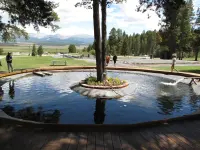
- Leadville National Fish HatcheryLeadville · National fish hatcheryFederal trout hatchery founded 1889 at 10,000 feet below Mount Massive near Leadville, Colorado, housed in an 1890 red sandstone building and now breeding Colorado's greenback cutthroat.
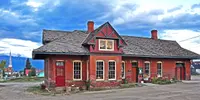
- Leadville RailroadLeadville · Scenic train rideClimb aboard the Leadville Railroad for a scenic ride through the Colorado Rocky Mountains, winding through the San Isabel National Forest at high elevation.
The Calendar
History
Gold in California Gulch
Leadville stands at 10,152 feet in the central Rocky Mountains as the Lake County seat, and the Colorado Encyclopedia calls it the highest incorporated city in the United States.1 To the east the high Mosquitoes tumble down to Carbonate, Iron, and Fryer Hills on the outskirts of the camp, long since stripped of trees, and gray and yellow dumps from old mines spill down into the town.2
Gold came first: on April 25, 1860, Abe Lee, one of a party of Georgians, found it in California Gulch, which was supposedly named for his shouts that he saw California in his pan.1,2 By the end of that summer about 10,000 people lined five miles of the gulch, living in wagons, tents, and brush huts, and the camp later took the name Oro City.1 More than $3 million in gold had been panned by 1865, and after a revival at the Printer Boy lode in 1868–69, only a few people were left by 1870.1
Carbonate of Lead
William Stevens and Alvinus Wood stayed on to work the old placer tailings, and in 1874 they found that the heavy black mud that had troubled Oro City’s placer miners was lead carbonate full of silver.1 The 1941 guide tells it differently: in 1875 “Uncle Billy” Stevens, a Minnesota prospector, took on A. B. Wood, a metallurgist, who found that the heavy red sands were virtually pure carbonate of lead.2 The two kept the find secret, telling even their own workers that they were mining lead, and staked claims across the hills before announcing the discovery in 1876.1 The first outside interest came from the St. Louis Smelting & Refining Company: in September 1876 its local agent, August Meyer, bought 300 tons of ore and shipped it to St. Louis, and his second shipment the next spring was rich enough to bring company president Edwin Harrison to Colorado.1 In the summer of 1877 Harrison and Meyer built the area’s first real smelter, the Harrison Reduction Works, at what is now the corner of Harrison Avenue and Chestnut Street, next to Meyer’s sampling works.1
The Carbonate Camp, 1878–1880
Leadville had a few hundred residents when it was incorporated at the start of 1878, and by the end of 1879 it had about 30,000, nearly as many as Denver.1 The 1941 guide places the incorporation in January 1878 at New Oro City, which was formed by a merger with Slabtown, and names H. A. W. Tabor as mayor and postmaster.2 Tabor had grubstaked two German shoemakers, George Hook and Auguste Rische, and his $17 grubstake gave him a third share when they struck the lode later developed as the Little Pittsburg.2 He took $500,000 in dividends from the Little Pittsburg, sold out within a year for $1,000,000, and put the profits into the Chrysolite and Matchless Mines.1,2 Lodging was wholly inadequate, and the Mammoth Palace, a shed with bunks for 500, rented out a sleeping turn of eight hours for 50¢.2
On May 26, 1880, night-shift miners at the Chrysolite kept the day shift out of the mine, and by the end of the day more than 2,000 miners had walked off the job.3 Governor Frederick Pitkin declared martial law on June 13, and on June 17 the union agreed to return to the prestrike status quo.3 The Denver & Rio Grande Railroad arrived soon after the strike, and brick storefronts replaced the boomtown shacks, but about three-quarters of the area’s sixteen smelters closed during the 1880s.1
Silver Panic and the Ice Palace
In 1893 a national panic and the repeal of the Sherman Silver Purchase Act sent silver prices down and bankrupted Horace Tabor, who died virtually penniless as postmaster of Denver on April 10, 1899.1,2 His last instructions to Baby Doe were to hold on to the Matchless, and she lived alone in a shack beside the mine shaft until her death in 1935.2 The mines turned to gold, copper, zinc, and lead, and the encyclopedia says that by 1895 Leadville had returned to its position as Colorado’s most productive mining town.1 The town built an ice palace 450 feet long with five-foot-thick walls for a Crystal Carnival that ran from January 1 to March 28, 1896, and that September parts of the palace were torn down to build barracks for militiamen sent against striking miners.4
Molybdenum at Climax
The Climax Mine opened at nearby Fremont Pass in 1918 to produce molybdenum, but metal prices fell after World War I, and Leadville’s population dropped from more than 12,000 in 1900 to about 4,000 by 1930.1 The 1941 guide called Climax the world’s largest molybdenum mine and noted that Leadville’s population rose and fell with employment there.2 During World War II the Tenth Mountain Division trained at nearby Camp Hale, and soldiers came to Leadville to live, buy groceries, and find entertainment.1,5 By the end of the 1970s Climax employed 1,800 Lake County residents, and in the fall of 1982 it suspended production indefinitely.1 Ken Chlouber, a Lake County commissioner and Climax employee, urged ultrarunner Jim Butera to hold a 100-mile race in town, and the first Leadville Trail 100 Run was held in August 1983 with forty-four starters.1
The Leadville Historic District, designated a National Historic Landmark in 1961, includes 67 mines in the 20-square-mile mining district east of the city, and the city counts 70 square blocks of original Victorian architecture.6 The clapboard house that August R. Meyer built in 1878 for his bride, Emma, now called Healy House, stands beside James V. Dexter’s 1879 log cabin.7 The city counts 25,000 former residents buried in Evergreen Cemetery.6
Within 30 Miles
Measured in a straight line from the town, nearest first.
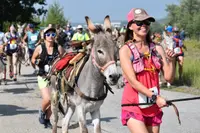
- Burro DaysFairplay · CelebrationBurro Days in Fairplay, held each July since 1949, is built around the World Championship Pack Burro Race, in which runners and burros climb to the 13,185-foot top of Mosquito Pass and back.

- Continental Divide WineryFairplay · WineryA tasting room and production winery in a Highway 285 shopping plaza in Fairplay, where the owners say wine is made higher than anywhere else on earth.
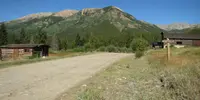
- Winfield Ghost TownBuena Vista · Ghost townMining camp in Clear Creek Canyon, Chaffee County, CO, listed on the National Register of Historic Places. The site has original buildings from the late 1800s to the 1940s with interpretive panels and signs; the buildings serve as recreation residences except the Ball Cabin and the Schoolhouse, which the Clear Creek Canyon Historical Society of Chaffee County operates as museums.
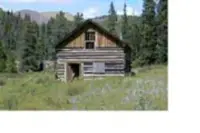
- Roberts CabinComo · CabinRobert's Cabin is located 3 miles NW of Como at CR 50 and CR 33. It dates back to the 1880s and is associated with the early Denver, South Park & Pacific Railroad. It can accommodate eight people with two double beds, two twin beds and one sleeper sofa. There is a wood stove and a port-a-potty.
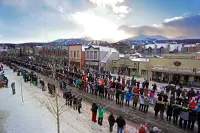
- Ullr FestBreckenridge · Annual celebration of winter and snowBreckenridge's festival for Ullr, Norse god of snow: a Main Street parade, a bonfire of old Christmas trees, and roots in the town's 1963 mock secession.
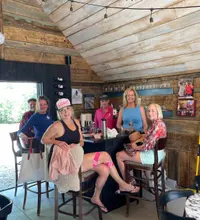
- Wild Mountain CellarsMinturn · Winery/vineyardCozy cabin space along the Eagle River with a rustic feel; big glass doors on both sides and a firepit out front.
- Betty Ford Alpine GardensVail · Botanical garden (alpine)Alpine botanical garden in Vail, Colorado, with over 3,000 alpine species at 8,200 feet of elevation.

- Ashcroft Ghost TownAspen · Ghost townMining town that rivalled Aspen at the headwaters of Castle Creek. By 1912, the population had dwindled to less than 50 residents and Ashcroft became a ghost town.
- Book NookBuena Vista · Used bookstoreBuena Vista's Favorite Used Bookstore

- Mt. Antero Treasures Mining AdventureBuena Vista · Mineral searching license for a daily digOne daily mineral searching license and one day with a guide per person; guides are experienced Mt. Antero prospectors from the operator's crew.
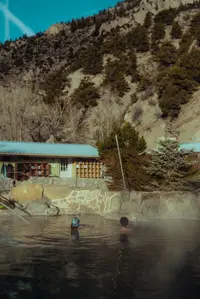
- Cottonwood Hot Springs Inn & SpaBuena Vista · Inn & spaNatural artesian hot springs inn and spa in Buena Vista, Colorado, with day-use soaking, a spa, lodge and cabin overnight stays that include soaking, and overnight 'soak all night' passes.
- Gold Rush Days (Buena Vista)Buena Vista · FestivalBuena Vista's three-day August festival in Chaffee County, Colorado, built around a pack burro race run annually since 1979 and a toilet-seat derby propelled by plungers.

Nearby towns: Georgetown and Gunnison. All the towns of Colorado. More of Colorado: Town Festivals, Wineries, and Factory Tours.
Sources
- Colorado Encyclopedia coloradoencyclopedia.org/article/leadville
- Colorado: A Guide to the Highest State (1941), p. 167 archive.org/details/coloradoguidetoh00writ_0/page/167
- Leadville Strike of 1880 coloradoencyclopedia.org/article/leadville-strike-1880
- Leadville Ice Palace (coloradoencyclopedia.org) coloradoencyclopedia.org/article/leadville-ice-palace
- Colorado’s “Winter Warriors” Honored at Leadville’s Healy House Museum historycolorado.org/press-release/2026/05/07/colorados-winter-warriors-honored-leadvilles-healy-house-museum
- Leadville, CO leadville-co.gov/about-leadville/page/history
- Healy House Museum & Dexter Cabin historycolorado.org/healy-house-museum-dexter-cabin