Gunnison
Gunnison County, Colorado. County seat.
Gunnison, the county seat on the Gunnison River, saw an 1874 farm colony fail before two railroads raced to reach the town.1,2,3
Details
- Founded
- Sylvester Richardson brought a settler colony to the valley in 1874, and the 1941 guide says the town was laid out five years later, after silver deposits were found near Crested Butte.1,2
- Name
- The town is named for John Williams Gunnison, the Army explorer whose 1853 railroad survey camped on the river near the present town.4,5
- County seat
- Gunnison is the county seat of Gunnison County.1
- Last checked
- October 6, 2026.
Point at a dot to see the place.Tap a dot to see the place. Road map of Gunnison.
In Gunnison
The Calendar
History
County Seat on the Gunnison River
Gunnison, the county seat of Gunnison County, stands along the Gunnison River in the large valley of the same name, and about a third of the county’s 15,324 residents live there.1 In 1941 the Federal Writers’ Project guide found it the trading center of the upper Gunnison Valley, with 1,415 people at 7,683 feet and the headquarters of the Gunnison National Forest.2
On September 6, 1853, the railroad survey led by John Williams Gunnison camped on the river near the present town.4,5 On October 26, 1853, in Utah, Paiute warriors attacked his camp and killed him; the river, the town, and Gunnison County carry his name.4
Richardson’s Colony and the Silver Strike
The 1941 guide says silver ore was found nearby as early as 1870, but Ute hostility kept it from being worked.2 In 1874 Sylvester Richardson brought a party of fewer than twenty into the valley, where they found well-watered farmland along the river and coal on Ohio Creek.1 The Colorado Encyclopedia calls it the first white settler colony in the Gunnison Valley and Richardson a geologist, while the 1941 guide calls him a prospector and says his farm colony failed.1,2 The colony drew few others until 1879, when gold and silver discoveries in the mountains brought people in, and after the Meeker Incident that year most of the remaining Tabeguache Utes were removed to a reservation in Utah.1 By the 1941 guide’s account, the town was laid out and prospered after important silver deposits were found near Crested Butte, and it held 6,000 people in 1893.2 A memoir in The Colorado Magazine, by a writer who arrived on October 20, 1881, recalls a lively, booming town divided into east and west sections.6
Two Railroads, a Smelter, and a Deep Winter
The Denver, South Park and Pacific Railroad gambled on a tunnel through the Continental Divide at Altman Pass, but the Denver and Rio Grande Railway, building over Marshall Pass, reached Gunnison five days before the South Park rails reached the tunnel’s east portal.3,7 South Park trains came through the 1,772-foot tunnel into Gunnison on September 2, 1882, a year behind their rival, and the railroad through the Alpine Tunnel was abandoned in 1910.3,7
Gunnison had no water system until 1882; before then water was hauled from the river and found a ready sale, and work on gas and water works began early in March of that year.6 E. R. Moffit of Joplin, Mo., built the town’s first smelter, which blew in on Sunday, December 17, 1882; a second, started in 1883 or 1884, closed down after about a year of experimenting.6 One authority put more snow in the winter of 1883-84 than in any since 1879-80, and a Gunnisonite coming down from an Elk Mountain mining camp told the memoirist he had followed the telegraph line to Gunnison sitting on the crossarms.6 Packer, held in the Gunnison county jail, was tried again for his crimes at Gunnison in 1886 and received a life sentence.6
Hay, Cattle, and the Normal School
Silver mining in Gunnison County petered out by 1893 as accessible ore ran out and prices fell.1 Hay and potatoes became staple crops and cattle and sheep ranching turned profitable, and by 1900, the Colorado Encyclopedia says, these had eclipsed mining as the most important activities in the county.1 The same year brought the first Cattlemen’s Days.1 The Gunnison National Forest was established in the spring of 1905, and its first rangers met suspicion and hostility from ranchers who feared losing grazing land.1 The Colorado Encyclopedia dates the opening of the State Normal School, a school for teachers that it calls the first college on the Western Slope, to 1911, while the 1941 guide gives Western State College a founding date of 1909 and an average enrollment of 400.1,2 It took the name Western State College of Colorado in 1923 and, with 2,300 students, became Western State Colorado University in 2012.1
The La Veta, the Freight Office, and Engine #268
The La Veta Hotel, built in 1884, rose four stories in an ornate style fashionable in the late 1880’s; the 1941 guide called it one of the oldest on the Western Slope and found its original chandeliers and much of its black walnut furniture still in place.2 The management then gave guests free meals on any day the sun failed to shine, which by its count had happened 17 days in 25 years.2 Fred and Frank Zugelder built the two-story sandstone Gunnison Hardware Building in 1882 as the downtown freight office of the Denver & Rio Grande Railway, and its first floor later held a hardware store.8 The Gunnison Council for the Arts bought it in 1992, and it is listed in the Colorado State Register of Historic Properties.8 The Gunnison Pioneer Museum’s marker records that Engine #268, a Denver and Rio Grande Western 2-8-0 built by Baldwin in 1882, worked in Gunnison for 73 years, until its fire was put out for the last time on July 1, 1955.9
Within 30 Miles
Measured in a straight line from the town, nearest first.
- Roaring Judy Fish HatcheryAlmont · Fish hatcheryA state fish hatchery on the East River north of Almont, Colorado, where the state's largest kokanee salmon run ends each fall in a Friday giveaway of spawned fish.
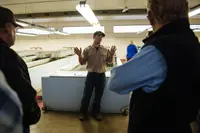
- Pitkin DaysPitkin · Annual celebrationPitkin Days, held each July in a former Gunnison County mining camp, runs from a free alpine footrace to a melodrama where the audience throws popcorn at the villain.
Nearby towns: Paonia and Leadville. All the towns of Colorado. More of Colorado: Wineries, Fairs & Rodeos, and Town Festivals.
Sources
- Gunnison County (coloradoencyclopedia.org) coloradoencyclopedia.org/article/gunnison-county
- Colorado: A Guide to the Highest State (1941), p. 312 archive.org/details/coloradoguidetoh00writ_0/page/312
- Two Great Trains (historical marker) hmdb.org/m.asp?m=158726
- John W Gunnison (coloradoencyclopedia.org) coloradoencyclopedia.org/article/john-w-gunnison
- John Williams Gunnison Centenary of His Survey and ... historycolorado.org/sites/default/files/media/document/2018/ColoradoMagazine_v31n1_January1954.pdf
- THE COLORADO MAGAZINE historycolorado.org/sites/default/files/media/document/2018/ColoradoMagazine_v9n6_November1932.pdf
- National Register nomination, Alpine Tunnel Historic District npgallery.nps.gov/GetAsset/a48685ad-dd89-44ca-aec2-a24a6a8f6221
- Denver & Rio Grande Freight historycolorado.org/location/gunnison-hardware-denver-rio-grande-freight-mechling-block-gunnison-arts-center
- Engine #268 (Cinderella) (historical marker) hmdb.org/m.asp?m=158567