Roaring Judy Fish Hatchery
Almont, Gunnison County, Colorado. Fish hatchery; Open all year.
Details

- Where
- 14131 North Highway 135, Almont, CO 14131. Directions
- When
- Daylight hours.
- Getting there
- From Gunnison, head north on CO 135. Just past mile post 14, turn left (west) off the highway, cross the bridge, and park in the public parking area.
- Fees
- Free.
- Access
- Gravel parking lots; taking of kokanee is prohibited; the East River is closed to fishing below the hatchery outlet to the property line in August and October to protect the kokanee spawning run.
- Walk-in or reserve
- Walk-ins welcome; call for guided tours.
- Phone
- 970-641-0190
- Website
- coloradobirdingtrail.com
- Managed by
- Colorado Division of Wildlife (now Colorado Parks and Wildlife).
- Established
- 1963.
- Coordinates
- 38.70255, -106.85172.
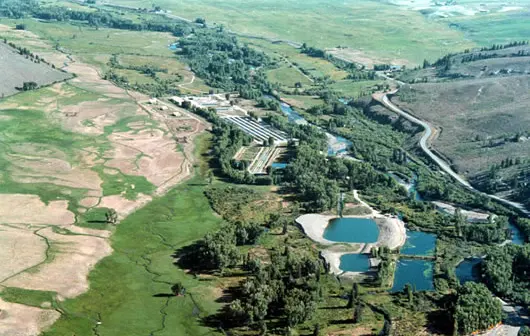
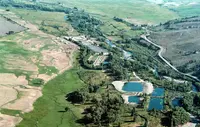
Just past mile post 14 on Colorado 135 north of Gunnison, a road turns west off the highway and crosses a bridge over the East River to the Roaring Judy Fish Hatchery. The grounds are a riverside park of mature cottonwoods, riparian brush, ponds, and channels, run by Colorado Parks and Wildlife and open without charge in daylight hours all year. The Colorado Birding Trail puts the property at 840 acres. The agency describes a 783-acre wildlife area as part of it, and Seth Firestone, the hatchery manager, has said the hatchery’s own operations use 30 percent of that ground. The rest is left to elk, deer, bears, and birds.
In summer, Wilson’s Snipe, Yellow Warbler, Red-naped Sapsucker, Fox Sparrow, and Willow Flycatcher breed in the brush. Trails follow the river and pass the ponds, and there is a small picnic area. Anglers, hunters, and fishing guides use the public access to a river that otherwise runs mostly through private land. “The public access portion of the hatchery is huge for the whole county, especially for Crested Butte,” said Jason White, owner of Crested Butte Angler. Over the five years before 2025, an average of 34,000 people visited between April and November.
Troughs, raceways, and rainbow trout
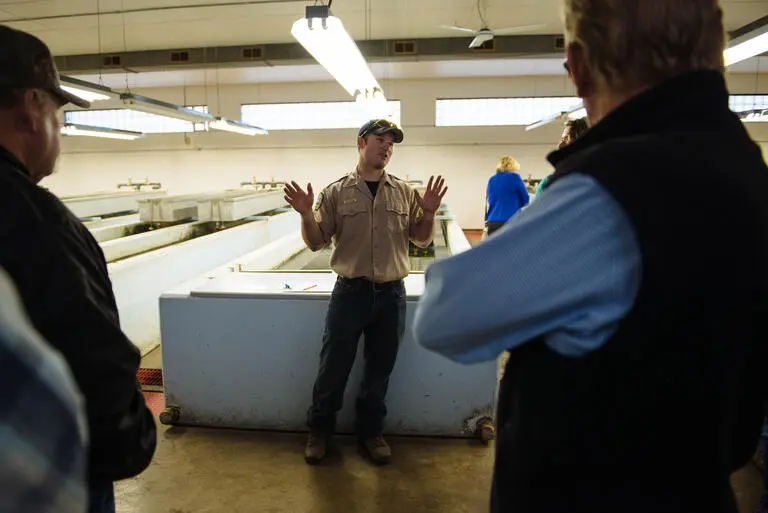
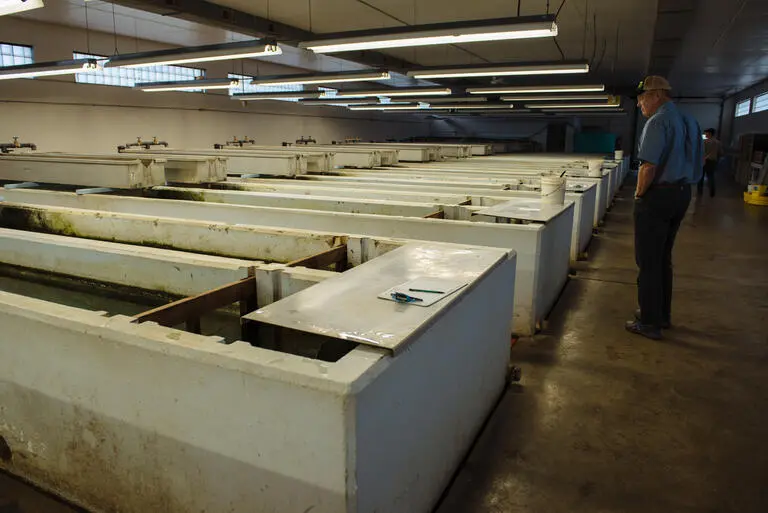
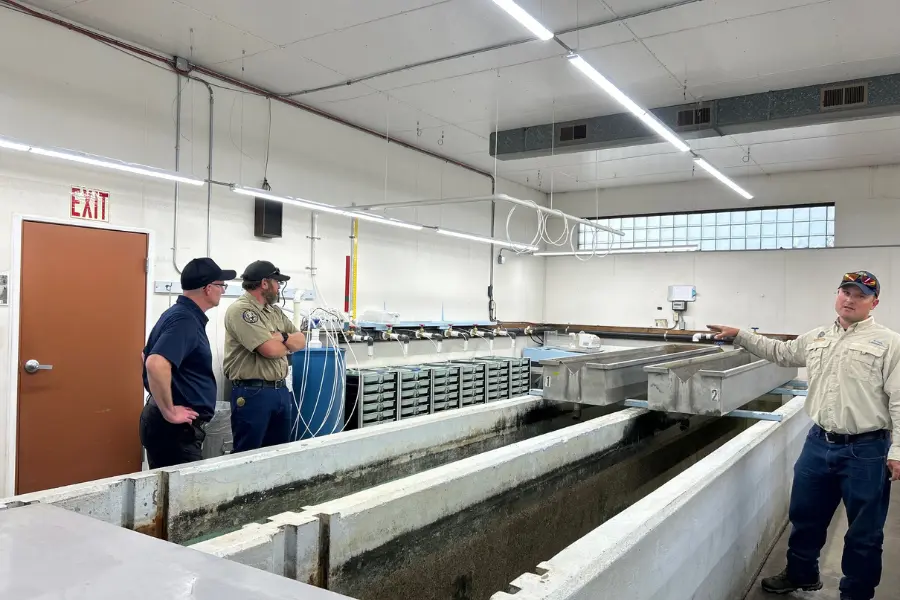
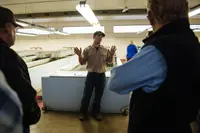
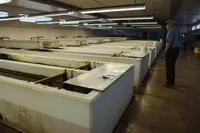
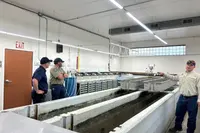
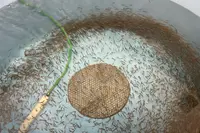
Tours begin in the visitor center, which holds row after row of heavy-duty water troughs connected down to the floor. Thousands of fingerlings swim in each trough. Firestone counts 44 tanks and 44 troughs in all. Larger fish are moved outside to concrete raceways, where they follow visitors up and down the length of the run in hope of a handful of food. Hatchery personnel hand out fish food so visitors can feed the rainbow trout. These rainbows are a strain resistant to whirling disease, a parasite that makes fish “whirl” and die. Trucks equipped to haul live fish carry them to lakes around the state. Plaques and pamphlets serve the self-guided visitor, and guided tours can be arranged by calling ahead.
By the agency’s count, Roaring Judy produces over 3 million kokanee fry a year, along with 100,000 subcatchable trout of 2 to 5 inches and 180,000 catchable trout of 10 inches. Its third fish is the native cutthroat, chiefly the Hayden Creek and Kelso Creek strains, which employees release into high-elevation lakes and streams where they need not compete with other species. In 2024 the hatchery stocked roughly 28,000 Hayden Creek and 19,300 Kelso Creek cutthroats. The fish usually go out by truck, but crews sometimes use ATVs, horses, mules, or people carrying backpacks to reach remote water.
Thirty miles to Blue Mesa and back
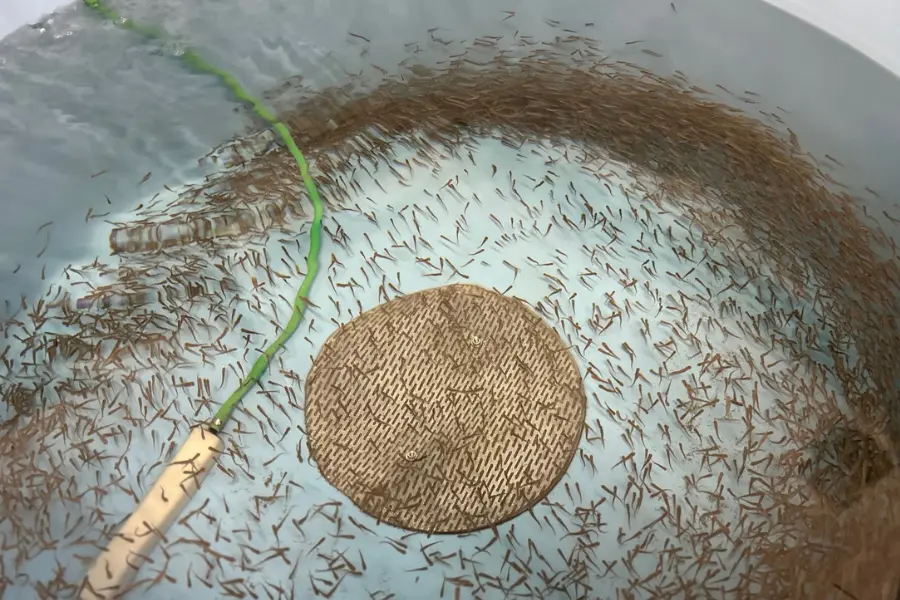
Kokanee are a landlocked form of sockeye salmon, and the hatchery is built around their life cycle. In October, fertilized “green eggs” come into the building. Crews use a Von Bayer trough to count eggs per ounce, then estimate the total by volume. The eggs incubate in trays for about 30 days and are sorted. The fertile ones go into hatching jars mounted on the tanks, each jar holding up to 150,000 eggs. They hatch in about 26 days. The fry lie on the tank bottom for about 21 days until the yolk sac is absorbed, then swim up and begin to take food. From February to mid-April the crew feeds them and cleans the tanks daily. “Our goal is to raise 3.1 million two-inch Kokanee to stock back in the East River,” Firestone said in 2024.
The release comes in spring. One account says it happens as soon as the ice melts on Blue Mesa Reservoir; a 2011 account says each April. On a Wednesday evening in 2019, more than 3.1 million fingerlings left the raceways through drains into the East River while children and parents watched. Firestone puts the trip to Blue Mesa at 28 miles, made in about nine hours. The Gunnison aquatic biologist Dan Brauch puts it at 30. About 10 percent are eaten before they reach the reservoir, by birds, bears, mink, raccoons, and brown and rainbow trout. In the reservoir, lake trout feed on them, and anglers with sonar hunt the schools. The survivors grow from a couple of inches to sometimes more than a foot.
Most return as three-year-olds. “It’s amazing that after three years they can remember that trip they made down the river to get back up,” Firestone said. The run begins in late August, and visitors can see adults swimming upstream near the fishing ponds in September and October. The males are orange and red, with humped backs and hooked jaws, which the agency’s page calls “kipe.” The females are silver. The East River below the hatchery outlet is closed to fishing from August 1 to October 31, and taking kokanee on the property is prohibited.
Spawning starts in the first week of October. Hatchery and biology crews strip eggs from the females and fertilize them with milt from the males. In a normal season, The Colorado Sun reported, around 14,500 kokanee arrive and yield more than 8 million eggs. The agency gives an average of 7.2 million, the largest kokanee spawn in Colorado, and says it supplies about 60 percent of the eggs other state hatcheries need to stock 26 lakes and reservoirs. The Gunnison Country Times, in 2025, gave the figures as about 4 million eggs a year sent to other hatcheries, 40 percent of all kokanee eggs collected in the state. “They prepare their whole lives for this one event,” Firestone said.
Fish Fridays
Kokanee die soon after spawning, so each week’s spawned fish are given away the following Friday, from about mid-October to the end of the spawn. People are asked to be there at 9 a.m. with a valid fishing license and a cooler.
The line forms early. Shirley Kelly of Glade Park wrote that she arrived at 5:45 a.m. on a Friday in October 2011 and found 12 cars ahead of her, their occupants having slept in them. By the time the gates opened there were about 100 cars behind her. The hatchery had about 3,000 fish that day and started at 10 per person, and anyone could go to the end of the line and come through again. “What an interesting venture, but I think one time is enough!” she wrote.
On October 27, 2022, Debbie Carpenter was first in line at 4 a.m. She had driven four hours from Grand Junction and waited in the car with her two young children while property technician Jeremiah Rummel worked the line checking licenses. Eight vehicles stood behind her. “Back then a person could drive away with as many as 40 salmon,” she said. “Now, sometimes it’s just a few salmon per car.” Two earlier Friday giveaways that October had been canceled for lack of fish, and the first giveaway of the season had yielded one fish per person. On the last Friday of the month Firestone handed out 600 salmon, the largest giveaway of that season. “Those that traveled very far were just glad to have a road trip,” Brauch said.
A creek, a ranch, and the Gunnison schoolchildren
The Division of Wildlife purchased the hatchery in 1963. The Gunnison Country Times reports it was built for the quality of its water and for the chance of a natural kokanee run at the headwaters of Blue Mesa Reservoir.
The name has more than one story. Brauch told a 2011 visitor that Gunnison schoolchildren named the hatchery in 1966, the year it began rearing trout eggs. A 2024 Mesa County account says the hatchery took its name from a nearby creek that local elementary students had named. The Denver Post reported that Roaring Judy was named after a turn-of-the-century ranch in the valley running toward Crested Butte.
The kokanee program grew up alongside the reservoir. The Colorado Sun dates the completion of Blue Mesa Dam to 1966, the same year the hatchery started rearing fish, and says the first kokanee went into the reservoir two years later. The Gunnison Country Times says the agency has stocked kokanee fingerlings in Blue Mesa since 1965 and from Roaring Judy every year since 1967; by its count the 2019 release was the 53rd in a row. Firestone traces the hatchery’s fish to Granby in northern Colorado, and the Granby fish to Flathead Lake in Montana. Since 2009 the hatchery has stocked between 2.9 and 3.2 million salmon a year.
The place has been lived in as well as worked. Jim Ferraro, an assistant supervisor who joined the Division of Wildlife in 1983, lived with his family in a home at the hatchery. Matt Nicholl, who joined the agency the same year, managed Roaring Judy and was the agency’s Hatchery Chief by 2008.
Low water and fire
The kokanee rise and fall with Blue Mesa. Egg takes fell by more than half after the drought years of 2012 and 2013. In 2018 the reservoir was drawn down to 30 percent of full pool, yet that fall the crew collected a record 9.2 million eggs from 15,800 fish and sent about 5 million to other hatcheries. Another decline began in 2020. In 2021 the harvest was 2.3 million eggs, about a third of the historical average of 7.6 million.
By the fall of 2022, Blue Mesa stood nearly 78 feet below full pool. Algae blooms and warm surface water squeezed the kokanee into a narrow band of habitat, where gill lice spread among the crowded fish. Hatchery staff and volunteers waded hip-deep in the East River’s channels to net strays that had missed the turn to the hatchery. At a point in the season when the river can run red with salmon, they caught 60. “That’s the million-dollar question,” Firestone said. “How many fish are still in the river?” By November 16, Brauch estimated that only 4,000 of the 3 million fry had come back, with 1.6 million eggs taken. In short years the hatchery has brought in eggs from other Colorado hatcheries and from Wyoming.
Fire has brought other fish to the hatchery. Cutthroat trout that the agency rescued from the Hayden Pass Fire in 2016 were taken to Roaring Judy’s isolation facility and spawned there the following springs; a 2026 account says survivors of that population were eventually moved to the Leadville National Fish Hatchery. In August 2025, crews electrofished 266 cutthroat trout from the path of the Stoner Mesa Fire west of Rico. These fish belong to a rare lineage that biologists call the “Uncompahgre cutthroat trout,” and they were driven 165 miles north to Roaring Judy. “We’ll keep them closely monitored until conditions are stable on the ground and we’re able to return them to the wild,” said Reid DeWalt, the agency’s deputy director.
On June 28, 2026, the Willow Fire started near Leadville. Over the next three days, federal and state crews netted more than 148,000 fish by hand from the Leadville National Fish Hatchery, which had operated since 1889. About 5,000 greenback cutthroat and 1,500 Hayden Creek brood fish were divided among four state hatcheries, Roaring Judy among them. At Roaring Judy, Firestone and fish culturist Joe Lagasse received greenback cutthroat, and fish culturist Kristi Lauerman received Hayden Creek cutthroat, fish descended from the population carried out of a burning drainage ten years before.
Notable Events
- 1963The Roaring Judy Hatchery was established. mesacounty.us
- 1963The hatchery was purchased by the Division of Wildlife in 1963. thefencepost.com
- 1965Kokanee fingerlings have been stocked in Blue Mesa by CPW since 1965. gunnisontimes.com
- 1966Blue Mesa Dam was completed in 1966, the same year that the Roaring Judy Hatchery started rearing fish; two years later the first kokanee were introduced into the reservoir. coloradosun.com
- 1966In 1966, when they began to rear the trout eggs, the name Roaring Judy fish hatchery was given by the Gunnison school children. thefencepost.com
- 1967The annual stocking of kokanee from Roaring Judy has occurred since 1967. gunnisontimes.com
- 2013Kokanee eggtake totals plummeted by more than 50% following the drought years of 2012 and 2013, as water levels fell in Blue Mesa. gunnisontimes.com
- 2016Cutthroat trout rescued by CPW from the Hayden Pass Fire were taken to the Roaring Judy Hatchery isolation facility and spawned the following springs. coloradooutdoorsmag.com
- 2018In 2018, CPW collected 9.2 million eggs, and sent about 5 million eggs to other hatcheries around the state. gunnisontimes.com
- 2020Data from the hatchery shows another notable drop starting in 2020, corresponding with the reservoir's declining elevation. gunnisontimes.com
- 2021Roaring Judy harvested 2.3 million eggs in 2021, about a third of the historical average of 7.6 million. coloradosun.com
- 2022Out of 3 million fry, only about 4,000 salmon made it back to the hatchery in 2022. coloradosun.com
- 2025Staff evacuated native cutthroat trout 165 miles north to the Roaring Judy Fish Hatchery to keep them out of the path of the Stoner Mesa Fire. summitdaily.com
- 2026Fish evacuated from the Leadville National Fish Hatchery were divided among CPW hatcheries, including the Roaring Judy State Fish Hatchery in Almont. seconews.org
People
- Kristi Miller, Fish hatchery technician at Roaring Judy (11 years).
- Jeremiah Rummel, Property technician for Colorado Parks and Wildlife at the Roaring Judy Hatchery giveaway.
- Matt Nicholl, Hatchery Manager at Roaring Judy Hatchery, later CPW Hatchery Chief (with the agency from 1983; Hatchery Chief in 2008).
- Jim Ferraro, Assistant supervisor of the hatchery facility; the family lived in a home at the hatchery (with the DOW since 1983).
- Cody Taylor, Hatchery technician for Colorado Parks and Wildlife at the Roaring Judy Hatchery.
- Blake Adams, Intern at the fish hatchery (2024).
- Seth Firestone, Hatchery manager.
- Jeff Spohn, Colorado Parks and Wildlife Chief of Hatcheries, who briefed a visiting commissioner on the hatchery's operations.
- Dan Brauch, Fish Biologist for the Gunnison area, who explained the hatchery and its kokanee to visitors.