Cottage Grove
Lane County, Oregon.
Cottage Grove is a town in Lane County, Oregon, on the Coast Fork of the Willamette, where the east and west sides once split into two rival towns.1,2,3
Details
- Founded
- Cottage Grove began on the donation land claim of Henry Small, and the first land claims, by J. Cochran and William Shields, date to 1851.4
- Name
- The city’s marker says settler Greenberry Pearce coined the name when he set up the first post office, naming it for cottages in an oak grove.3
- Last checked
- October 6, 2026.
Point at a dot to see the place.Tap a dot to see the place. Road map of Cottage Grove.
In Cottage Grove
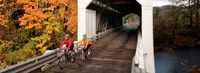
- Cottage Grove Covered Bridge Tour RouteCottage Grove · Covered bridge tour route (for motor vehicles)A 20-mile loop past six covered bridges around Cottage Grove, Oregon, ending at what is believed to be the last covered railroad bridge west of the Mississippi.
- Sharps Creek Recreation Site (BLM), Lane County, ORCottage Grove · Recreation siteStep off the beaten path and explore a delightful gem nestled in the foothills of the Cascade Mountains with ties to the historic Bohemia Mining District, 18 miles southeast of Cottage Grove. The site offers a 12-unit campground, day-use picnicking area, and a nearby swimming hole formed naturally among rounded boulders at the base of an overlook extending above Sharps Creek.

The Calendar
History
Henry Small’s Claim and the Railroad
The Coast Fork of the Willamette River divides Cottage Grove, a town in south-central Lane County, into an eastern and a western section.1,2 River Road, Cottage Grove’s first main street, was once a Kalapuya Indian trail, became part of the Applegate Trail in 1846, and served as a stage route in the 1860s.5 The town had its beginning on the donation land claim of Henry Small, and the historic context statement dates the first land claims, by J. Cochran and William Shields, to 1851.4 The city’s marker says settler Greenberry Pearce coined the name when he set up the first post office, naming it for cottages in an oak grove.3 The post office moved to Cottage Grove from Cresswell in 1867.4 The Oregon and California Railroad obtained a right-of-way through town in 1871, and the first train arrived on July 7, 1872.3,4 Cottage Grove was incorporated on February 11, 1887.3
Slabtown and Lemati
By 1893, the city’s marker says, there were two feuding town centers: “Slabtown” on the west, named for lumber slabs laid in the muddy streets, and East Cottage Grove, later named Lemati, on the east.3 The Federal Writers’ Project guide tells it differently: in 1894 a west-side representative persuaded the legislature to designate the west side as Cottage Grove, and the resentful east-siders incorporated as Lemati, leaving Cottage Grove off the railroad.2 In that guide’s account the Cottage Grove marshal had to go to Lemati to meet the mail trains, and when he neglected to remove his badge the Lemati marshal jailed him until Cottage Grove paid his fine.2 The city’s marker adds that citizens of Lemati once dragged the post office 600 feet east in a midnight raid.3 The marker dates the reunion as Cottage Grove to 1899, while the guide says only that a reconciliation came after two years.2,3
Bohemia Gold
In 1858, the city’s marker says, gold was discovered 30 miles east along the upper Row River, while the town was still struggling to establish itself.3 Mill stamps for the mines arrived by rail at the depot, and when the Bohemia Mines boomed in 1902 a short rail line ran daily from Cottage Grove to Disston.1,3 The blocks around the station at Main Street filled with hardware stores, saloons, groceries, lodging houses, and gambling halls, and the boom swelled the population to 3,000.3
The Chambers Mill and Bridge
As mining disappeared the timber industry grew, and in 1909 thirty-one sawmills were recorded within twenty miles of town.3 John Harvey Chambers, who came to Oregon from Nebraska in 1902, moved to Cottage Grove in 1903 to take charge of a sawmill whose owner had defaulted on a loan.6 In 1917 he gained control of the Oregon Pacific and Eastern Railway, built to serve the Bohemia Mining District, and used it for lumber transport.3,6 The Chambers Mill was established in 1925, and that year J.H. Chambers built a bridge to carry logs from the Lorane Valley timber across the Coast Fork Willamette River to it.6,7 On August 8, 1942, fire burned the mill to the ground with more than five million board feet of lumber, and the seventy-six-year-old owner rebuilt, dying in October 1944 with the new mill nearly complete.6 Under Warren Daugherty the mill burned again, in 1950 by the city marker’s date and in 1951 by the Cottage Grove Sentinel’s, and the rails and buildings were sold for scrap.6,8 The city marker calls the Chambers Covered Bridge Oregon’s last covered railroad bridge and the chamber of commerce calls it the only one west of the Mississippi; it was restored and dedicated for public use in December 2011.9,10,11 When the Federal Writers’ Project guide was written, the town of 2,475 stood in the heart of a lumbering region, with stock raising, dairying, and fruit culture also carried on.2 The 1940s were the heyday of timber cutting, with dozens of mills operating around Cottage Grove, but by 1979 timber jobs in town had declined by 68%.9
Marietta at the East End of Town
In the summer of 1926 Buster Keaton filmed The General here, building a set representing Marietta, Georgia, at the east end of town and a 215-foot trestle across the Row River near Culp Creek for the climactic scene.12 In 1977 city officials closed Main Street for three days so the homecoming parade scene of Animal House could be filmed there.4,13 A large mural of the General hangs on Main Street, and the town has a statue and a mural of Opal Whiteley, whose diary the Atlantic Monthly began running in March 1920.12,14
Within 30 Miles
Measured in a straight line from the town, nearest first.
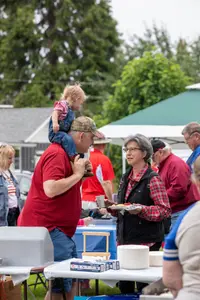
- Creswell 4th of July CelebrationCreswell · 4th of july celebrationAn all-day Independence Day in Creswell, Oregon, with pancakes at Holt Park, a parade and fireworks at dusk, whose parade began, by one account, with a fire truck in 1992.
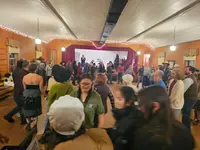
- Spencer Creek Grange winter square dances, Eugene OR (Lane County)Eugene · Old-time community square danceThree Winter Square Dances will be taking place at the Spencer Creek Grange over the course of the first three months of 2026. Dances will be held on Saturday evenings between 7:30 to 9:30 on January 10th, February 14th and March 14th.
- Lane County FairEugene · County fairThe Lane County Fair fills the fairgrounds on West 13th Avenue in Eugene, Oregon, each July, and traces its exhibitions to an 1858 showing of fruit, grain, and livestock.

- Picc-a-dilly Flea MarketEugene · Local businessEugene's largest, longest-running and most diverse flea market, conveniently located at the Lane County Fairgrounds.

- McKenzie River Scenic BywayEugene · 34-mile/55-kilometer riverside routeThe steely blue McKenzie River sets the course for this 34-mile/55-kilometer riverside route, which links the fruitful Willamette Valley to the fragrant fir forests of the Cascade Mountains.
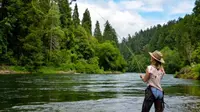
- Musick Guard StationCottage Grove · Guard stationMusick Guard Station is located in southwestern Oregon, offering visitors a glimpse into a historic mining community in the Umpqua National Forest.
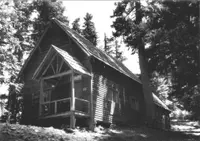
- Timber Butte CabinLowell · Fire lookout cabin rentalLookout cabin in the Fall Creek area of the Willamette National Forest at 3,650 feet, 19 miles from Lowell, Oregon; open mid-April through late October for scenery and a variety of recreation.
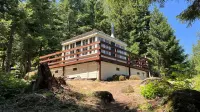
- Brandborg Vineyard & WineryElkton · WineryBrandborg Vineyard & Winery pours pinot noir and Alsace-style whites from a two-story building on Highway 38 in Elkton, Oregon; its founder helped win the Elkton Oregon AVA.
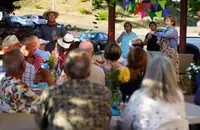
- Fort Umpqua DaysElkton · FestivalFort Umpqua Days is a free Labor Day weekend festival in Elkton, Oregon, held around a volunteer-built replica of the Hudson's Bay Company's southernmost fur post.
- Willamette HatcheryOakridge · Fish hatcheryWillamette Trout Hatchery and the adjacent Oakridge Salmon Hatchery were combined in 1983 and operate today as Willamette Hatchery.
Nearby towns: Roseburg and Corvallis. All the towns of Oregon. More of Oregon: Town Festivals, Scenic Drives, and Swimming Holes.
Sources
- National Register nomination, ________Cottage Grove Downtown Comnercial Historic District npgallery.nps.gov/NRHP/GetAsset/NRHP/93001568_text
- Oregon: End of the Trail (1940), p. 314 archive.org/details/oregonendoftrail00writrich/page/314
- Cottage Grove—Getting Established (historical marker) hmdb.org/m.asp?m=298415
- cottage grove, oregon historic context statement irma.nps.gov/DataStore/DownloadFile/582031
- River Road (historical marker) hmdb.org/m.asp?m=112909
- A Man, a Mill, & a Bridge to Timber (historical marker) hmdb.org/m.asp?m=298140
- Chambers Railroad Bridge cottagegroveor.gov/1445/Chambers-Railroad-Bridge
- Where We Live: Sentinel of a by-gone era cgsentinel.com/news/where-we-live-sentinel-of-a-by-gone-era/article_3662647e-f5fd-11ee-bf26-438af3a29a79.html
- Millwork Memories (historical marker) hmdb.org/m.asp?m=298433
- Cottage Grove Area Chamber of Commerce cgchamber.com/covered-bridge-tour
- Chambers Covered Railroad Bridge (historical marker) hmdb.org/m.asp?m=298132
- The General (film) oregonencyclopedia.org/articles/the_general_film
- Animal House (film) oregonencyclopedia.org/articles/animal_house_film_
- Opal Whiteley (1897-1992) oregonencyclopedia.org/articles/whiteley_opal