

Lane County Fair
Eugene, Lane County, Oregon. County fair.
Details

- Where
- 796 W. 13th Avenue, Eugene, OR 97402. Directions
- When
- July 21-25, 2027.
- Getting there
- Downtown LTD Eugene station serves the Fairgrounds directly via routes 33, 36, 41 & 43, with two bus stops just outside the Fairgrounds.
- Fees
- Adults 13 to 64: $10.00; Seniors 65 and older: $7.00; First Responders & Military Personnel: $7.00; Youth 6 to 12: $7.00; Kids 5 & Under: FREE.
- Hours
- Wednesday, July 21, 2027: grounds open 11:00am, close 11:00pm; gate admission hours 11:00am - 10:00pm.
- Access
- Public parking $10 per car, cash or card, entered via the main entrance at 13th and Jefferson.
- Walk-in or reserve
- Walk-in; admission can be purchased until an hour before closing each day, after that entrance is not allowed.
- Phone
- 541.682.4292
- Website
- atthefair.com
- Managed by
- Lane Events Center.
Five days on West 13th Avenue
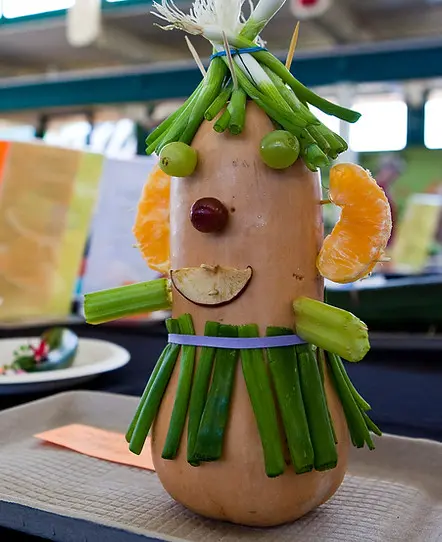
The gates open at eleven in the morning. On opening day, Grange Day, children ten and under get in free between eleven and one if they bring a dressed-up fruit or vegetable. The 2027 fair runs July 21 through 25 on the Lane County Fairgrounds at 796 W. 13th Avenue, under the management of the Lane Events Center. The grounds stay open until eleven at night Wednesday through Saturday and close at eight on Sunday. Cars enter the public lots at 13th and Jefferson. The Lane County Mounted Posse and Search and Rescue run the lots as a fundraiser and charge $10 a car. Four Lane Transit District routes, the 33, 36, 41, and 43, run from the downtown Eugene station to two stops just outside the grounds. A clear bag policy is in effect at the gates.
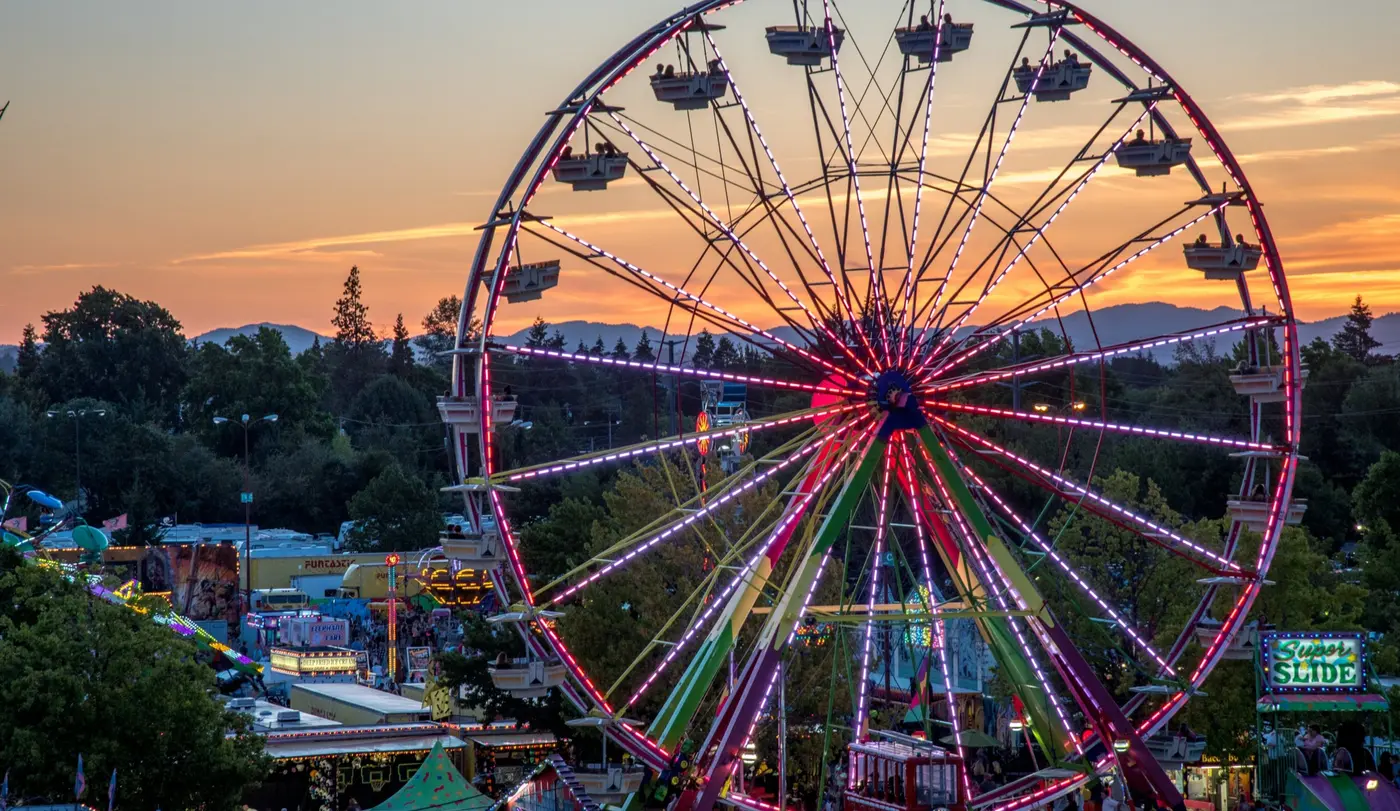
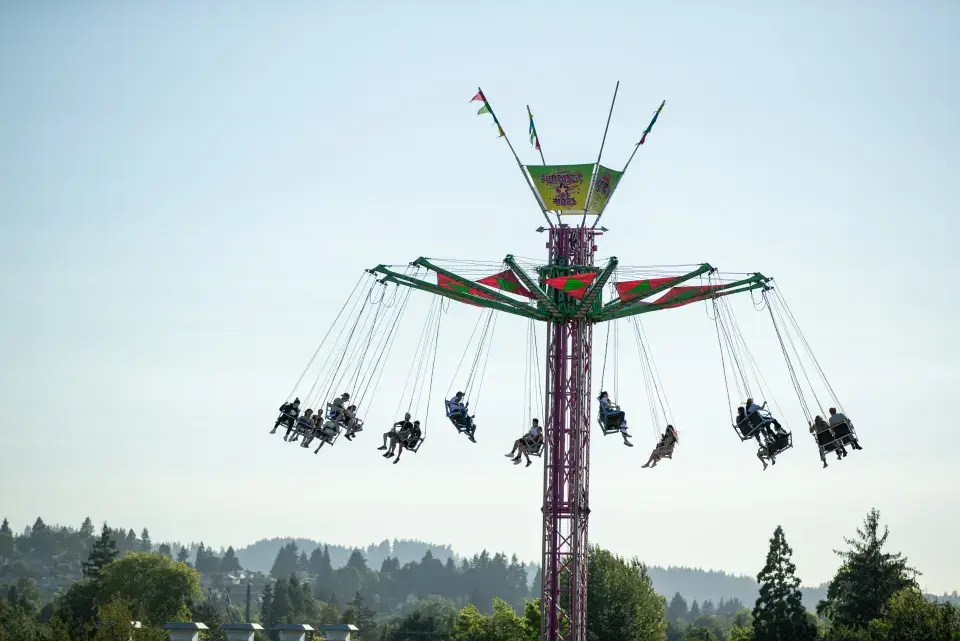
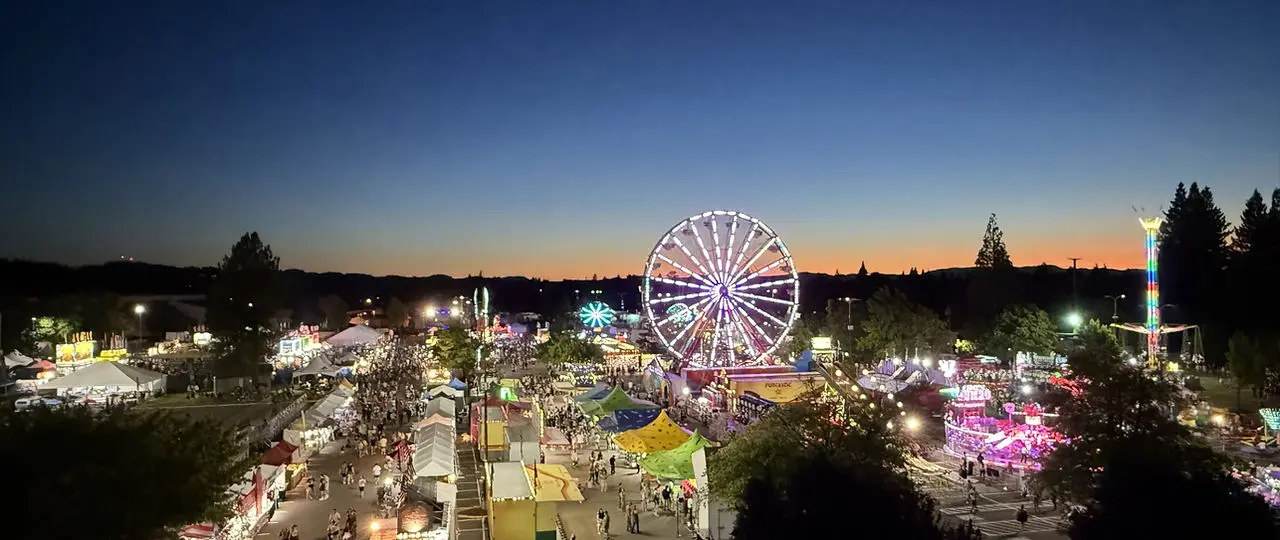
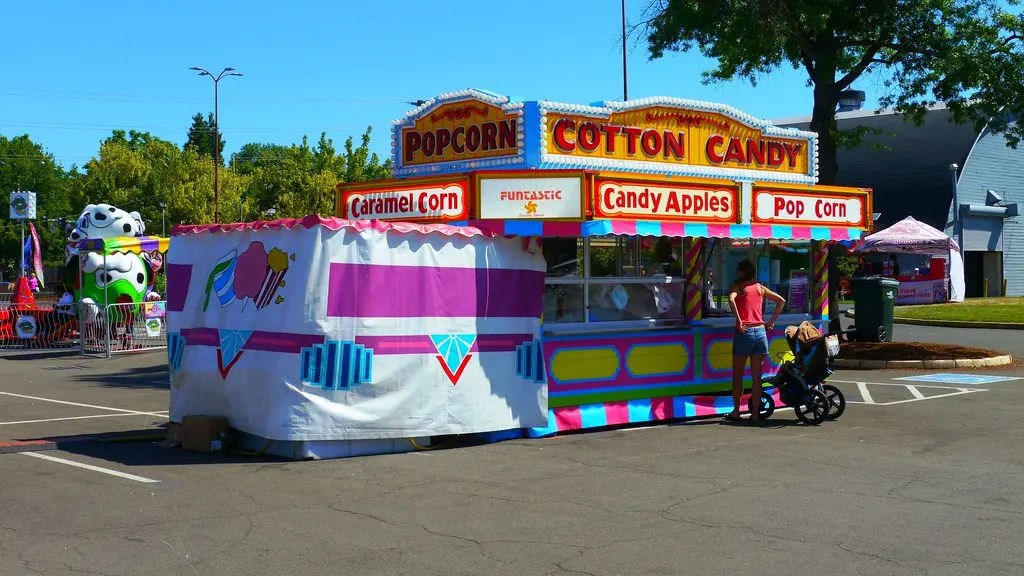
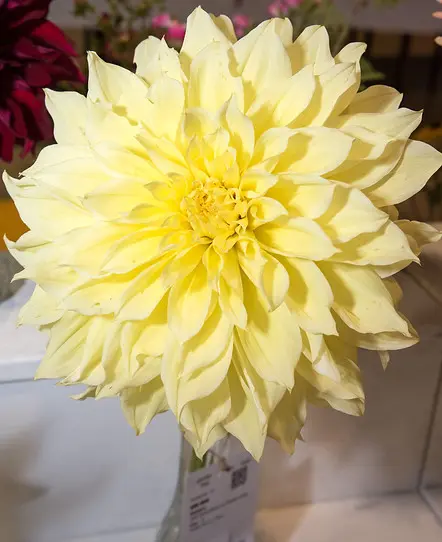
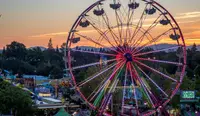
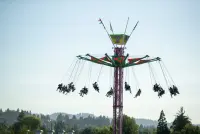
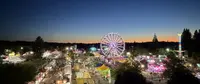
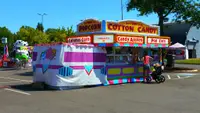
Inside, the carnival has every kind of ride, and a large Ferris wheel looks out over the fairgrounds and the city. Food Row sells elephant ears, cotton candy, barbecue, funnel cakes, corn dogs, deep-fried creations, and a good deal of ice cream. The Lane County 4-H and FFA exhibitors fill the animal barns in the Expo Halls with small animals, poultry, sheep, goats, swine, and cattle. The barns stay open until 9:30 at night except on Sunday, when they close at six. Horses are shown in the Livestock Building. The creative halls hold judged entries in art, photography, textiles, floral work, food preservation, baking and candy, and land products, along with displays from the county’s granges.
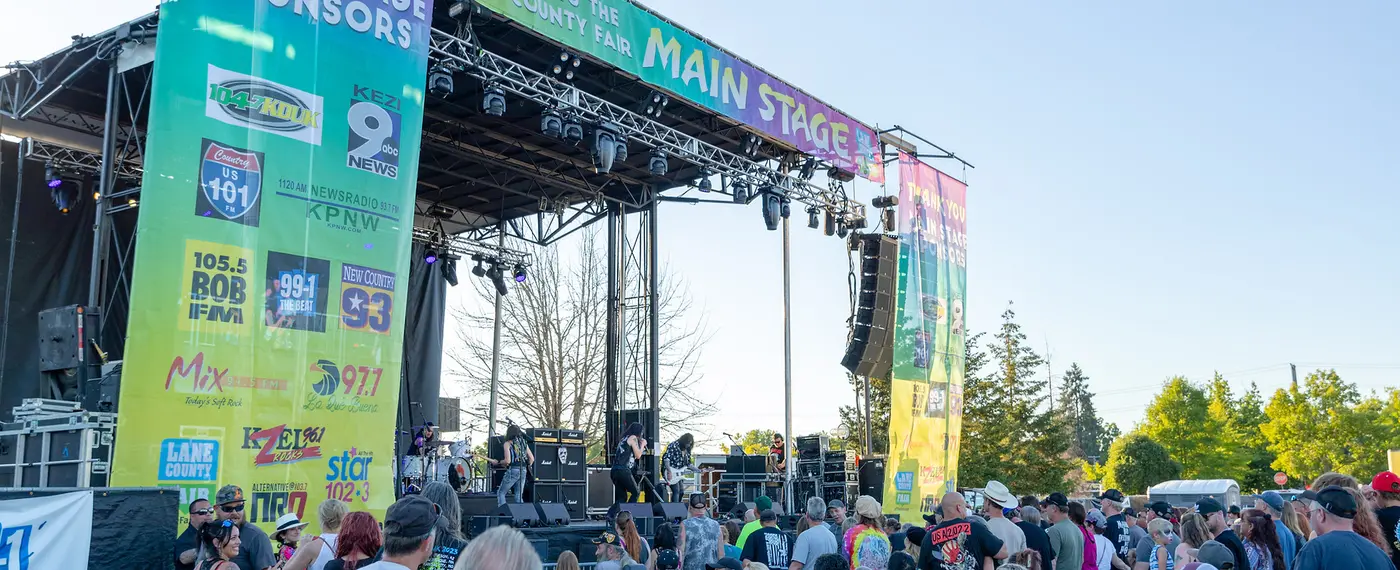
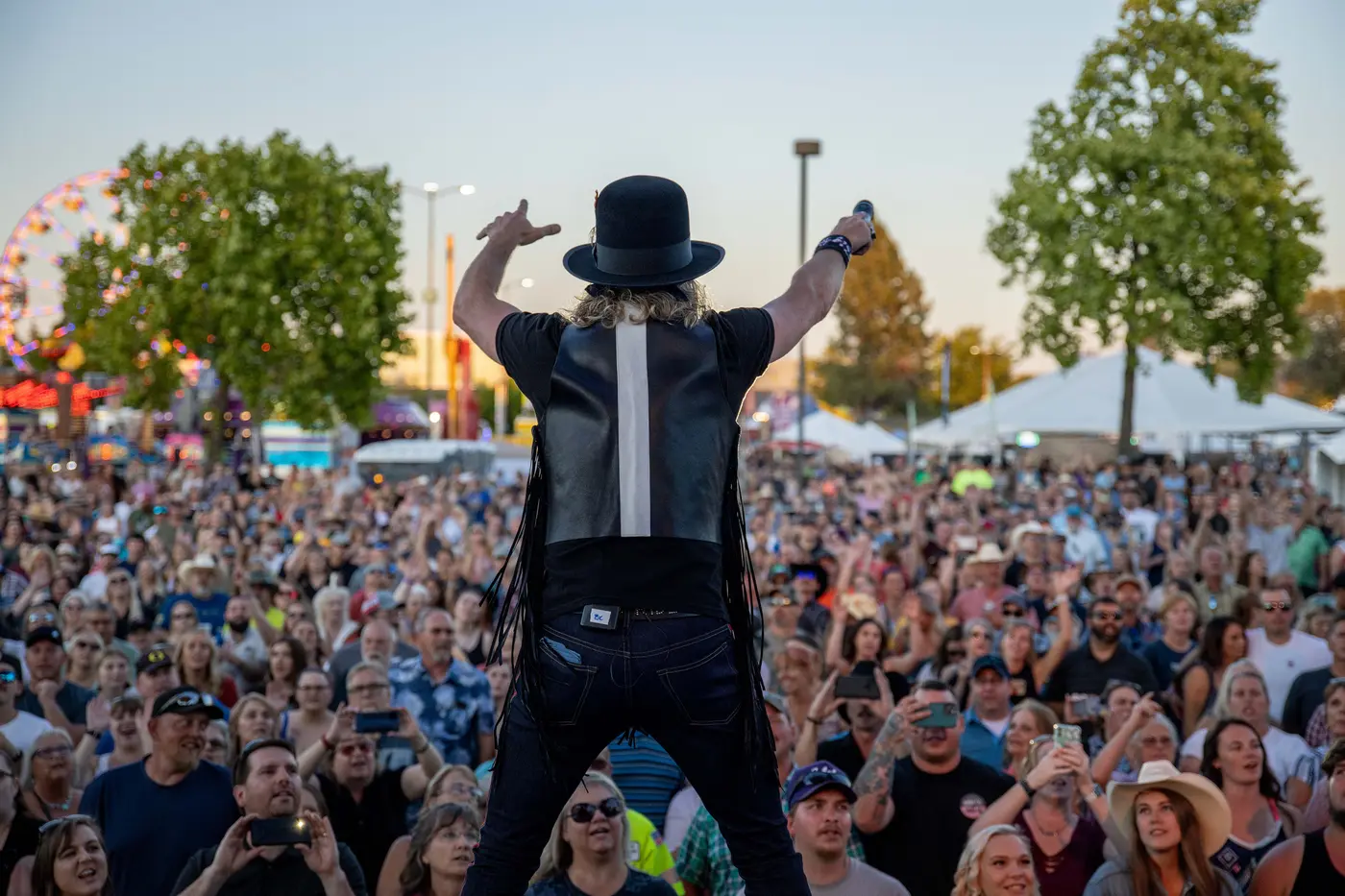
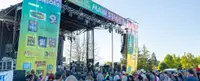
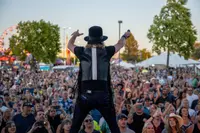
Music runs from midday to night. During the 2026 fair, the Community Stage carried acoustic singer-songwriters and local rock, blues, and country acts every afternoon, free with gate admission. The main stage that year opened on Wednesday, July 22, with the Challenge of Champions Bull Riding Tour, followed by Ned LeDoux. Rome from Sublime with Rome played Thursday, Blue Öyster Cult Friday, and Justin Moore Saturday, and Lecrae closed the fair on Sunday. The 2027 lineup is to be announced in the spring of 2027, and a concert ticket also admits its holder to the fair. Touring acts have played these grounds since at least 1968, according to the Lane County Music History Project, in halls whose posters have called them the Lane Auditorium, the Lane County Civic Center, and the Lane Expo Center. The project lists the Porter Wagoner Show with Dolly Parton on February 14, 1972, and notes that she wrote the song “Eugene, Oregon” after that concert.
Each day of the fair carries its own occasion. On Thursday, guests 65 and older gather in the Auditorium from eleven to two for the Senior Social, with desserts and ice cream served while supplies last. Seniors, first responders, and military personnel pay $4 at the gate that day. On Sunday, anyone who brings three non-perishable food items for Food for Lane County gets in free between eleven and three. During the 2026 fair, the Lane County History Museum next door, at 740 W. 13th Avenue, kept its doors open from eleven to five, Wednesday through Saturday.
A summer without a fair
In May 2020, KLCC reported that the annual event would not take place that year, the first such year since the fair started in the 1800s. The cause was Governor Kate Brown’s prohibition on large gatherings through September, imposed to slow the spread of COVID-19. The fair had been scheduled for July 22 through 26. Rachael Bivens, marketing manager for the Lane Events Center, told the station that safety came first, but that it was devastating to cancel an event families looked forward to every summer and many vendors depended on for income.
The fair returned July 21 through 25, 2021. “Our goal is to make it look almost as it would in any other year,” Rachel Bivens, then the fair’s marketing and assistant manager, told KLCC. She also said: “For us, it is the largest event we hold each year. A lot of people who participate in the fair, this is their business, this is their livelihoods.”
Shootings occurred at the fair in both 2021 and 2023, injuring one or more fairgoers. In one of the two, an uninvolved bystander was struck by a bullet and taken to the hospital. For the 2024 fair, Eugene police and the Lane County Sheriff’s Office added officers, and the gates got a clear bag policy and metal detectors. “We just want to ensure that actions don’t happen again this year,” said Eugene Police Captain Roy Wright.
Rhinehart’s pavilion at Ninth and Oak
The fair’s start in the 1800s has more than one date. Olga Freeman, a former Lane County treasurer and clerk, wrote the fair’s early history for the Lane County Historian in 1971. She noted that the 1884 fair is usually considered the first Lane County fair, though others had been held much earlier. A Lane County Agricultural Society formed in September 1858, and on October 9 it held an exhibition of fruits, grains, and livestock in Eugene. Its fair of October 11 and 12, 1859, drew 44 exhibitors, who were awarded 71 premiums. George Belshaw led the winners with seven. John Whiteaker, described as a practical farmer and newly installed as the first governor of the state of Oregon, gave the main address. By Freeman’s count, it was the sixth fair held in the state. The society held another fair on October 9 and 10, 1861, and then, apparently, none until 1884.
On Thursday, September 25, 1884, the society’s officers waited nervously to see whether the public would come. J. B. Rhinehart had added two halls to a former paint shop at Ninth and Oak Streets. The result was a 50-by-100-foot pavilion for farm products, handiwork, baked goods, and machinery, lit by newly installed electric lamps. Livestock stood on the north and east sides of the public square, and Cole’s Circus played all three days. A thousand entries were in place on opening morning, and twice as many by evening. They included a squash weighing 145 pounds and a Clydesdale mare, owned by O. P. Adams of Linn County, with a mane over seven feet long. Belshaw showed the cereal grains and wheat from his farm four miles west of Eugene, which had won gold medals at the 1876 Philadelphia Centennial Exposition and at Paris. Men paid 75 cents to get in, women 25. The second day was reported as “a beautiful day, the sky overhead clear and the sun shining brilliantly, but not hot.” The city band played each night. The Oregon and California Railroad offered round-trip fares 60 percent below regular rates: 25 cents from Springfield and a dollar from Cottage Grove.
The society then incorporated and sold stock. At the 1885 fair, 5,000 people watched the Saturday parade of stock, and bicycle races drew riders from across the state. The Eugene City Guard recorded the trouble too. A lunch stand collapsed under its own weight. A young man accidentally fired his pistol and shot off part of his boot heel. Tin-horn gamblers were numerous, and William Sheldon’s house was burglarized of a silver watch while the family was at the fair. In 1887, young women sang and played the pianos and organs of a Salem dealer, a glassblower worked before a crowd, and a fight at the races ended with seven people arrested and fined.
The 1888 fair was judged a success. It was also the last of the run. Freeman found that no Lane County fairs were held from 1889 to 1904, and again from 1905 to 1908, and that “no adequate explanation is readily apparent.” She pointed to the Rhinehart buildings, which had been converted to stores and a theater. She also pointed to an 1893 act of the legislature creating district agricultural societies. The county society disbanded in 1895. In 1897, S. Meriau offered his park, track, and pavilion for a county fair in return for ten percent of the gate, and there is no record that anyone took him up on it. In 1902, the town’s merchants held a street fair and carnival in the park blocks, opened with the crowning of Queen Marie Masterson.
The Huddleston ground
In 1908, Alten Hampton, Henry Hollenback, and David Linn incorporated a new Lane County Agricultural Society. Money from its stock sale bought the present fairgrounds from Samantha A. Huddleston and paid for a pavilion and grandstands. The Second District fair opened there on September 8, 1909. The new society held its own first fair September 21 through 24, 1910, with Jack Rodman as president and M. S. Wallis as secretary. In 1923, the society sold the grounds to Lane County for $20,000.
A September 1950 issue of the Cottage Grove Sentinel shows the fair from the county’s side. Neighbors from Dorena helped at the Dorena Grange food booth. Frank and Mrs. Gray showed 42 head of registered Aberdeen-Angus cattle and brought home eleven ribbons, among them a grand champion on a heifer. Kathleen Gillispie took a blue ribbon for her freezing and a red for her cake. Jeanne Voss and Thora Seaver, 4-H girls, stayed at the fair all week to care for their calves. Jeanne’s calf won a blue ribbon and Thora’s a red, and on Saturday night Thora walked in the fashion parade and won a red ribbon for her dress.
Notable Events
- 1859The fair on October 11 and 12 drew 44 individual exhibitors and awarded 71 premiums. ir.library.oregonstate.edu
- 1861The Lane County Agricultural Society held a fair October 9 and 10; the source says apparently no more fairs were held until 1884. ir.library.oregonstate.edu
- 1884The Lane County Agricultural Society sponsored a three-day fair beginning September 25. ir.library.oregonstate.edu
- 1908Alten Hampton, Henry Hollenback, and David Linn incorporated the Lane County Agricultural Society; stock-sale money enabled it to acquire the present fairgrounds from Samantha A. Huddleston. ir.library.oregonstate.edu
- 1909Stock-sale receipts financed a pavilion and grandstands, and the Second District fair opened at the present fairgrounds September 8. ir.library.oregonstate.edu
- 1910The board set September 21-24 for the first fair held by the newly incorporated Lane County Agricultural Society. ir.library.oregonstate.edu
- 1923The Lane County Agricultural Society sold its fairground holdings to Lane County for $20,000. ir.library.oregonstate.edu
- 2020The return report says COVID-19 canceled the previous year's fair. klcc.org
- 2021A shooting injured one or more fairgoers; the retrospective also describes a later shooting and a bystander injury without identifying which incident. klcc.org
- KLCC called this the first time the annual event would not take place since it started in the 1800s. klcc.org
- A clear bag policy and entrance metal detectors were to be in effect. klcc.org
People
- Alten Hampton, Incorporator of the Lane County Agricultural Society (1908).
- Avery A. Smith, President of the Lane County Agricultural Society.
- David Linn, Incorporator of the Lane County Agricultural Society (1908).
- George Belshaw, President of the new fair association.
- Henry Hollenback, Incorporator of the Lane County Agricultural Society (1908).
- J. B. Rhinehart, Expanded the building at Ninth and Oak with two halls and provided the pavilion used for fair exhibits.
- J. S. Churchill, Secretary of the new fair association.
- Jack Rodman, President of the fair association (1910).
- M. S. Wallis, Secretary of the fair association (1910).
- Samantha A. Huddleston, Owner from whom the society acquired the present fairgrounds.
- Kate Brown, Governor whose large-gathering prohibition prompted the fair cancellation.
- Rachael Bivens, Lane Events Center Marketing manager describing the cancellation's effects.
- Rachel Bivens, Lane County Fair marketing manager and assistant manager explaining the decision to bring the event back.
- Roy Wright, Eugene Police Captain describing increased fair law-enforcement presence.
Sources
- atthefair.com
- atthefair.com/concerts
- atthefair.com/livestock-exhibits
- atthefair.com/creative-exhibits
- laneeventscenter.org/event/lane-county-fair
- eugenecascadescoast.org/event/lane-county-fair/50601
- flickr.com/photos/discoveroregon/48399342822
- atthefair.com/dates-and-times
- atthefair.com/tickets-and-deals
- atthefair.com/parking-and-transportation
- facebook.com/LaneCountyFair
- lchm.org/event/lane-county-fair
- ir.library.oregonstate.edu/downloads/n296wz24d
- oregonnews.uoregon.edu/lccn/2019260070/1950-09-28/ed-1/seq-16/ocr
- lanemusichistory.com/lane-county-fair-grounds