Fort Umpqua Days
Elkton, Douglas County, Oregon. Festival.
Details

- Where
- 15850 State Highway 38 W, Elkton, OR 15850. Directions
- When
- Saturday and Sunday, September 5th and 6th.
- Fees
- Free.
- Hours
- 9:00 a.m. to 4:00 p.m. each day.
- Access
- The Echoes of the Umpqua Pageant takes place at 5:00 p.m., after the 4:00 p.m. festival close.
- Managed by
- Elkton Community Education Center.
Saturday of Labor Day weekend in Elkton begins with an outdoor pancake breakfast on the grounds of the Elkton Community Education Center, on State Highway 38 along the east bank of the Umpqua River. After breakfast the crowd goes downtown for the candy parade, which marches along the river. In 2026 it started at 10 a.m. as the “Celebrating the 250th Anniversary of the USA” Parade. Then people return to the center for the rest of Fort Umpqua Days, two days given to a fur-trading post that stood a short way upriver from here in the 1830s, 1840s, and early 1850s.
Pie, raffles, and chicken bingo
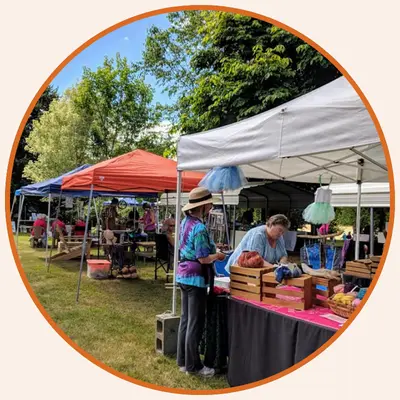
The festival fills the center’s 43-acre site by the river. The site holds a butterfly pavilion, a native plant park and nursery, market gardens, trails, a café, and a stockade fort reached by a walking path or a driveway. Local artisans set up booths under the birch trees. A wine and beer garden pours beside them, and live music runs through both days. The 2026 program put chicken bingo and the band Cover Culture at 1 p.m. Saturday, with the pie auction that afternoon. Sunday morning opened with the Thomas Batterman Mental Health Project 5K, followed by sets from Vine Katz and Elk Creek Ramble and another round of chicken bingo.
Local groups and the center run raffles during the festival: boats, class fundraiser baskets, a contest to guess the weight of a squash. Visitors can also take part in honorary butterfly adoptions. When the program was newer, the News-Review reported in 2017 that a family paid $20, named its butterfly, and released it into the wild, where a tag tracked where it went.
Admission to the 2026 festival was free. The grounds were open from 9 a.m. to 4 p.m. each day, and at 5 p.m. the community staged the Echoes of the Umpqua Pageant. Deb Gritton, the center’s executive director, said before the 2026 festival: “Whether visitors come for the living history, the music, the butterfly habitat, or simply to enjoy a great weekend with family and friends, we hope they leave with a deeper appreciation for this community and the stories that helped shape it.” The 2026 edition ran as planned, and afterward the center said it was already looking forward to the next.
Johnnycakes inside the stockade
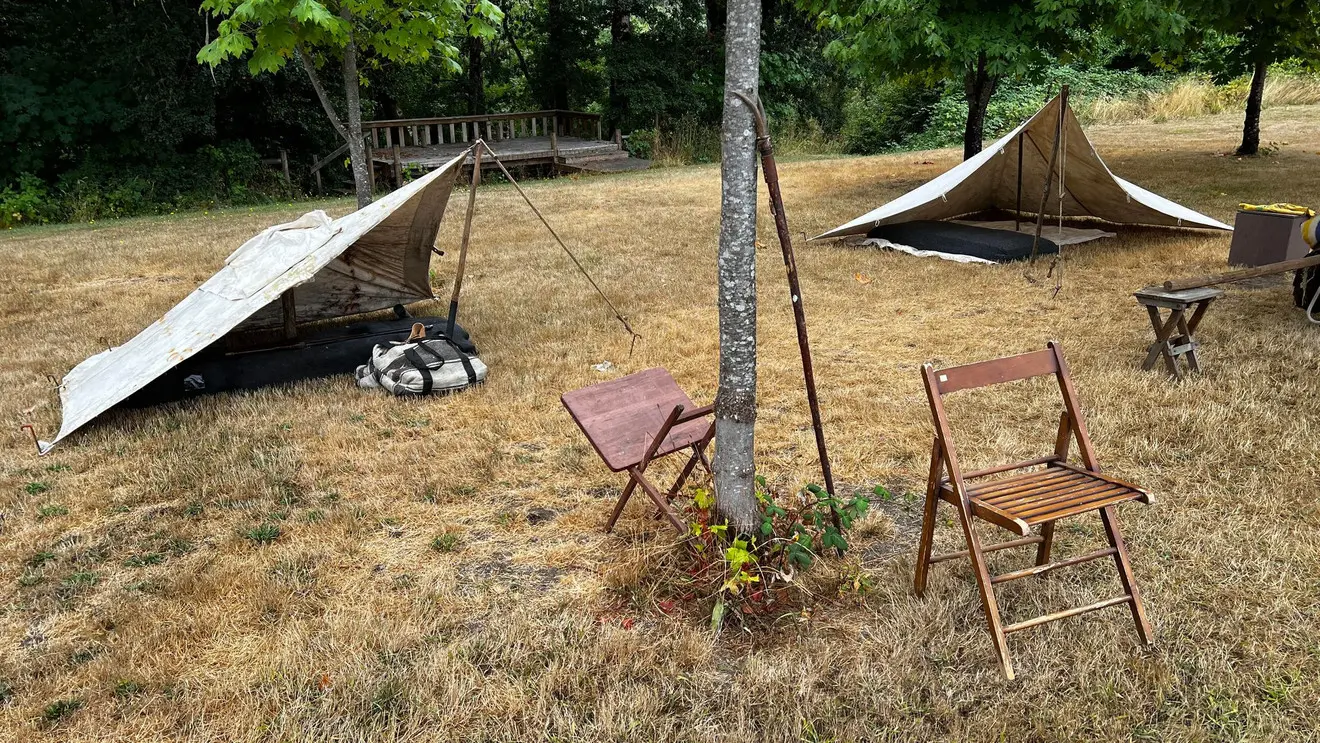
The fort is at the center of the weekend. Volunteer interpreters work it as the Hudson’s Bay Company post of 1836 through 1851, with blacksmithing, woodworking, traditional crafts, and living-history demonstrations. On a Saturday of hot weather and smoky air in 2017, the News-Review student reporter Haylie Ellison found re-enactors and center staff in period clothing spinning and dyeing yarn, weaving, grinding corn, and frying cornmeal johnnycakes. David Walp, who portrayed a fur trader, told her: “It is really neat to be able to educate people and watch them light up.”
Children that year earned a stamp at each hands-on station. Six stamps got them a bag of handmade marbles or arrowheads. Ali Timm, 7, of Fall Creek, watered the garden with a bucket and a water pump and said she liked “learning more about how they gardened” in the 1800s. Outside the walls were vendor booths, wine tasting, a gift shop, a quilt display, and a produce stand run by local high school students. The festival’s proceeds fund the center, and the paper reported that the previous year’s festival had raised $12,000.
Native history has a place in the program too. In 2023, Marjory Hamann, then the center’s executive director, told KPIC: “There are people demonstrating the life of fur trappers, people who traded with the Hudson’s Bay Company, and we also have educators from the Cow Creek Band of Umpqua Tribe of Indians coming to show folks what the Native American lifestyle was like during that time period.” The center states that the site lies within the traditional homelands of the Komemma Kalapuya. It also says Yoncalla, Kalapuya, Umpqua, Lower Umpqua, Coos, Tututni, and Siuslaw people all spent time, traveled, and traded here.
A sheep field and a fort without blueprints
The center began in 1999, when Carol Beckley, a retired teacher and longtime Elkton resident, bought a small sheep field and invited her neighbors to imagine what it could become. The center gives Elkton’s population as 170 and its own volunteer count as 115.
Volunteers built the fort over several years, and the sources give its progress differently. The Oregon Encyclopedia says the center completed the replica in 2009. In 2012, John Sowell of the News-Review described volunteers who had worked over the past decade to replicate the fort. By then a guard tower, a trading post building, and the stockade were finished, and a second building was nearly done. The center’s own photographs show the barracks roof going on in 2011. Sowell wrote that no blueprints were ever found, and that Elkton resident Don Guentner visited several other Hudson’s Bay forts and studied their plans for ideas. The center describes the finished complex of stockade walls, trade building, men’s quarters, and blacksmith’s shed as based on the original fort design.
The festival’s age is counted two ways in the News-Review. The paper called the 2017 celebration the 15th, and the 2019 celebration the 20th. The 2019 festival marked that 20th year with a Saturday birthday dinner and a concert by the Slow Ponies in place of the usual pageant. That year the Lion’s Club cooked pancakes both mornings, the parade ran on River Drive, a barbecue lunch came with live music, vintage bicycles were on display, and the bass tournament took a year off.
Gagnier’s post at the bend of the river
The Oregon Encyclopedia, a project of the Oregon Historical Society, credits Jean Baptiste Gagnier, a 34-year-old French Canadian, with locating Fort Umpqua. He chose a broad, flat terrace at a sweeping westward bend of the Umpqua, on the west bank a short distance upstream from the mouth of Elk River, where Elkton now stands. The land was used mainly by the Yoncalla band of Kalapuya, with Lower Umpqua people visiting from downstream. Most sources give 1836 as the founding year. A Schwemm Family Foundation page puts it around 1832.
It was the company’s farthest south post. A roadside marker calls Gagnier and his family the first residents of Douglas County, and the encyclopedia calls the fort the first non-Native year-round settlement in southern Oregon. Ordered to make the post as self-sufficient as possible, Gagnier raised wheat and corn, melons, onions, and potatoes, and planted an apple orchard. In 1841 U.S. Navy Lt. Henry Emmons estimated 80 acres of cropland and over 2,000 feet of rail fence. Fenced native-grass pasture fed the horse herd that supplied fresh mounts to the company’s annual Southern party, led by Michel Laframboise and others, which trapped for beaver south into central California. The men also raised cattle and hogs. They were French Canadians, Métis, Hawaiians, local Natives, Iroquois, and Scots, and they rarely numbered more than a dozen.
Lt. George Emmons drew the fort in 1841 and described a “picketed enclosure something like [Fort] Vancouver.” By his plan it measured 200 by 150 feet, with twelve-foot log pickets and bastions with gun ports on two opposite corners. The marker gives the stockade as twelve feet high and ninety feet square, with bastions at diagonal corners. Inside were a storehouse for furs and supplies, a house for the post master, and quarters for the employees. Outside the walls, the marker says, stood a barn, a stable, and a few apple trees.
Relations with Native people were mostly peaceful, according to the encyclopedia. In 1838, HBC Factor James Douglas wrote that some Lower Umpqua began to “menace the post…with destruction.” He sent “Mr. Thomas McKay and six good men” from Fort Vancouver to “tranquilize the Natives.” McKay apparently did so without violence, and the next year Douglas called the Natives at the fort “quiet and well disposed.” In 1841, Native deaths from smallpox, likely brought by white travelers, led to threats against the post’s employees. The marker says the fort was twice besieged.
By the early 1840s the Umpqua, Rogue, Klamath, and Sacramento watersheds were trapped out, and the Southern party’s forays soon ended. In 1850 the captain of the American trading vessel Samuel Roberts reported that “there was formerly a brisk business carried on here…but at present it doesn’t amount to much.” The encyclopedia records that most of the fort burned in November 1851. A few company men stayed until 1853, and the company then leased the land to American settlers who ran cattle on the terrace. The marker says the gold rush and the donation land laws ended the Indian trade and that the post was abandoned in 1852. The center’s account names flooding, isolation, and shifting trade routes as the causes of its closure. The center’s account also notes that control of the Oregon Territory was for a time undecided between Britain and the United States, and that the company’s influence in the valley was such that the region very nearly became British.
After the land was sold, the Henry Beckley family owned and farmed the fort site for many years. Its approximate location is known but has not been verified by archaeological investigation, and it is not open to the public. A marker stands in a pull-out on the east side of Route 138, south of Mehl Creek Road. It begins: “On the west bank and upstream is the site of Fort Umpqua.”
Notable Events
- 1836Fort Umpqua, the farthest south of the company's posts, operated between 1836 and the early 1850s on the Umpqua River in present-day Douglas County. oregonencyclopedia.org
- 1838HBC Factor James Douglas wrote that some Lower Umpqua began to menace the post with destruction. oregonencyclopedia.org
- 1840sThe watersheds of the Umpqua, Rogue, Klamath and Sacramento rivers had become trapped out, and annual Southern party forays soon ended. oregonencyclopedia.org
- 1841U.S. Navy Lt. George Emmons drew a plan of Fort Umpqua, describing a picketed enclosure something like Fort Vancouver. oregonencyclopedia.org
- 1841Native deaths from smallpox, likely brought by white travelers, caused threats against the post's employees. oregonencyclopedia.org
- 1851Most of the fort burned, but a few HBC men remained there until 1853; the Company then leased the land to American settlers. oregonencyclopedia.org
- 1852The gold rush and the donation land laws brought settlers to the Umpqua Valley, ended the profitable Indian trade, and the post was abandoned. hmdb.org
- 1999Carol Beckley purchased a small sheep field and invited neighbors to imagine what it could become; it grew into the Elkton Community Education Center. elktonbutterflies.com
- 2009The Elkton Community Education Center completed a replica of Fort Umpqua on the east bank of the Umpqua River on Highway 38. oregonencyclopedia.org
People
- Carol Beckley, longtime Elkton resident and retired teacher whose idea began the Elkton Community Education Center.
- Marjory Hamann, ECEC Executive Director.
- Deb Gritton, Elkton Community Education Center Executive Director.
- Ali Timm, Fall Creek child visitor who enjoyed learning about gardening at the festival.
- David Walp, Re-enactor representing a fur trader at Fort Umpqua Days.
- Hannah Sperandio, ECEC events coordinator quoted about Fort Umpqua Days.
- Heather Whitman, Elkton resident quoted on the festival's educational value.
- Don Guentner, Elkton resident who visited other Hudson's Bay forts and viewed their plans to gather ideas for the replica.
- George Emmons, U.S. Navy lieutenant who drew a plan of Fort Umpqua (1841).
- Henry Beckley, his family owned and farmed the fort site for many years.
- Henry Emmons, U.S. Navy lieutenant who estimated Fort Umpqua's cropland and rail fence (1841).
- James Douglas, HBC Factor who wrote of threats to the post (1838).
- Jean Baptiste Gagnier, located Fort Umpqua; post master for much of its existence.
- Michel Laframboise, HBC fur trader who led Southern-party brigades supplied with fresh mounts by the fort.
- Thomas McKay, sent from Fort Vancouver with six good men to tranquilize the Natives (1838).
Sources
- elktonbutterflies.com/event/fort-umpqua-days
- facebook.com/Elkton-Community-Education-Center-108772282530480
- oregontic.com/oregon-historical-markers/umpqua-southern-oregon-region
- oregonencyclopedia.org/articles/fort_umpqua
- hmdb.org/m.asp?m=113337
- nrtoday.com/news/fort-umpqua-days-preserves-elktons-history/article_61fe6401-e564-5629-aaaa-4fc402e63570.html
- elktonbutterflies.com/fort-umpqua