


Cottage Grove Covered Bridge Tour Route
Cottage Grove, Lane County, Oregon. Covered bridge tour route (for motor vehicles); Year-round.
Details

- Where
- City of, 400 E. Main Street, Cottage Grove, OR 97424. Directions
- When
- Driving time 1-2 hours.
- Getting there
- Your bridge tour begins along Row River Road, traveling east from I-5 exit 174.
- Access
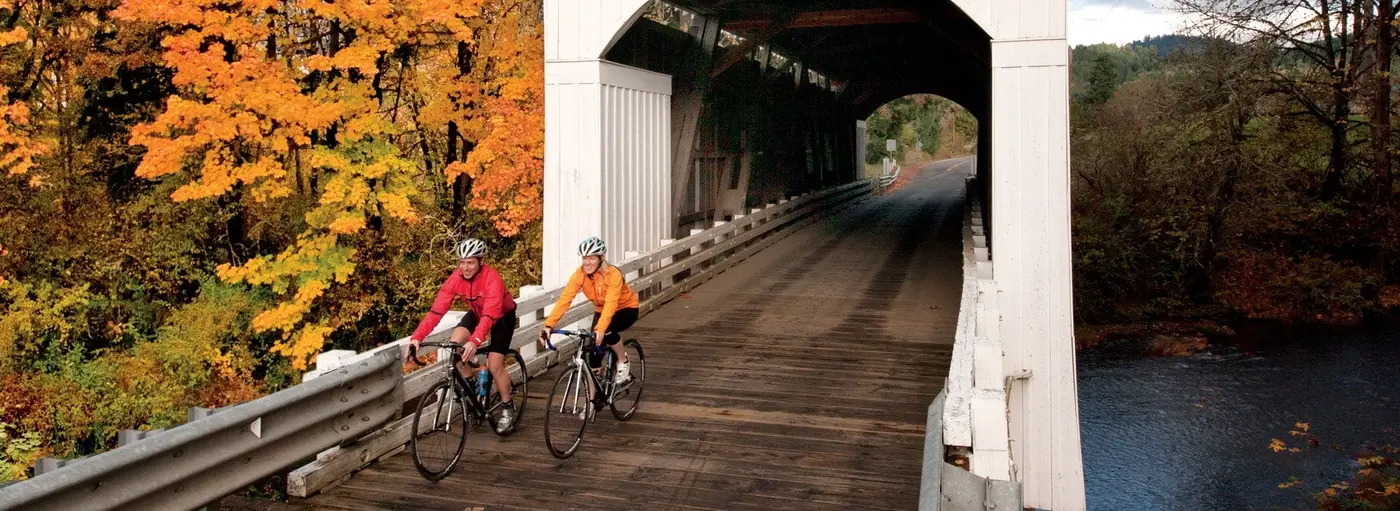
- Most are open to bicycles and pedestrians; some still handle vehicle traffic.
- Phone
- (541) 942-5501
- Website
- cottagegroveor.gov
Layng Road runs straight through the Mosby Creek Bridge. The span is 90 feet long, was built in 1920 and restored in 1990, and its single lane still carries cars in both directions. Of the six bridges on the Cottage Grove tour, it is the only one the city lists as open to traffic. It is also Lane County’s oldest covered bridge. The portals are semi-circular arches, and a ribbon of openings runs near the roof line on each side. The chamber of commerce describes the outside as board-and-batten. Restrooms are at the Mosby Creek Bridge area, at Dorena Bridge, and in town.
Four bridges east of town
Travel Oregon gives the Cottage Grove Covered Bridge Tour Route as 20 miles and one to two hours of driving, good the year round. Travel Lane County calls it an approximately 30-mile loop through town and around Dorena Reservoir, with picnic sites along the way. Travel Oregon’s version starts on Row River Road, heading east from I-5 exit 174. Travel Lane County’s starts in the historic downtown and runs the other way. For much of the distance the road keeps company with the Row River Trail, 16 miles of pavement that forms part of the Covered Bridges Scenic Bikeway. In 2015 that bikeway became Oregon’s first designated scenic bikeway. The full ride is about 36 miles, of moderate difficulty, with flat, smooth stretches.
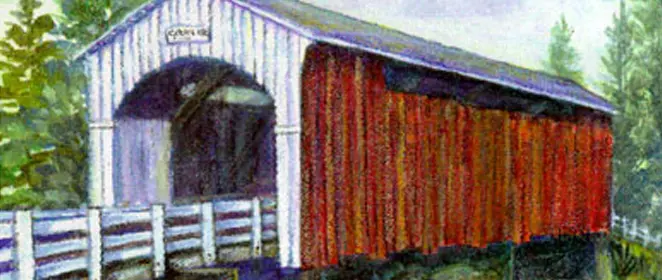
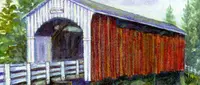
Going east, the first bridge is Currin, which spans the Row River at Layng Road. It is Lane County’s only two-tone bridge, with white portals and barn-red sides. Built in 1925 and restored in 1995, it carries the name of a local pioneer family. It replaced an earlier covered bridge of 1883, which the city credits to Nels Roney, a prominent local bridge builder. According to the county’s 2003 brochure, Roney and A.S. Miller & Sons competed for contracts to build the very first bridges in Lane County. That brochure gives Currin a span of 105 feet. The Cottage Grove Historical Society gives 60.
From Currin the road and the trail wind southeast along the undulating shore of Dorena Lake. Dorena Bridge stands at the far end, 105 feet across the Row River. It was built in 1949, after Dorena Dam formed the lake. Its name comes from the town of Dorena, which the water covered when the reservoir was completed that year. The bridge, also called the Star Bridge, once tied together the roads on the north and south sides of the lake. It was rehabilitated with new windows in 1996 and is closed to traffic now. It serves as a rest area and, the city says, a popular place for weddings.
The route swings back west on Shoreview Drive and Garoutte Road to Stewart Bridge, 60 feet across Mosby Creek, built in 1930 and restored in 1996. It has semi-circular portal arches, ribbon openings at the eaves, and decorative S-curve brackets. The city and the chamber both say the deep water beneath it is considered one of the best swimming holes in the county. A mile north on Mosby Creek Road is the Mosby Creek Bridge. Past it the road runs west beside the trail and becomes Main Street at the edge of downtown.
Flaggers on Layng and Garoutte roads
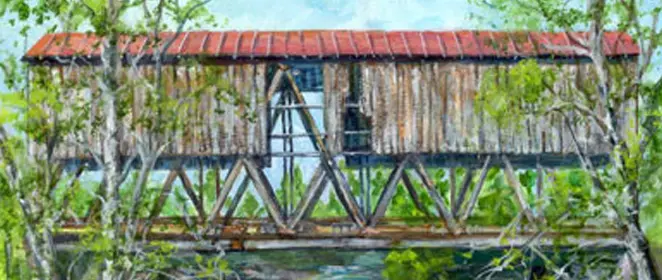
Currin and Stewart now stand beside the road. Both have been closed to vehicles for many years and are bypassed by concrete bridges. In 2026 both are closed to people on foot as well. In March 2026, Lookout Eugene-Springfield reported posted signs at each bridge warning sightseers not to walk or climb on them. The spans that once joined each bridge to the ground had been removed, leaving a gap.
Lane County keeps 20 covered bridges, more than any other county west of the Mississippi. A 1915 editorial in a Eugene newspaper, quoted in the county brochure, held that “Lane County is convinced that wooden bridges properly built will last as long as steel and they know the cost is much less.” Upkeep is the county’s problem now. “They’re in pretty poor shape, and that’s because it’s been about 40 years since any significant repairs have been made,” Brett Henry, Lane County’s parks manager, told Lookout.
Neither bridge sits on a road in use, so neither qualifies for county road money. County commissioners voted 3–2 to spend up to $500,000 of lodging tax revenue on the two. Commissioners Pat Farr and David Loveall opposed it, citing the budget, and Loveall noted that the county would still have 18 covered bridges if those two came down. Henry put preliminary estimates at $500,000 to $5 million. “The goal is for the bridge not to collapse, because if it collapses, then we’re looking at remediation and decommissioning,” he said. At the end of September 2026, Lane County Parks announced stabilization work on both bridges through December 31, 2026, on weekdays. One lane of Layng Road and one lane of Garoutte Road may be closed at times, with flaggers directing traffic.
Two footbridges on the Coast Fork
Downtown, at the corner of Main Street and River Road beside City Hall, Centennial Bridge is open to pedestrians only. It is 84 feet long, a timber through Howe truss. Volunteers built it from timbers of dismantled county bridges, two of them according to the city and Travel Oregon. It rests on the abutments of the old Main Street Bridge, which stood until the 1950s, and it marks the city’s centennial. The historical society, the county, and Travel Oregon date it to 1987. The city and the chamber give 1997. Alonzo “DeRoss” Kinkade, a Cottage Grove insurance man and twice president of the Lions Club, was instrumental in its construction, according to his 2025 obituary in the Cottage Grove Sentinel. The chamber named him First Citizen in 1987.
A half-mile upstream, the Swinging Bridge carries foot and bicycle traffic. It was used mostly by children crossing the Coast Fork to get to school. The present bridge is at least the fourth on the site. Earlier versions could be made to swing side to side, which gave it its name.
The Chambers logging spur
Half a mile south on River Road, at Harrison, stands Chambers Bridge. It is a single Howe truss span across the Coast Fork, 78 feet long and 24 feet wide. Like other railroad spans, it stands taller from deck to roof than the highway bridges. The Sentinel reports that it carried engines of up to 100 tons, and that the locomotive’s stack was custom made to fit inside. The city calls it the only remaining covered railroad bridge in Oregon and believes it to be the only one west of the Mississippi.
Rebuilt for pedestrians, the bridge is the centerpiece of an outdoor interpretive center on local timber production. Looking through it, a visitor can see a metal train-engine play structure in the distance. Sources differ on whether it can be crossed. The chamber says it is open to the public again, and Lookout reported in 2026 that pedestrians and bicyclists use it. The city’s covered-bridges page says it is closed to traffic and pedestrians.
The city, the chamber, and the Sentinel say lumberman J.H. Chambers built it in 1925. The city’s covered-bridges page gives his initials as J.E. Local historian Curt Deathrage, quoted in the Sentinel, says Chambers ran a sawmill on the south side of town, the Lorane Valley Lumber Company, later J.H. Chambers and Son, and a smaller mill in Lorane until his death in 1946. The Oregon Pacific and Eastern Railroad, at one time owned by Chambers, had a spur through the bridge to Lorane. Trains took small logs west to the Lorane mill and hauled back lumber and big logs for the mill in Cottage Grove. That mill burned twice. Warren Daugherty bought and ran both mills for five years until a second fire, in 1951, destroyed most of the Cottage Grove sawmill. What survived went to the W.A. Woodard Lumber Company.
How long the trains ran depends on the source. The chamber and the 2003 county brochure say seven years, until the mill burned. The historical society says seventeen. The city says 1925 to 1951, with the railroad sold for scrap in the 1950s. The bridge’s 1979 National Register nomination carries an attached history that tells it differently again: built in 1936 by the Oregon, Pacific and Eastern for a spur to the Frank Chambers Mill, which burned in 1943.
Round Up for the Bridge
That nomination describes a bridge long abandoned. The western approach had been removed for South River Road. The sides stood so high they nearly hid a rusting metal roof. Arsonists had made it a frequent target, “as charred timbers attest.” It was listed on November 29, 1979. Half-ownership at the time lay with the city and half with Alex Madonna of the Madonna Inn in San Luis Obispo, California.
For half a century the mill property sat vacant. In the 1980s it served as “Bohemia City” during the annual Bohemia Mining Days. In November 2005 the Sentinel reported that Kris Woodard had bought the property from the late Alex Madonna for a mixed-use development that would include the bridge. Hayden Homes later turned the mill site into the River Walk subdivision on Highway 99. The city secured full ownership of the bridge in December 2006. By then it was leaning to the upriver side. The city says it stood only because of the oversized timbers cut to carry steam locomotives, timbers that also added to the cost of restoring it.
In February 2007 the city began Round Up for the Bridge, inviting residents to round up their water and sewer bills for a restoration trust fund. Some added a dollar or two, and the largest round-up was $20. By February 27, 2009, the program had raised $7,790 toward the city’s match for a $1,315,370 grant from the National Historic Covered Bridge Preservation Program. Federal recovery money and Oregon transportation funds followed. In 2010 a high wind nearly brought the bridge down, and the original was removed for safety. Work began that summer and was completed in November 2011.
Stephen Lawn, of the chamber’s tourism committee, lives near the bridge. “I see all the time all the cars with different license plates with different states and people stopping and checking it out,” he told Lookout.
Notable Events
- 1883The earlier Currin covered bridge was constructed in 1883. cghistory.org
- 1920Mosby Creek Bridge was built in 1920, making it Lane County's oldest covered bridge. cghistory.org
- 1925Chambers Bridge was constructed in 1925 to transport logs to a local mill. cghistory.org
- 1925Currin Bridge was built in 1925 to replace an earlier covered bridge constructed in 1883. cghistory.org
- 1925A lumberman built the wood bridge to harvest timberland west of town. cgsentinel.com
- 1930Stewart Bridge was built in 1930. cghistory.org
- 1936The nomination's attached bridge history dates construction to 1936 and identifies it as private. npgallery.nps.gov
- 1943The sawmill served by the Chambers logging spur burned in 1943. npgallery.nps.gov
- 1946Local historian Curt Deathrage says Chambers operated the Lorane sawmill until his death in 1946. cgsentinel.com
- 1949Dorena Bridge was constructed in 1949. cghistory.org
- 1950sCentennial Bridge rests on abutments of the old Main Street Bridge, which stood until the 1950s. cottagegroveor.gov
- 1950sThe railroad was sold for scrap and Chambers Bridge was no longer used. cottagegroveor.gov
- 1951Warren Daugherty operated the two mills for five years until a second fire destroyed most of the Cottage Grove sawmill in 1951. cgsentinel.com
- 1951The city dates the bridge's operation from 1925 to 1951. cottagegroveor.gov
- 1979The Keeper listed Chambers Bridge as part of the Oregon Covered Bridges Thematic Resource, reference number 79002081. npgallery.nps.gov
- 1980sThe abandoned mill property served as the site of Bohemia City during annual Bohemia Mining Days celebrations. cgsentinel.com
- 1987Volunteers constructed Centennial Bridge using dismantled county bridge timbers to commemorate the 100th anniversary of Cottage Grove's founding. cghistory.org
- 1990Mosby Creek Bridge was restored in 1990. cghistory.org
- 1995Currin Bridge was restored in 1995. cghistory.org
- 1996Dorena Bridge was rehabilitated and modified with new windows in 1996. cghistory.org
- 1997Volunteer labor constructed Centennial Bridge in 1997 to celebrate Cottage Grove's centennial, using material from two demolished Lane County bridges. cottagegroveor.gov
- 2005The Sentinel reported Kris Woodard's purchase of the sawmill property on which the bridge stands from the late Alex Madonna of California. cgsentinel.com
- 2006The City of Cottage Grove secured full ownership of the previously privately owned bridge. cottagegroveor.gov
- 2007The city began the program so local citizens could contribute to the restoration project. cottagegroveor.gov
- 2010Restoration using local funding and a National Historic Covered Bridge Restoration Grant began in summer 2010. cgchamber.com
- 2010A high wind nearly collapsed the deteriorated bridge, requiring removal of the original bridge for safety. cgsentinel.com
- 2011With preservation, recovery, transportation and local funding, the bridge was reconstructed for pedestrians as the centerpiece of an outdoor interpretive center about timber production. cgsentinel.com
- 2026Lane County Parks was working to stabilize Currin Covered Bridge and Stewart Covered Bridge. cgsentinel.com
- The society says the bridge was used until the mill burned down seventeen years after construction. cghistory.org
People
- J.H. Chambers, Lumberman who constructed Chambers Bridge to transport logs to his sawmill (1925).
- Alex Madonna, Named as a present owner alongside the City of Cottage Grove in the nomination.
- Curt Deathrage, Local historian quoted on the sawmills served by the bridge.
- Kris Woodard, Purchased the sawmill property containing the bridge, intending mixed-use development that included the historic bridge (purchase reported November 2005).
- Warren Daugherty, Lumberman who purchased and operated the two mills served by the bridge (five years, ending in 1951).
- Alonzo ‘DeRoss’ Kinkade, Instrumental in the construction of Centennial Bridge (December 21, 1939 - January 1, 2025).
- J.E. Chambers, Lumberman who built Chambers Railroad Bridge (1925).
- Nels Roney, Prominent local bridge builder who built the earlier Currin covered bridge (1883).
- William Howe, Creator of the Howe truss design discussed on the Chambers Bridge history page.
- Frank Chambers, Associated with the Frank Chambers Mill in Cottage Grove, the destination of logs carried by the bridge's railroad spur in the attached history.
- Philip Kushlan, Listed contact for the City of Cottage Grove's ownership in the bridge nomination.
Sources
- traveloregon.com/things-to-do/trip-ideas/scenic-drives/cottage-grove-covered-bridge-tour-route
- cottagegroveor.gov/1444/Covered-Bridges
- cgchamber.com/covered-bridge-tour
- lanecountyor.gov/government/county_departments/public_works/historic_covered_bridges_in_lane_county
- eugenecascadescoast.org/blog/post/cottage-grove-covered-bridges
- lookouteugene-springfield.com/story/government-politics/2026/03/02/in-lane-county-covered-bridges-span-the-past-and-present
- cottagegroveor.gov/1445/Chambers-Railroad-Bridge
- npgallery.nps.gov/NRHP/GetAsset/NRHP/79002081_text
- lanecountyor.gov/UserFiles/Servers/Server_3585797/File/Government/County%20Departments/Public%20Works/Historic%20Covered%20Bridges%20In%20Lane%20County/Cov_Br_Bro_03.pdf
- cghistory.org/index.php/history/2-uncategorised/5-covered-bridges
- cgsentinel.com/news/where-we-live-sentinel-of-a-by-gone-era/article_3662647e-f5fd-11ee-bf26-438af3a29a79.html
- cgsentinel.com/news/travel-advisory-bridge-work-east-of-cottage-grove/article_8a9c6775-ee23-43d8-861b-a24bea983cab.html
- cgsentinel.com/obituaries/alonzo-deross-kinkade/article_3ab1b866-d30d-11ef-96a2-eb8affb742af.html