Virginia City
Storey County, Nevada. County seat.
Virginia City, in Storey County, Nevada, grew up on the Comstock Lode, found in 1859, and was rebuilt after the fire of 1875.1,2
Details
- Founded
- Virginia City was founded in 1859 after the Comstock discovery, and by April 1860, as some 10,000 hopefuls from California arrived, it had been laid out as a city.3,4
- Name
- Residents named the town for an early miner, James “Old Virginny” Finney.3
- County seat
- The Storey County Courthouse in Virginia City still houses the county’s officers and the County Commissioners.1
- Last checked
- October 6, 2026.
Point at a dot to see the place.Tap a dot to see the place. Road map of Virginia City.
In Virginia City
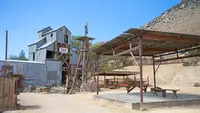
- Comstock Gold MillVirginia City · Last fully operational stamp mill in the stateThe last fully operational stamp mill in Nevada, a two-stamp Joshua Hendy mill built in 1864, runs on F Street in Virginia City beside the V&T tracks.
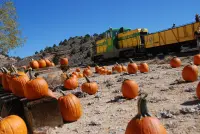
- Virginia & Truckee RailroadVirginia City · Heritage railroadTake a narrated 35-minute scenic ride from Virginia City to Gold Hill and back aboard the legendary Virginia & Truckee Railroad. Travel historic rails once used to carry passengers, dignitaries, and millions of dollars in Comstock gold and silver ore.
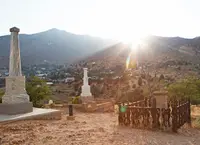
- Virginia CityVirginia City · Old west mining townA preserved Old West silver-mining town famous for the 1859 Comstock Lode discovery, the entire town on the National Register of Historic Places and designated a National Historic Landmark. Today the town has a small year-round population with preserved C Street district, museums, saloons, hotels, mine tours, and haunted buildings.
The Calendar
History
Sun Mountain and Old Virginny
Virginia City sits on the slope of Mount Davidson, first called Sun Mountain, at more than 6,000 feet, halfway between Reno and Carson City.3,5 A monument in the center of town credits the Comstock Lode’s discovery to Ethan Allen Grosh and Hosea Ballou Grosh, followed by Patrick McLaughlin and Peter O’Reilly’s silver find on ground claimed by Henry T.P. Comstock and James Fennimore.2 The monument dates the discovery to 8 June 1859 at the head of Six Mile Canyon, while a Chamber of Commerce marker places it in the spring of 1859 at the head of Gold Canyon.2,6 The settlement was founded in 1859, and its residents named it for an early miner, James “Old Virginny” Finney.3 By April 1860 some 10,000 hopefuls from California had arrived, and Virginia City and Gold Hill had been laid out as cities.4 Virginia City was incorporated under the Utah Territory in 1861, and Storey County, organized in 1860, was named for Captain Edward Storey, who was killed in the Pyramid Lake Indian wars.1,3
Square Sets and the Big Bonanza
In 1860 Phillip Deidesheimer invented square-set timbering, which let miners work large ore bodies at great depth, and a marker notes that he chose not to patent it and encouraged its free use.2 By 1863 the town had 15,000 people, and the miners unionized that year; their union won the $4.00 daily rate in 1867 and the eight hour day in 1872.4 On April 7, 1869, fire broke out at the Yellow Jacket Mine’s 800-foot level, and by one account perhaps more than forty miners died in that worst incident, many of them never recovered.3 In 1873 Hermann Schussler brought water to the Comstock by inverted siphon from Marlette Lake, some 30 miles to the west.7 The state marker says the Virginia and Truckee Railroad first connected Virginia City to Carson City in 1869, while a Daughters of the American Colonists marker dates service to Gold Hill to December 1869 and to Virginia City to 1870.8,9 On August 24, 1872, Superintendent Henry M. Yerington drove the last spike a mile west of Carson City, which joined Virginia City to Reno by rail.8 John Mackay, James Fair, James Flood and William O’Brien gained the Consolidated Virginia and California mines in 1871 by one account and in 1872 by another, and in 1873 they struck the Big Bonanza at the 1,167 foot level.4,7 The population rose from 11,359 in 1870 to 20,000 in 1875, Chinatown counted more than 1,500 people at its height in the early 1870s, and by 1880 a third of Virginia City was Irish.3,4 The 1940 state guide tells how Adah Isaacs Menken rode across the stage in Mazeppa wearing pink tights and lashed to an unsaddled horse, and how the camp gave her a bullion bar worth $2000.10
The Fire of October 26, 1875
Early on the morning of October 26, 1875, someone knocked over a coal oil lamp in a boarding house, and strong winds spread the blaze until thirty-three blocks were leveled.11 The losses included St. Mary in the Mountains Catholic Church, the Storey County Courthouse, Piper’s Opera House, the International Hotel, and most of the business district.11 Contractor Peter Burke began a new courthouse in 1876 and finished it in 1877 for $117,000.00, and the seven foot zinc Statue of Justice for its alcove arrived from New York that year at $236.00.1 Legend has it that she was one of only a few made without a blindfold, though research has found about 20 such models in the country.1 The Fourth Ward School opened in 1877 with space for one thousand students; new regulations in 1936 made it a financial burden, and in 1986 it reopened as a museum.3,12 John Piper bought Maguire’s Opera House in 1875 and rebuilt it after that year’s fire, and when it burned again in 1883 its replacement went up on B Street, where the 1940 guide found it standing.10
Decline and the Landmark District
Production peaked at more than $38,000,000 in 1876 and fell to only $1,400,000 in 1881, while the population dropped to 15,448 by 1880 and to 9,000 by 1889.4 The collapse of the Bank of California and the crash of the San Francisco stock market in 1875 contributed to the decline of the Comstock District, and after a rich lode turned up at Bodie, California, in 1878, thousands of people left.5 A marker says the town’s worst years came during the depression of the 1930’s, when only several hundred people lived there.7 The Daughters of the American Colonists marker says the V&T closed down in 1939, while the state marker records the last train passing on May 31, 1950.6,8,9 A dwindling Virginia City held on, in part through a change that followed the premiere of the television show Bonanza in 1959, and from 1959 to 1974 the series put a mythical Virginia City on the screen.3,13 In 1961 the National Park Service listed the Comstock as the Virginia City Historic Landmark District, which takes in Virginia City, Gold Hill, Silver City, and Dayton, with 400 buildings on 14,750 acres.3,5 The town’s water still comes from the Marlette Lake source, and water from the mines still drains out at the mouth of the Sutro Tunnel.7
Within 30 Miles
Measured in a straight line from the town, nearest first.
- Dayton Valley DaysDayton · Community festivalA two-day September street festival in Historic Downtown Dayton, Nevada, begun in 1989 to fund artists in local schools and later turned to saving the town's old buildings.
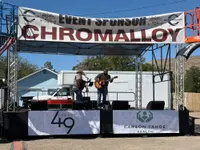
- Steamboat Hot Springs Healing Center & SpaReno · Natural mineral hot springs and wellness spaReno, Nevada's only mineral hot springs.
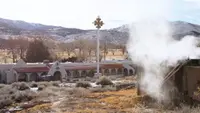
- Carson Hot Springs ResortCarson City, NV · Historic hot springs resortSituated in Nevada's Capital City, this large natural hot spring has been relied upon for more than 150 years; first used by American Indians pre-statehood and rediscovered in 1849.

- Nevada DayCarson City · Statehood paradeNevada's statehood celebration in Carson City, held downtown since 1938, where a four-hour parade follows a dawn balloon launch and precedes single-jack drilling into Sierra White granite.
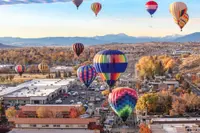
- Coin Press No. 1 DemonstrationsCarson City · Museum eventsEvery Saturday at the Nevada State Museum in Carson City, Coin Press No. 1 strikes silver medallions in the old mint where it struck the first CC dollars in 1870.
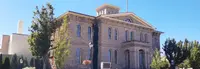
- Sand Harbor Swim BeachIncline Village · State parkThe largest alpine lake in North America, Lake Tahoe is a cobalt blue lake atop the Sierra Nevada mountain range. On its eastern shores, gently sloping beaches, crystal-clear water and interesting rock formations allow for wonderfully sublime swimming, kayaking and scuba diving at Sand Harbor. Boaters, water-skiers and fisherman can easily launch from one of the park's two ramps. Visitors who would like a peaceful retreat from surf and sun can picnic in the shade of cedars and Jeffrey pines in one of many picnic sites equipped with barbecues and tables. The park also hosts the Lake Tahoe Shakespeare Festival every summer.

- El Rancho Swap MeetSparks · Open-air marketA weekend flea market in Sparks, Nevada, held on the lot of the El Rancho Drive-In, which an accordionist opened in 1950 and whose screens still show first-run movies.
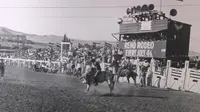
- Reno RodeoReno · PRCA rodeoTen-day PRCA rodeo each June run by a nonprofit volunteer association, drawing over 140,000 fans as the 4th richest PRCA tour rodeo.
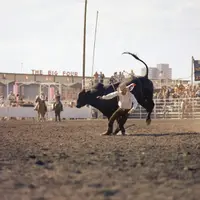
- State Fair of NevadaReno · State fairThe official State Fair of Nevada, revived in June 2026 at the Reno fairgrounds after its 2011 collapse, where youth livestock go to the Governor's Sale of Champions.
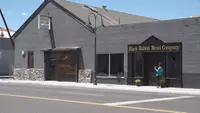
- Black Rabbit Mead CompanyReno · MeaderyNevada's first meadery, pouring carbonated, semi-dry mead from Sierra Nevada honey inside an 1889 narrow-gauge locomotive house on East Fourth Street in Reno.
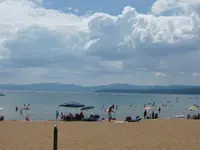
- Kings Beach State Recreation AreaKings Beach · Day-use only areaKings Beach State Recreation Area features 979 feet of beautiful frontage property along the North Shore of Lake Tahoe. This day-use only area has a large sandy beach and multiple picnic tables under the shade of Jeffery pines.
- Genoa Candy DanceGenoa · Annual genoa candy dance arts and crafts faireA two-day crafts faire and Saturday dinner dance in Genoa, Nevada, begun in 1919 to buy street lights and still paying the town's electric bill.
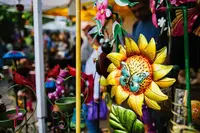
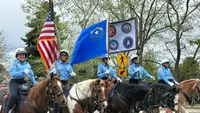
- Genoa Western Heritage DaysGenoa · FestivalGenoa Western Heritage Days is a spring weekend of cowboy poetry, Chautauqua and a horse parade in Genoa, Nevada, the first permanent settlement in what became the state.
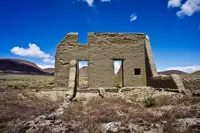
- Fort Churchill to Wellington Back Country BywaySilver Springs · Back country byway - type i & type IIA 67-mile BLM back-country route in western Nevada running from the adobe ruins of Fort Churchill, an 1860 Army post, over the Pine Nut Mountains to Wellington.
- Silver Springs & Stagecoach Founders DaySilver Springs · Block party car showThe Founders Day Block Party Car Show returns Saturday, October 10th at Penny Park as part of our special Silver Springs & Stagecoach America 250 Celebration!
8 more within 30 miles on the road map.
Nearby towns: Carson City and Gardnerville. All the towns of Nevada.
Sources
- Storey County Courthouse (historical marker) hmdb.org/m.asp?m=22007
- Virginia City (historical marker) hmdb.org/m.asp?m=21565
- Virginia City and Gold Hill onlinenevada.org/articles/virginia-city-and-gold-hill
- National Register nomination, Virginia City, NV npgallery.nps.gov/NRHP/GetAsset/NHLS/66000458_text
- Virginia City Historic District, Nevada (U.S. National Park Service) nps.gov/places/virginia-city-historic-district.htm
- Life in Virginia City on the Comstock Lode (historical marker) hmdb.org/m.asp?m=81819
- The Big Bonanza (historical marker) hmdb.org/m.asp?m=50103
- Virginia and Truckee Railroad Right-of-Way shpo.nv.gov/nevadas-historical-markers/historical-markers/virginia-and-truckee-railroad-right-of-way
- V & T, 1869 - 1950 (historical marker) hmdb.org/m.asp?m=45645
- Nevada: A Guide to the Silver State (1940), p. 98 babel.hathitrust.org/cgi/pt?id=mdp.39015048749454&seq=150
- The Great Fire of 1875 shpo.nv.gov/nevadas-historical-markers/historical-markers/the-great-fire-of-1875
- HISTORIC FOURTH WARD SCHOOL shpo.nv.gov/uploads/documents/CCCHP-21-04_Application_Historic_Fourth_Ward_School_Foundation_(1).pdf
- Virginia City and Early Nevada Mining onlinenevada.org/articles/virginia-city-and-early-nevada-mining