

Black Rabbit Mead Company
Reno, Washoe County, Nevada. Meadery.
Details

- Where
- 401 East 4th St, Reno, NV 89512. Directions
- When
- M, T & W ~ 4 - 10 PM; TR ~ 4:00 - 12:00 AM; F ~ 12 PM - 1 AM; S ~ 12 PM - 1 AM; SU ~ 12 PM - 8 PM.
- Walk-in or reserve
- Private: Book the whole meadery; Semi-Private: Book the back seating area.
- Phone
- (775) 410-6198
- Managed by
- Black Rabbit Mead Company.
Mead on East Fourth Street
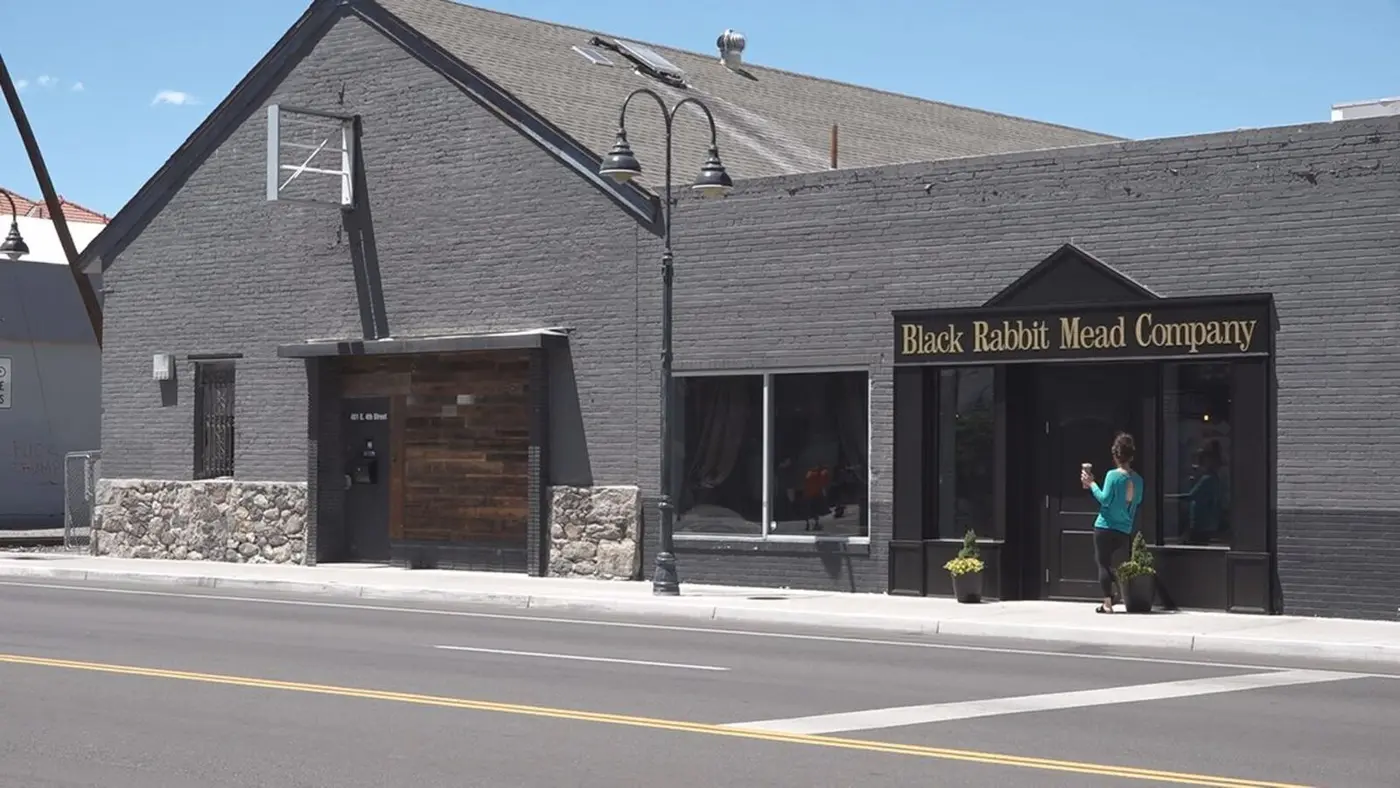
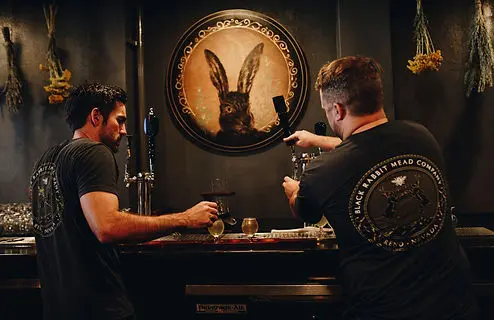
The bar at 401 East Fourth Street pours mead, the drink made from honey, by the pint. The house style is carbonated and semi-dry, 6.9 percent alcohol by volume, gluten-free, and often infused with fruits, herbs, or spices. All of the honey comes from the mountains and foothills of the Sierra Nevada. “It’s going to come across as something between beer and cider,” co-owner Will Truce told KOLO-TV in 2019. The company says mead is traditionally served like a sweet wine, and that this drier cider style is made by only a handful of companies.
The room is both bar and production facility, in what the owners and the state tourism office call Reno’s Brewery District. Travel Nevada counts ten other alcohol makers within a few blocks. Some meads are made only for the taproom, including beer-style and cocktail-style versions, and six-packs go out the door with travelers headed into the Reno-Tahoe country. The full bar specializes in locally sourced drinks, and the kitchen sends out savory hand pies alongside non-alcoholic options. The bar’s own page invites guests to “raise a horn to this good mountain life.” It hosts live music and community events, and parties can book the back seating area or the whole meadery. The two owners divide the work: Jake Conway handles production, finances, and licensing, and Truce handles sales and distribution.
Two teachers and a beekeeper’s honey
Conway and Truce were long-time friends who both taught school before they made mead. The company describes them as local high school teachers. KOLO places them at a charter school in Carson City. The two sources tell the founding differently. In the company’s account, the pair met another teacher, Al of Al’s Bees, who offered them honey and a mead-making kit if they would split the bottles. In KOLO’s 2019 report, the owner of Al Bees approached them about six years earlier with crystallized honey he could not sell. Both accounts agree on what followed. The friends made mead for fun, kept at it for years, and went professional.
Nevada law had only recently begun to allow mead to be made and sold throughout the state. The company says Nevada was the last state without a meadery. Reno, it adds, had long had hobbyist mead makers, among them several nationally award-winning makers and judges for national competitions. KOLO reported that fifteen years before 2019 the country had about twelve meaderies, and by then almost seven hundred. “We’re excited to be the first one. That’s always a great bragging right to have,” Conway said.
The meadery opened softly in July 2019 with four varieties, among them Pineapple-Jalapeno, Raspberry, and one Truce likened to a smooth IPA. It opened for the “Art on 4th” Artown Block Party on July 18th, and its grand opening was scheduled for July 27th. Conway described how first-time tasters often reacted: “People who have tried it are like, oh yeah my uncle made this once down in his basement. Or I have a friend who’s made a couple of batches. And they’re like, this is much better than that.”
A locomotive house built after the fire
The building is older than the drink’s revival in Reno by 130 years. In May 1889 a major fire destroyed a large section of Reno, including the east Reno holdings of the Nevada-California-Oregon Railway, with damages estimated at $15,000. The railroad immediately built a new brick depot, a freight house, and a locomotive house. Work on the locomotive house began in June, and it was completed in September of 1889. Its builder is unknown.
The railroad had been organized in Reno on June 1, 1880, as the Nevada and Oregon Railroad Company. It was planned to run south toward the mining camps near Aurora and north to Goose Lake. The southern line was abandoned, and the track crept north until it reached Lakeview, Oregon, in 1912, 238 miles out. The line passed through two more names before the Moran Brothers banking firm, which had bought it in 1884, renamed it the Nevada-California-Oregon. Unlike most Nevada railroads, it lived on cattle, sheep, and lumber rather than on mining.
The 1889 house was a one-story rectangle about 35 by 143 feet. It stood on a rubble stone foundation, with common-bond brick on three sides. The east wall was built of wood so it could be taken down for expansion. Four monitor skylights stood three feet above a slate roof. A turntable just north of the building turned engines and cars so crews could run them inside for repairs. A photograph from about 1910 shows arched entries just large enough for railcars to pass through. At first the building stored narrow-gauge locomotives. In 1901 a temporary wooden car shop, 130 by 90 feet, went up on the east side and gave space for painting and woodworking. The old house was then divided, with a machine shop in the southern half and engines kept in the northern half. Around 1910 the wooden shop came down and an eight-stall brick roundhouse rose beside the building, which from then on served only as a machine shop.
Plumbing, appliances, and mead
In 1917 the declining N-C-O sold sixty-four miles of line, from Hackstaff Crossing, later called Herlong, to Reno, to the Western Pacific Railroad for $700,000. The sale included the Reno terminal: the machine shop, the roundhouse, and the two-story passenger depot at 530 East Fourth Street. The N-C-O moved its headquarters and shops to Alturas, California. Southern Pacific bought the rest of the road in April 1925, and the N-C-O kept its corporate name until September 1929.
The Western Pacific’s standard-gauge equipment could not use the narrow-gauge shops. In 1921 it leased the old locomotive house to the Crane Company of Nevada, a branch of a Chicago plumbing supply firm, which stayed until 1963. Fire took the eight-stall roundhouse in 1940. In the mid-1940s a brick addition, 40 by 143 feet with a sloping shed roof, was built against the east side. By then the skylights were gone, replaced by a clerestory roof that was itself later removed for air vents. The railroad sold the building to the Yancy Company of Reno in 1957. Jon E. Madsen bought it in 1973.
Robert A. Nylen of the Nevada Historical Society prepared the National Register nomination, dated May 3, 1982. At that time customers came in through the south front to a kitchen appliance showroom. Nylen recorded it as the oldest surviving structure of its type in Reno and the second-oldest locomotive house in Nevada, after the Virginia and Truckee engine house in Carson City, completed in 1873. Together with the N-C-O depot, he wrote, it was the last remnant in Nevada of one of the twentieth century’s longest narrow-gauge railroads. It was listed in 1983. A 2011 photograph shows few changes in the three decades since. In 2019 the former machine shop took in its first meadery.
Notable Events
- 1889A massive fire burned down the company’s previous holdings earlier in 1889, requiring the rapid construction of a fire-proof brick and iron shop and engine house. renohistorical.org
- 1901A temporary wooden car shop was added to the east side, and the original locomotive house was divided between a machine shop and locomotive storage. npgallery.nps.gov
- 1917The N-C-O sold sixty-four miles of rail line from Hackstaff Crossing (Herlong) to Reno to the Western Pacific Railroad for $700,000. npgallery.nps.gov
- 1921Leased to the Crane Company of Nevada, which operated its plumbing supply business out of the structure until 1963. npgallery.nps.gov
- 1940The adjacent eight-stall roundhouse was destroyed by fire. npgallery.nps.gov
- 1940sA small brick addition was constructed. renohistorical.org
- 1957The Western Pacific sold the old locomotive house and machine shop to the Yancy Company of Reno. npgallery.nps.gov
- 1973In 1973, the property was purchased by the present owner named in the nomination. npgallery.nps.gov
- 1983The building was listed in the National Register of Historic Places. renohistorical.org
- 2019In 2019 the building became the home of Nevada's first meadery, the Black Rabbit Mead Company. renohistorical.org
- After a soft opening, the meadery's Grand Opening was scheduled for July 27th. kolotv.com
People
- Al, Teacher from Al's Bees who introduced the founders to mead.
- Jake Conway, founder; former high school teacher.
- Will Truce, founder; former high school teacher.
- Jon E. Madsen, owner of property at the time of the National Register nomination.
- Robert A. Nylen, prepared the National Register nomination as Project Director, NAER Nevada Statewide Survey, Nevada Historical Society (May 3, 1982).
Sources
- blackrabbitmeads.com/aboutus
- blackrabbitmeads.com/renotaproom
- blackrabbitmeads.com/contact
- blackrabbitmeads.com/copy-of-book-your-event
- kolotv.com/content/news/Nevadas-first-Meadery-opens-in-Brewery-District-512786321.html
- travelnevada.com/food-drink/black-rabbit-mead-co
- blackrabbitmeads.com/about-us
- blackrabbitmeads.com/onlinestore
- blackrabbitmeads.com
- renohistorical.org/items/show/51
- npgallery.nps.gov/AssetDetail/NRIS/83001120
- npgallery.nps.gov/GetAsset/a418bd49-cbf9-48a8-a96a-7a7f5cde5bc7