Coin Press No. 1 Demonstrations
Carson City, Carson City County, Nevada. Museum Events.
Details

- Where
- 600 North Carson Street, Carson City, NV 89701. Directions
- When
- Saturdays, 11:00am-3:00pm.
- Getting there
- The museum is located in downtown Carson City, catty-corner from the Carson Nugget. Enter through the Dema Guinn Concourse (glass structure).
- Fees
- $10 adults, free for children 17 and under and museum members.
- Hours
- Monday-Sunday, 8:30 am-4:30 pm.
- Access
- Holidays Closed: Thanksgiving Day, Christmas Day, and New Year's Day.
- Website
- carsonnvmuseum.org
- Managed by
- Nevada State Museum.
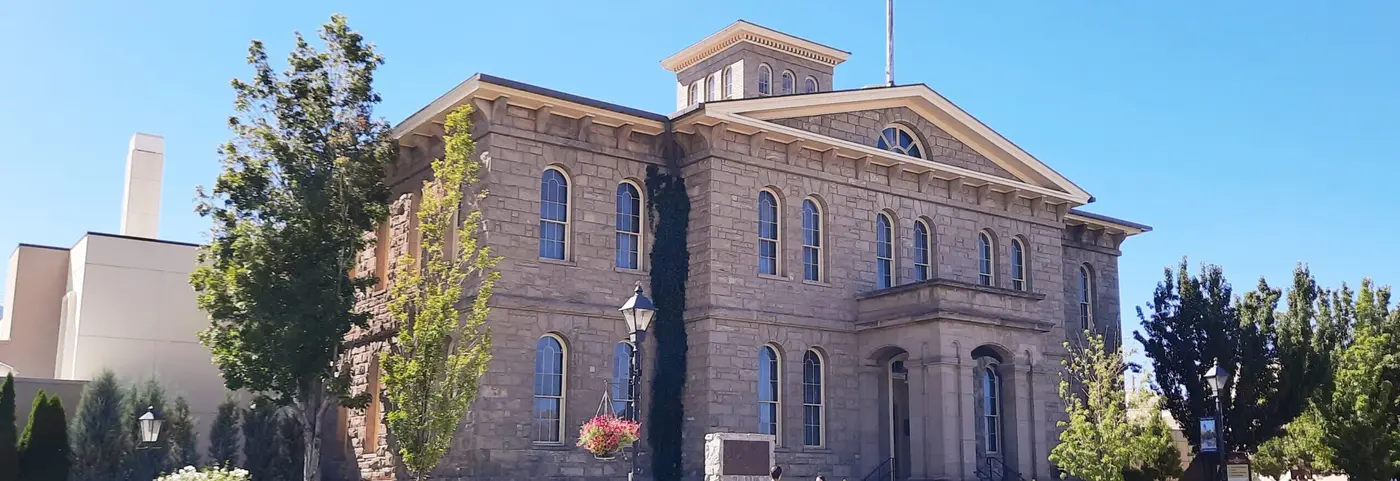
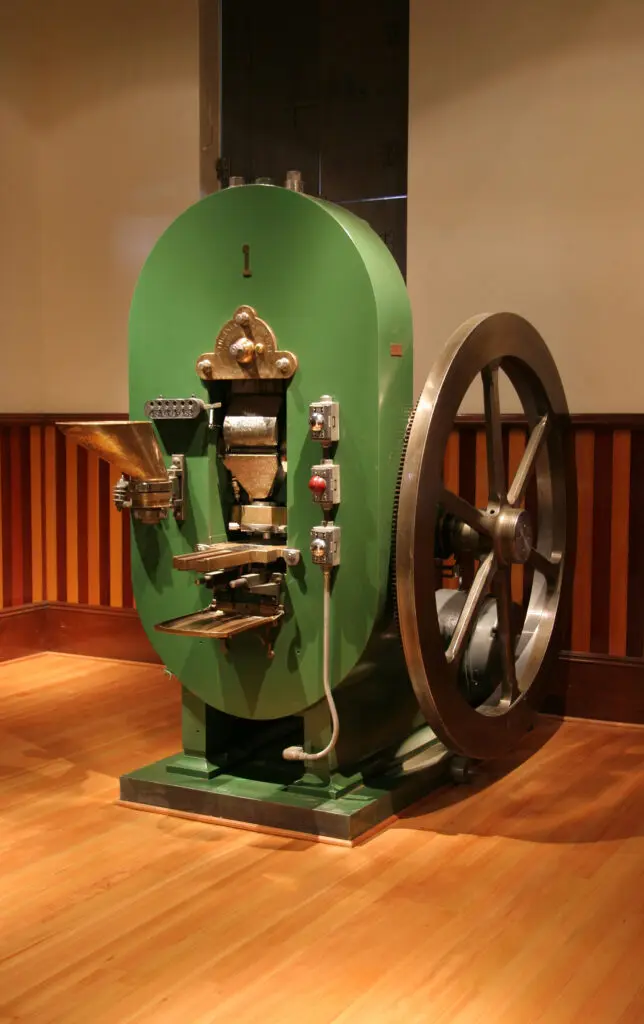
On Saturdays from 11 a.m. to 3 p.m., a six-ton coin press goes to work inside the old United States Mint on North Carson Street in Carson City. Visitors to the Nevada State Museum buy a planchet, a blank of .999 fine silver, and watch volunteer adjusters and coiners strike it on Coin Press No. 1. The finished medallion comes back mounted in a card that records its series number. While the press works, docents give the history of the machine and of the mint around it.
The designs change. In April 2023 the press struck reproductions of the 1870 Seated Liberty half dollar, “the first half dollar minted on this press in 1870,” in the words of Myron Freedman, then administrator of the Nevada Division of Museums and History. The museum bought Nevada silver for those medallions, from existing mines and not the Comstock, Freedman said. For the Mark Twain Days Festival that month it offered medallions with the CC mark and a likeness of a young Mark Twain “from the days he would have been here in the city,” as Museum Director Josh Bonde put it.
“You can almost put yourself back in 1875 and hear the machines thumping away and envision the smokestacks going,” Bonde told the Nevada Appeal. “This is as close as we’re going to get.”
The rest of the building keeps the mint’s record. Its guest register, with the names of visitors from throughout the United States, lies open on the first floor. The mint bell, which rang at 8:30 a.m. and 4:30 p.m. six days a week to tell the city the mint was open, was brought inside for display in 2019; church bells used to fill the Sunday gap. The Mint Theater holds an engraved gold pocket watch that mint employees gave their first superintendent, Abraham Curry. Another case holds coin dies dug up on the museum grounds, beside a collection of nearly every coin the Carson City Mint produced. The self-guided “Mint to Museum” panels, in text and audio, include a photograph taken before 1878, the only known image of Coin Press No. 1 at work in the mint.
The building Abe Curry built
The museum’s panels call it Abe Curry’s mint in Abe Curry’s town. Curry, born in 1815, came from Downieville, California, to Mormon Station, now Genoa, in 1858. When a Genoa lot owner would not name a fair price, Curry reportedly said, “Well I’m going to create a town of my own,” and rode about 13 miles north. There he and three partners bought the Eagle Valley Ranch for $500 and horses, and the ranch became Carson City.
The Comstock mills turned out doré, bars of mixed gold and silver. The San Francisco Mint would separate the metals and return them as coin or bullion, but carrying the doré there was costly and risky. Congress authorized a branch mint in March 1863, by the museum’s account; the U.S. Mint gives March 3, 1863, and State Historical Marker No. 196 says March 3, 1862. When the Treasury sent a man to weigh Carson City against Virginia City, Curry and other promoters wined and dined him, and his report praised Carson City’s level ground and wagon routes. Curry then sold the government the building site and won the contract to build the mint.
The plans came from Alfred B. Mullett, supervising architect of the Treasury, who according to the museum never set foot in Nevada. The state marker says the sandstone blocks were quarried at the Nevada State Prison. Ground was broken July 18, 1866. The museum dates the Masonic cornerstone ceremony to September 24, while the U.S. Mint gives September 18, 1866. Curry was budgeted $150,000. Labor costs soared, anti-Chinese sentiment kept cheap immigrant labor off the job, and refractory brick for the furnaces had to come from Scotland. Curry went east twice to plead for money. On the first trip, in 1867, he sailed from San Francisco by steamship because the transcontinental railroad was not finished. He was gone nine months and came home with promises of more funding and the mint’s machinery. The building was finished on December 13, 1869, at a cost of $426,787.66. Two weeks later an earthquake of about magnitude 6.1 broke windows, cracked walls, and toppled chimneys around Carson City. Curry hurried downtown and found his mint undamaged.
A hundred silver dollars a minute
The press was made by Morgan & Orr of Philadelphia. Its brass maker’s plate read “Morgan & Orr/ Builders/ Philadelphia. 1868,” according to the museum; the Northern Nevada Business Weekly says it was built in 1869. Volunteer Woody Davis says it took a dozen men several months to build, with no power tools. He says it “came in pieces,” shipped through the Caribbean, carried by train across the Isthmus of Panama, then shipped up to San Francisco. “It weighs 12,000 pounds,” Davis said. “That’s three Toyota Corollas.” When it arrived in 1869 it was painted, as was the custom of the day, with a large “1” for the first press at the branch mint.
On completion day the machinery stood installed, but the dies had not come from Philadelphia, and the press was silent. Curry opened the doors anyway on January 6, 1870, to let the town look. The museum dates the first silver dollars to February 4, 1870; the Nevada Appeal and the U.S. Mint give February 11. The first coin bearing the CC mint mark was a Seated Liberty silver dollar. No other United States mint mark has double letters. Carson City residents said CC stood for “Compliments of Curry,” because he often handed the coins out as souvenirs. President Ulysses S. Grant had appointed Curry the first superintendent. He resigned in September 1870 to run for lieutenant governor on the Republican ticket, lost when the Democrats swept, and took a job a block away supervising construction of the Virginia and Truckee Railroad shops, foundry included. He died in October 1873.
Steam ran the press. “Eventually all the wheels and everything went back to the power plant in the basement, and that was wood-fired,” Freedman said. “There used to be stacks of cord wood in this lot right across the street that they would feed to the machine. And it stunk, and it smoked up the ceiling.” Arches built in the basement carried the press’s weight, Exhibit Program Manager Laurel Weil said. Neighbors complained of fumes from assaying and refining, soot from the chimneys, and cordwood blocking Curry Street. Visitors came anyway. Mint guides called “conductors” led tours, and the coin press room in the northeast corner drew the most interest, since the press could strike 100 silver dollars a minute. Davis adds 125 dimes a minute, and sets the figure beside six to eight coins a minute from a strike press in Austria and four or five from a screw press in Mexico City.
The press was the mint’s only one until 1875, and Freedman said, “All of the Carson City minted coins from 1870 to 1874 were made on this machine.” Over the years it struck dimes, 20-cent pieces, quarters, half dollars, silver dollars, and trade dollars, and gold pieces of five, ten, and twenty dollars. The Coinage Act of 1873 stopped the silver dollar, and Carson City turned to Trade Dollars meant for Asia. Nevadans called the act the Crime of ‘73. An 1873 Carson City dime with no arrows, the only one known to survive, sold at auction for $1.8 million in 2012, and the Business Weekly says it was certainly struck on No. 1. James Crawford became superintendent in 1874, during a national coin shortage, and in 1876 the mint struck over $6.4 million in gold and silver, its all-time high. Curry’s daughter, Elvira Curry Cowen, rose from adjuster to forewoman in 1877; the museum says the U.S. Mint honors her as the first woman to reach a supervisory role. Eventually three presses worked in the building.
A railroad plate on a federal machine
The Carson Mint was hard on its presses, as the many cracked dies recovered in archaeological digs show. According to the Business Weekly, No. 1 was designed for much lower tonnage than the 200 tons it ran at in its early years. In March 1878, by the museum’s account, its pressure arch cracked in the upper right quadrant; Davis puts the crack in 1877, with repairs done in 1878. Ordering a three-ton replacement arch from Philadelphia would have lost time, and Davis says the press was too heavy to ship east. Crawford arranged for the V&T foundry, the one Curry had overseen, to recast it. Davis describes the foundry as a 49-man casting plant down the street. The press came back with a new brass plate: “Virginia and Truckee/ R.R. Works/ Carson, Nev. 1878.” It is still on the machine.
“These guys are such wild men,” Davis said. “The government is way back there, and they’re 3,000 miles out here, and they put their own name on a federal machine.”
Crawford died in 1885, the longest-serving superintendent, facing an anti-silver Democratic president. That year the mint shut down for political reasons and stayed closed under Grover Cleveland’s administration until October 1889. Coinage ended for good in the spring of 1893. From its opening, the state marker records, the mint had struck $49,274,434.30. In 1899 the presses were removed and formal mint status withdrawn as Comstock mining declined. The building served as an assay office until 1933. In 1939 Nevada bought it. The museum records that Senators Pat McCarran and Key Pittman introduced purchase bills for $5,000 and that President Franklin D. Roosevelt signed the measure; the U.S. Mint gives the price as $10,000. On October 31, 1941, during the Nevada Day ceremonies, Judge Clark J. Guild presented the Nevada Museum and Art Institute to Governor E. P. Carville.
Four mints and a $225 sale
No. 1 went to the Philadelphia Mint, where it was converted from steam to electric power in 1930. In 1945 it moved to the San Francisco Mint and was renumbered “5” for its place in the coining department. When San Francisco halted coin production in 1955, the old press was slated for scrap. The museum puts this in the late 1950s, and credits F. J. “Monte” Monteagle, a newsman, railroad enthusiast, and coin collector who saw the V&T plate and knew the press came from Carson City. The Business Weekly names him Frederick Monteagle, an Oakland newspaperman. “He’s the guy in 1958 who sent word to Nevada that they were scrapping the press,” said coin dealer Rusty Goe, author of The Mint on Carson Street. With Monteagle as middleman, Guild and the museum trustees bought the press for its scrap value, $225. The Appeal’s 1917 account credits Guild and other local businessmen; its 2023 account says museum officials got a call and the press was identified by its V&T plaque. It was back in Carson City in 1958.
In 1964, with the nation short of coins, U.S. Mint director Eva Adams, a native of Ely, asked to borrow it. The press was trucked to the Denver Mint and struck more than 188 million coins over the next three years. It came home for good in 1967 and was given a much slower electric drive. By the Appeal’s count it had worked at four United States mints: Carson City, Philadelphia, San Francisco, and Denver.
Since then it has struck Nevada Bicentennial medals in gold, silver, copper, and bronze in 1976, and medallions for the Pony Express, the V&T reconstruction, the Abraham Lincoln Bicentennial, Nevada’s sesquicentennial, and the museum’s 75th birthday. Curator of history Bob Nylen and longtime volunteer coiner Ken Hopple remembered a cold January day in 2006, when a crowd gathered for the “Spirit of the West” medallions struck for the release of the Nevada state quarter and bought them as they left the press. In 1999 historian Dennis Cassinelli found hundreds of old dies during construction of a park at the museum. Some were used to strike tokens that still showed the cancellation marks cut into them, until the original iron dies began to crack.
The machine needs care. After months of repairs in 2017, an Oakland coin press consultant, a restoration specialist at the Nevada State Railroad Museum, and independent analysts advised against the 150 to 170 tons needed for dollar-size medallions. The museum switched to 30-millimeter pieces, about half-dollar size, struck at no more than 110 tons. Parts, and often the tools to fit them, have to be made from scratch. “Our No. 1 priority as a museum is to protect the artifact,” said Freedman, then the museum’s director.
In 2023 the press ran again after nearly a year out of commission. Chris de Witt, restoration supervisor at the railroad museum, worked on it with Weil and her team. “It was masterful watching Chris and Laurel and their team without an instruction manual,” Bonde said. Weil pointed back to the V&T shops of 1878. “There’s a history there,” she said. “Full circle.”
Notable Events
- 1862Congress passed a bill establishing a branch mint in the Territory of Nevada. shpo.nv.gov
- 1863Congress passed legislation authorizing the Carson City Branch Mint. carsonnvmuseum.org
- 1866Groundbreaking ceremonies took place. usmint.gov
- 1866The cornerstone for the new facility was laid. usmint.gov
- 1867Curry made his first Washington and Philadelphia visit because mint construction was greatly over budget. carsonnvmuseum.org
- 1869The building was completed and the machinery installed, but the press was silent pending coin dies. carsonnvmuseum.org
- 1869Curry returned to Washington to work again with Nevada's delegation because promised funding was insufficient. carsonnvmuseum.org
- 1869The six-ton steam-powered Morgan and Orr press arrived at the new mint. nevadaappeal.com
- 1870Coin Press No. 1 minted its first silver dollars February 4, 1870. carsonnvmuseum.org
- 1870Abe Curry opened the mint's doors before coin dies arrived. carsonnvmuseum.org
- 1870Curry unexpectedly resigned and announced a candidacy for lieutenant governor. carsonnvmuseum.org
- 1870All Carson City coins during these years were made on this machine. nevadaappeal.com
- 1870From opening to the end of coin operations, coinage amounted to $49,274,434.30. shpo.nv.gov
- 1873Changes to the nation's monetary system resulted in different coin varieties being produced. usmint.gov
- 1874Crawford started as superintendent during a national coin shortage. carsonnvmuseum.org
- 1875Coin Press 1 was the only press at the mint until this year; eventually three operated there as demand grew. nnbw.com
- 1876The mint responded with over $6.4 million in gold and silver coinage, an all-time high. carsonnvmuseum.org
- 1876More coins were struck than in any other year in the mint's history. usmint.gov
- 1877Cowen rose from adjuster to forewoman; the museum says the U.S. Mint honors her as the first woman to attain a supervisory role. carsonnvmuseum.org
- 1877The press cracked and was too heavy to ship to the East Coast for repair. nevadaappeal.com
- 1878The Bland-Allison Act authorized the Morgan dollar and required government silver purchases and renewed silver-dollar minting. carsonnvmuseum.org
- 1878James Crawford arranged for the nearby Virginia and Truckee foundry to recast the arch; the returned press had a V&T brass plate. carsonnvmuseum.org
- 1878The pressure arch cracked in its upper right quadrant. carsonnvmuseum.org
- 1878The massive steel casting bearing the stamping stresses cracked. nevadaappeal.com
- 1878Workers attached a V&T plaque after repairs were completed. nevadaappeal.com
- 1885The mint shut down and remained closed under Grover Cleveland's Democratic administration until the fall of 1889. usmint.gov
- 1893Coin production ceased after politics interfered and legislation requiring federal silver purchases was repealed. carsonnvmuseum.org
- 1899The Carson City Mint ceased coining operations in 1893, and the presses were removed in 1899. nevadaappeal.com
- 1899Formal mint status was withdrawn because of the drastic decline in Comstock mining. usmint.gov
- 1930Press No. 1 was taken to the Philadelphia mint, where it was remodeled in 1930 from steam power to operate with electric power. nevadaappeal.com
- 1933The facility's assay office closed. usmint.gov
- 1939McCarran and Pittman introduced purchase bills for $5000; Roosevelt signed the measure into law. carsonnvmuseum.org
- 1941Judge Guild officially presented the Nevada Museum and Art Institute to Governor Carville and Nevada's citizens during the Nevada Day opening ceremonies. carsonnvmuseum.org
- 1945The press was transferred to San Francisco and renumbered for its place in the coining department. nevadaappeal.com
- 1950sAt the San Francisco Mint the press was deemed obsolete and surplus; F. J. Monte Monteagle saved it from the junkyard. carsonnvmuseum.org
- 1950sOfficials received a call that the press would be discarded; it was identified by its V&T plaque and returned to Carson. nevadaappeal.com
- 1955When San Francisco temporarily halted coin production, the old press was due to be scrapped. nevadaappeal.com
- 1958Through the efforts of Judge Clark J. Guild and other local businessmen, the antique press was purchased by the state of Nevada for $225 and arrived back in Carson City in 1958. nevadaappeal.com
- 1964U.S. Mint director Eva Adams requested the press when the nation faced a severe coin shortage. nevadaappeal.com
- 1967After its Denver duty the press returned to the Carson City Mint/Museum and was converted to a much slower electric drive. nevadaappeal.com
- 1975The press produced a coin commemorating the country's bicentennial. nnbw.com
- 1976The press struck Nevada Bicentennial medals in gold, silver, copper and bronze. nevadaappeal.com
- 1999After hundreds of dies were discovered during park construction, some were used to strike tokens bearing cancellation marks; this was discontinued when original iron dies cracked. nevadaappeal.com
- 2006Commemorative coins were minted to coincide with release of the Nevada state quarter, a memorable day for Nylen and coiner Hopple. nnbw.com
- The ceremony preceded prolonged work and delays; the building was completed at a cost of $426,787.66 on December 13, 1869. carsonnvmuseum.org
People
- Abraham Curry, First mint superintendent appointed by President Grant; also supervised mint construction.
- Alfred B. Mullet, Treasury supervising architect whose building Curry was funded to construct.
- Anna Williams, Schoolteacher used as Morgan's model for the capped Liberty head coin.
- Anne Martin, The museum believes she worked as an adjuster when the mint opened; later a clerk and head of the assay office (Believed an adjuster in 1869; clerk by 1900; appointed assay-office chief in 1921.).
- E. P. Carville, Governor to whom Guild officially presented the museum at its opening in the mint building (October 31, 1941.).
- Elvira Curry Cowen, Abe Curry's daughter; adjuster who became forewoman and is honored as the first woman to attain a U.S. Mint supervisory role (Became forewoman in 1877.).
- F. J. “Monte” Monteagle, Newsman, railroad enthusiast and coin collector who saved the surplus press from the junkyard.
- F. J. "Monte" Monteagle, Newsman, railroad enthusiast, and coin collector who saved the press from the junkyard.
- Franklin D. Roosevelt, President who signed the mint-building purchase measure (1939.).
- George T. Morgan, Designer of the Morgan dollar's capped Liberty head.
- James Crawford, Carson City Mint superintendent (1874 until his death in 1885.).
- Key Pittman, Nevada senator who introduced bills for the state's purchase of the mint building.
- Max C. Fleischmann, The museum's most significant benefactor, known as Major (1877–1951.).
- Pat McCarran, Nevada senator who introduced bills for the state's purchase of the mint building.
- Clark J. Guild, Museum founder who, with trustees and Monteagle as middleman, bought the press for Nevada for $225.
- Dennis Cassinelli, The column's first-person discoverer of hundreds of coin dies subsequently used for token striking (1999 discovery.).
- Eva Adams, Native Nevadan and U.S. Mint director who requested the press loan during a severe coin shortage (1964.).
- Chris de Witt, Nevada State Railroad Museum restoration supervisor whom the museum turns to for help with the historic press.
- Josh Bonde, Museum director commenting on the living, interactive historic press.
- Kelly Brant, Coin Press Program Manager.
- Laurel Weil, Exhibit Program Manager who helped present the press exhibit and participated in its latest repair.
- Myron Freedman, Nevada State Museum director who emphasized continued historical use and protection of the press.
- Woody Davis, Coin Press volunteer who explained the machine's history.
- Bob Nylen, Curator of history at the Nevada State Museum.
- Frederick Monteagle, Oakland newspaperman and Carson City coin collector whose intervention helped save the press from scrapping (1958 warning to Nevada.).
- Ken Hopple, Longtime volunteer and coiner who gave press demonstrations (2006 commemorative minting.).
- Rusty Goe, Coin dealer, collector and author of The Mint on Carson Street (2003 book.).
- Alfred B. Mullett, Architect of the Carson City Mint and Treasury supervising architect.
- Grover Cleveland, President whose Democratic administration coincided with the politically motivated mint shutdown (middle of 1885 until the fall of 1889.).
- Ulysses S. Grant, President who appointed Abraham Curry the mint's first superintendent.
Sources
- facebook.com/NevadaStateMuseumCC
- nevadaappeal.com/news/2017/jun/28/coin-press-no-1-claims-spot-in-nevada-history
- carsonnvmuseum.org/mint-to-museum-en
- carsonnvmuseum.org/event/coin-press-no-1-demonstrations
- carsonnvmuseum.org/location-hours-admission
- nevadaappeal.com/news/2023/apr/01/mint-coin-press-bringing-history-to-life-in-carson-city
- nnbw.com/news/2017/jul/20/historic-coin-press-returning-to-operation-at-neva
- shpo.nv.gov/nevadas-historical-markers/historical-markers/the-united-states-mint-carson-city-nevada
- npgallery.nps.gov/GetAsset/de28e3f0-36ea-40f0-8e4b-43fff503df0b
- usmint.gov/news/inside-the-mint/the-history-of-the-carson-city-mint