.jpg)
Fort Churchill to Wellington Back Country Byway
Silver Springs, Lyon and Douglas counties County, Nevada. Back Country Byway - Type I & Type II.
Details

- Where
- Silver Springs, Lyon and Douglas counties County, NV. No street address stated. Directions
- Getting there
- West from Fort Churchill on State Route 2B and U.S. 50 for 21 miles along the Carson River to Dayton, then south 29 miles through the Pine Nut Mountains to Wellington on State Route 208.
- Fees
- None.
- Access
- Roads can be rough and muddy; high-clearance four-wheel drive recommended on the Dayton to Wellington section; minimal signage.
- Walk-in or reserve
- No reservations through Recreation.gov; open drive.
- Phone
- (775) 885-6000
- Website
- blm.gov
- Managed by
- BLM-Carson City Field Office.
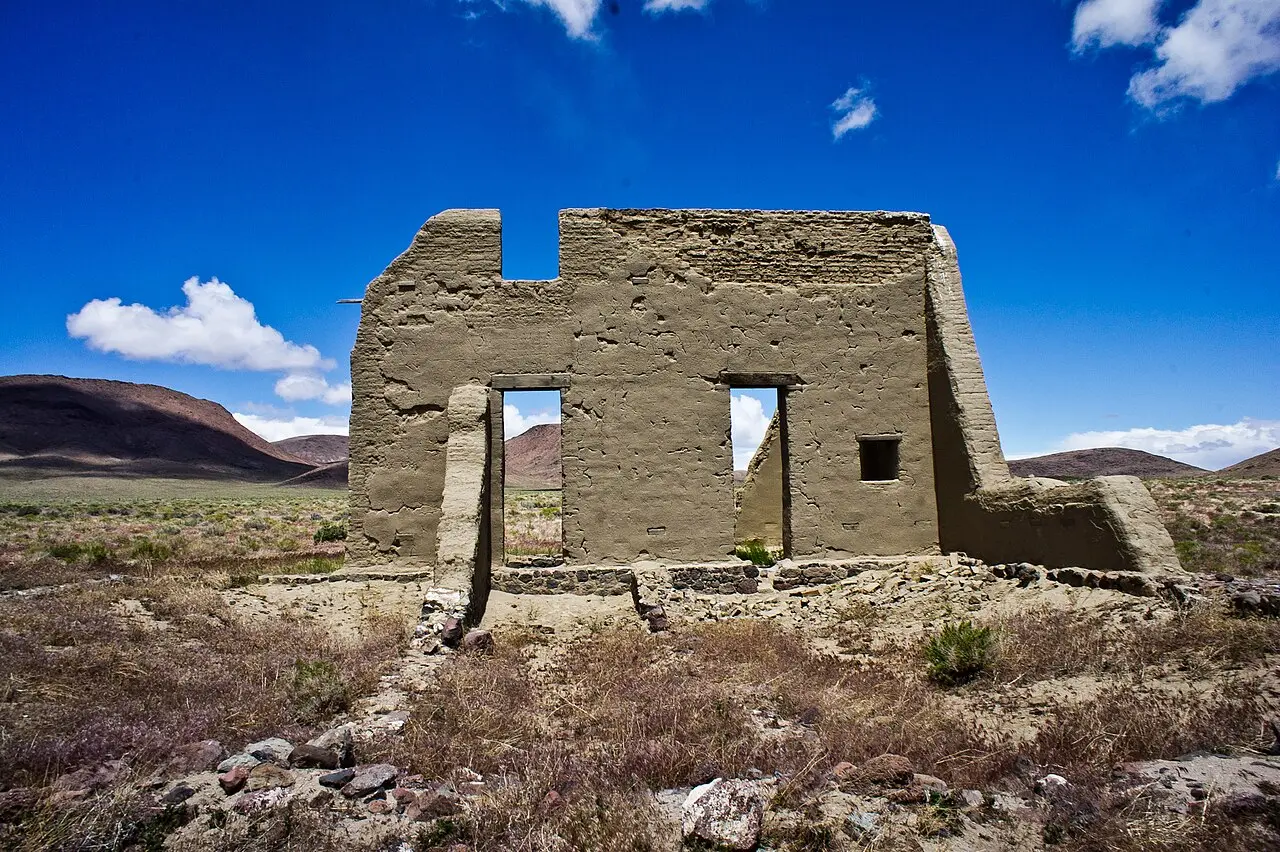
At the foot of Churchill Butte, on the north bank of the Carson River, the adobe walls of Fort Churchill stand in what Nevada State Parks calls a state of “arrested decay.” Some walls still hold the outline of a building. Others, as the Dayton historian Dennis Cassinelli wrote in 2017, are “nothing more than mounds of dried mud from the melted adobe brick.” Crews have replaced some of the old bricks with new adobe blocks so that visitors can see roughly how the buildings first looked. A self-guided trail runs among the ruins, with an interpretive sign at each building. Climbing on the walls or entering the buildings is not permitted. The fort sits at 4,250 feet. The butte rises to 6,250 feet on the north, and the rolling desert hills and higher ground of the Pine Nut Range lie to the south.
The park at mile zero
Fort Churchill State Historic Park covers 3,200 acres, according to the National Park Service. Its visitor center was built by the Civilian Conservation Corps and has since been refurbished. Exhibits cover the fort, the Native Americans who lived in the area, and the surrounding country. The main campground has 20 sites under large cottonwoods, and a picnic area lies along the river. A 2.2-mile Nature Trail follows the Carson from the fort to Buckland Station, a two-story ranch house built in 1870. Visitors there tour the ground floor on their own and can watch a short film on the station and the fort. The river draws canoeists and bird watchers, and anglers fish it catch-and-release for walleye, white bass, wiper, catfish, and trout. The post cemetery holds the graves of Samuel and Eliza Buckland and five of their eight children. The park calendar for October 2026 lists a Lantern Tour on October 16, Coffee with a Ranger on October 18, and a Fall Fling on October 24.
The fort is also the starting point of the Fort Churchill to Wellington Back Country Byway. The Bureau of Land Management route runs 67 miles through Lyon and Douglas counties and is rated Type I and Type II. Recreation.gov breaks the route down as about 38 miles of Type I road and 29 miles of Type II.
West along the Carson, south over the Pine Nuts
The first leg follows State Route 2B and U.S. 50 west for 21 miles to Dayton, along the tree-lined Carson River and the route of the Pony Express National Historic Trail. The country here is ranchland. Dayton’s own state park holds the remains of an 1860s silver mill, one of the first to process ore from the Comstock Lode.
At Dayton the byway turns south for 29 miles into the Pine Nut Mountains. It climbs steeply above Eldorado Canyon, passes through the Como Mining District and the Burbank Canyons Scenic Area, and looks back on the Sierra Nevada and the Carson River Valley. Wild horses range in the Pine Nuts. The road then drops into Smith Valley and reaches Wellington on State Route 208.
Travel Nevada warns that the roads can be rough and muddy, that signage is minimal, and that a good map is needed. It recommends high-clearance four-wheel drive on the Dayton to Wellington section. Recreation.gov advises that four-wheel drive may be needed for the entire route. The BLM notes that Nevada back roads can become completely impassable when wet. The drive takes four to five hours, and there is no fee.
Williams Station, May 1860
The fort exists because of a burned trading post. Williams Station stood on the Carson River about ten miles from the later fort site. The state parks history places it northeast of the fort, and the Park Service places the fort southeast of the station. Accounts of what began the trouble differ. The Park Service writes that most accuse white traders from the station of assaulting Northern Paiute girls, and that warriors retaliated on May 6, killing the offenders and burning the building. The state parks history gives May 8. That morning the station keeper James Williams came back to find his two brothers and a helper dead and the station a smoking ruin. It says the attack “may have been brought about” by the keepers’ kidnapping of several Paiute women. Cassinelli’s account names a band of Paiute and Bannock as the attackers.
Williams carried the news to Buckland Station nearby. From there, Pony Express riders relayed it west “in increasingly exaggerated form,” the state parks history says. The Comstock towns of Virginia City, Genoa, Dayton, Silver City, and Carson City sent volunteers under Major Ormsby, about 105 men by the state’s count. They buried the dead at the station and followed the trail north to Pyramid Lake. Along the Truckee River they were surrounded. Ormsby ordered a charge and was killed, and the volunteers lost two-thirds of their force.
In early June, Colonel John Hayes and Captain Joseph Stewart returned with more volunteers and Army regulars from California, and the outnumbered Native forces retreated. The two battles became known as the Pyramid Lake War. The state parks history calls it the single greatest confrontation between Native Americans and settlers in Nevada’s history. The Park Service records a cease-fire in August 1860. The Pony Express, barely a month old when the fighting began, suspended service for 44 days. Nothing remains of Williams Station, and its site now lies beneath Lahontan Reservoir.
Two companies of infantry and a saloon
Pony Express owners, stagecoach men, and settlers demanded a permanent garrison. Stewart’s Carson River Expedition began building on July 20, 1860, at the junction of the Pony Express Trail and the Carson Route of the California Trail. The post took its name from Sylvester Churchill, Inspector General of the Army. Its adobe buildings, set on stone foundations, formed a square around a parade ground. The fort was completed in 1861, and about 200 soldiers were stationed there at any one time. During the Civil War it served as supply depot for the Nevada Military District and as a base for patrols on the overland routes.
The British traveler Sir Richard Burton came through in October 1860. He described “a well-disposed cantonment, containing quarters for the officers and barracks for the men,” and judged that its two infantry companies were too few for a post that “required at least 2,000 men.” Pony riders brought telegrams to headquarters, but the fort was never a Pony Express station. That role fell for a time to Samuel Buckland’s log-cabin store and saloon, a mile and a half east. Burton complained of its “vile…atmosphere of rum, knorshnapps, stable tobacco, flies, and profane oaths.”
Buckland had come west from Kirkersville, Ohio, in the gold rush of 1850. In 1859 he bought land on the Carson in a place called Pleasant Grove, and his ranch became an Overland Stage stop. In 1860 he contracted with Russell, Majors and Waddell to serve the Pony Express. The same year he married Eliza Prentis.
Auction, trust, and stabilization
The transcontinental railroad was finished in 1869, and the Army left Fort Churchill that fall. Buckland bought all its buildings at auction for $750. He used the salvaged wood to build his two-story ranch house in 1870. The state of Nevada, then 7 years old, declined to acquire the fort in 1871. For years the ruins sheltered travelers on the Carson River Trail, and scavengers carried off building material. In 1884 the soldiers buried in the post cemetery were moved to Lone Mountain Cemetery in Carson City.
In the early 1930s the Nevada Sagebrush Chapter of the Daughters of the American Revolution took up the fort’s cause. Aided by Assembly Bill 189 of the 1931 Legislature, the state took custody of 200 acres of the old military reservation on October 6, 1932. On April 30, 1934, it deeded the land and buildings to the chapter to hold in trust. Beginning in 1935, the Civilian Conservation Corps spent two years under National Park Service guidance stabilizing the ruins and building the campground, the picnic grounds, and the visitor center. World War II drew the labor away, and vandals and weather went to work on the walls again.
Renewed interest in the 1950s brought the fort into the state park system in 1957. On February 16, 1961, the DAR returned the title to the state, and a governor’s proclamation declared Fort Churchill a state historical monument. The same year, a century after its completion, it was named a National Historic Landmark. Before any of this road existed, the route from Virginia City to the fort ran down Six-Mile Canyon, across what is now U.S. 50, and down the Carson River Canyon Road. The Buckland ranch, its house framed in the fort’s salvaged wood, became part of the park in 1997.
Notable Events
- 1860The conflict ended with a cease-fire agreement. nps.gov
- 1860Accounts of the triggering event vary, but most accuse white traders at Williams Station of assaulting Northern Paiute girls. nps.gov
- 1860Construction began on a permanent desert outpost. parks.nv.gov
- 1861Construction of Fort Churchill near Silver Springs was completed. nevadaappeal.com
- 1869After the transcontinental railroad was completed the army vacated Fort Churchill. nps.gov
- 1870The house at Buckland's nearby ranch is now part of Fort Churchill State Park and listed on the National Register. nps.gov
- 1871The State of Nevada declined the chance to acquire Fort Churchill. nevadacar.org
- 1884Soldiers buried in the post cemetery were moved to Lone Mountain Cemetery in Carson City. parks.nv.gov
- 1930sThe Nevada Sagebrush Chapter took an interest in preserving the fort and had 200 acres transferred to Nevada. parks.nv.gov
- 1931Assembly Bill 189 aided the subsequent deed of the fort's land and buildings to the Nevada Sagebrush Chapter DAR to hold in trust. nevadacar.org
- 1932Nevada took custody of 200 acres of the original military reservation. nevadacar.org
- 1934Nevada deeded the land and buildings to the Nevada Sagebrush Chapter DAR to hold in trust. nevadacar.org
- 1935Under National Park Service guidance the CCC spent two years stabilizing the ruins and creating a state park. parks.nv.gov
- 1957In 1957 Fort Churchill became part of the Nevada State Park system. fhwaapps.fhwa.dot.gov
- 1961Fort Churchill was declared a National Historic Landmark. nevadaappeal.com
- 1997Buckland Ranch became part of the state park. nevadaappeal.com
- Resource shortages left the fort abandoned and exposed to vandalism and weather. parks.nv.gov
People
- Sylvester Churchill, U.S. Army Inspector General honored in the fort's name.
- Colonel John Hayes, With Captain Joseph Stewart formed volunteers and Army regulars after Ormsby's defeat.
- Major Ormsby, Led the volunteer expedition defeated before the fort was established.
- Sir Richard Burton, British traveler who visited and described Fort Churchill (October 1860).
- Captain Joseph Stewart, Led the Carson River Expedition ordered to establish the post.
- Eliza Buckland, Buckland family member buried in the fort cemetery.
- James Williams, Station keeper who discovered the attack that led to fort establishment (May 8, 1860).
- Samuel Buckland, Buckland family member buried in the fort cemetery.
Sources
- blm.gov/programs/recreation/recreation-programs/byways/nevada
- fhwaapps.fhwa.dot.gov/bywaysp/byway/68958
- recreation.gov/camping/poi/10407118
- travelnevada.com/off-roading/fort-churchill-to-wellington-backcountry-byway
- parks.nv.gov/learn/park-histories/fort-churchill-history
- nevadaappeal.com/news/2017/aug/09/dennis-cassinelli-nevadas-fort-churchill
- nps.gov/places/fort-churchill-state-historic-park.htm
- nevadacar.org/fort-churchill-society
- blm.gov/programs/recreation/recreation-programs/byways/nevada
- parks.nv.gov/parks/fort-churchill
- travelnevada.com/off-roading/fort-churchill-to-wellington-backcountry-byway