Dillon
Beaverhead County, Montana. County seat.
Dillon, the Beaverhead County seat in Montana, began in 1880 when local businessmen bought a rancher’s land so the stalled Utah and Northern railroad could pass.1
Details
- Founded
- Dillon was founded by a group of local businessmen whose trust deed, recorded on December 4, 1880, marked the town’s birth after they bought a ranch blocking the Utah and Northern.1
- Name
- Dillon is named for Sidney Dillon, president of the Union Pacific.1
- County seat
- Dillon is the seat of Beaverhead County, having taken the role from Bannack when voters judged Bannack too far off the beaten track.1
- Last checked
- October 6, 2026.
Point at a dot to see the place.Tap a dot to see the place. Road map of Dillon.
In Dillon
- Beaverhead County MuseumDillon · MuseumBeaverhead County Museum has been collecting, preserving, displaying and interpreting local history since the 1930s. The museum is housed in a log building complex in downtown Dillon. Our friendly volunteers will greet you at the door and offer a wealth of information.
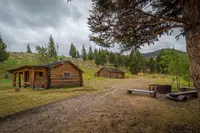
- Birch Creek CabinDillon · Historic log cabin rentalA two-room Forest Service log cabin at Thief Creek near Dillon, Montana, used as a ranger station as early as 1908, below a 1935 Civilian Conservation Corps camp.
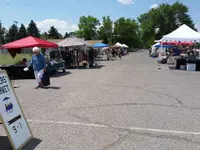
- Dillon Farmers' MarketDillonHomegrown and Handmade market connecting local producers and shoppers in an open-air setting with over 20 vendors bringing locally grown produce, locally prepared or processed specialty food products, baked goods, arts and crafts.
The Calendar

History
A Rancher in the Right-of-Way
In 1930 the Beaverhead Chapter of the Daughters of the American Revolution placed a tablet in Dillon on the site of the first public school building, which also served as the first court house, theatre, and library, and dedicated it on the fiftieth anniversary of the town’s founding.2 In 1935 the Beaverhead Chapter of the Daughters of the American Revolution marked the southern gateway to Montana opened by the Beaverhead River, listing among those that passed through it the Great Beaverhead Wagon Toll Road of 1866-1880 and the Utah and Northern, the first railroad into Montana, in 1880.3 Construction of the Utah and Northern came to a sudden standstill here in 1880, when a rancher refused to give up land for the right-of-way.1 A few men doing business at or near the end of the track banded together, bought the ranch, and gave the railroad company the right to go through.1 Their trust deed, recorded on December 4, 1880, marked the birth of Dillon, and Lambert Eliel, trustee for the group, granted title to town lots that were sold at public auction.1 The town took its name from Sidney Dillon, president of the Union Pacific.1
Bannack and the County Seat
The 1939 guide records that in 1862 the only signpost in a vast wilderness stood at the confluence of the Beaverhead River and Rattlesnake Creek, a rough board daubed in axle grease with directions to the “grass Hop Per digins” at Bannack.1 At Bannack, 22 miles from Dillon, John White and a small party of prospectors from Colorado had found placer gold along Grasshopper Creek on July 28, 1862.1,4 When Congress created the Territory of Montana on May 26, 1864, President Lincoln named Bannack the temporary capital, though by that December the diggings had proved shallow and most miners had left for Alder Gulch.1 Dillon became the county seat when voters decided that Bannack was too far off the beaten track.1
Shorthorns, Wool, and Teachers
Martin Barrett, born in Ireland, arrived in Montana Territory in 1863 and chose to make his fortune from the goldfields by raising stock at Horse Prairie, running 2,000 head of shorthorn cattle on 4,500 acres by 1871.5 The Dillon Implement Company, founded in August 1886 north of the Union Pacific depot, sold carriages, wagons, saddles, harnesses, farm implements, and windmills to area ranchers and farmers.6 Barrett, a founding member of the Dillon State Bank, gave $100,000 in 1921 toward a new hospital in Dillon that was named for him.5 In 1939 the Federal Writers’ Project guide counted 2,422 people and called Dillon a very important primary wool market and the largest wool-shipping point in Montana.1 A local company ran the wool warehouse near the railroad station, marketing wool for growers at one cent for 10 pounds, with room for 3 million pounds and electric conveyors for the sacks.1 The guide found in the town the air of a much larger city, and an assurance and repose it owed, perhaps, to having known few economic setbacks.1 The Montana State Normal College, near the southern city limits, then prepared teachers for the state’s public schools with about 350 students and 25 teachers on a 14-acre campus.1 Dillon is now home to the University of Montana Western, and cattle, sheep, and horses dot the country framed by the Beaverhead River and the Pioneer Mountain Range.7
City Hall and the Implement Block
Contractor William Reed built Dillon’s city hall between April and November 1914 on ground bought from David Robb for $4,450, at a total cost of about $40,000.8 The historic-district record names its architect as Bozeman’s Fred F. Willson, designer of the Romanesque Revival building with its decorative brickwork and fanlight windows, while the city’s marker gives the name as Fred R. Willson.8,9 It housed the fire and police departments, the water commission, a jail, and living quarters for firefighters, and its large auditorium held lectures, dances, boxing and wrestling matches, and theatrical productions.9 Large openings onto East Center Street mark the former fire-engine bays, and behind the hall stands a shop built in 1936-37 with Works Progress Administration funds, which also held the jail’s female prisoners.9 The Dillon Implement Company’s second building, put up in 1902 while William Phillips was its manager, is of stone quarried in the Frying Pan Basin about 9 miles north of Dillon.6 Next door Charles Phillips built a building of mold-formed concrete blocks in 1916 with the Beaverhead Bank downstairs; over the years the buildings housed many businesses, including the original location of the Safeway grocery store, and the Implement Company building was renovated in 2014.6 Martin Barrett and his wife Alice retired to a house in town built in 1912 that joins Colonial Revival symmetry to the horizontal rooflines of the Prairie style.5 The Hotel Metlen and the main U.S. Post Office are both on the National Register of Historic Places.10,11 In 1939 a few of the first log cabins still stood on the northern side of town, and the broad, tree-shaded streets ran out into country roads leading to ranches much older than the city.1
Within 30 Miles
Measured in a straight line from the town, nearest first.
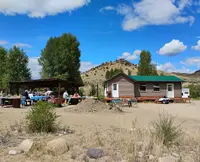
- Red Rock Mine and Garnet GalleryAlderRoadside garnet-screening stop on Montana Highway 287 between Alder and Virginia City with water tanks and shade building.
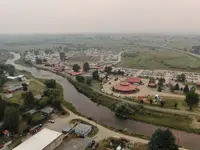
- Madison County Fair & RodeoTwin Bridges · FairgroundsMadison County Fairgrounds has lots to do for everyone. This is a place for family fun.
- RochesterTwin Bridges · Ghost townTownsite that grew up around the Watseca gold mine, discovered in 1869 and operated until the 1980s; remaining structures include stone buildings, a wooden head frame, an abandoned gold mill, and the old cemetery.
- Twin Bridges Flotilla and Alumni WeekendTwin Bridges · Annual town weekendA summer weekend in Twin Bridges, Montana, where decorated rafts, drift boats, and kayaks float the Beaverhead River as a parade, followed by a rubber duck race.

- Sheridan DaysSheridan · Festival/daysA four-day event with three nights of live music, anchored to Main Street and the Base Ball Park in Sheridan, MT.
- Twin Bridges Historical Association MuseumTwin Bridges · MuseumRenovated building full of historical artifacts and documents, continuing its mission with all-volunteer labor.
- Crystal Park Mineral Collection AreaRockhounding (crystals) areaA Forest Service dig at 7,800 feet on Montana's Pioneer Mountains Scenic Byway, where anyone with a shovel and a screen may take quartz and amethyst from decomposed granite.
Nearby towns: Ennis and Butte. All the towns of Montana. More of Montana: Fairs & Rodeos, Lookouts & Cabins, and Holiday Celebrations.
Sources
- Montana: A State Guide Book (1939), p. 290 archive.org/details/montanastateguid00federich/page/290
- Dillon’s Founding (historical marker) hmdb.org/m.asp?m=145700
- Beaverhead Canyon Gateway (historical marker) hmdb.org/m.asp?m=145713
- National Register record, Bannack Historic District npgallery.nps.gov/AssetDetail/NRIS/66000426
- Martin Barrett House (historical marker) hmdb.org/m.asp?m=209432
- Dillon Implement Company (historical marker) hmdb.org/m.asp?m=180752
- Beaverhead County beaverheadcountymt.gov/county-fair
- City of Dillon City Hall (historical marker) hmdb.org/m.asp?m=180694
- Dillon City Hall Historic District historicmt.org/items/show/3026
- Hotel Metlen (historical marker) hmdb.org/m.asp?m=253468
- U.S. Post Office — Dillon Main (historical marker) hmdb.org/m.asp?m=253462