Birch Creek Cabin
Dillon, Beaverhead County, Montana. Historic log cabin rental; January 1st through December 31st.
Details

- Where
- 420 BARRETT STREET, Dillon, MT 59725. Directions
- When
- Open year-round.
- Getting there
- About 20 miles northwest of Dillon: take the Apex exit, west on the Birch Creek gravel road 7 1/2 miles to the Education Center turnoff (in snow you may have to park at the turnoff), cross the bridge, first right on Thief Creek Road, cabin about 1/4 mile west at Thief Creek.
- Fees
- $65 per night.
- Access
- Electricity available; no water available.
- Walk-in or reserve
- Reservations available at Recreation.gov.
- Phone
- 406-683-3900
- Website
- fs.usda.gov
- Managed by
- Dillon Ranger District.
- Coordinates
- 45.41457, -112.85518.
Two rooms on Thief Creek
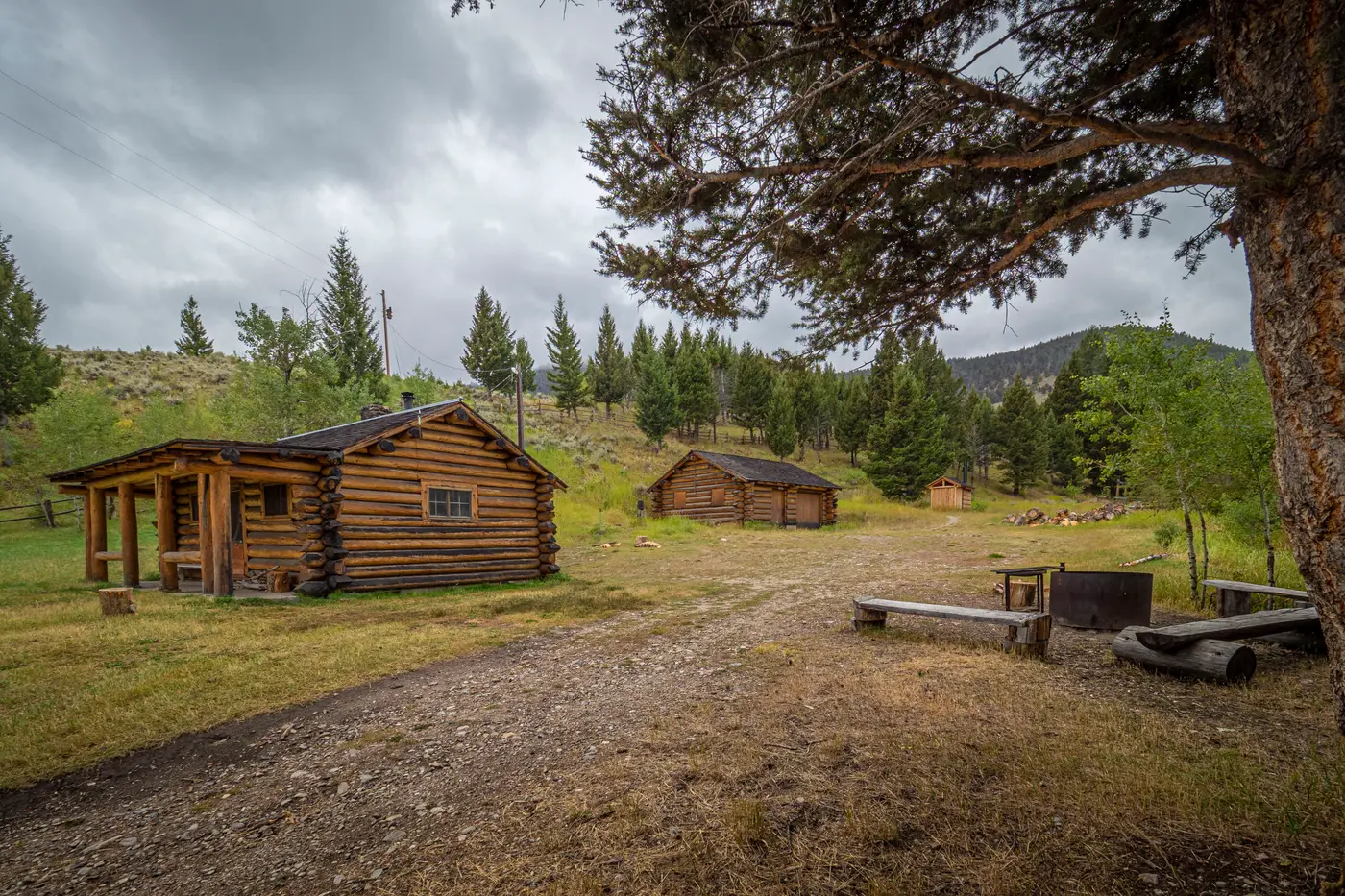
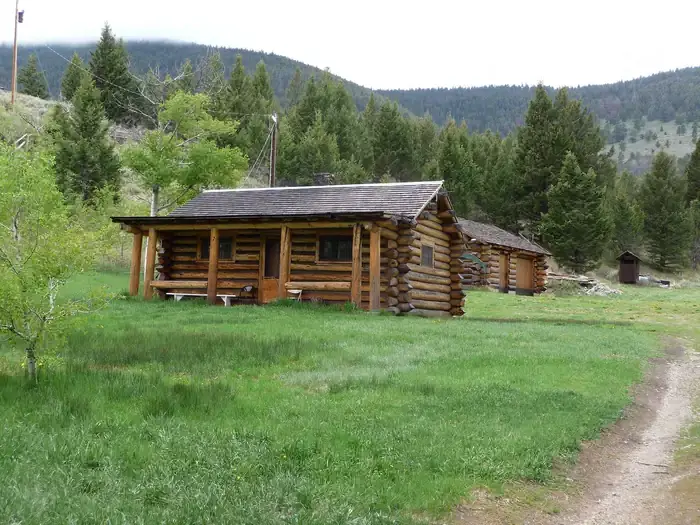
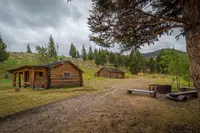
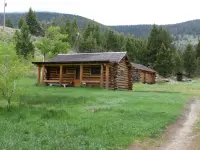
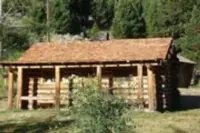
Birch Creek Cabin stands about a quarter mile west up Thief Creek Road, just past the bridge over Birch Creek. It is a two-room log cabin on the eastern slopes of the Pioneer Mountains, about 20 miles northwest of Dillon, where Thief Creek meets Birch Creek. Bunkbeds with mattress pads sleep up to four. The separate kitchen holds a table and chairs, an electric cook stove, pots and pans, and basic eating and cooking utensils. A wood stove heats the place. The Forest Service provides firewood but does not guarantee it, and it leaves an axe with one request: do not split wood inside the cabin or on the porch. A vault toilet stands 100 feet west.
The Dillon Ranger District of the Beaverhead-Deerlodge National Forest rents the cabin year-round for $65 a night. There is electricity, but there is no drinking water “until further notice,” and winter guests are told to haul in water for drinking, cooking and cleaning. Renters bring their own blankets, pillows, matches, food, toilet paper and garbage bags, and they carry out all trash when they leave. There is no cell phone reception at the cabin. Limited coverage, depending on the carrier, may be found east toward the forest boundary. The rental notices warn of bears, avalanches, and hantavirus, which the Forest Service lists as a risk at remote cabins.
The road in, and the snow on it
The approach leaves Interstate 15 at exit 74 at Apex, 12 miles north of Dillon, and turns west onto the gravel Birch Creek Road. The Forest Service puts the turnoff for the Education Center at 7½ miles. Recreation.gov calls it about 8. In most seasons a passenger car can make the drive. The site is not plowed in winter, though, and the last quarter mile may lie under impassable snow. Winter guests leave their cars at a parking area off Birch Creek Road near the Thief Creek Bridge and finish on skis, snowshoes or a snowmobile.
Two cross-country ski and snowshoe routes run next to the cabin: the Birch Creek Loop and the May Lake Ski Trail. In the warmer months a network of hiking trails climbs the surrounding peaks and valleys, some of them to alpine lakes holding grayling and cutthroat, brook and rainbow trout. There is also fishing in the creek below the cabin. Old mining roads cross the country and are open to foot, bike, off-highway vehicle and horse. Thief Creek Road itself is passable in summer and fall. Nearby are the Farlin Mining Community, Torrey and Tweedy mountains, the Aspen Picnic Area, Dinner Station Campground, and the Bond Lake, Deerhead Lake and Minneopa trailheads. Elk, moose, deer, pine marten, wolverine, northern goshawk, wolf and black bear live in the area, and, rarely, grizzly bear.
The cabin was in use as a forest ranger station as early as 1908. The rental pages give no more of its early story than that. They do note what sits on the slope above it: a work camp of the Civilian Conservation Corps.
Camp F-60
The camp occupies an open, east-sloping ridge of sage and grass. Torrey Mountain, which the camp’s 1982 National Register nomination puts at 11,000 feet, is in view to the west. Construction began on April 25, 1935. By May 9 a company of 200 men had moved in. Under the Forest Service, the company built and rebuilt roads in the area, developed campgrounds, fought fire, surveyed, carried out search and rescue, and strung telephone lines. According to the University of Montana Western, “the CCC boys, as they were often called,” were paid thirty dollars a month along with food, shelter and clothing. The nomination adds that Birch Creek put weight on education for the young men in residence.
By 1939 Camp F-60 had fifteen permanent buildings:
- a mess hall
- a welfare building
- four barracks
- the Army headquarters
- the Army and Forestry quarters
- a school building
- a forestry office
- a blacksmith shop
- an Army supply building
- a latrine and laundry
- a garage and repair shop
A pump house and a paint house stood among them. Ornamental stone fences, a fountain, and an entrance of ornamental posts marked the grounds. The camp ran from 1935 to 1941. The university says it was abandoned with the start of the Second World War.
Bible camp, register, classroom
Afterward the buildings changed slowly. In 1953, eleven of the garage’s thirteen bays were dismantled. Around 1962 a storage garage went up, built from the salvaged lumber. Between those dates, in 1955, the Evangelical Covenant Church of America began running the site as the “Birch Creek Bible Camp.” In the late 1970s the site passed to the Forest Service. A 1979 environmental assessment recommended developing it for education.
Joan Louise Brownell of Montana State University prepared the National Register nomination in March 1982, and the camp was listed that year. Her form describes a 14-acre district on sagebrush benchland. In it, eight structures made up the camp, six of them with no interior or exterior alterations, along with the two surviving garage bays and the later storage garage. The sources count the survivors differently. The Forest Service says 6 of the 15 original buildings remain. The University of Montana Western counts seven original structures.
The university’s School of Outreach began operating Birch Creek Outdoor Education in 1983. It later added the Bender Conference Center, a modern building with a dining hall and more overnight rooms. The Forest Service dates the Bender to 1984; the university says the mid-1980s. The Education Center turnoff on Birch Creek Road leads to these grounds. The center now hosts private retreats, outdoor education courses for grade-school children, and university classes. The Bender operates from May 1 to September 30.
Walk-in visitors are welcome at the camp year-round. In summer, the Army Headquarters and the School Building are open to the public. The headquarters is a small board-and-batten building set on a rock outcrop in a grove of Douglas fir, with the remains of the original walks and fountain to its west. The Army and Forestry Quarters are finished inside in knotty pine and divided into cubicles. On the north side of the hospital, a Red Cross is painted on the board and batten.
Notable Events
- 1908Used as a forest ranger station. recreation.gov
Sources
- recreation.gov/camping/campgrounds/234406
- recreation.gov/api/camps/campgrounds/234406
- fs.usda.gov/r01/beaverhead-deerlodge/recreation/birch-creek-cabin
- fs.usda.gov/media/44202
- umwestern.edu/section/birch-creek-center-history
- fs.usda.gov/r01/beaverhead-deerlodge/recreation/birch-creek-civilian-conservation-corps-camp
- npgallery.nps.gov/GetAsset/34607117-5760-4447-915a-4f0123c53db2