Butte
Silver Bow County, Montana.
Butte, in Silver Bow County, Montana, is a copper city built on a hillside, and its copper gave it a 41 percent share of the world copper market by 1910.1,2
Details
Point at a dot to see the place.Tap a dot to see the place. Road map of Butte.
In Butte
- Beautiful Things On Broadway, LLCButte · Gift and home decor shopA locally owned boutique in Historic Uptown Butte with a thoughtfully curated selection of antiques, handcrafted goods, and unique art pieces.
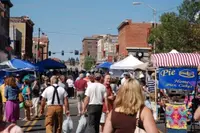
- Butte Farmers MarketButte · Farmers marketSince 1995, the Butte Farmers' Market has blossomed and grown, earning a reputation for providing shoppers with hanging and bedding plants, farm fresh eggs, fruits and vegetables, baked goods, jams and jellies, honey, and other prepared foods.
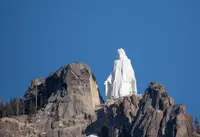
- Our Lady of the RockiesButte · 90-foot statue placed on the east ridge overlooking butteEntirely nondenominational tribute to women and mothers everywhere, built in the likeness of Mary, Mother of Jesus; draws visitors from all over the world.
The Calendar

History
Placer Camp on Silver Bow Creek
A marker in Centerville, in Butte, looks out on the Berkeley Pit, a former open-pit copper mine a mile long, half a mile wide, and 1,780 feet deep, mostly filled with water.1 In 1939 the Federal Writers’ Project guide found Butte, then Montana’s largest city at 39,532 people, lying against a bare southward-sloping hillside punctuated with copper ore dumps and the gallows frames that mark mine shafts.3 To the northwest stands Big Butte, the volcanic cone from which the city takes its name, marked by a white “M” placed near its summit by students of the State School of Mines.3
The guide dated the town to 1864, when G. O. Humphrey and William Allison arrived from the gold camp at Virginia City, and a roadside marker says Butte owes its existence to placer gold discovered on Silver Bow Creek.3,5 They also found a prospect hole four or five feet deep and beside it a pair of elk horns apparently used for digging, left by an earlier prospector who left no other record of himself.3 In 1866, when the first house went up on the present Quartz Street, forty men and five women were living in tents in Buffalo Gulch; the placer camp had between 400 and 500 inhabitants in 1867, water was scarce, and by 1870 half of them had left.3,6 The National Park Service gives a different start, writing that Butte was founded as a mining town after the discovery of silver in the region in 1872.4
Farlin’s Silver and Daly’s Copper
In 1874 William L. Farlin came back from Idaho and quietly claimed several quartz outcrops, and when word spread that the black ledges of Butte were rich in silver, miners swarmed to the camp.3 The excitement drew Marcus Daly, who had come from Ireland at 15 and learned mining in the Nevada silver camps.3 Daly sank a shaft on a claim of his own that had been passed over as valueless, struck copper instead of silver, and at 400 feet reached a vein 50 feet wide.3
A townsite patent was issued in 1876 and the city was incorporated in 1879, the same year a fire consumed much of Main Street and brought on masonry and stone construction.3,7 Two years later the Utah & Northern Railroad gave the camp an outlet to the Union Pacific at Ogden, the copper boom was on, and by 1885 Butte had 14,000 people.3 The Great Northern reached Butte in 1889, the Butte, Anaconda & Pacific was completed in 1894 to haul ore to the Anaconda smelter, and the Chicago, Milwaukee, St. Paul & Pacific ran its first trains through in 1908.3 Butte grew from 3,300 people in 1880 to over 45,000 in 1900, and the city issued 1,684 building permits in 1897 and 1898 as carpenters struggled to keep up.6 The Montana Historical Society’s marker says copper gave Butte a 41 percent share of the world copper market and 40,000 people by 1910, while the Park Service puts the district’s output at nearly one third of the world’s copper in the early 1900s.2,4 Daly formed the Amalgamated Copper Mining Company in 1899, Amalgamated won the War of the Copper Kings, and the end of its court battle with F. Augustus Heinze in 1906 set off a building boom.4,6,7
Strikes, Unions, and Martial Law
The first strike came at Walkerville in 1878, when workers at two mines refused a pay cut and formed the Butte Workingmen’s Union, and in 1893 the Western Federation of Miners was formed in Butte.4 By the early 20th century 34 unions represented over 18,000 workers, from miners and brewers to musicians and newsboys.4 Between 1906 and 1925, 685 miners in the Butte area died in accidents, and the Granite Mountain Memorial honors 168 miners lost in the Speculator Fire of 1917.1,4 In 1914 the Silver Bow County Courthouse, a Beaux Arts building by Link and Haire dedicated in 1912, became barracks for state militia while Butte was under martial law after violent labor disputes.8
China Alley
Chinese immigrants arrived in 1868 with the first placer gold mines, and in the early 1880s Ing Pong built a log cabin just west of Main Street, where a Chinatown began to form.4 When the unions and the Butte Chamber of Commerce called a boycott of Chinese and Japanese businesses in 1896, 130 businessmen led by Hum Fay of the Palace Restaurant sued in federal court and won.4 By 1940 only 70 to 80 Chinese remained in Butte, down from an estimated high of 2,500.4 The Mai Wah Noodle Parlor and Wah Chung Tai buildings now house a museum of the Asian experience in Montana, and the Pekin Noodle Parlor still occupies the brick building on South Main Street it moved into in 1911.4
The Pit and the Landmark District
In 1955 the Anaconda Company opened the pit to mine low-grade metals, and it swallowed Meaderville, McQueen, and W.A. Clark’s Columbia Gardens amusement park.5 Mining ceased in the 1980s, when ARCO, which had bought the Anaconda company in 1977, closed its entire Montana operation.4 The National Park Service named Butte a National Historic Landmark in 1961 and in 2006 extended the landmark to Walkerville and Anaconda, which the marker calls the largest NHL in the West.5 Over 100 buildings from before 1900 still stand in the business district, among them City Hall, which held the city government from 1891 until city and county governments consolidated in 1977.7,9
Within 30 Miles
Measured in a straight line from the town, nearest first.
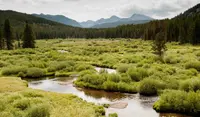
- Pioneer Mountains Scenic BywayWise River · Scenic highwayOn the Pioneer Mountains Scenic Byway in the Beaverhead-Deerlodge National Forest, you can travel the length of the Pioneer Mountain Range. Granite peaks topping 10,000 feet in elevation are to the east, and gentler, forested terrain stretches out to the west.
- Hells Canyon Guard StationWhitehall · Quaint log cabinA 1906 ranchers' line cabin on Hells Canyon Creek in Montana's Highland Mountains, later a Forest Service guard station, now rented by the night behind a key-code lock.
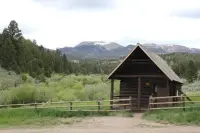
- Canyon Creek CabinMelrose · Reservation cabinA 1930 Forest Service guard station rented by the night, set at 7,300 feet beneath a cliff in Montana's eastern Pioneer Mountains where mountain goats keep house.
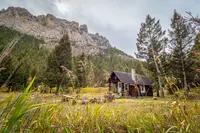
- Ringing Rocks TrailheadPipestone · Geologic areaUnique geological formation. Part of the edge of the Boulder Batholith, and found in a large jumbled pile of boulders, the rocks in this unique geologic formation near Butte, Montana, chime melodically when tapped lightly with a crescent wrench or mallet.
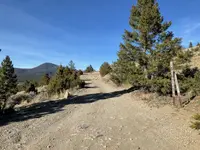
- Black Dog AntiquesAnaconda · Antique mallHoused in the Historic Washoe Brewery Building, an Italian Renaissance-inspired brick landmark; the main floor has 10,000 total square feet of retail space.
- Copper Village Museum and Arts CenterAnaconda · Museum and arts centerTake a step into Anaconda's past when you visit our museum, located in the basement of our historic building. Our exhibits bring to life the rich history of Anaconda, focusing extensively on the town's copper boom.
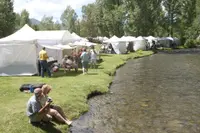
- Smeltermen's DayAnaconda · Annual community celebrationAnaconda, Montana's three-day August celebration of its smelter workers, once a union holiday held August 8 because the ACM weatherman named it the best bet against rain or snow.
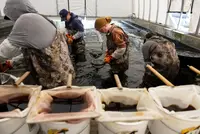
- Washoe Park Trout HatcheryAnaconda · State-run hatcheryWashoe Park also has the state's oldest fish hatchery located at the east end of the park.
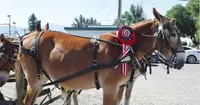
- Whitehall Frontier DaysWhitehall · Community eventWhitehall Frontier Days fills the last weekend of July in this Jefferson Valley railroad town with two nights of PRCA rodeo, a Legion Street parade, and a firemen's duck race.
- Twin Bridges Historical Association MuseumTwin Bridges · MuseumRenovated building full of historical artifacts and documents, continuing its mission with all-volunteer labor.
- Madison County Fair & RodeoTwin Bridges · FairgroundsMadison County Fairgrounds has lots to do for everyone. This is a place for family fun.
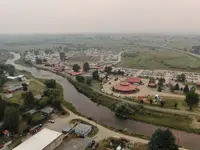
- RochesterTwin Bridges · Ghost townTownsite that grew up around the Watseca gold mine, discovered in 1869 and operated until the 1980s; remaining structures include stone buildings, a wooden head frame, an abandoned gold mill, and the old cemetery.
- Twin Bridges Flotilla and Alumni WeekendTwin Bridges · Annual town weekendA summer weekend in Twin Bridges, Montana, where decorated rafts, drift boats, and kayaks float the Beaverhead River as a parade, followed by a rubber duck race.

Nearby towns: Philipsburg, Dillon, Helena, and Ennis. All the towns of Montana. More of Montana: Flea Markets and Fairs & Rodeos.
Sources
- Welcome! To the Top of the World (historical marker) hmdb.org/m.asp?m=128057
- Butte National Historic Landmark District (historical marker) hmdb.org/m.asp?m=184878
- Montana: A State Guide Book (1939), p. 134 archive.org/details/montanastateguid00federich/page/134
- Butte-Anaconda Historic District, Montana (U.S. National Park Service) nps.gov/places/butte-anaconda-historic-district.htm
- Butte (historical marker) hmdb.org/m.asp?m=186109
- Butte National Historic Landmark District historicmt.org/tours/show/13
- Central Business District, Butte: Butte National Historic Landmark District historicmt.org/items/show/37
- Silver Bow County Courthouse: Butte National Historic Landmark District historicmt.org/items/show/1937
- City Hall (historical marker) hmdb.org/m.asp?m=183684