Philipsburg
Granite County, Montana.
Philipsburg, seat of Granite County, is a silver town laid out in 1867, where masonry replaced the wooden false-front buildings on Broadway.1,2,3
Details
- Founded
- Philipsburg’s townsite was laid out on June 15, 1867, though the 1939 Federal Writers’ Project guide dates its settlement to 1866.1,2
- Name
- The town is named for mining engineer Philip Deidesheimer, superintendent of a silver-mining company, though a University of Montana column gives his name as Peter Deiesheimer.1,4,5
- Last checked
- October 6, 2026.
Point at a dot to see the place.Tap a dot to see the place. Road map of Philipsburg.
In Philipsburg
- Granite County Museum & Cultural CenterPhilipsburg · Cultural centerThe Granite County Museum & Cultural Center, located in the historic Courtney Hotel on South Sansome Street, was founded in 1991 with the help of dedicated volunteers and generous donors and held its grand opening May, 1992.

- Hogback HomesteadPhilipsburg · Fully furnished two story log cabinA 1917 log homestead on Hogback Creek in Montana's Sapphire Mountains, rented out by the Lolo National Forest, that stands on a campsite people used for perhaps ten thousand years.
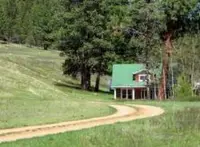
- Moose Lake CabinPhilipsburg · CabinHistoric 1917 Forest Service work station cabin in the Beaverhead-Deerlodge National Forest, offering close access to the Anaconda-Pintler Wilderness Area.
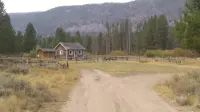
- Morgan-Case HomesteadPhilipsburg · Rustic log cabinA rustic log cabin on approximately 320 acres along Rock Creek, listed on the National Register of Historic Places for its significance relating to early homesteading and ranching in Granite County and western Montana.
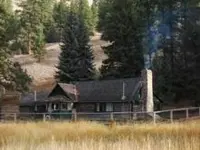
- Racetrack CabinPhilipsburg · USFS rental cabinRacetrack cabin is situated next to Racetrack Creek on the east side of the Flint Creek Range at an elevation of about 6,300 feet surrounded by dense forest near Deer Lodge Montana. Originally built as a mining cabin in the 1930s it was later donated to the Forest Service and refurbished for use by the public.
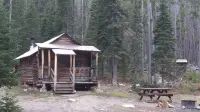
- Stony CabinPhilipsburg · Forest service cabin rentalStony Cabin is a small primitive cabin that was built in 1914 as a place for Forest Service employees to sleep while working in the area. The cabin is situated close to Stony Creek Road and across the street from Stony Creek Campground.
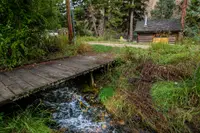
- The Ranch at Rock CreekPhilipsburgSecluded in one of Montana's most pristine valleys, the ranch's 19th-century homestead thrives in balance with its diverse eco-system. The world's first Forbes Travel Guide Five-Star guest ranch, all-inclusive design with twice-daily activities.
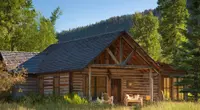
- West Fork Of Rock Creek Cabin (MT)Philipsburg · Log cabinIt is a large cabin that provides a great experience in the mountains of southwestern Montana. The cabin offers access to numerous trails and wildlife viewing, as well as a comfortable place to picnic and spend the nights.
The Calendar

History
Masonry on Broadway
On Broadway in Philipsburg, masonry blocks of the 1880s and 1890s stand where the wooden false-front buildings of the mining camp days once stood.3,6 The town is the county seat of Granite County, in western Montana, and counted 1138 residents in 1980.2 After the World War I manganese boom, Philipsburg slipped into a stable existence based on agriculture, government, logging, limited mining, and tourism.3
Deidesheimer’s Townsite on Flint Creek
Silver was discovered south of the present town in 1864, and the first claims were staked in 1865.3,7 Early in the summer of 1866 one of the locators, Hector Horton, interested James Stuart and the St. Louis and Montana Mining Company in a prospecting trip, and a silver rush followed on the Hope, Algonquin, Speckled Trout, and other lodes.7 In 1866 the Polish-born merchant William Weinstein came around the mountain from the mining camp of Cable with a wagon-load of goods and became Philipsburg’s first general merchant.8 Philipp Deidesheimer, known from the Comstock, arrived in 1866 and evaluated the district for the St. Louis and Montana Mining Company.7 In the spring of 1867 Deidesheimer built a wagon road up Flint Creek, and on June 15 of that year the townsite was laid out.2 An area newspaper reported the town growing at the “rate of one house per day,” and by December 1867 it held about 1500 people.2,3 The town carries Deidesheimer’s name; the 1939 Federal Writers’ Project guide calls him Philip Deidesheimer, superintendent of a silver-mining company, and dates the settlement to 1866, while a University of Montana column names him Peter Deiesheimer.1,5,7
The Hope Mill and the Empty Town
In 1867 Deidesheimer supervised construction of the Hope Mill, which the 1939 guide describes as a ten-stamp silver mill built to handle the free-milling ores from the Hope Mine.1,7 The same guide calls it the first silver mill in Montana and says it served as a fort during Indian troubles.1 The Hope operated only intermittently, and by 1869, when it was temporarily shut down, most of the residents had left town.2 Honora Hynes ran a two-and-one-half-story frame boardinghouse built in 1880 until the silver crash of 1893, and a marker calls it the last-remaining frame boardinghouse in a town whose wooden commercial buildings were mostly rebuilt in brick.9
Granite Mountain and the Railroad
Charles McLure, superintendent of the Hope Mill, took a lease and option on the Granite Mountain property in 1880 and formed a syndicate of St. Louis investors.7 At about 200 feet of depth the miners struck bonanza silver ore.7 The Granite Mountain and the Bi-Metallic worked the same orebody, first located in 1872, and from 1885 to 1893 the Granite Mountain produced $20 million in silver while the Bi-Metallic produced $6 million from 1883 to 1893.7 The Mining History Association calls Granite, 2 ½ miles southeast of Philipsburg, the greatest silver bonanza in the world in its time.7 Until 1887 five stage lines ran between Philipsburg and Granite, and on September 15 of that year the Philipsburg branch of the Northern Pacific Railroad arrived.2 Houses went up in a five-year rush between 1887 and 1891, and by 1887 the town had three brick yards operating “full force.”2 Doe and Hoyer put up a brick building in 1887 whose drug store, run by M. E. Doe and his sons until 1969, sold the town’s first gasoline, hand pumped from barrels out front.6
Panic, Sapphires, and Manganese
The Panic of 1893 sharply curtailed the town’s growth, as 400 miners in Philipsburg and Granite were laid off and Granite, with its 2,500 residents, became a ghost town overnight.2 Sapphires found in Rock Creek in 1892 helped stabilize the local economy, and the first small round stones were shipped to Switzerland for watch bearings.3,5 Granite County was created in 1893 with Philipsburg as its seat, and Colonel J. W. Morse’s lecture hall of 1887 served as the county courthouse.3,9 The Philipsburg Grade School, designed by Bell and Kent and financed by a $30,000 bond, was dedicated in 1896, and two hundred students attended its first year.10 The first permanent home for Granite County offices, designed by John Link and Charles Haire and cut from Montana granite, was completed in 1913.9 The Philipsburg Mining Co. began mining manganese at the Algonquin mine in 1916, by 1918 the town had shipped 127,415 tons of high-grade ore, and the historic district’s register entry calls Philipsburg the largest supplier of domestic manganese during World War I.2,3 With manganese profits, brothers Morris and Humphrey Courtney built a building in 1918 whose basement held the Granite County Garage and whose first floor sold Overland automobiles, and in 1991 the Granite County Museum & Cultural Center was founded in the Courtney Hotel.9,11,12 The Philipsburg State Bank failed in 1924, two mills burned in 1925 and were not rebuilt, and by 1930, the nomination says, the town “seems to have settled into a stable but limited existence.”2 In 1939 the Federal Writers’ Project guide found a silver town of 1,355 whose mines also produced manganese, where “luxurious automobiles” stopped before very simple houses.1 Weinstein’s store building, later a bank and a mortuary, has held mining company offices for the Taylor-Knapp Company since 1950.8
Within 30 Miles
Measured in a straight line from the town, nearest first.
- Washoe Park Trout HatcheryAnaconda · State-run hatcheryWashoe Park also has the state's oldest fish hatchery located at the east end of the park.

- Smeltermen's DayAnaconda · Annual community celebrationAnaconda, Montana's three-day August celebration of its smelter workers, once a union holiday held August 8 because the ACM weatherman named it the best bet against rain or snow.
- Copper Village Museum and Arts CenterAnaconda · Museum and arts centerTake a step into Anaconda's past when you visit our museum, located in the basement of our historic building. Our exhibits bring to life the rich history of Anaconda, focusing extensively on the town's copper boom.

- Black Dog AntiquesAnaconda · Antique mallHoused in the Historic Washoe Brewery Building, an Italian Renaissance-inspired brick landmark; the main floor has 10,000 total square feet of retail space.
- Old Montana Prison MuseumDeer Lodge · Museum complex dedicated to law enforcementGuided and self-guided tours lead through the intimidating Cell House and into the chilling slide bar cells and black box of Maximum Security.
- Territorial DaysDeer Lodge · Annual territorial days celebrationTerritorial Days is the Powell County Chamber of Commerce's one-day June festival on Main Street in Deer Lodge, Montana, opening with a road race called the Prison Break Run.

- Grant-Kohrs Ranch National Historic SiteDeer Lodge · National historic siteWide open spaces, the hard-working cowboy, his spirited cow pony, and vast herds of cattle are among the strongest symbols of the American West. Once the headquarters of a 10 million acre cattle empire, Grant-Kohrs Ranch National Historic Site preserves these symbols and commemorates the role of cattlemen in American history.
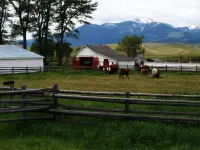
- Tri-County FairDeer LodgeAnnual Tri-County Fair held 3rd week of August, 4-H/FFA Fair with open class entries, rodeo and carnival.

Nearby towns: Butte. All the towns of Montana. More of Montana: Town Festivals and Lookouts & Cabins.
Sources
- Montana: A State Guide Book (1939), p. 372 archive.org/details/montanastateguid00federich/page/372
- National Register nomination, Historic Resources of Philipsburg, Montana npgallery.nps.gov/NRHP/GetAsset/NRHP/64000437_text
- Philipsburg Historic District historicmt.org/items/show/50
- About Philipsburg, Montana visitphilipsburg.com/about
- Philipsburg and the Flint Creek Valley: Silver and Sapphires umt.edu/this-is-montana/columns/stories/philipsburg.php
- Doe’s Drug Store (historical marker) hmdb.org/m.asp?m=205451
- Montana Mining Tours mininghistoryassociation.org/Philipsburg.htm
- Weinstein Building: Philipsburg Historic Disctrict historicmt.org/items/show/640
- Philipsburg Historic Disctrict historicmt.org/tours/show/39
- Philipsburg Grade School historicmt.org/items/show/643
- Courtney Hotel (historical marker) hmdb.org/m.asp?m=49371
- Granite County Museum & Cultural Center visitmt.com/listing/granite-county-museum-cultural-center-3180