
Hogback Homestead
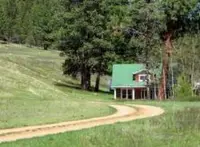
Philipsburg, Granite County, Montana. Fully furnished two story log cabin; April 1 - November 30.
Details

- Where
- 2933 Rock Creek Road, Philipsburg, MT 59858. Directions
- When
- Check-in is at 3 p.m. and check-out is at 11 a.m.
- Getting there
- From I-90 take Rock Creek Road (exit 126) south 29 miles, or take Scenic Highway 1 south toward Philipsburg; 1 mile before Philipsburg turn west on State Road 348, go 13 miles, cross Rock Creek, turn north on Rock Creek Road 102 and go 10 miles to the homestead.
- Fees
- Overnight Use: $75 per night.
- Access
- Bring your own bedding, linens and cleaning supplies. Drinking water may not always be available. Outdoor fire ring available.
- Walk-in or reserve
- Upon reservation renters will receive gate and cabin combination codes via email.
- Phone
- 406-329-3814
- Website
- fs.usda.gov
- Managed by
- Missoula Ranger Station.
- Established
- 1917.
- Coordinates
- 46.41046328, -113.6993802.
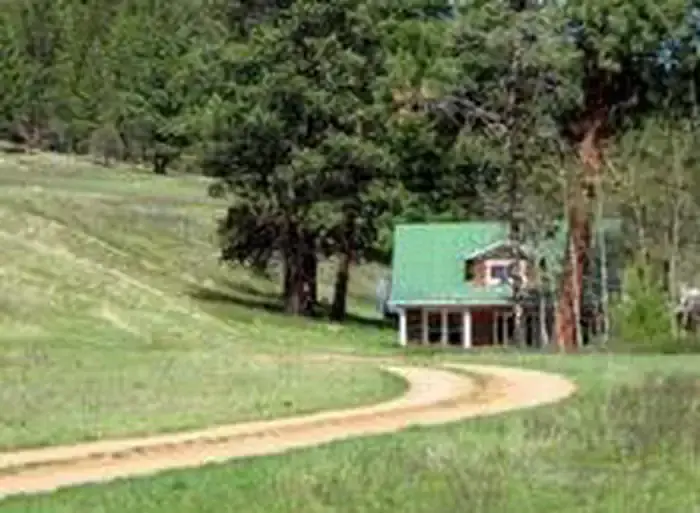
The gate at Hogback Homestead opens by combination, and the code arrives by email with the reservation. In late fall and early spring the lock tumblers tend to freeze, and Recreation.gov advises renters to carry a lighter to warm them. Beyond the gate stands a two-story log cabin on about five acres along Hogback Creek, near where it meets Rock Creek in Granite County. The rental listing gives the elevation as 4,500 feet. Philipsburg lies about twenty miles to the southeast.
The road in is Rock Creek Road. From Interstate 90 it is hard-surfaced for 12 miles, then turns to single-lane gravel with pull-outs, blind turns and steep grades, and the Forest Service calls it unsuitable for RVs or trailers. From the south the route leaves the highway near Philipsburg on State Road 348, crosses Rock Creek and turns north. Patrick Shea rode that way by bicycle for a Southwest Montana travel story. After a short, steep climb over loose gravel and potholes, he found the homestead “on the coasting side of the hill.” The trailhead for Hogback Ridge and a network of trails sits at the entrance to the site. Rock Creek, a Blue Ribbon trout stream, runs close by. The surrounding forest is Douglas fir and lodgepole pine, with bighorn sheep, mountain goats, elk, moose, deer and black bears. Shea writes that the Salish and Pend d’Oreille name for Rock Creek translates to “logs in the water.”
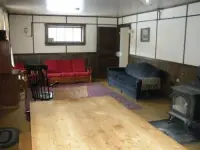
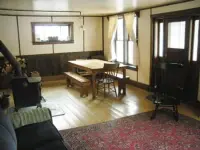
Bench table, wood stove, hand pump
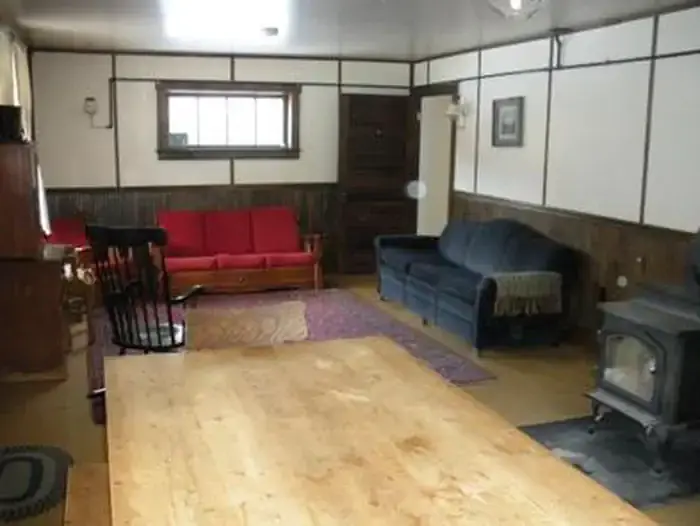
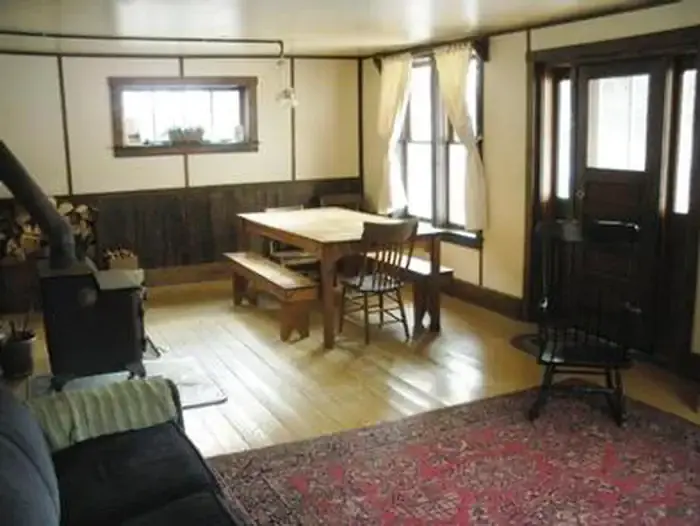
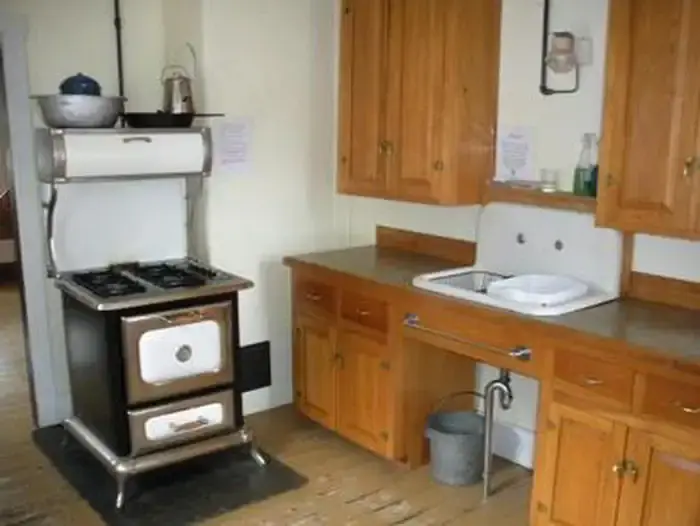
The cabin sleeps eight. The first floor is wheelchair accessible and holds the kitchen, a combined living and dining room, and a bedroom with a double bed. Upstairs are a second double-bed room and a room with two sets of bunks. The furniture is period: a large bench-style dining table, a kitchen table, chairs, couches and dressers. A wood stove heats the house, and meals are cooked on a propane stove. The lights run off a solar panel array and a bank of batteries.
Water comes, intermittently, from a hand pump behind the house, and the Forest Service does not guarantee it is fit to drink. Renters bring their own drinking water, along with bedding, towels, food, matches and toilet paper. An accessible vault toilet stands out back, and there is an outdoor fire ring. No pets are allowed. The cabin rents from April 1 to November 30. At either end of that season, snow can stop vehicles short of the cabin, and guests may hike or ski as much as a mile to the door. The Forest Service describes the stay as “an opportunity to experience the setting and lifestyle of the early 1900s.”
Gernhard’s flume
By the Forest Service’s account, the house was built in 1917 as a permanent home. Shea names an earlier work on the claim. In 1913, he writes, Charles F. Gernhard built an extensive wood flume irrigation system to water his crop fields.
Brenda Lynn Reed studied the site for a University of Montana master’s thesis in 1994. She dated the cabin to the second decade of the century and wrote that its artifacts reflect farming, household tasks, “and the individuality of the site’s occupants.” The homesteader plowed the upper terrace above the cabin. Together with burrowing rodents and frost, the plowing mixed the soil there.
A campsite under the yard
That soil holds older things. The cabin and its yard occupy two terraces that Hogback Creek formed near its junction with Rock Creek, and together they make up archaeological site 24GN13. University of Montana archaeologists first recorded its prehistoric component in 1974.
In 1979 the Lolo National Forest bought 320 acres in the Upper Rock Creek drainage. The purchase took in two patented homestead claims with buildings still standing, Hogback and Morgan-Case. Forest workers examined the cabin that year and gave it its own site number, 24GN167. On visits in 1979, 1983 and 1988 they noted stone artifacts on the ground. In June and July of 1989, staff and volunteers dug seven test units, each a meter square, on the upper terrace, reaching depths of 60 centimeters. The flakes and tool fragments they found showed that the site was eligible for the National Register of Historic Places.
In 1990 the Missoula Ranger District began rehabilitating the cabin, both for rental and to interpret early homesteading in western Montana. The digging had to come first. C. Milo McLeod, the Lolo National Forest archaeologist, later described a pre-contact site in use from 10,000 years before present through the historic period. Crews recovered nearly 4,000 artifacts before the earth moving needed to restore the dwelling and improve access. Reed’s thesis dealt with the stone, nearly 2,000 flaked lithic artifacts. Most of the material across the site came from the top twenty centimeters of earth.
Because the layers were so disturbed, Reed relied on projectile point styles to date the occupations. The styles suggest use perhaps as early as ten thousand years ago. People using Hanna points, and possibly McKean, certainly camped there, and the sequence runs through Pelican Lake and Besant to Late Corner-Notched. In 1993 excavators found a point that somewhat resembles Folsom; some examiners suggested it was a relatively late Paleoindian point.
Reed concluded that 24GN13 was a campsite. Both men and women probably used it, though not necessarily at the same time, and they carried out a range of tasks there. She argued that Native Americans likely visited over several thousand years, and that some of them had probably been to obsidian quarries to the south or traded with people who had. Citing McLeod, she added that scarred ponderosa pines may show visits within the last two hundred years. Forest Service staff asked her not to disclose the exact location of the prehistoric component, and her thesis leaves out a larger-scale map.
Volunteers on Upper Rock Creek
The Missoula Ranger District and Passport in Time volunteers finished the rehabilitation in 1995. Upstream, the district began work in 2000 on the second cabin from the 1979 purchase, the Morgan-Case Homestead. McLeod says an African American woman from Maryland settled that claim in the late 1880s. Shea names her as Agnes “Annie” Morgan, born in Baltimore in 1833, and has her arriving in the early 1890s. Both cabins now rent through the Forest Service.
When McLeod retired in 2008, he organized the Friends of Upper Rock Creek Historic District to help with preservation maintenance at Hogback Homestead and two other district properties. In April 2025 he told both cabins’ stories to the Montana Archaeological Society at the Depot Center in Livingston, in a talk titled “Surprising and Unintended Consequences of Managing Cultural Resources: Rehabilitation of Two Historic Homesteads; Granite County Montana.”
Notable Events
- 1917The homestead was built as a permanent home. fs.usda.gov
- 1979The Lolo National Forest purchased 320 acres in the Upper Rock Creek drainage, incorporating the patented Hogback and Morgan-Case homestead claims with standing architecture. mtarchaeologicalsociety.org
- 1990The Missoula Ranger District began rehabilitating the Hogback Homestead to preserve and interpret its historic values; the homestead-era improvements overlay a significant pre-contact archeological site dating from 10,000 BP through the historic period, requiring extensive data recovery. mtarchaeologicalsociety.org
- 1995The Missoula Ranger District and Passport in Time volunteers completed the rehabilitation effort. nrmra.org
- 2008On retirement, C. Milo McLeod organized the Friends of Upper Rock Creek Historic District to assist with preservation maintenance at Hogback Homestead and two other district properties. nrmra.org
People
- C. Milo McLeod, Retired Lolo National Forest archaeologist who organized the Friends of Upper Rock Creek Historic District to help preserve Hogback Homestead (2008).
- Brenda Lynn Reed, Author of an anthropology thesis on flaked lithic artifacts from the Hogback Homestead site (24GN13) (1994).
Sources
- fs.usda.gov/r01/lolo/recreation/hogback-homestead
- recreation.gov/camping/campgrounds/233337
- nrmra.org/Newsletters/2024/fall2024_10212024.pdf
- travelersrest.org/events/winter-storytelling
- mtarchaeologicalsociety.org/mas-2025-program
- southwestmt.com/specialfeatures/this-is-montana/special-places/from-philipsburg-biking-the-rock-creek-route
- scholarworks.umt.edu/etd/2371
- visitmt.com/listing/hogback-homestead-cabin-13899
- scholarworks.umt.edu/cgi/viewcontent.cgi?article=3390&context=etd