Crystal Park Mineral Collection Area
Beaverhead County, Montana. Rockhounding (crystals) area.
Details

- Where
- 420 Barrett Street Dillon, MT 59725. Directions
- When
- Open seasonally from mid-June through mid-October, dependent on snow and weather conditions.
- Season
- mid-June through mid-October, depending on snowpack.
- Getting there
- From Dillon take I-15 South for 3 miles. Take the Highway 278 exit and continue West for 22 miles. Turn North onto the Pioneer Mountains Scenic Byway Road 73 and continue for approximately 17 miles.
- Fees
- Day Use: $5 per person per day (11 and older).
- Access
- Site Open.
- Walk-in or reserve
- First come-first served.
- Phone
- 406-683-3900
- Managed by
- Dillon Ranger District.
- Coordinates
- 45.4867, -113.10422.
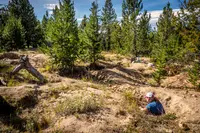
After a rain the crystals lie on top of the ground. “If you come to the park after a rain,” Gail Plovanic, recreation manager for the Beaverhead-Deerlodge National Forest, told NBC Montana in 2025, “you’ll see them shining on the surface.” The ground is decomposed granite on a hillside at 7,800 feet, off the Pioneer Mountains Scenic Byway between Wise River and Polaris, in Beaverhead County. East of the road the Pioneer Mountains climb to 10,000 feet. Crystal Park lies to the west.
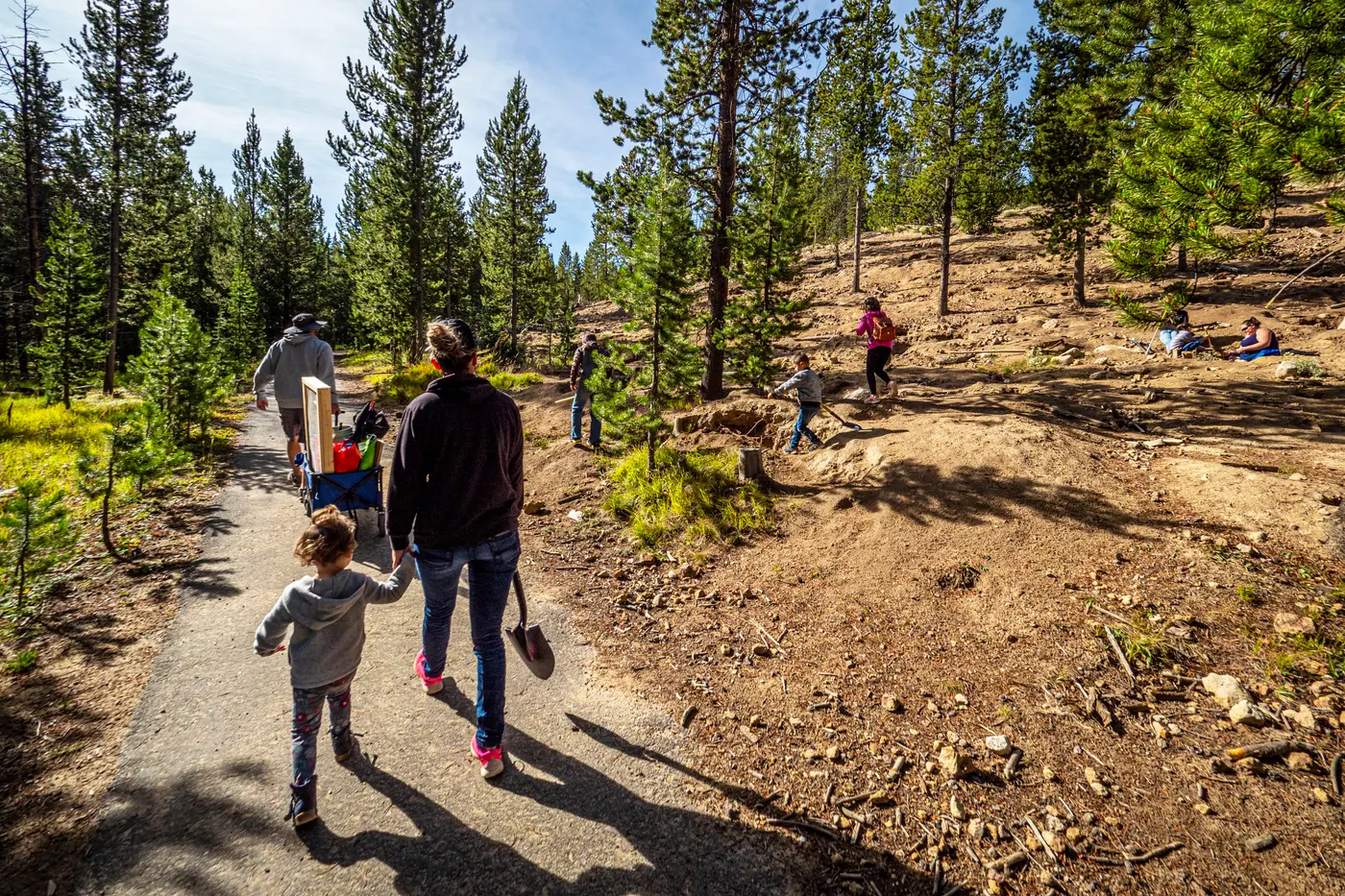
The Forest Service has reserved 220 acres here for rockhounding, but not all of it is dug at once. The Dillon Ranger District’s 2023 brochure puts the open digging area at about 30 acres. Plovanic described a 40-acre perimeter. A paved trail with benches and an overlook runs around the park and is built to be universally accessible. The digging begins a short walk from paved parking. There are three picnic sites with tables and grills, vault toilets, and a hand pump for drinking water. Visitors pay the day fee at the parking area on a self-serve system, and a host usually stays on site through the summer to help visitors and see that the rules are kept. The park is open for day use only. The nearest campground is Price Creek, with 28 units in the trees about a mile south.
Shovels, screens, and chopsticks
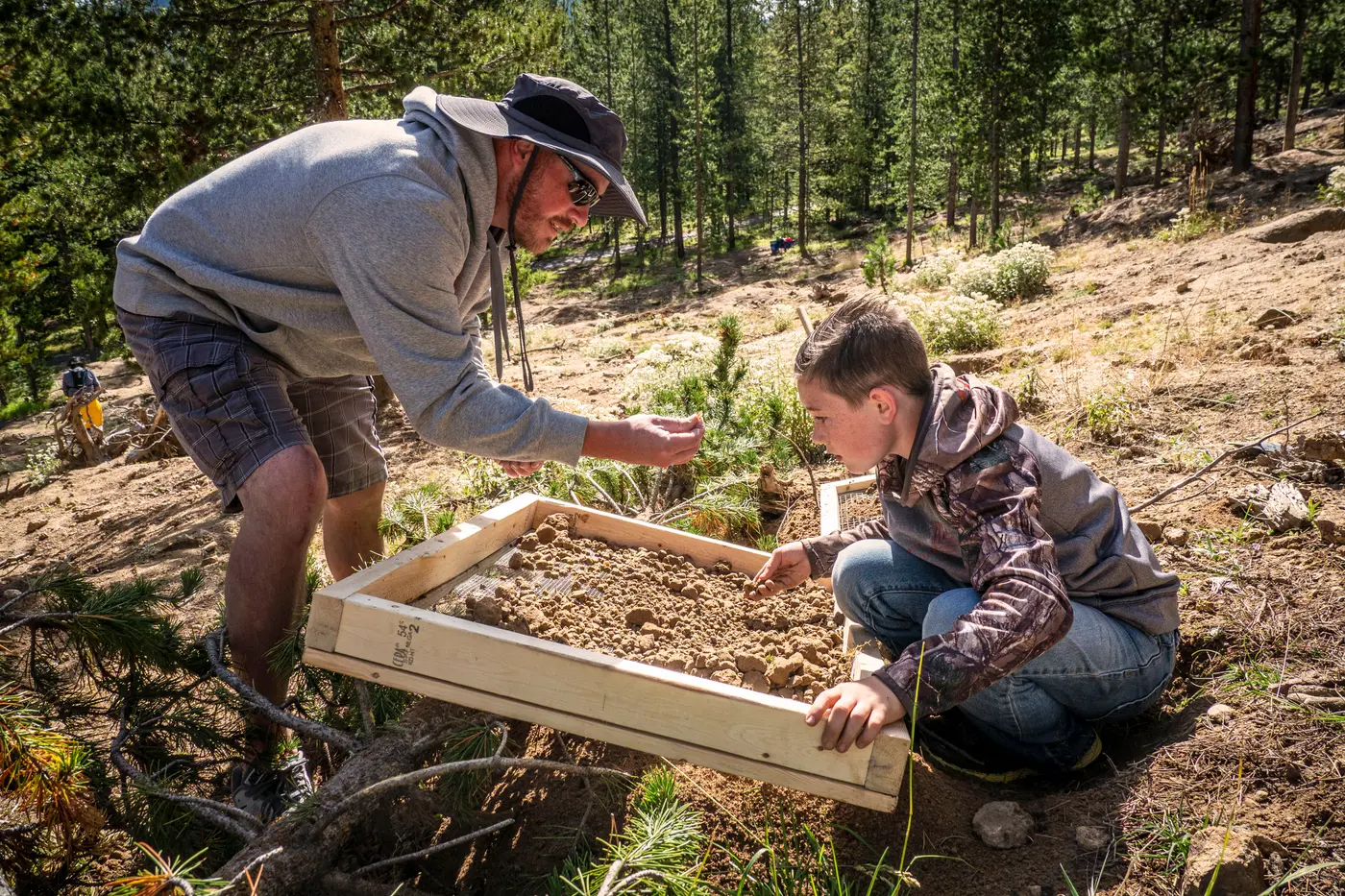
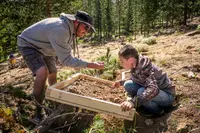
Only hand tools are allowed. “It’s rather easy digging,” said Paul Senn, a professional prospector who grew up in the area and owns Montana Crystal Miner. “You’re digging through decomposed granite.” He brings a shovel or two and a screen. “It’s just moving and sifting dirt.” To lift a crystal free: “I recommend chopsticks because they don’t hurt the crystals.”
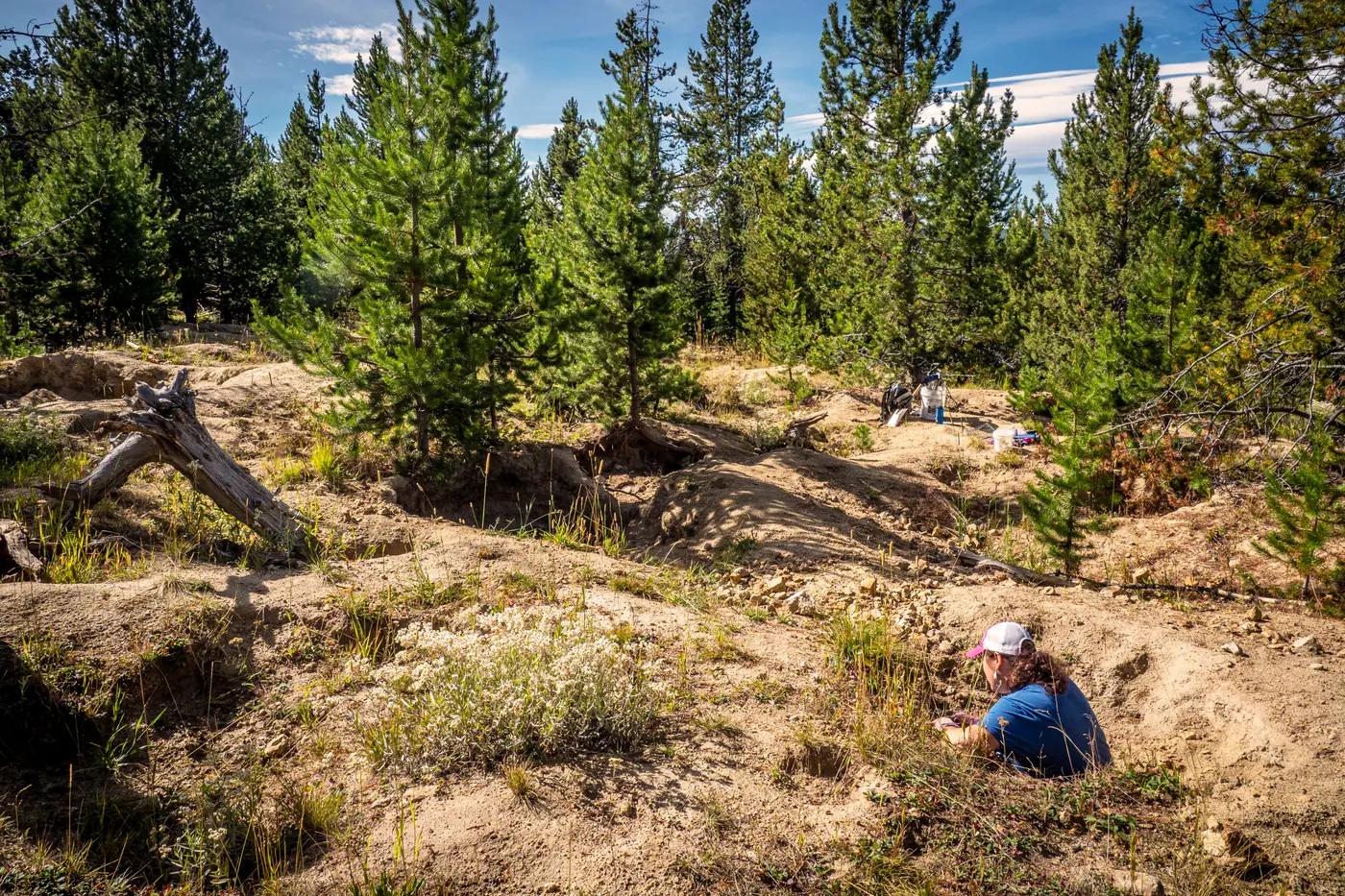
The rules are posted on signs through the park. Each person may dig five days a season, and commercial digging is barred. No tunneling, no overhanging banks, and no hole walls higher than four feet. Diggers may not pile rocks at the edge of a hole or dig within five feet of a trail, parking area, sign, or fence. Nobody digs under a tree. “It creates instability, and the trees could tip over on top of you,” Plovanic said. “But also, it kills the trees.”
In August 2025 NBC Montana’s Kevin Maki found Karla Schaff at work with her daughter and grandchildren. “I’m from Balfour, North Dakota,” she said. “I’m a rock hound.” It was her fourth trip. “My daughter does make some jewelry. But mostly we just enjoy having them. We share them.” Her granddaughter, Delilah Beherendsen, allowed that the work “sometimes can get a little boring. But it is fun.” Then she turned up a smoky amethyst, and a man digging his own hole nearby looked over. “That’s a pretty scepter,” he said. “Oh, my goodness.” Not far off, Everett Hatfeild, down from Washington with his mother to see his grandparents, held up a can of crystals he had sifted out that morning. “This is the most I’ve ever seen,” he said.
Six sides, smoky and purple
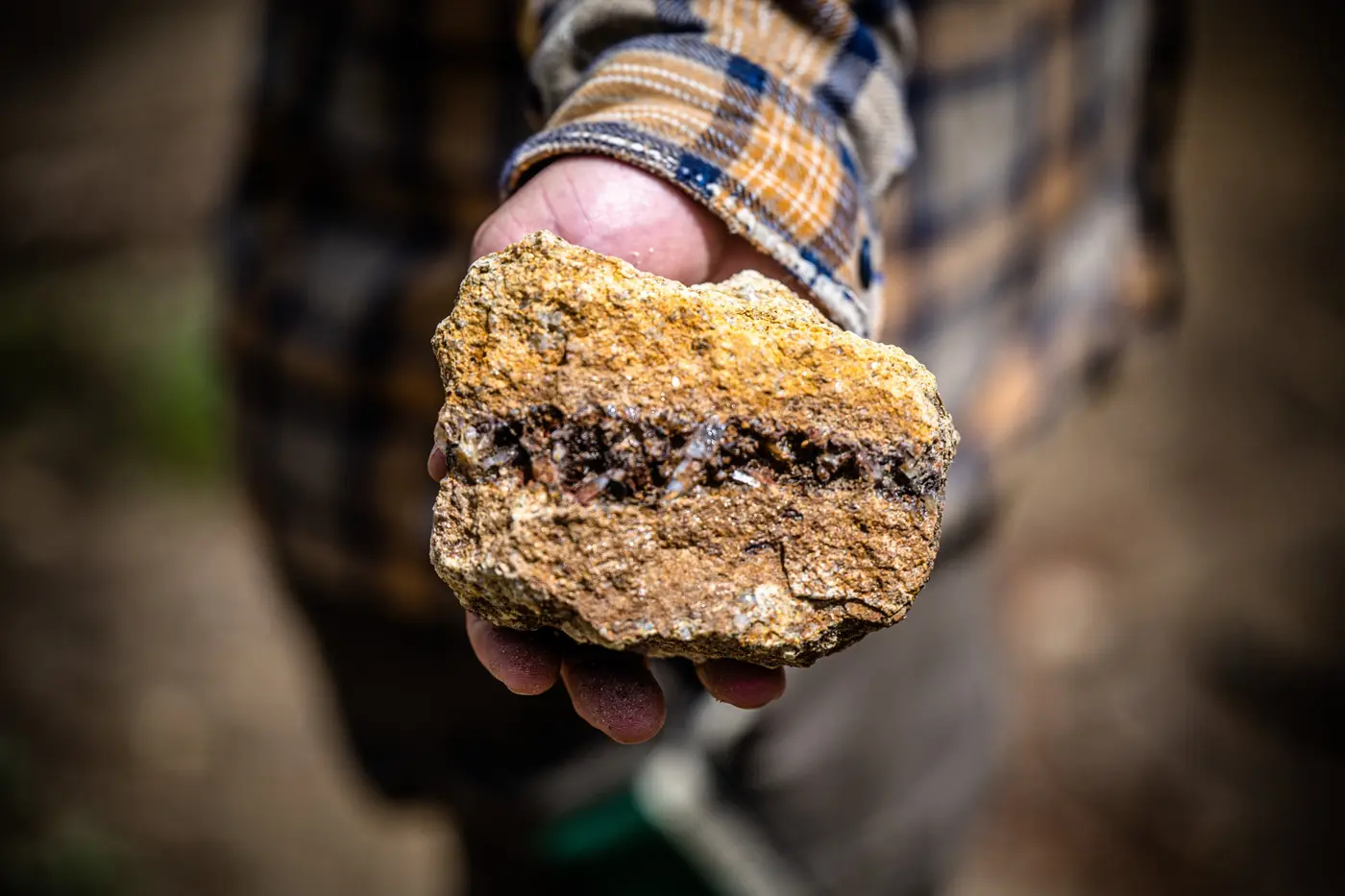
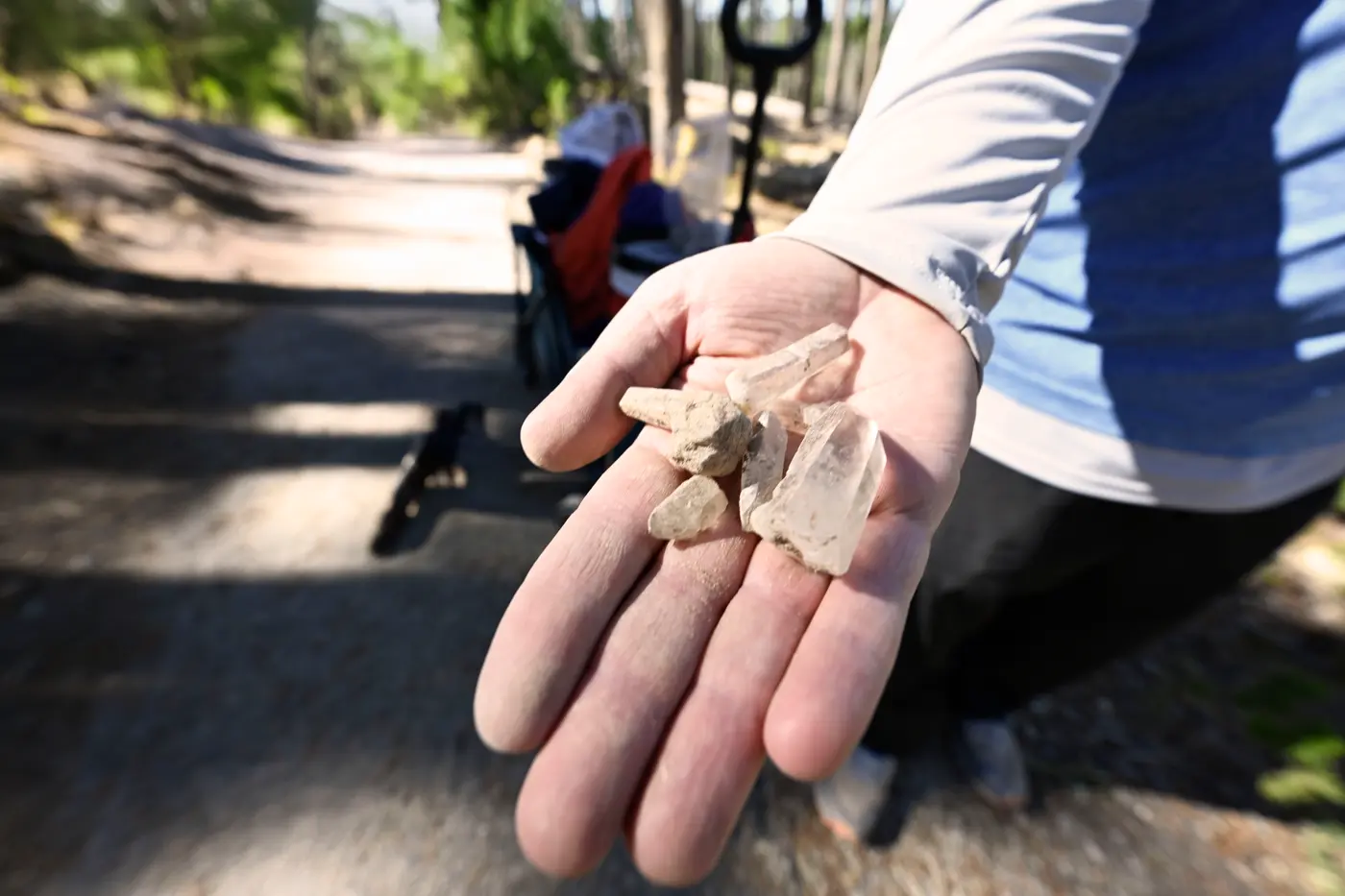
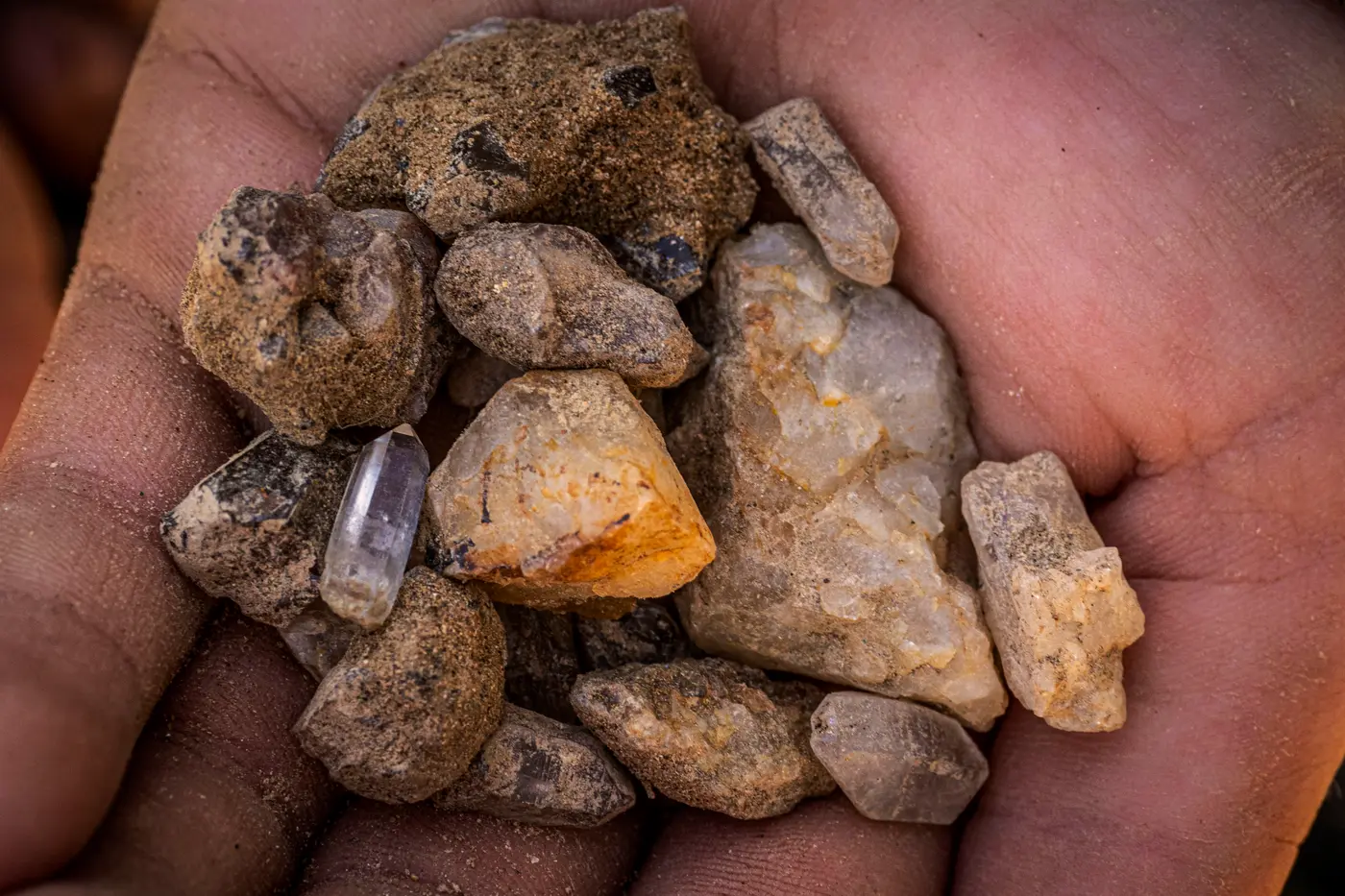
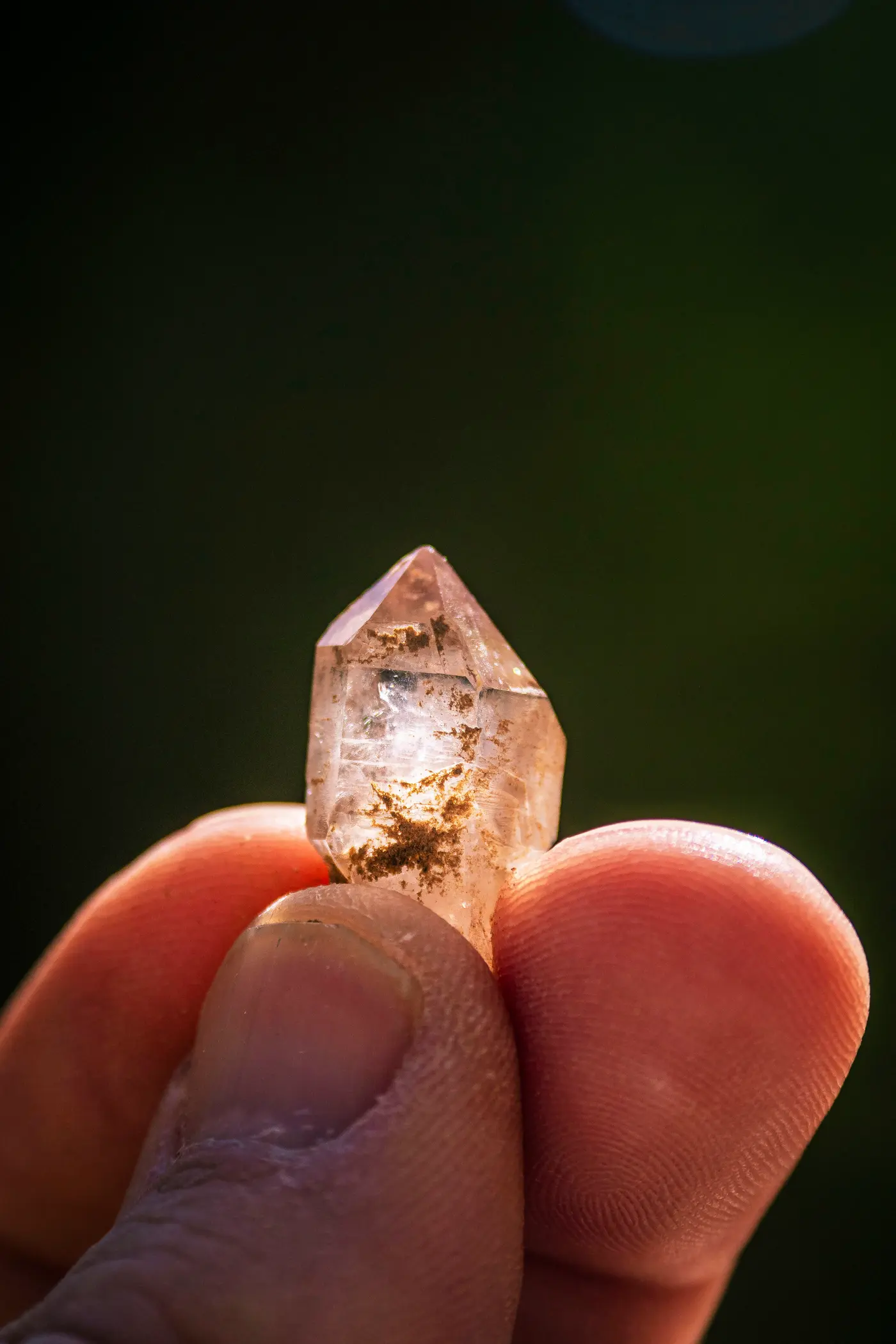
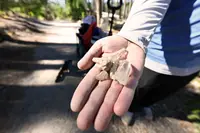
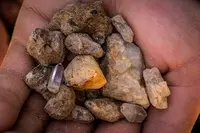
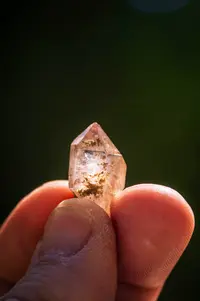
A quartz crystal is a six-sided prism with pointed faces at the end. At Crystal Park they come clear or cloudy, white, gray, or purple. The milky white is caused by fine gas bubbles, the forest brochure says, and the gray and purple by minerals within the quartz. Gray crystals are called smoky and purple ones amethyst. Most are single and smaller than a thumb, though some run several inches. Senn has seen quartz “as large as grapefruit,” and found one of his own six inches below the surface. Two crystals grown together at an angle of 84 degrees 39 minutes make a “Japan Law Twin.” A larger crystal capping a smaller one is a scepter. Rob Thomas, a geology professor at the University of Montana Western in Dillon, says the great majority have a point at one end only. Crystals pointed at both ends grew where there was room between the rocks. “Those are pretty rare but super cool.”
Some crystals come up stained orange by iron-rich groundwater, which Thomas says a mild acid will remove. Many rockhounds soak them in citric or oxalic acid. Amethyst shatters or fades in heat, so it should not go in hot water. The crystals have little money value. “Some folks turn them into jewelry and some folks set them on their desks,” Plovanic said. “Some folks believe they have healing powers.”
The story in the rock begins, by Thomas’s account, more than 72 million years ago, with the floor of the Pacific Ocean sliding beneath the continent. “Liquid rock rises up and finds avenues to travel both vertically and laterally,” he said. The magma reached southwest Montana as the Pioneer Batholith, and its granite made the Pioneer Mountains. As the granite cooled, super-heated water carried quartz, pyrite, and other minerals through it, and they settled out in veins and in cavities called vugs. Where the rock was still between 300 and 500 degrees Celsius and iron from pyrite was at hand, amethyst sometimes grew directly on colorless crystals.
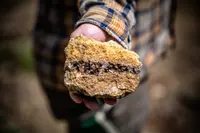
Thomas says the western Pioneers have been rising for 17 million years while the Big Hole, Wise River, and Beaverhead country drops. Erosion stripped the overlying rock down to the granodiorite. There, mica, which swells when wet, broke the bedrock into granite sand called grus. “People are screening through the grus to find the crystals that are liberated from the rock,” Thomas said. Weathering freed the crystals from their veins, which is why they seem scattered at random. Careful digging sometimes shows a remnant vein as a reddish-brown streak in the pale granite, and following it can lead to a pocket. Senn recalls drilling in the area decades ago that found quartz and amethyst “as far down as 80 feet deep.” Asked whether the diggers will run out, Plovanic answered, “No. Not in our lifetimes we won’t.” Thomas does not dig at all. “I never go up there to collect,” he said. “I look for the rocks that are still intact to show how crystals grow in those spaces.”
A claim staked in 1969
The Forest Service byway brochure places Crystal Park among the broad meadows at the head of the Wise River, along with Moose Park. Here the road crosses a 7,800-foot divide between the Wise River, flowing north, and Grasshopper Creek, flowing south. The Shoshone, Bannock, Salish, and Kootenai hunted this country before white settlement, according to a University of Montana column, and the Shoshone spent much of the summer in the Big Hole Valley and the foothills of the West Pioneers. Gold was found in July 1862 on the lower reaches of Grasshopper Creek. The Beaverhead National Forest was established over both Pioneer ranges in 1908.
The early history of the site itself, said Erik Torgerson, a minerals specialist with the forest, is still a mystery. Miners filtered into the region in the mid-1800s. Mike Ryan, the forest’s heritage resources and range staff officer, has said that the lack of cultural or historic sites at this spot lets the public dig “without adversely affecting our history.” Speaking in 2024, Senn called it “a long-known local spot for probably 50 or 60 years.”
In 1969 the Butte Mineral and Gem Club staked a claim. A couple of years later the club and the Forest Service agreed to make it a recreation area. The road past it became a Scenic Byway on January 10, 1989. In 1993 Public Land Order No. 6958 withdrew the 220 acres from location and entry under the mining laws, though not from mineral leasing, “to protect and preserve Crystal Park Recreation Area.” Rock & Gem magazine describes this as an executive order. In 1996 the Beaverhead merged with the Deerlodge to form the present forest. In 2004 the Forest Service asked the Secretary of the Interior to withdraw another 390 acres as a Crystal Park addition. The record does not say how that request ended. The 1993 order was due to lapse on March 1, 2023. After a public comment period opened in September 2022 and a virtual public meeting on November 7, 2022, Public Land Order No. 7920 took effect on March 2, 2023, and extended the withdrawal to March 1, 2053.
Dozers, berms, and a closed road
Senn says hundreds of people come every summer day. “We’re getting pretty big for her britches,” said Catherine McRae, the forest’s public affairs officer. The two parking lots overflow on summer weekends, and drivers who park along the narrow byway sometimes get stuck. Help is an hour and a half away, and with no cell service, even calling a tow truck can take time. Grizzlies pass through on occasion, and the mosquitoes in summer call for repellent or netting.
Not everyone keeps to the rules. “Always fill in your hole when you’re done,” Senn said. “Don’t tunnel, don’t dig under the trees and don’t undermine pathways. But a lot of people just aren’t following them. If it becomes a greater cost, the only logical solution is to shut it down.” McRae said some diggers believe the best crystals lie under the trees and the paved path, which she called far from the case. “The takeaway is not to get what you can while you can,” she said.
“Usually every three-ish years we take a dozer and create berms to dissuade the runoff,” Torgerson said. In 2022 the area closed for a few days while crews backfilled holes, took down hazard trees, and reclaimed the ground. The fresh dirt draws diggers, but “about a month and a half after dozing the area you can’t even tell.” Green patches now dot the gravel where vegetation has been let back in to hold the slope. The Retired Smokejumpers Association and the Dillon recreation crew have put up new signs and rebuilt the benches. The forest is working with the University of Montana Western on a long-term plan, which may rest parts of the ground a season at a time, and on kiosks with video on how the crystals formed.
Each winter the byway closes from December 1 through May 15 between the Pettingill parking lot and Elkhorn Hot Springs and serves as a snowmobile trail. In the fall of 2026 it closed early. A Forest Service order for the Bobcat Lakes and Sand Creek fires, effective September 19, 2026, opened the byway from the south only as far as Hot Springs Road, for access to Elkhorn Hot Springs. The rest of the byway stayed closed while heavy equipment worked in the area, through noon on December 31, 2026, unless rescinded. The order does not name Crystal Park. The forest’s page for the site, last updated October 1, 2026, listed it as open.
Notable Events
- 1908In 1908 the Beaverhead National Forest was established in the area, allowing the USFS to protect the ecosystems of both ranges. umt.edu
- 1969The Butte Mineral and Gem Club staked a claim, and a couple of years later the club and the Forest Service agreed to make it a recreational area. rockngem.com
- 1989Designated a Scenic Byway January 10, 1989, the route extends south from State Highway 43 at Wise River, Montana, to State Highway 278, between Dillon and Jackson. southwestmt.com
- 1993PLO No. 6958, cited at 58 FR 11968, withdrew 220 acres of National Forest System lands from location and entry under the United States mining laws, but not from leasing under the mineral leasing laws, to protect and preserve Crystal Park Recreation Area. govinfo.gov
- 1996In 1996 the Beaverhead was merged with the Deerlodge to form Beaverhead-Deerlodge National Forest, the manager of Crystal Park. umt.edu
- 2004The Forest Service asked the Secretary of the Interior to withdraw 390 acres of National Forest System land to preserve the unique resource of quartz crystals in the Crystal Park Recreational Mineral Collection Area Addition; the notice segregates the land for up to 2 years from location and entry under the United States mining laws. govinfo.gov
- 2022The public had an opportunity to comment on the proposed extension by joining a virtual meeting on November 7th, 2022, at 6:30 P.M. MST. fs.usda.gov
- 2022The area was closed for a few days to backfill holes, handle hazardous trees and reclaim the area. rockngem.com
- 2023The withdrawal extended by this Order will expire on March 1, 2053 unless, after review, the Secretary determines the withdrawal shall be further extended. govinfo.gov
People
- Erik Torgerson, minerals specialist with the Beaverhead-Deerlodge National Forest.
Sources
- fs.usda.gov/r01/beaverhead-deerlodge/recreation/crystal-park-picnic-and-mineral-collection-area
- fs.usda.gov/media/44164
- fs.usda.gov/r01/beaverhead-deerlodge/alerts/updated-area-road-trail-closure-bobcat-lakes-sand-creek-fires
- fs.usda.gov/r01/beaverhead-deerlodge/recreation/dillon-ranger-district-0
- govinfo.gov/content/pkg/FR-2023-02-23/pdf/2023-03721.pdf
- govinfo.gov/content/pkg/FR-2004-04-12/pdf/04-8153.pdf
- southwestmt.com/images/pdfs/Pioneer-Mountains-National-Scenic-Byway.pdf