Kemmerer
Lincoln County, Wyoming. County seat.
Kemmerer, the Lincoln County seat, began as a coal town that no company ran, and James Cash Penney opened a Golden Rule Store there in 1902.1
Details
Point at a dot to see the place.Tap a dot to see the place. Road map of Kemmerer.
In Kemmerer
- American Fossil quarryKemmerer · Private dig packageA private quarry northwest of Kemmerer, Wyoming, where visitors split Green River Formation slabs and keep every fossil they find; its rock yielded the oldest known bat skeletons.
- Fossil Butte National Monument Research Quarry programKemmerer · National monumentA summer ranger program at Fossil Butte National Monument near Kemmerer, Wyoming, where staff work a research quarry in the old lakebed and log each find by length, angle, and depth.
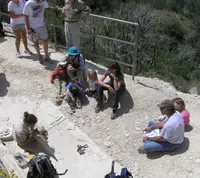
- Fossil Lake Safari quarryKemmerer · Fossil dig quarryA pay-to-dig quarry in the Green River Formation northwest of Kemmerer, Wyoming, where visitors split 52-million-year-old lake-bottom limestone with hammer and chisel and keep the fish they find.
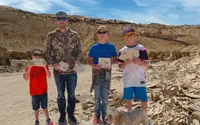
- In Stone Fossils quarry digsKemmerer · Private exclusive quarryA fossil gallery on Coral Street in Kemmerer, Wyoming, whose guides lead night digs by headlamp in the Green River Formation's 18-inch layer at a private quarry.
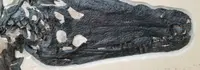
- Ulrich's Fossil Gallery quarry toursKemmerer · Pay-to-dig fossil quarryJoin Ulrich's Fossil Gallery for an unforgettable fossil-hunting adventure in Wyoming's world-famous Green River Formation. Dig for real fossils, learn professional excavation techniques, and take home your discoveries.

History
An Independent Coal Town, 1897
The J. C. Penney Home, a rectangular, barely two-story, gable-roofed clapboard house, stands on Kemmerer’s downtown triangle; it was moved there in the 1970s, after the Union Pacific Railroad gave the town the land.3 The town lies in Lincoln County near the southwest corner of Wyoming, and the work around it and neighboring Diamondville continues to be coal and trona mining, oil and gas production, and natural gas processing.1
The town sprang up, as one account puts it, seemingly overnight after coal was found in 1897, on the Oregon Short Line, a Union Pacific subsidiary built in 1882 from Granger northwest to Montpelier, Idaho.4 Mahlon S. Kemmerer (1843 to 1925) and Patrick J. Quealy (1857 to 1930) founded it that year, and it took the name of Kemmerer, the primary investor behind early coal exploration in the area.1,2 The town was officially incorporated in 1899.1 Unlike the nearby coal towns of Frontier and Diamondville, Kemmerer was not run by a company, so people and firms outside the mining industry bought its lots.1 It came to live on livestock as well as minerals, and when Lincoln County was carved from Uinta County in 1911, Kemmerer, which WyoHistory.org calls the largest town, became the county seat.1
The Golden Rule Store
When Penney arrived the town had 1,000 residents, and WyoHistory.org sums up its trade this way: the railroad needed coal, the mines needed miners, and the miners and their families needed dry goods.4 On April 14, 1902, the owners of the Golden Rule Store, a small dry goods chain, who had sent James Cash Penney to manage their Evanston store, made him a one-third partner in their new store in Kemmerer.4 He put up $2,000 for his share, and in its first year the store cleared $8,000 on sales of more than $28,000.4 The Penney family moved into the clapboard house, thought to be already standing, in 1903 or 1904, and it was his home until about 1909, the years in which the State Historic Preservation Office says he worked out the organization of his chain.3 In 1907 he bought out his partners’ Wyoming holdings, in 1909 he moved the company’s headquarters to Salt Lake City, and in 1913 he replaced the Golden Rule name with his own.4 By 1928 the chain had more than 1,000 stores, and the J. C. Penney Historic District, near the eastern edge of the business section, was listed on the National Register of Historic Places in 1978.4,5,6
A Rustling Trial and the Explosion of 1923
Twenty-six miners died in a cave-in at neighboring Diamondville in February 1901, and 22 more died in the same mine that October.7 In 1919 Annie Richey was arrested for cattle rustling near Fossil, 15 miles west of Kemmerer, and was tried and convicted at the county courthouse in Kemmerer.1 Her lawyers appealed, and the Wyoming Supreme Court upheld the conviction; in the meantime she was released on bond and went home to her ranch, where she was poisoned, and her alleged murder was never solved.1
The dangers of coal mining came home to Frontier and Kemmerer on August 14, 1923, a holiday, when only 135 of the usual 250 miners were at work; the mine exploded, and ninety-nine of them died.1,7 The history “The Most Dangerous Occupation” ranks it the second-worst coal mining tragedy in Wyoming’s history.7 Investigators blamed a fire boss, killed in the blast, who had tried to relight his safety lamp with a match, while 23 men barricaded themselves away from the flames and were rescued hours later.1,7 Frontier and Kemmerer held a joint three-day funeral and buried their dead on the Friday, Saturday, and Sunday that followed.1
Courthouse, School Bell, and Monuments
The Lincoln County Courthouse, built in 1925 to plans by the Salt Lake City firm of Headlund and Watkins, sets a dome and entablature against large brick parapet walls, and it was listed on the National Register in 1984.3,8 The bell of the Kemmerer Grade School, built in 1901 and used until 1926, sits in a tower donated by the Kemmerer/Diamondville 1990 Centennial Committee.9 In 1931 the citizens of Kemmerer raised an Oregon Trail Memorial by popular subscription, “To All Pioneers Who Passed This Way To Win and Hold The West.”10 The Kemmerer Founders Monument bears the words “Wyoming’s Aquarium in Stone” and the names of the founders.2
Within 30 Miles
Measured in a straight line from the town, nearest first.
All the towns of Wyoming. More of Wyoming: Rockhounding.
Sources
- Lincoln County Wyoming (wyohistory.org) wyohistory.org/encyclopedia/lincoln-county-wyoming
- Kemmerer Founders Monument (historical marker) hmdb.org/m.asp?m=80542
- County History (lincolncountywy.gov) lincolncountywy.gov/explore/county_history.php
- James Cash Penney: From Clerk to Chain-store Tycoon wyohistory.org/encyclopedia/james-cash-penney-clerk-chain-store-tycoon
- J C Penney Historic District National Historic Landmark (wyoshpo.wyo.gov) wyoshpo.wyo.gov/index.php/programs/national-register/wyoming-listings/view-full-list/671-j-c-penney-historic-district-national-historic-landmark
- List View (U.S. National Park Service) nps.gov/state/wy/list.htm?program=all
- The Most Dangerous Occupation: The Quest for Safety in Wyoming’s Coal Mines wyohistory.org/encyclopedia/most-dangerous-occupation-quest-safety-wyomings-coal-mines
- Lincoln County Courthouse (wyoshpo.wyo.gov) wyoshpo.wyo.gov/index.php/programs/national-register/wyoming-listings/view-full-list/676-lincoln-county-courthouse
- Wyoming Centennial (historical marker) hmdb.org/m.asp?m=36654
- Oregon Trail Memorial (historical marker) hmdb.org/m.asp?m=36650